
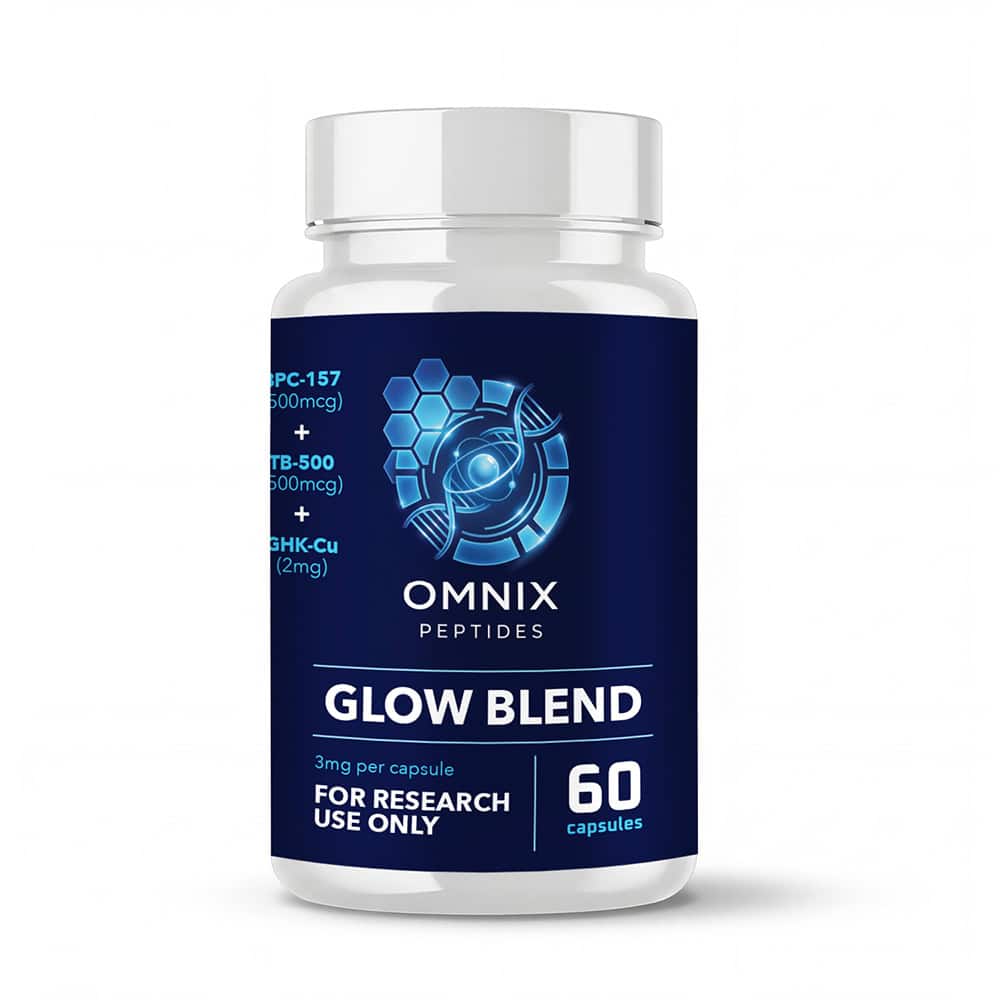
Glow Blend Capsules 2mg
Oral research format combining GHK-Cu, BPC-157, and TB-500. Used in preclinical studies of orally administered skin- and hair-targeted peptide blends. HPLC-tested, third-party COA per batch.
$139.99
In stock
Research goals: Skin & Hair
Description
Glow Blend is a three-component peptide combination of GHK-Cu (the copper-binding tripeptide glycyl-L-histidyl-L-lysine, complexed with copper), BPC-157 (the synthetic stable gastric pentadecapeptide derived from human Body Protection Compound), and TB-500 (the N-acetylated 17–23 fragment of thymosin beta-4). The three components are paired in a single product because their mechanisms are commonly framed as complementary in research and clinical-anecdote contexts: GHK-Cu modulates collagen and elastin synthesis, antioxidant gene expression, and dermal extracellular matrix remodeling; BPC-157 modulates nitric oxide signaling and growth factor expression to support gastrointestinal, vascular, and connective-tissue healing; and TB-500 sequesters G-actin to drive cell migration, angiogenesis, and post-injury tissue remodeling. All three individual compounds are also available as standalone products in our catalog, where their evidence bases are summarized in greater depth.
The peer-reviewed evidence summarized below is drawn from studies of each compound separately. No published peer-reviewed work has tested the specific GHK-Cu + BPC-157 + TB-500 combination at the amounts or ratios sold in this product.
Important Note on the Evidence Base
To our knowledge, no peer-reviewed clinical or preclinical study has tested the specific GHK-Cu + BPC-157 + TB-500 three-component combination at the amounts or ratios sold in this product. The rationale for combining them is mechanistic complementarity (different signaling pathways, all three implicated in tissue repair and dermal remodeling) and clinical anecdote in the peptide-therapy community — not formal head-to-head, combination-vs-monotherapy, or concentration-response data on the blend itself. Each individual component has its own evidence-base limitations, summarized briefly in the citations below and in greater depth on the respective standalone product descriptions:
- GHK-Cu — substantial human dermal-application literature, much of it cosmetic-industry-affiliated. Mechanistic gene expression studies are well replicated.
- BPC-157 — evidence base is concentrated in a single research group (Sikiric and collaborators at the University of Zagreb), with limited fully independent replication. Most studies are rodent models.
- TB-500 — commercial “TB-500” is the N-acetylated 17–23 fragment of thymosin beta-4, NOT the full-length 43-amino-acid Tβ4 protein. Peer-reviewed clinical trials in the Tβ4 family (RGN-259 ophthalmic, RGN-352 cardiac) used full-length Tβ4. Whether the heptapeptide fragment fully recapitulates the parent protein’s effects in vivo is unresolved. TB-500 is on the World Anti-Doping Agency prohibited list.
This product is for laboratory research only. None of the three components is approved by the FDA or EMA.
Published Research on the Component Compounds
GHK-Cu Genome-Wide Gene Expression — Pickart et al., BioMed Research International (2015)
This widely-cited review and analysis paper synthesizes the mechanistic case for GHK-Cu’s effects on dermal and tissue repair. The authors compile data showing GHK-Cu modulates expression of more than 4,000 human genes — including substantial upregulation of antioxidant defense genes, DNA repair genes, and genes encoding collagen and elastin biosynthesis enzymes — while downregulating pro-inflammatory and tissue-degradation pathways. The paper remains the most-cited single source for GHK-Cu’s pleiotropic gene-expression effects and is a primary reference for the compound’s research applications in dermal aging, wound healing, and oxidative stress models.1
BPC-157 Achilles Tendon Healing in Rats — Staresinic et al., Journal of Orthopaedic Research (2003)
This rat-model study tested whether systemic intraperitoneal BPC-157 administration could improve healing of surgically transected Achilles tendons. Daily BPC-157 (10 μg, 10 ng, or 10 pg per kg body weight) was administered starting 30 minutes post-surgery. All BPC-157 amounts produced histologically and functionally improved tendon healing relative to saline controls, with effects evident across a five-log amount-range. The study established the systemic-administration paradigm that has since been applied across BPC-157’s musculoskeletal research portfolio.2
Thymosin Beta-4 Cardiac Repair — Bock-Marquette et al., Nature (2004)
This foundational paper demonstrated that the G-actin-sequestering peptide Tβ4 promotes myocardial and endothelial cell migration in the embryonic heart and retains this property in postnatal cardiomyocytes. Tβ4 was shown to form a functional complex with PINCH and integrin-linked kinase (ILK), activating the survival kinase Akt. After coronary artery ligation in mice, intraperitoneal Tβ4 treatment upregulated cardiac ILK and Akt activity, enhanced early myocyte survival, and improved cardiac function — establishing the mechanistic basis for the broader tissue-repair claims associated with thymosin beta-4 and its 17–23 fragment TB-500. Note: this work used full-length Tβ4, not the TB-500 heptapeptide fragment.3
RGN-259 Phase 3 Trial in Neurotrophic Keratopathy — Sosne et al., International Journal of Molecular Sciences (2022)
This Phase 3 randomized, placebo-controlled, double-masked clinical trial evaluated topical 0.1% RGN-259 (full-length recombinant Tβ4 ophthalmic solution) in patients with neurotrophic keratopathy. RGN-259 promoted rapid healing of corneal epithelial defects, improved Mackie classification disease stage, and produced significant improvements in ocular discomfort, foreign body sensation, and dryness, with no significant adverse effects. This is the strongest peer-reviewed human evidence in the Tβ4 family, although the formulation tested was full-length Tβ4, not the TB-500 fragment used in commercial peptide products.4
About the Compounds
GHK-Cu
- Compound class: copper-bound tripeptide; endogenous human peptide
- Sequence: glycyl-L-histidyl-L-lysine bound to a Cu2+ ion (Gly-His-Lys:Cu)
- CAS Number: 89030-95-5 (GHK-Cu complex); 49557-75-7 (free GHK tripeptide)
- Molecular Formula (peptide): C14H24N6O4 (free tripeptide); the complex carries a single Cu2+
- Molecular Weight: 340.38 g/mol (free tripeptide); 403.93 g/mol (Cu complex)
- Mechanism: copper-dependent regulation of collagen, elastin, and antioxidant gene expression in dermal and connective tissue
- Regulatory status: not approved by the FDA or EMA. Endogenous human peptide
BPC-157
- Compound class: synthetic stable gastric pentadecapeptide; partial sequence of human Body Protection Compound
- Sequence: H-Gly-Glu-Pro-Pro-Pro-Gly-Lys-Pro-Ala-Asp-Asp-Ala-Gly-Leu-Val-OH (GEPPPGKPADDAGLV)
- CAS Number: 137525-51-0
- Molecular Formula: C62H98N16O22
- Molecular Weight: 1419.55 g/mol
- Mechanism (working): modulation of nitric oxide system, VEGFR-2 expression, and growth factor signaling supporting GI, vascular, and connective-tissue repair
- Regulatory status: not approved by the FDA or EMA
TB-500
- Compound class: synthetic N-acetylated heptapeptide; thymosin beta-4 (17–23) fragment
- Sequence: Ac-Leu-Lys-Lys-Thr-Glu-Thr-Gln (Ac-LKKTETQ)
- CAS Number: 885340-08-9
- Molecular Formula: C38H68N10O14
- Molecular Weight: 889.02 g/mol
- Mechanism: actin-sequestering motif of Tβ4; modulates cell migration, angiogenesis, and tissue repair signaling
- Regulatory status: not approved by the FDA or EMA. Prohibited by the World Anti-Doping Agency in competition
Product Specifications
- Format: capsules (three-component blend; refer to COA for component ratio per capsule)
- Strength: 2 mg total peptide content per capsule
- Count: 60 capsules per bottle
- Purity: ≥99% (HPLC verified, each component)
- Container: sealed amber bottle
- Certificate of Analysis: lot-specific COA available, with separate purity and identity verification for all three component peptides
See the FDA Disclosure, Storage Instructions, and RUO tabs for handling, storage, and regulatory information.
References
- Pickart L, Vasquez-Soltero JM, Margolina A. GHK peptide as a natural modulator of multiple cellular pathways in skin regeneration. Biomed Res Int. 2015;2015:648108. doi:10.1155/2015/648108
- Staresinic M, Sebecic B, Patrlj L, et al. Gastric pentadecapeptide BPC 157 accelerates healing of transected rat Achilles tendon and in vitro stimulates tendocytes growth. J Orthop Res. 2003;21(6):976-983. doi:10.1016/S0736-0266(03)00110-4
- Bock-Marquette I, Saxena A, White MD, DiMaio JM, Srivastava D. Thymosin β4 activates integrin-linked kinase and promotes cardiac cell migration, survival and cardiac repair. Nature. 2004;432(7016):466-472. doi:10.1038/nature03000
- Sosne G, Kleinman HK, Springs C, Gross RH, Sung J, Kang S. 0.1% RGN-259 (Thymosin β4) ophthalmic solution promotes healing and improves comfort in neurotrophic keratopathy patients in a randomized, placebo-controlled, double-masked Phase III clinical trial. Int J Mol Sci. 2022;24(1):554. doi:10.3390/ijms24010554
Preparation and storage
Research-only handling information. Glow Blend is sold strictly for in vitro laboratory research. The handling and storage guidance below reflects standard practice in published peptide research literature. Glow Blend is not a drug, supplement, or food product, and is not for human consumption, veterinary use, or medical applications.
Format
- Form: Capsules
- Available strengths: 60ct
- Verified purity: >99% (HPLC, LC–MS)
- Documentation: Batch-specific Certificate of Analysis (COA) included
Handling for Research Use
Glow Blend capsules ship as a pre-encapsulated, dry oral-research format. No reconstitution is required. The capsules can be opened for analytical or assay work that requires the dry powder.
Storage & Handling
- Upon receipt: Store in a cool, dry place away from direct light.
- Short-term storage: Room temperature in a sealed container is acceptable for several months.
- Long-term storage: Refrigeration at 4 °C (39 °F) extends shelf stability. Capsules do not require freezing.
- Humidity: Keep the original desiccant-sealed container closed when not in use. Excess moisture can compromise capsule integrity.
- Light exposure: Minimize exposure to direct light during handling.
Important Notice
All Omnix Peptides products are sold for laboratory, research, or analytical purposes only. They are not for human consumption, veterinary use, or medical applications. Researchers and laboratory professionals must follow all applicable institutional, local, state, and federal regulations governing the handling of research compounds.
Citations
Citations and reference data. Omnix Peptides supplies research-grade compounds for use by qualified laboratory professionals. The references below cite published preclinical research conducted in animal models and in vitro systems. They are not intended to represent clinical evidence in humans, and Glow Blend has not been approved by the FDA, EMA, or any other regulatory authority for any indication.
Compound Reference Data
- Compound: Glow Blend
- CAS Number: 89030-95-5 (GHK-Cu complex); 49557-75-7 (free GHK tripeptide)
- Molecular Formula: C62H98N16O22
- Molecular Weight: 340.38 g/mol (free tripeptide); 403.93 g/mol (Cu complex)
- Sequence: glycyl-L-histidyl-L-lysine bound to a Cu2+ ion (Gly-His-Lys:Cu)
- Synonyms: —
Selected Published Studies
The following peer-reviewed studies were conducted using animal models or in vitro cell-culture systems. They are listed here as a reference for researchers investigating Glow Blend. None of these studies should be interpreted as recommending Glow Blend for human use, treatment, or any clinical purpose.
- Pickart L, Vasquez-Soltero JM, Margolina A. GHK peptide as a natural modulator of multiple cellular pathways in skin regeneration. Biomed Res Int. 2015;2015:648108. doi:10.1155/2015/648108
- Staresinic M, Sebecic B, Patrlj L, et al. Gastric pentadecapeptide BPC 157 accelerates healing of transected rat Achilles tendon and in vitro stimulates tendocytes growth. J Orthop Res. 2003;21(6):976-983. doi:10.1016/S0736-0266(03)00110-4
- Bock-Marquette I, Saxena A, White MD, DiMaio JM, Srivastava D. Thymosin β4 activates integrin-linked kinase and promotes cardiac cell migration, survival and cardiac repair. Nature. 2004;432(7016):466-472. doi:10.1038/nature03000
- Sosne G, Kleinman HK, Springs C, Gross RH, Sung J, Kang S. 0.1% RGN-259 (Thymosin β4) ophthalmic solution promotes healing and improves comfort in neurotrophic keratopathy patients in a randomized, placebo-controlled, double-masked Phase III clinical trial. Int J Mol Sci. 2022;24(1):554. doi:10.3390/ijms24010554
Evidence-Base Disclosure
The published evidence base for Glow Blend consists predominantly of preclinical research — animal models (often rats or mice) and in vitro cell-culture experiments. Where Phase I or Phase II human trials exist, they are noted in the compound page summary. Researchers should interpret the cited literature within the experimental context of each individual study.
Frequently asked questions
Frequently asked questions about the Glow Blend Capsules. Questions on this page cover handling, storage, documentation, and ordering. Glow Blend is sold for laboratory, research, or analytical purposes only — not for human consumption, veterinary use, or medical applications.
Why does Omnix offer Glow Blend in a capsule format?
Capsule format is used in oral-research and analytical contexts where dry, pre-measured administration is preferred over a reconstituted solution. The capsules contain the same research-grade compound supplied in the vial format and are tested to the same purity specification.
Do the Glow Blend capsules require refrigeration?
Capsules are stable at room temperature for several months when kept in a cool, dry place away from direct light. Refrigeration at 4 °C (39 °F) extends shelf stability and is recommended for long-term storage. Capsules do not require freezing.
Can the capsules be opened to access the dry powder?
Yes. The capsule shell can be opened for analytical or assay work that requires direct handling of the dry powder. Once opened, the powder should be used immediately or transferred to a sealed, light-protected container.
Is Glow Blend approved by the FDA?
No. Glow Blend is not approved by the FDA, EMA, or any other regulatory authority for any indication. Glow Blend is sold by Omnix Peptides strictly for laboratory, research, or analytical purposes. It is not for human consumption, veterinary use, or medical applications.
What is included with each Glow Blend Capsules?
Each order includes the sealed product container and a batch-specific Certificate of Analysis (COA) verifying identity and purity by HPLC and LC–MS. The full COA library for Omnix Peptides is available at /coa-lab-reports/.
What is a Certificate of Analysis (COA), and how do I read it?
A COA is a batch-specific lab report that documents the identity, purity, and quality control results for the production lot you receive. The COA lists the compound name, CAS number, lot number, analytical methods used (HPLC, LC–MS), and the measured purity percentage. Every Omnix order includes the COA for the lot shipped.
What is the CAS number for Glow Blend?
The CAS number for Glow Blend is 89030-95-5 (GHK-Cu complex); 49557-75-7 (free GHK tripeptide). Researchers can use this identifier to locate published literature in PubMed and other scientific databases.
How does Omnix Peptides ship orders?
Orders ship from a US-based facility with tracked domestic shipping. Free shipping is offered on orders over $99. Lyophilized vials and capsules ship at ambient temperature; sprays ship insulated when seasonal conditions require it. Tracking information is provided by email after the order ships.
What if my product arrives damaged or the seal is broken?
Contact Omnix Peptides within 48 hours of delivery. Product damaged in transit or arriving with a compromised seal will be replaced at no cost. See the Shipping & Return Policy at /shipping-return-policy/ for full terms.
Where can I find published research on Glow Blend?
Peer-reviewed studies relevant to Glow Blend are listed in the Citations tab on this product page. The same studies can be located independently on PubMed using the CAS number (89030-95-5 (GHK-Cu complex); 49557-75-7 (free GHK tripeptide)) or the compound name.
Customer reviews
Certificate of Analysis
Certificate of Analysis (COA) for this batch is available on request. Email orders@omnixpeptides.com with your order number to receive a copy. COAs include HPLC purity analysis performed by an independent third-party laboratory.
Reviews
There are no reviews yet.