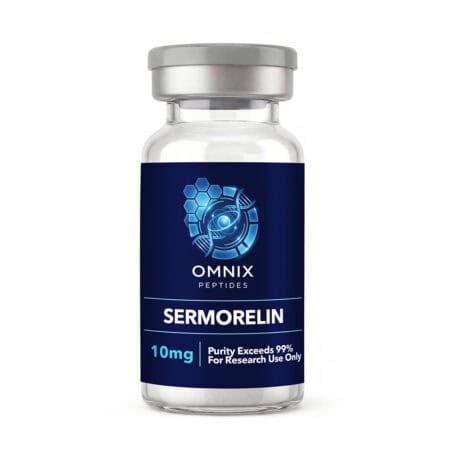
Sermorelin (CAS 86168-78-7) is the synthetic 29-amino-acid N-terminal fragment of human growth hormone-releasing hormone (GHRH), produced as GHRH(1–29)-NH2 with a C-terminal amide. Sermorelin functions as a full agonist of the growth hormone-releasing hormone receptor (GHRH-R) on pituitary somatotroph cells, stimulating endogenous pulsatile release of growth hormone (GH) and a downstream rise in insulin-like growth factor 1 (IGF-1). The 1–29 fragment retains the full biological GHRH-releasing activity of the parent 44-amino-acid hormone.
Sermorelin was FDA-approved in 1990 for the diagnosis and treatment of growth hormone deficiency in children, and as a diagnostic provocative agent for the GH-secretory capacity of the pituitary in adults. The compound was withdrawn from the U.S. market in 2008 for commercial reasons rather than safety or efficacy concerns. Sermorelin is no longer a marketed FDA-approved drug product in the United States; the material supplied by Omnix is sold strictly for in vitro laboratory research.
The peer-reviewed clinical literature on sermorelin includes pediatric GH-deficiency trials supporting the original 1990 approval, and a smaller body of work in older adults investigating GH-axis activation. In the controlled trial published by Corpas and colleagues in The Journal of Clinical Endocrinology & Metabolism, healthy men aged 70–85 received twice-daily subcutaneous sermorelin or placebo for 14 days. The investigators reported that sermorelin treatment reverse[d] the decreased GH and insulin-like growth factor-I levels
seen in older men, restoring mean GH pulse amplitude and IGF-1 toward values observed in young adults [1]. The single-nightly-injection study published by Vittone and colleagues in Metabolism reported concentration-dependent overnight GH and IGF-1 responses to sermorelin in healthy elderly men over a four-week treatment period [2]. Researchers consulting this page should weight the evidence base as predominantly pediatric (for the original approval) and limited in adults (small short-duration studies in older men).
Mechanism of Action
Sermorelin acts upstream of growth hormone, by stimulating endogenous pulsatile GH release from pituitary somatotrophs rather than by exogenous GH replacement.
GHRH receptor agonism. Native GHRH is a 44-amino-acid hypothalamic peptide that binds the GHRH receptor — a class B G-protein-coupled receptor — on anterior pituitary somatotroph cells, activating the Gαs/adenylyl cyclase/cAMP pathway and stimulating both the synthesis and the pulsatile secretion of growth hormone. Structure-activity work in the 1980s established that the N-terminal 29 amino acids (residues 1–29) retain the full biological GHRH-releasing activity of the parent hormone. Sermorelin is the synthetic [Leu27]-free GHRH(1–29)-NH2 sequence with a C-terminal amide, retaining full receptor agonist activity in a shorter and synthetically more accessible peptide.
Restoration of pulsatile GH secretion. Because sermorelin acts at the level of the pituitary rather than as a GH replacement, the physiologic pattern of GH release — pulsatile, with intact negative-feedback regulation by somatostatin and IGF-1 — is preserved. This is mechanistically distinct from administration of recombinant human growth hormone (rhGH), which produces a sustained non-pulsatile elevation of circulating GH. In the Corpas 1992 study in older men, twice-daily subcutaneous sermorelin restored mean GH pulse amplitude and 24-hour GH integrated concentration toward those of young-adult reference values [1].
Short circulatory half-life. Unmodified GHRH(1–29) is rapidly inactivated in plasma by dipeptidyl peptidase-4 (DPP-4), which cleaves the N-terminal Tyr-Ala dipeptide. The published pharmacokinetic literature reports a circulatory half-life of approximately 11–12 minutes after intravenous administration, with somewhat extended apparent duration following subcutaneous administration due to slow absorption from the injection site. The short half-life underlies the multiple-daily or once-nightly administration protocols used in the published clinical literature.
Relationship to other GHRH analogs. Subsequent GHRH analogs have been developed to address the short half-life of unmodified GHRH(1–29). Tesamorelin extends the molecule to the full 44-amino-acid native GHRH sequence with an N-terminal trans-3-hexenoic acid modification that confers DPP-4 resistance, supporting once-daily administration in its FDA-approved HIV-lipodystrophy indication. CJC-1295 (the non-DAC variant) is a GHRH(1–29) analog with four amino-acid substitutions that confer DPP-4 resistance and modestly extend the half-life relative to native sermorelin. The three compounds share the GHRH receptor as the molecular target and differ in plasma stability and resulting administration frequency.
Available Forms
Omnix Peptides currently supplies sermorelin in a single research format. Each lot is independently characterized by HPLC and LC–MS, with a batch-specific Certificate of Analysis available on the product page.
- Sermorelin Vial — lyophilized powder for reconstitution. The vial is the canonical research format for sermorelin; subcutaneous administration is the route used in the published clinical literature, with intravenous administration used in the diagnostic-provocation setting.
Sermorelin is classified under the Growth Hormone research category. For research framed around overlapping GHRH-axis pharmacology, see also the related compound hubs for Tesamorelin (DPP-4-resistant full-length GHRH analog approved for HIV-associated lipodystrophy), CJC-1295 No DAC (an alternative GHRH(1–29) analog with substitutions conferring DPP-4 resistance), and Ipamorelin (a selective growth hormone secretagogue acting at the ghrelin receptor and frequently paired with GHRH analogs in research protocols on complementary GH-axis activation).
Amount in the Published Research Literature
The following amount ranges describe the protocols used in the peer-reviewed sermorelin literature. They are reported here for research-reference purposes only and do not constitute administration recommendations of any kind.
Pediatric GH deficiency (1990 FDA approval). The original FDA approval was supported by pediatric trials using once-daily bedtime subcutaneous sermorelin in children with growth hormone deficiency, typically at 30 µg/kg/day, administered for treatment durations of 6 months to multiple years and assessed by growth velocity and standard auxological endpoints. The same compound was also used as a diagnostic provocative agent, administered as a single intravenous bolus (typically 1 µg/kg) with serial GH sampling over 60–120 minutes.
Corpas 1992 study in older men. Healthy men aged 70–85 received twice-daily subcutaneous sermorelin (10 µg/kg) or placebo for 14 days, with mean GH pulse amplitude and 24-hour GH integrated concentration measured at baseline and after treatment. The investigators reported that the administration schedule was sufficient to restore both endpoints toward young-adult reference values, with IGF-1 increasing in parallel [1].
Vittone 1997 single-nightly-injection study. Healthy elderly men received once-nightly subcutaneous sermorelin or placebo at three amount levels for four weeks, with overnight GH integrated concentration and IGF-1 as primary endpoints [2]. The investigators reported concentration-dependent overnight GH and IGF-1 responses, with the higher amounts producing IGF-1 elevations into the young-adult reference range over the four-week treatment period.
Adverse-event profile across the program. The most commonly reported adverse events in the sermorelin clinical literature are injection-site reactions (erythema, swelling, pain) and transient flushing, with arthralgia and peripheral edema reported at higher amounts in older adults. The class profile of adverse events characteristic of agents that elevate IGF-1 applies, including the possibility of reductions in insulin sensitivity at sustained higher exposures. The historical FDA-approved label addressed contraindication in known or suspected neoplasia and in patients with hypersensitivity to sermorelin or any component of the formulation.
Researchers planning protocols are referred to the original primary literature cited in the References section for full methodological detail, including subject inclusion criteria, blood-sampling schedules, GH and IGF-1 assay methodology, and primary versus secondary endpoint definitions.
Frequently Asked Questions
Is sermorelin FDA-approved?
Sermorelin was FDA-approved in 1990 for the diagnosis and treatment of growth hormone deficiency in children, and as a diagnostic provocative agent for pituitary GH-secretory capacity. The compound was withdrawn from the U.S. market in 2008 for commercial reasons rather than safety or efficacy concerns, and there is no currently marketed FDA-approved sermorelin drug product. The material supplied by Omnix is sold strictly for in vitro laboratory research.
What mechanism of action does sermorelin use?
Sermorelin is a full agonist of the growth hormone-releasing hormone (GHRH) receptor on pituitary somatotroph cells. It is the synthetic 29-amino-acid N-terminal fragment of native GHRH (GHRH(1–29)-NH2), which retains the full biological GHRH-releasing activity of the 44-amino-acid parent hormone. The compound stimulates endogenous pulsatile GH release, with a downstream rise in IGF-1. Because it acts upstream of GH, physiologic GH pulsatility and negative feedback by somatostatin and IGF-1 are preserved.
How does sermorelin differ from tesamorelin?
Sermorelin is the unmodified 29-amino-acid N-terminal fragment of native GHRH (GHRH(1–29)-NH2). Tesamorelin is the full-length 44-amino-acid GHRH sequence with an added trans-3-hexenoic acid at the N-terminus, which confers resistance to dipeptidyl peptidase-4 (DPP-4) cleavage and substantially extends plasma stability. Both compounds are full agonists at the GHRH receptor. Sermorelin’s short circulatory half-life (approximately 11–12 minutes after intravenous administration) requires multiple-daily or once-nightly administration; tesamorelin’s extended stability supports once-daily administration in its FDA-approved HIV-lipodystrophy indication.
How does sermorelin differ from CJC-1295 No DAC?
Both are GHRH(1–29) analogs and act at the same GHRH receptor. Sermorelin is the unmodified GHRH(1–29)-NH2 sequence. CJC-1295 (no DAC) is GHRH(1–29) with four amino-acid substitutions (D-Ala2, Gln8, Ala15, Leu27) that confer DPP-4 resistance and modestly extend the circulatory half-life relative to unmodified sermorelin while retaining the same receptor-binding profile. The DAC (drug affinity complex) variant of CJC-1295 adds a maleimide linker for albumin binding and is a different compound from the no-DAC variant; Omnix supplies the no-DAC variant only.
What does the Corpas 1992 study show about older men?
The Corpas 1992 study was a controlled trial in healthy men aged 70–85, who received twice-daily subcutaneous sermorelin (10 µg/kg) or placebo for 14 days. The investigators reported that the administration schedule restored mean GH pulse amplitude and 24-hour GH integrated concentration toward young-adult reference values, with IGF-1 increasing in parallel [1]. The study established the principle that GH-axis activation in older adults is achievable through GHRH receptor agonism without exogenous GH administration.
What is sermorelin’s pharmacokinetic profile?
Unmodified sermorelin has a short circulatory half-life of approximately 11–12 minutes after intravenous administration, with somewhat extended apparent duration following subcutaneous administration due to slow absorption from the injection site. The compound is rapidly inactivated in plasma by dipeptidyl peptidase-4 (DPP-4), which cleaves the N-terminal Tyr-Ala dipeptide. The short half-life underlies the multiple-daily or once-nightly administration protocols used in the published clinical literature.
What are the most common adverse events reported in sermorelin trials?
The most commonly reported adverse events in the sermorelin clinical literature are injection-site reactions (erythema, swelling, pain) and transient flushing, with arthralgia and peripheral edema reported at higher amounts in older adults. The class profile of agents that elevate IGF-1 applies, including the possibility of reductions in insulin sensitivity at sustained higher exposures. The historical FDA-approved label addressed contraindication in known or suspected neoplasia.
References
- Corpas E, Harman SM, Piñeyro MA, Roberson R, Blackman MR. Growth hormone (GH)-releasing hormone-(1-29) twice daily reverses the decreased GH and insulin-like growth factor-I levels in old men. J Clin Endocrinol Metab. 1992;75(2):530-535. doi:10.1210/jcem.75.2.1379256 · PubMed: 1379256
- Vittone J, Blackman MR, Busby-Whitehead J, et al. Effects of single nightly injections of growth hormone-releasing hormone (GHRH 1-29) in healthy elderly men. Metabolism. 1997;46(1):89-96. doi:10.1016/s0026-0495(97)90174-8 · PubMed: 9005976
- Walker RF. Sermorelin: a better approach to management of adult-onset growth hormone insufficiency? Clin Interv Aging. 2006;1(4):307-308. doi:10.2147/ciia.2006.1.4.307 · PubMed: 18046906
For Research Use Only. The product described on this page is sold strictly for in vitro laboratory research and is not intended for human or animal consumption, diagnostic use, or therapeutic use. The published research summarized above is provided as scientific reference material. Sermorelin was an FDA-approved drug product from 1990 to 2008; there is no currently marketed FDA-approved sermorelin drug product in the United States. Nothing on this page constitutes medical advice, a therapeutic claim, or a recommendation for any use outside of a properly resourced and ethically reviewed research setting.