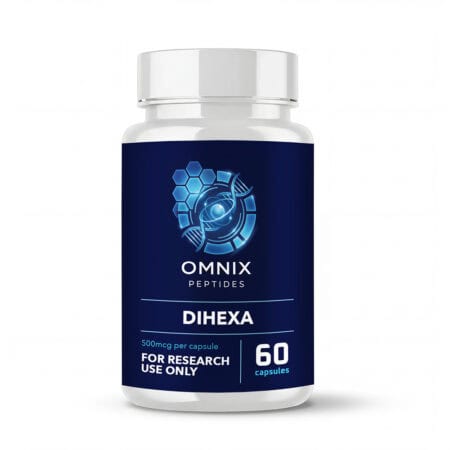
Cognitive research peptides are compounds investigated in the peer-reviewed literature for their effects in neurotrophic, anxiolytic, attention, and cognitive-impairment models. Research has investigated the following peptides in the context of cognitive- and neuro-related preclinical models: Dihexa, Selank (TP-7), and Semax. The published evidence base in this category is a mix of preclinical rodent work (predominant for Dihexa) and Russian-language clinical literature with limited Western peer-reviewed replication (Selank and Semax, both registered as pharmaceuticals in the Russian Federation).
Mechanistic targets investigated include HGF/c-Met signaling and synaptogenesis (Dihexa), GABA-A receptor and BDNF-dependent anxiolysis (Selank), and ACTH(4–10) analog neurotrophic activity with BDNF/NGF expression effects (Semax).
What Peer-Reviewed Research Investigates in This Category
Cognitive-category peptide research in the published literature investigates several mechanistic themes:
- HGF/c-Met signaling and synaptogenesis — angiotensin IV analog research in rodent cognitive-impairment and dementia models, with downstream signaling through PI3K/AKT and MAPK/ERK pathways. The Wright/Harding group at Washington State University produced most of the foundational Dihexa literature.
- Anxiolysis and stress response — studies of synthetic tuftsin-family analogs in rodent elevated plus-maze, open-field, and forced-swim paradigms, with downstream investigation of GABA-A receptor modulation and BDNF expression.
- Attention and cognitive enhancement — controlled studies of ACTH(4–10) analogs in rodent active-avoidance, water-maze, and attention paradigms; Russian clinical literature in ischemic stroke recovery and asthenia.
- Neurotrophic factor expression — BDNF and NGF mRNA and protein expression changes in hippocampus and frontal cortex following peptide administration.
Selank and Semax are both formally registered in the Russian Federation (Selank as an anxiolytic; Semax for ischemic stroke and cognitive indications). They are not approved by the FDA or EMA. Western peer-reviewed clinical data are limited; most translation of the Russian clinical literature is mechanistic or summary-form. Dihexa has no published human clinical trials of its own; the structurally distinct prodrug fosgonimeton (Athira ATH-1017) reached Phase 2/3 in Alzheimer’s disease and missed its primary endpoint in 2023.
Compounds Studied in Cognitive Research
Dihexa
Dihexa (PNB-0408; N-hexanoyl-Tyr-Ile-(6)-aminohexanoic amide; CAS 1401708-83-5) is a synthetic small oligopeptide derived from angiotensin IV. Its working mechanism is allosteric facilitation of HGF/c-Met signaling: Dihexa binds HGF with high affinity and is proposed to potentiate HGF dimerization and c-Met phosphorylation. McCoy et al. (2013, J Pharmacol Exp Ther) reported procognitive effects in the scopolamine-impaired rat Morris water maze, and Sun et al. (2021, Brain Sci) reported memory rescue in the APP/PS1 mouse model of Alzheimer’s-like cognitive impairment via PI3K/AKT signaling.1 No published human clinical trials of Dihexa itself as of 2026.
Selank (TP-7)
Selank is a synthetic heptapeptide analog of the immunomodulatory peptide tuftsin (Thr-Lys-Pro-Arg) extended with a Pro-Gly-Pro tripeptide stabilizing tail (sequence: TKPRPGP). Developed at the Russian Academy of Medical Sciences and registered as an anxiolytic in the Russian Federation, Selank has been investigated for anxiolytic effects in rodent models and in Russian clinical literature in generalized anxiety disorder.2 Western peer-reviewed clinical data are limited.
Semax
Semax is a synthetic heptapeptide analog of the N-terminal 4–10 fragment of adrenocorticotropic hormone (ACTH), extended with a Pro-Gly-Pro tripeptide tail (sequence: MEHFPGP). Developed in parallel with Selank at the same Russian research program and registered in the Russian Federation for cognitive indications and ischemic stroke recovery, Semax has been investigated for neurotrophic effects (BDNF and NGF expression in hippocampus and frontal cortex) and attention-related effects in rodent and Russian clinical research.3 Not approved by the FDA or EMA.
Frequently Asked Research Questions
What peptides are studied for cognitive research?
The peer-reviewed cognitive-peptide research literature focuses on three compounds: Dihexa (an angiotensin IV analog studied for HGF/c-Met-mediated synaptogenesis in rodent dementia models), Selank (a tuftsin-derived heptapeptide studied for anxiolytic effects), and Semax (an ACTH(4–10) analog studied for neurotrophic and attention-related effects). Selank and Semax are registered pharmaceuticals in the Russian Federation but are not FDA- or EMA-approved.
Is there human clinical evidence for Dihexa?
No published human clinical trials of Dihexa itself had reported as of 2026. The structurally distinct prodrug fosgonimeton (Athira Pharma ATH-1017), which is metabolized to a Dihexa-related active molecule, reached Phase 2/3 in Alzheimer’s disease and missed its primary endpoint in 2023. The published Dihexa evidence base is preclinical (rodent cognitive-impairment models and in vitro HGF/c-Met signaling).
What is the difference between Selank and Semax?
Selank and Semax are both synthetic heptapeptides developed at the Russian Academy of Medical Sciences with shared Pro-Gly-Pro stabilizing tails, but their parent sequences differ. Selank is derived from the immunomodulatory peptide tuftsin (TKPR), while Semax is derived from the ACTH(4–10) sequence (MEHFPGP). They are registered for different clinical indications in the Russian Federation — Selank as an anxiolytic, Semax for cognitive indications and ischemic stroke recovery.
Are Russian-language clinical trials of Selank and Semax peer-reviewed?
Selank and Semax have substantial Russian-language clinical literature, much of it published in peer-reviewed Russian journals. Western peer-reviewed replication and large, double-blind placebo-controlled trials following ICH-GCP standards are limited. Researchers evaluating the Selank or Semax literature should be aware that journal access, blinding standards, and reporting conventions in the Russian-language literature differ from Western pharmaceutical-trial standards.
What experimental models dominate the cognitive-peptide literature?
The dominant preclinical models are: rodent water-maze and active-avoidance for learning and memory; scopolamine-induced cognitive impairment; APP/PS1 and 5xFAD transgenic mouse models of Alzheimer’s-like pathology; elevated plus-maze and open-field for anxiolysis; and BDNF/NGF mRNA and protein quantification in hippocampus and frontal cortex following peptide administration.
References
- McCoy AT, Benoist CC, Wright JW, et al. Evaluation of metabolically stabilized angiotensin IV analogs as procognitive/antidementia agents. J Pharmacol Exp Ther. 2013;344(1):141–154. PubMed. Sun X, Deng Y, Fu X, et al. AngIV-analog Dihexa rescues cognitive impairment and recovers memory in the APP/PS1 mouse via the PI3K/AKT signaling pathway. Brain Sci. 2021;11(11):1487.
- Medvedev VE, Tereshchenko OG, Kost NV, et al. Optimization of pharmacotherapy of generalized anxiety disorders with Selank. Zh Nevrol Psikhiatr Im SS Korsakova. 2014;114(7):17–22.
- Gusev EI, Skvortsova VI, Miasoedov NF, et al. Effectiveness of semax in acute period of hemispheric ischemic stroke (a clinical and electrophysiological study). Zh Nevrol Psikhiatr Im SS Korsakova. 1997;97(6):26–34.