TB-500 is a synthetic peptide closely related to thymosin beta-4 (Tβ4), a naturally occurring 43-amino-acid protein that is one of the most abundant intracellular peptides in mammalian cells and a major regulator of cellular actin dynamics. The research literature investigating TB-500 and Tβ4 has been published in journals including Nature, Trends in Molecular Medicine, Frontiers in Pharmacology, and the International Journal of Molecular Sciences, and includes preclinical mechanism work, animal-model tissue-repair studies, and one published Phase 3 trial of a topical Tβ4 ophthalmic formulation (RGN-259) in neurotrophic keratopathy.
In the foundational 2004 Bock-Marquette study published in Nature, Tβ4 was reported to activate integrin-linked kinase and promote cardiac cell migration, survival, and cardiac repair in a mouse myocardial-injury model [1]. The Sosne 2022 Phase 3 trial of 0.1% RGN-259 (Tβ4 ophthalmic solution) in neurotrophic keratopathy patients reported that the formulation promotes healing and improves comfort
versus vehicle in a randomized, placebo-controlled, double-masked design [2]. Mechanistic work characterizing Tβ4 as an actin-sequestering protein that moonlights to repair injured tissues
has been comprehensively reviewed by Goldstein, Hannappel, and Kleinman in Trends in Molecular Medicine [3].
TB-500 is not approved by the FDA, EMA, or any other regulatory authority for any indication. The related Regenera Pharma compound RGN-259 (a 0.1% Tβ4 ophthalmic solution) has been advanced through Phase 3 trials in neurotrophic keratopathy and dry eye disease, but a regulatory approval for the ophthalmic formulation has not yet been granted as of the most recent published trial data.
Important Note on the Evidence Base
Important note on the evidence base: Most peer-reviewed research on the TB-500 / Tβ4 axis is preclinical, involving rodent models of cardiac injury, dermal wound healing, corneal injury, and skeletal-muscle repair, alongside in vitro cell-culture mechanism work. The Sosne 2022 Phase 3 trial in neurotrophic keratopathy evaluated a topical ophthalmic formulation (RGN-259) and is the most rigorous published clinical evidence to date. There are no published Phase 3 trials of systemic TB-500 administration in humans. Researchers consulting this page should weight study design and route of administration accordingly.
Mechanism of Action
Thymosin beta-4 is a multifunctional intracellular peptide whose research literature has expanded from its original characterization as an actin-sequestering protein to encompass tissue-repair, anti-inflammatory, and pro-survival activities across multiple injury models.
Actin sequestration. The classical biochemical activity of Tβ4 is binding to monomeric (G-actin) actin molecules with 1:1 stoichiometry, preventing their polymerization into filamentous (F-actin) form. By regulating the G-actin/F-actin equilibrium, Tβ4 modulates cytoskeletal dynamics in ways that affect cell shape, migration, and division. The 2005 Goldstein, Hannappel, and Kleinman review in Trends in Molecular Medicine synthesized the actin-sequestration biology with the emerging tissue-repair literature, framing Tβ4 as a moonlighting
protein whose intracellular biochemical role is complemented by extracellular signaling activities released after cell injury or secretion [3].
Cardiac repair and integrin-linked kinase activation. The Bock-Marquette 2004 study in Nature reported that intraperitoneal administration of Tβ4 in a mouse myocardial-infarction model promoted survival of cardiomyocytes, migration of embryonic and adult cardiac cells, and improved cardiac function 4 weeks post-injury [1]. The investigators characterized the mechanism as activation of integrin-linked kinase (ILK) with downstream Akt phosphorylation, providing a defined intracellular signaling pathway linking Tβ4 administration to cardioprotection. The Postrach 2014 study in Frontiers in Pharmacology subsequently reported that systemic administration of Tβ4 produced cardioprotective effects in a rat model of ischemic myocardial injury [4].
Corneal and ocular repair. The Sosne 2022 Phase 3 trial used a 0.1% RGN-259 ophthalmic solution applied topically to the affected eye in patients with neurotrophic keratopathy, a serious corneal disease characterized by impaired corneal innervation and persistent epithelial defects [2]. The investigators reported significant improvements in corneal healing and patient-reported comfort metrics. The corneal-repair indication has been supported by preclinical models of corneal injury, where Tβ4 has been reported to promote re-epithelialization, reduce inflammation, and improve healing.
Wound healing and inflammation. Across multiple preclinical wound-healing models — dermal, hepatic, neural, and others — Tβ4 has been reported to promote tissue repair through a combination of pro-migratory, pro-survival, and anti-inflammatory effects. The mechanistic literature has invoked actin sequestration, ILK–Akt signaling, vascular endothelial growth factor (VEGF) modulation, and inhibition of NF-κB–driven inflammatory gene programs as contributors to the integrated tissue-repair phenotype.
Available Forms
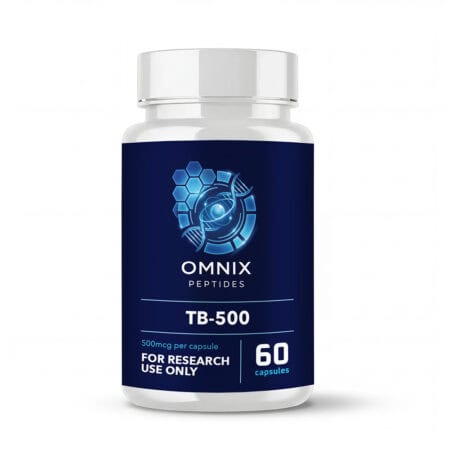
Omnix Peptides currently supplies TB-500 in a single research format. Each lot is independently characterized by HPLC and LC–MS, with a batch-specific Certificate of Analysis available on the product page.
- TB-500 Vial — lyophilized powder for reconstitution. Multiple strengths available per vial. The vial is the canonical research format used in the preclinical literature evaluating Tβ4 and Tβ4-derived peptides via parenteral administration. (The Phase 3 RGN-259 ophthalmic formulation studied by Sosne and colleagues uses a topical 0.1% aqueous formulation, which is not Omnix’s research format.)
TB-500 is classified under the Recovery & Healing research category. For research framed around tissue repair more broadly, see also the related compound hubs for BPC-157, GHK-Cu, and the combination BPC+TB Blend — all classified under the recovery research category, with complementary but mechanistically distinct profiles.
Amount in the Published Research Literature
The following amount ranges describe the protocols used in the peer-reviewed Tβ4 / TB-500 literature. They are reported here for research-reference purposes only and do not constitute administration recommendations of any kind.
Bock-Marquette 2004 cardiac repair model. The foundational Nature study used intraperitoneal administration of Tβ4 at approximately 150 µg per mouse, administered before and after coronary artery ligation, in a mouse myocardial-infarction model [1]. The investigators assessed cardiomyocyte survival, cardiac cell migration, and ventricular function over a 4-week post-injury period.
Postrach 2014 systemic cardioprotection model. The rat ischemic myocardial-injury study evaluated systemic Tβ4 administration via intravenous infusion, reporting cardioprotective effects on infarct size and ventricular remodeling [4]. Researchers should consult the primary article for full amount schedule and vehicle-composition detail.
Sosne 2022 Phase 3 ophthalmic trial. The Phase 3 trial in neurotrophic keratopathy patients used 0.1% RGN-259 (Tβ4 ophthalmic solution) applied topically to the affected eye, with the administration frequency and duration specified in the trial protocol [2]. The topical ophthalmic route is not directly translatable to systemic administration protocols.
Note on TB-500 vs. Tβ4. TB-500 is widely used as a research-chemical name for peptides related to thymosin beta-4. The published preclinical and clinical literature is on the parent Tβ4 protein or on defined fragments of it; researchers using TB-500 in research protocols should be explicit about the exact peptide sequence, length, and stability profile of their material, since these characteristics affect biological activity and study reproducibility.
Researchers planning protocols are referred to the original primary literature cited in the References section for full methodological detail.
Frequently Asked Questions
Is TB-500 FDA-approved?
No. TB-500 is not approved by the FDA, EMA, or any other regulatory authority for any indication. The related Regenera Pharma compound RGN-259 (a 0.1% thymosin beta-4 ophthalmic solution) has been advanced through Phase 3 trials in neurotrophic keratopathy and dry eye disease, but a regulatory approval for the ophthalmic formulation has not yet been granted as of the most recent published trial data.
What is the published evidence base for TB-500 / thymosin beta-4?
Most peer-reviewed research on the TB-500 / thymosin beta-4 axis is preclinical, involving rodent models of cardiac injury, dermal wound healing, corneal injury, and skeletal-muscle repair, alongside in vitro cell-culture mechanism work. The Sosne 2022 Phase 3 trial in neurotrophic keratopathy patients evaluated a topical 0.1% RGN-259 ophthalmic formulation and is the most rigorous published clinical evidence to date. There are no published Phase 3 trials of systemic TB-500 administration in humans.
What mechanism of action does thymosin beta-4 use?
Thymosin beta-4 binds to monomeric (G-actin) actin molecules with 1:1 stoichiometry, preventing their polymerization into filamentous (F-actin) form and regulating cytoskeletal dynamics. Beyond actin sequestration, thymosin beta-4 has been reported to promote cardiac cell migration and survival via integrin-linked kinase (ILK) and Akt signaling (Bock-Marquette 2004) [1], to promote corneal epithelial repair, and to modulate inflammation through NF-κB–related pathways.
What does the Bock-Marquette 2004 cardiac study show?
The Bock-Marquette 2004 study in Nature used a mouse myocardial-infarction model with intraperitoneal thymosin beta-4 administration. The investigators reported that thymosin beta-4 promoted cardiomyocyte survival, cardiac cell migration, and improved cardiac function 4 weeks post-injury, with a defined mechanism involving activation of integrin-linked kinase (ILK) and downstream Akt phosphorylation [1]. The study established the framework for subsequent thymosin beta-4 cardioprotection research.
What does the Sosne 2022 Phase 3 ophthalmic trial show?
The Sosne 2022 Phase 3 trial of 0.1% RGN-259 (thymosin beta-4 ophthalmic solution) in patients with neurotrophic keratopathy reported that the topical formulation promotes healing and improves comfort
compared with vehicle, in a randomized, placebo-controlled, double-masked design [2]. The corneal-repair finding has been supported by preclinical models of corneal injury showing thymosin beta-4 effects on re-epithelialization.
How does TB-500 differ from BPC-157?
TB-500 and BPC-157 are structurally unrelated peptides studied in overlapping but distinct injury and tissue-repair models. TB-500 is a synthetic peptide related to thymosin beta-4, with mechanistic emphasis on actin-binding, cell migration, and ILK-Akt signaling. BPC-157 is a 15-amino-acid synthetic peptide derived from a gastric protein, with mechanistic emphasis on VEGFR2-mediated angiogenesis and fibroblast migration. The two are sometimes combined in research blends — see the BPC+TB Blend hub.
Is TB-500 the same as thymosin beta-4?
TB-500 is widely used as a research-chemical name for peptides related to thymosin beta-4 (Tβ4), but the two are not always identical. The published preclinical and clinical literature is on the parent Tβ4 protein (43 amino acids) or on defined fragments of it; researchers using TB-500 in research protocols should be explicit about the exact peptide sequence, length, and stability profile of their material, since these characteristics affect biological activity and study reproducibility.
References
- Bock-Marquette I, Saxena A, White MD, DiMaio JM, Srivastava D. Thymosin β4 activates integrin-linked kinase and promotes cardiac cell migration, survival and cardiac repair. Nature. 2004;432(7016):466-472. doi:10.1038/nature03000
- Sosne G, Kleinman HK, Springs C, Gross RH, Sung J, Kang S. 0.1% RGN-259 (Thymosin β4) ophthalmic solution promotes healing and improves comfort in neurotrophic keratopathy patients in a randomized, placebo-controlled, double-masked Phase III clinical trial. Int J Mol Sci. 2022;24(1):554. doi:10.3390/ijms24010554 · PubMed: 36613994
- Goldstein AL, Hannappel E, Kleinman HK. Thymosin β4: actin-sequestering protein moonlights to repair injured tissues. Trends Mol Med. 2005;11(9):421-429. doi:10.1016/j.molmed.2005.07.004
- Postrach J, Schmidt M, Thörmer J, et al. Cardioprotection by systemic administration of thymosin beta four following ischemic myocardial injury. Front Pharmacol. 2014;5:36. doi:10.3389/fphar.2014.00036
For Research Use Only. The product described on this page is sold strictly for in vitro laboratory research and is not intended for human or animal consumption, diagnostic use, or therapeutic use. The published research summarized above is provided as scientific reference material. Nothing on this page constitutes medical advice, a therapeutic claim, or a recommendation for any use outside of a properly resourced and ethically reviewed research setting.