Dihexa (N-hexanoic-Tyr-Ile-(6) aminohexanoic amide; development code PNB-0408; CAS 1401708-83-5) is an orally active, blood-brain-barrier-permeable synthetic hexapeptide derived from the endogenous hexapeptide angiotensin IV (Ang IV). It was developed in the laboratory of Joseph Harding at Washington State University as a metabolically stabilized analog designed to retain Ang IV’s procognitive activity while overcoming the parent peptide’s short half-life and poor BBB permeability. The compound has been characterized in rat and mouse cognitive-research models — principally scopolamine-induced cognitive impairment, aged-rat cognitive decline, and the APP/PS1 transgenic Alzheimer’s disease model — with reported effects on hippocampal synaptogenesis, dendritic spine density, and Morris water maze performance.
The most consistent mechanistic finding in the published Dihexa research literature is that the compound’s procognitive and synaptogenic effects are not mediated by the classical AT4 receptor, despite Dihexa’s structural origin as an Ang IV derivative. In a 2014 study published in the Journal of Pharmacology and Experimental Therapeutics, Benoist and colleagues used the HGF/c-Met dimerization antagonist Hinge to block Dihexa’s effects in scopolamine-impaired rats, demonstrating that the procognitive activity requires functional hepatocyte growth factor (HGF) / mesenchymal-epithelial transition factor (c-Met) receptor signaling [3]. Subsequent work by Sun and colleagues in the APP/PS1 mouse model identified downstream PI3K/AKT pathway activation as a major component of the mechanism, with the PI3K inhibitor wortmannin reversing Dihexa’s anti-inflammatory and anti-apoptotic effects [5]. The HGF/c-Met framing places Dihexa in a different mechanism class from classical Ang IV / AT4 agonists.
Dihexa has not been investigated in human clinical trials. The published research base is entirely preclinical (rat and mouse studies plus rat hippocampal neuron culture work). Dihexa is not approved by the FDA, EMA, or any other regulatory authority for any indication, and is not in active regulatory development as a drug candidate. Researchers should interpret the rodent amount protocols summarized below as scientific reference for the published model systems, not as guidance for any other context.
Important Note on the Evidence Base
Important note on the evidence base: The Dihexa research literature is entirely preclinical — rodent behavioral models, in vitro hippocampal neuron culture, and mechanistic work characterizing HGF/c-Met-dependent signaling. There are no human clinical trials of Dihexa itself. Readers researching the broader hepatocyte growth factor / c-Met pathway for cognitive indications should be aware that Fosgonimeton (development code ATH-1017), a structurally distinct small-molecule prodrug developed by Athira Pharma as an HGF positive modulator, has been investigated in three clinical trials in dementia indications. The Phase 2 ACT-AD trial (NCT04491006) in mild-to-moderate Alzheimer’s disease failed its primary endpoint in June 2022. The Phase 2 SHAPE trial (NCT04831281) in Parkinson’s disease dementia and dementia with Lewy bodies failed its primary endpoint in December 2023. The Phase 2/3 LIFT-AD trial (NCT04488419), evaluating once-daily subcutaneous fosgonimeton 40 mg versus placebo in 312 participants with mild-to-moderate Alzheimer’s disease over 26 weeks, failed its primary endpoint (Global Statistical Test composite of ADAS-Cog11 and ADCS-ADL23) and its key secondary endpoints when results were announced in September 2024. Fosgonimeton and Dihexa are different molecules with different chemical structures and different pharmacokinetic profiles, but they share the HGF/c-Met pathway as their proposed primary mechanism class. The fosgonimeton clinical history is not direct evidence about Dihexa, but it is relevant context for any reader evaluating the HGF/c-Met pathway as a research target for cognitive applications.
Mechanism of Action
Dihexa was designed to retain the procognitive activity of angiotensin IV while overcoming the parent peptide’s metabolic instability and poor blood-brain-barrier permeability. The published mechanistic literature has converged on the HGF/c-Met receptor system as the primary molecular target, with downstream effects on dendritic synaptogenesis and PI3K/AKT signaling.
Structural origin and rationale. Angiotensin IV (Val1-Tyr2-Ile3-His4-Pro5-Phe6) is an endogenous hexapeptide fragment of the renin-angiotensin system, historically considered a metabolite of angiotensin II but subsequently shown to have independent procognitive activity in rodent models. Ang IV itself is metabolically unstable and crosses the blood-brain barrier poorly. In a 2011 study, Benoist and colleagues established that the procognitive core of Nle1-Ang IV resides in its three N-terminal residues (Nle-Tyr-Ile), and that C-terminally truncated tetrapeptides and tripeptides retained scopolamine-reversal activity in the Morris water maze [1]. The McCoy 2013 paper extended this work by introducing N- and C-terminal modifications designed to enhance metabolic stability and hydrophobicity, ultimately producing Dihexa (N-hexanoic-Tyr-Ile-(6) aminohexanoic amide) as an orally active, BBB-permeable analog [2].
HGF/c-Met receptor system — the primary mechanism class. Despite Dihexa’s structural derivation from Ang IV, mechanistic studies have established that the compound does not act through the classical AT4 receptor (insulin-regulated aminopeptidase, IRAP). The Benoist 2014 study used the HGF/MET dimerization antagonist Hinge to block Dihexa’s procognitive activity in scopolamine-impaired rats, with oral Dihexa (2 mg/kg/day) reversing the scopolamine-induced Morris water maze deficit when administered alone but losing effect when co-administered with Hinge [3]. The same study showed that Dihexa potentiates HGF-stimulated c-Met phosphorylation and downstream signaling at concentrations consistent with high-affinity binding. The Wright and Harding 2015 review in the Journal of Alzheimer’s Disease situated the HGF/c-Met system more broadly as a candidate cognitive-research target, summarizing the receptor’s roles in neurogenesis, synaptic plasticity, and neuroprotection [4].
Dendritic spinogenesis and synaptogenesis. The most quantitatively striking effect reported in the Dihexa literature is on dendritic spine density in rat hippocampal neuron cultures. McCoy and colleagues reported that 5-day treatment of dissociated rat hippocampal neurons with Dihexa increased dendritic spine density approximately three-fold compared to vehicle control (~41 spines per 50 µm of dendrite versus ~15 spines), with the increase reflecting both new spine formation and increased spine-head width consistent with synaptic maturation [2]. Subsequent work has reported that the spinogenic effect requires HGF/c-Met activation and is blocked by the same Hinge antagonist that blocks the procognitive effect in vivo [3].
PI3K/AKT signaling in the APP/PS1 mouse model. Sun and colleagues extended the mechanistic work to the APP/PS1 transgenic Alzheimer’s disease mouse model. After three months of intragastric Dihexa administration (1.44 or 2.88 mg/kg), the APP/PS1 mice showed restored Morris water maze performance, increased neuronal cell counts and synaptophysin expression on Nissl staining, reduced microglial and astrocyte activation, decreased pro-inflammatory cytokines (IL-1β, TNF-α) and increased anti-inflammatory IL-10. The mechanistic core of the finding was that Dihexa activated the PI3K/AKT signaling pathway in the brains of the APP/PS1 mice, and that the PI3K inhibitor wortmannin reversed Dihexa’s anti-inflammatory and anti-apoptotic effects [5]. The Sun 2021 work positions PI3K/AKT as a downstream signaling node coupling HGF/c-Met receptor activation to the cognitive and anti-inflammatory readouts characterized in the broader Dihexa literature.
Available Forms
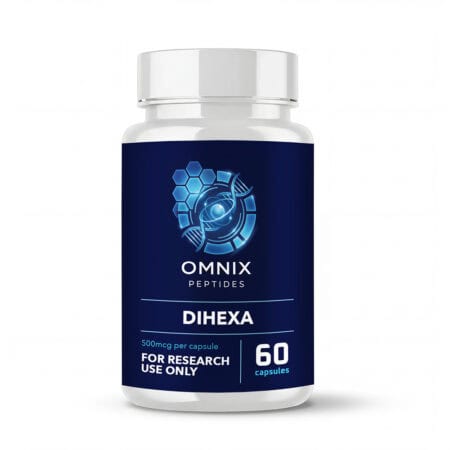
Omnix Peptides supplies Dihexa in a single research format. Each lot is independently characterized by HPLC and LC–MS, with a batch-specific Certificate of Analysis available on the product page.
- Dihexa Capsules 10 mg, 30-count — oral capsule format. The capsule format reflects the orally active, BBB-permeable design that distinguishes Dihexa from its parent peptide angiotensin IV; the published rodent literature has used intragastric (oral) and oral gavage administration as the primary delivery route.
Dihexa is classified under the Cognitive & Neurological research category. For research framed around different cognitive mechanism classes, see the Semax hub (a heptapeptide derived from ACTH4-10 with proposed BDNF-mediated mechanisms — the closest cognitive-category neighbor in the catalog, though a different mechanism class). For broader cognitive-landscape research adjacent to the growth-hormone axis, see the CJC-1295 no-DAC hub.
Amount in the Published Research Literature
The following administration ranges describe the protocols used in the peer-reviewed rodent literature on Dihexa. They are reported here for research-reference purposes only and do not constitute administration recommendations of any kind. Dihexa has not been investigated in human clinical trials, and no human-equivalent amount translation has been published in the peer-reviewed literature.
McCoy 2013 — scopolamine and aged-rat cognitive protocols. The McCoy 2013 paper, which introduced and characterized Dihexa as the metabolically stabilized lead from the Harding laboratory’s Ang IV-analog series, used scopolamine-induced cognitive impairment in young rats and natural cognitive decline in aged rats as the primary Morris water maze readouts. Oral Dihexa at 2 mg/kg/day reversed the scopolamine-induced spatial learning deficit, with treated rats performing indistinguishably from non-impaired controls. The aged-rat cohort showed improved Morris water maze performance with the same oral protocol, though with greater variability reflecting the heterogeneous baseline cognitive status of the aged-rat population. The in vitro hippocampal-neuron-culture spine-density work used Dihexa concentrations across a wide range, with effects observed at picomolar concentrations [2].
Benoist 2014 — HGF/c-Met mechanism-confirmation protocol. The Benoist 2014 mechanism-confirmation study replicated the 2 mg/kg/day oral Dihexa protocol from McCoy 2013 in scopolamine-impaired rats, with the addition of intracerebroventricular Hinge co-administration to block HGF/c-Met dimerization. Oral Dihexa reversed the scopolamine deficit by day 7 of training; Hinge co-administration eliminated the effect, confirming the HGF/c-Met dependence [3].
Sun 2021 — APP/PS1 transgenic mouse protocol. The Sun 2021 study used the APP/PS1 transgenic mouse model of Alzheimer’s disease, with intragastric administration of Dihexa at 1.44 mg/kg or 2.88 mg/kg once daily for three months (six to nine months of age in the APP/PS1 cohort). Both amounts restored Morris water maze performance relative to vehicle-treated APP/PS1 controls; the 2.88 mg/kg amount produced the larger effect on neuroinflammatory cytokine markers and PI3K/AKT pathway activation [5]. The intragastric administration route used in Sun 2021 reflects the BBB-permeability and oral-bioavailability profile characterized for Dihexa in the McCoy 2013 pharmacokinetic work.
Researchers planning protocols are referred to the original primary literature cited in the References section for full methodological detail, including vehicle composition (the Sun 2021 vehicle was 10% DMSO, 40% PEG300, 5% Tween-80, 45% saline), administration timing relative to behavioral testing, and outcome assessment timepoints.
Frequently Asked Questions
Is Dihexa FDA-approved?
No. Dihexa is not approved by the FDA, EMA, or any other regulatory authority for any indication, and is not in active regulatory development as a drug candidate. The published research base is entirely preclinical (rat and mouse studies plus rat hippocampal neuron culture work). Dihexa has not been investigated in human clinical trials.
Is Dihexa the same as Fosgonimeton?
No. Dihexa (N-hexanoic-Tyr-Ile-(6) aminohexanoic amide; development code PNB-0408) and Fosgonimeton (development code ATH-1017) are different molecules with different chemical structures and different pharmacokinetic profiles. Dihexa is a synthetic hexapeptide derivative of angiotensin IV developed in the Joseph Harding laboratory at Washington State University; Fosgonimeton is a structurally distinct small-molecule prodrug developed by Athira Pharma. The two compounds share the HGF/c-Met pathway as their proposed primary mechanism class but are not the same molecule. The clinical history of Fosgonimeton (Phase 2 and Phase 2/3 failures in 2022, 2023, and 2024 across mild-to-moderate Alzheimer’s disease and Parkinson’s disease dementia / dementia with Lewy bodies) is not direct evidence about Dihexa.
What mechanism of action has been characterized for Dihexa?
Mechanistic studies have established that Dihexa’s procognitive and synaptogenic effects are mediated by the hepatocyte growth factor (HGF) / c-Met receptor system rather than by the classical AT4 receptor, despite Dihexa’s structural origin as an angiotensin IV derivative. The Benoist 2014 study used the HGF/MET dimerization antagonist Hinge to demonstrate that blocking c-Met activation eliminates Dihexa’s procognitive effect in scopolamine-impaired rats. Downstream signaling includes activation of the PI3K/AKT pathway, characterized in the Sun 2021 APP/PS1 mouse model. The major in vitro readout is increased dendritic spine density in rat hippocampal neuron cultures (approximately three-fold over vehicle in the McCoy 2013 work).
Why is Dihexa orally active when most peptides are not?
The N-hexanoic (C-terminal) and 6-aminohexanoic amide (N-terminal) modifications introduced during the lead-optimization phase of the Harding laboratory’s Ang IV-analog program were specifically designed to increase hydrophobicity, decrease hydrogen bonding, and improve metabolic stability against the proteases that degrade native angiotensin IV. The resulting compound has reported serum half-life and blood-brain-barrier permeability sufficient for oral and intragastric administration in rodent studies, which is unusual for a peptide derivative of this size. This pharmacokinetic profile distinguishes Dihexa from the parent angiotensin IV peptide, which does not cross the blood-brain barrier well and is rapidly degraded in circulation.
What rodent models has Dihexa been studied in?
Three primary rodent model classes appear in the published Dihexa literature. First, scopolamine-induced cognitive impairment in young rats — used in McCoy 2013 and Benoist 2014 as a pharmacological model of cholinergic disruption of spatial learning, with Morris water maze as the primary behavioral readout. Second, aged-rat natural cognitive decline — used in McCoy 2013 to test Dihexa in a non-pharmacological cognitive-impairment model. Third, the APP/PS1 transgenic mouse model of Alzheimer’s disease — used in Sun 2021 to test Dihexa in an amyloid-pathology model, with Morris water maze, neuroinflammatory cytokines, and PI3K/AKT pathway activation as primary readouts. In vitro work has used dissociated rat hippocampal neuron cultures for the dendritic-spinogenesis assay.
What does the Fosgonimeton clinical history mean for Dihexa research?
Fosgonimeton (ATH-1017) is a structurally distinct small-molecule prodrug developed by Athira Pharma as a positive modulator of HGF/c-Met signaling — the same mechanism class as Dihexa, but a different molecule. Fosgonimeton failed its primary endpoint in three separate clinical trials: ACT-AD (Phase 2, mild-to-moderate Alzheimer’s disease, June 2022); SHAPE (Phase 2, Parkinson’s disease dementia and dementia with Lewy bodies, December 2023); and LIFT-AD (Phase 2/3, mild-to-moderate Alzheimer’s disease, September 2024). The fosgonimeton clinical history is not direct evidence about Dihexa, since the two compounds have different chemical structures and different pharmacokinetic profiles. However, it is relevant context for any researcher evaluating the HGF/c-Met pathway as a research target for cognitive applications — the pathway has not yielded a successful clinical readout for a related modulator molecule to date.
How does Dihexa differ from other cognitive research peptides?
Dihexa is distinguished from other cognitive research peptides primarily by its proposed mechanism class. Semax, a heptapeptide derived from ACTH(4-10), has been investigated through proposed BDNF-mediated and neuroprotective mechanisms in cerebral ischemia and cognitive models. CJC-1295 (no-DAC) is a GHRH analog whose cognitive-adjacent effects, if any, would operate through the growth-hormone axis. Dihexa’s positioning is specifically through the HGF/c-Met receptor system with downstream PI3K/AKT signaling and dendritic spinogenesis as the major in vitro readout. These are non-overlapping mechanism classes; the literatures are entirely separate.
References
- Benoist CC, Wright JW, Zhu M, Appleyard SM, Wayman GA, Harding JW. Facilitation of hippocampal synaptogenesis and spatial memory by C-terminal truncated Nle1-angiotensin IV analogs. J Pharmacol Exp Ther. 2011;339(1):35-44. doi:10.1124/jpet.111.182220 · PubMed: 21719467
- McCoy AT, Benoist CC, Wright JW, et al. Evaluation of metabolically stabilized angiotensin IV analogs as procognitive/antidementia agents. J Pharmacol Exp Ther. 2013;344(1):141-154. doi:10.1124/jpet.112.199497 · PubMed: 23055539
- Benoist CC, Kawas LH, Zhu M, et al. The procognitive and synaptogenic effects of angiotensin IV-derived peptides are dependent on activation of the hepatocyte growth factor/c-met system. J Pharmacol Exp Ther. 2014;351(2):390-402. doi:10.1124/jpet.114.218735 · PubMed: 25187433
- Wright JW, Harding JW. The brain hepatocyte growth factor/c-Met receptor system: a new target for the treatment of Alzheimer’s disease. J Alzheimers Dis. 2015;45(4):985-1000. doi:10.3233/JAD-142814 · PubMed: 25649658
- Sun X, Deng Y, Fu X, Wang S, Duan R, Zhang Y. AngIV-Analog Dihexa rescues cognitive impairment and recovers memory in the APP/PS1 mouse via the PI3K/AKT signaling pathway. Brain Sci. 2021;11(11):1487. doi:10.3390/brainsci11111487 · PubMed: 34827486
For Research Use Only. The products described on this page are sold strictly for in vitro laboratory research and are not intended for human or animal consumption, diagnostic use, or therapeutic use. The published research summarized above is provided as scientific reference material. Nothing on this page constitutes medical advice, a therapeutic claim, or a recommendation for any use outside of a properly resourced and ethically reviewed research setting.