5-Amino-1MQ (5-amino-1-methylquinolinium) is a small-molecule selective inhibitor of nicotinamide N-methyltransferase (NNMT) developed at the University of Texas Medical Branch by Neelakantan and colleagues as part of a medicinal-chemistry program targeting NNMT for metabolic-disease research. Unlike the other compounds catalogued here, 5-Amino-1MQ is not a peptide; it is a quinolinium-class small molecule with a membrane-permeable structure designed for intracellular enzyme inhibition.
The most cited mechanistic finding is the Neelakantan and colleagues 2018 study in Biochemical Pharmacology, in which the investigators reported that 5-Amino-1MQ reverse[s] high fat diet-induced obesity in mice
through selective inhibition of the NNMT enzyme, with measurable reductions in adipose tissue mass, improvements in insulin sensitivity, and increases in adipose tissue cellular metabolic activity in C57BL/6 mice fed a 60% kcal-from-fat diet [1]. The mechanistic rationale builds on earlier work by Kraus and colleagues in Nature (2014), in which adipocyte-specific NNMT knockdown protected mice from diet-induced obesity, establishing NNMT as a metabolic-disease target candidate [2].
5-Amino-1MQ is not approved by the FDA, EMA, or any other regulatory authority for any indication. There are no completed Phase 2 or Phase 3 clinical trials of 5-Amino-1MQ in human participants. NNMT inhibition as a therapeutic strategy has been explored in industry pharmaceutical pipelines (including a Pfizer program for non-alcoholic fatty liver disease that was reportedly discontinued in early clinical development), but no NNMT inhibitor has reached regulatory approval to date. The compound is supplied as a research-use chemical for investigation of NNMT enzymology, adipose-tissue methylation biology, and the metabolic-aging interface.
Important Note on the Evidence Base
Important note on the evidence base: The peer-reviewed 5-Amino-1MQ research literature consists of small-molecule medicinal-chemistry characterization (selectivity, potency, membrane permeability) and rodent in vivo work primarily in diet-induced obesity models. There are no completed Phase 2 or Phase 3 clinical trials of 5-Amino-1MQ in human participants, and no NNMT inhibitor has reached regulatory approval for any indication. The broader NNMT-as-therapeutic-target hypothesis is supported by knockdown and knockout studies, but small-molecule pharmacological validation in humans is pending. Researchers consulting this page should weight the evidence base accordingly.
Mechanism of Action
5-Amino-1MQ’s mechanism centers on selective inhibition of nicotinamide N-methyltransferase, with downstream metabolic effects mediated through changes in cellular methyl-donor availability, NAD+ precursor flux, and adipocyte energy expenditure.
NNMT enzyme inhibition. Nicotinamide N-methyltransferase catalyzes the transfer of a methyl group from S-adenosyl-L-methionine (SAM) to nicotinamide, producing 1-methylnicotinamide (1-MNA) and S-adenosyl-L-homocysteine (SAH). The reaction consumes the universal cellular methyl donor SAM and the NAD+ salvage precursor nicotinamide, producing a metabolite (1-MNA) that is excreted in urine. 5-Amino-1MQ binds the NNMT active site at low micromolar Ki, producing selective inhibition relative to other SAM-dependent methyltransferases [1]. The compound’s quinolinium scaffold confers membrane permeability that enables intracellular enzyme inhibition, distinguishing it from earlier polar NNMT inhibitor scaffolds that did not effectively enter intact cells.
Methyl-donor and NAD+ precursor pool effects. NNMT inhibition increases cellular concentrations of both substrates that the enzyme would otherwise consume: SAM (the universal methyl donor) and nicotinamide (the NAD+ salvage precursor). The Kraus 2014 study reported that adipocyte-specific NNMT knockdown in mice increased adipocyte energy expenditure through a mechanism interpreted as elevated methyl-donor availability for polyamine biosynthesis and for histone methylation that modulates adipocyte gene-expression programs [2]. The downstream effects include increased adipose-tissue thermogenesis and reduced fat-storage gene-expression programs.
Adipose-tissue methylation biology. NNMT is upregulated in white adipose tissue in obesity and in cancer cachexia models, and NNMT enzymatic activity has been implicated in maintaining the adipocyte fat-storage phenotype through SAM-dependent epigenetic remodeling. The Neelakantan 2018 study reported that 5-Amino-1MQ administration to diet-induced obese mice produced reductions in adipose-tissue NNMT enzymatic activity, with concurrent reductions in fat mass and improvements in glucose tolerance [1]. The investigators interpreted the effects as direct pharmacological validation of the NNMT-knockdown phenotype reported earlier in genetic models.
NAD+ salvage and the longevity-research framing. Because NNMT consumes nicotinamide, its inhibition theoretically increases the availability of nicotinamide for entry into the NAD+ salvage pathway via nicotinamide phosphoribosyltransferase (NAMPT). The NAD+-salvage-pathway connection has positioned NNMT inhibition within the broader cellular-aging and sirtuin-pathway research framework, alongside NAD+ precursors such as nicotinamide riboside and nicotinamide mononucleotide. The magnitude of the NAD+-elevation effect of NNMT inhibition in vivo, and its contribution to the metabolic phenotype relative to the methylation effects, remains an active area of research.
None of the mechanisms summarized here have been independently verified in adequately powered human clinical trials of 5-Amino-1MQ specifically.
Available Forms
Omnix Peptides supplies 5-Amino-1MQ in two research formats. Each lot is independently characterized by HPLC and LC–MS, with a batch-specific Certificate of Analysis available on each product page.
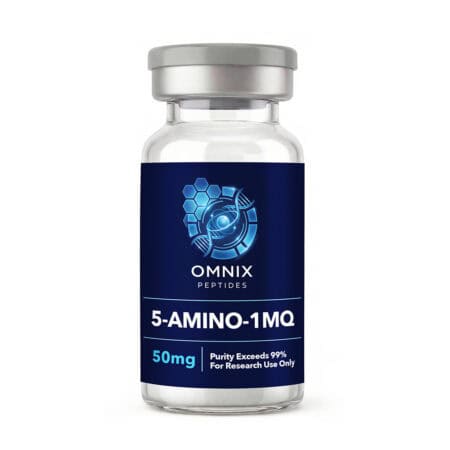
- 5-Amino-1MQ Vial — lyophilized powder for reconstitution. The vial format supports the amount flexibility used in published rodent metabolic studies and in vitro enzyme-inhibition characterization.
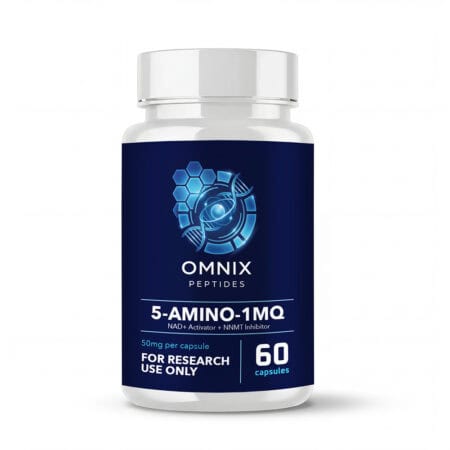
- 5-Amino-1MQ Capsules — 50 mg per capsule. Oral format used in research models evaluating chronic enteric administration where the membrane-permeable small-molecule structure supports oral bioavailability.
5-Amino-1MQ is classified under the Metabolic & Weight and Longevity & Anti-Aging research categories per its dual mechanism profile (NNMT-mediated adipose-tissue metabolism; NAD+ salvage and methylation biology relevant to cellular-aging research). For research framed around overlapping metabolic-aging pharmacology, see also the related compound hubs for MOTS-c (mitochondrial-derived peptide regulating AMPK and metabolic-aging endpoints) and NAD+ (NAD+ salvage substrate directly elevating cellular NAD+ pools).
Amount in the Published Research Literature
The following amount ranges describe the protocols used in the peer-reviewed 5-Amino-1MQ literature. They are reported here for research-reference purposes only and do not constitute administration recommendations of any kind.
Neelakantan 2018 diet-induced obesity study. Adult male C57BL/6 mice on a 60% kcal-from-fat high-fat diet received intraperitoneal or oral 5-Amino-1MQ at amounts in the milligram-per-kilogram range or vehicle, over an 11-day treatment period in the published protocol. Endpoints included body weight, fat mass (NMR spectroscopy), glucose tolerance, and adipose-tissue NNMT enzymatic activity [1]. The investigators reported concentration-dependent reductions in fat mass and adipose-tissue NNMT activity without significant changes in lean mass or food intake.
Kraus 2014 NNMT knockdown reference study. The original genetic-validation study used antisense oligonucleotide-mediated knockdown of NNMT in adipose tissue of mice on a high-fat diet, with whole-body and adipose-tissue metabolic endpoints measured against scrambled-oligonucleotide controls [2]. The investigators reported that NNMT knockdown produced protection from diet-induced obesity and increased adipocyte energy expenditure, establishing the genetic precedent for the 5-Amino-1MQ pharmacological program.
In vitro enzyme-inhibition characterization. Published in vitro work has characterized 5-Amino-1MQ as a competitive NNMT inhibitor with low micromolar potency against the recombinant enzyme, and as a cell-permeable agent that suppresses NNMT activity in cultured 3T3-L1 adipocytes at micromolar concentrations [1]. The selectivity profile against related SAM-dependent methyltransferases has been characterized in the same publication series.
Pharmacokinetic profile. 5-Amino-1MQ’s membrane-permeable small-molecule structure produces oral bioavailability in rodent models, distinguishing it from peptide compounds and supporting the oral capsule research format. Published rodent pharmacokinetic data report a plasma half-life consistent with once- or twice-daily oral administration for sustained NNMT inhibition. Published human pharmacokinetic data for 5-Amino-1MQ are not available.
Adverse-event profile. No human clinical trial adverse-event data is available for 5-Amino-1MQ. The published rodent literature has not reported overt toxicity at the studied amounts, but the available data are not equivalent to a regulated Phase 1/2 safety database. Theoretical concerns about chronic NNMT inhibition include effects on the metabolism of other quinolinium and methylpyridinium endogenous metabolites and on the broader cellular methylation landscape; these have not been systematically characterized.
Researchers planning protocols are referred to the original primary literature cited in the References section for full methodological detail.
Frequently Asked Questions
Is 5-Amino-1MQ FDA-approved?
No. 5-Amino-1MQ is not approved by the FDA, EMA, or any other regulatory authority for any indication. There are no completed Phase 2 or Phase 3 clinical trials of 5-Amino-1MQ in human participants. NNMT inhibition as a therapeutic strategy has been explored in industry pharmaceutical pipelines, but no NNMT inhibitor has reached regulatory approval to date.
Is 5-Amino-1MQ a peptide?
No. 5-Amino-1MQ is a small molecule, not a peptide. The compound is a quinolinium-class structure (5-amino-1-methylquinolinium) developed as a membrane-permeable selective inhibitor of the nicotinamide N-methyltransferase enzyme. Its inclusion in Omnix’s research catalog reflects its use in metabolic and longevity research alongside peptide compounds with overlapping target pathways.
What is NNMT and why is it a research target?
Nicotinamide N-methyltransferase (NNMT) is a cytoplasmic enzyme that catalyzes the transfer of a methyl group from S-adenosyl-L-methionine (SAM, the universal methyl donor) to nicotinamide (the NAD+ salvage precursor), producing 1-methylnicotinamide and S-adenosyl-L-homocysteine. NNMT is upregulated in obesity and cancer cachexia, and NNMT knockdown in mice protects against diet-induced obesity [2]. The combination of these findings positioned NNMT as a candidate metabolic-disease and metabolic-aging research target, motivating development of selective small-molecule inhibitors including 5-Amino-1MQ.
What does the Neelakantan 2018 mouse study show?
The Neelakantan 2018 study in Biochemical Pharmacology reported that 5-Amino-1MQ administration to C57BL/6 mice on a 60% kcal-from-fat high-fat diet produced concentration-dependent reductions in fat mass and adipose-tissue NNMT enzymatic activity without significant changes in lean mass or food intake [1]. The investigators interpreted the findings as direct pharmacological validation of the NNMT-knockdown phenotype reported earlier in the Kraus 2014 genetic-validation study.
What is the mechanism of action of 5-Amino-1MQ?
5-Amino-1MQ selectively inhibits nicotinamide N-methyltransferase (NNMT) by binding the enzyme’s active site. The reduced enzymatic activity increases cellular concentrations of both substrates that NNMT would otherwise consume: S-adenosyl-L-methionine (the universal cellular methyl donor) and nicotinamide (the NAD+ salvage precursor). The downstream effects on adipose-tissue gene expression, methylation status, and NAD+ pool dynamics are interpreted in the published literature as the basis for the metabolic phenotype observed in mouse models.
What administration routes have been used in 5-Amino-1MQ research?
Published rodent in vivo studies have used intraperitoneal injection and oral (gavage) administration. The membrane-permeable small-molecule structure produces oral bioavailability that distinguishes 5-Amino-1MQ from peptide compounds and supports the oral capsule research format. Published human pharmacokinetic data are not available.
References
- Neelakantan H, Vance V, Wetzel MD, et al. Selective and membrane-permeable small molecule inhibitors of nicotinamide N-methyltransferase reverse high fat diet-induced obesity in mice. Biochem Pharmacol. 2018;147:141-152. doi:10.1016/j.bcp.2017.11.007 · PubMed: 29155147
- Kraus D, Yang Q, Kong D, et al. Nicotinamide N-methyltransferase knockdown protects against diet-induced obesity. Nature. 2014;508(7495):258-262. doi:10.1038/nature13198 · PubMed: 24717514
- Pissios P. Nicotinamide N-methyltransferase: more than a vitamin B3 clearance enzyme. Trends Endocrinol Metab. 2017;28(5):340-353. doi:10.1016/j.tem.2017.02.004 · PubMed: 28291578
For Research Use Only. The products described on this page are sold strictly for in vitro laboratory research and are not intended for human or animal consumption, diagnostic use, or therapeutic use. The published research summarized above is provided as scientific reference material. Nothing on this page constitutes medical advice, a therapeutic claim, or a recommendation for any use outside of a properly resourced and ethically reviewed research setting.