IGF-1 LR3 (Long R3 Insulin-like Growth Factor 1; CAS 946870-92-4) is a recombinant analog of human insulin-like growth factor 1 in which the native 70-amino-acid sequence is extended at the N-terminus by a 13-amino-acid sequence and carries an arginine-for-glutamate substitution at position 3 (E3R). The combined modifications produce a protein that retains full agonist activity at the type 1 IGF receptor (IGF-1R) while binding the IGF binding proteins (IGFBP-1 through IGFBP-6) with substantially reduced affinity. The reduction in IGFBP binding increases the bioavailable free fraction and extends the functional half-life of the molecule compared with native IGF-1.
IGF-1 LR3 was developed at GroPep Limited (Adelaide, Australia) and originally characterized by Francis and colleagues in The Journal of Molecular Endocrinology, who reported that the modified analog showed enhanced biological potency relative to native IGF-1 in cell-culture systems and that the enhancement was attributable to reduced binding to IGFBPs rather than to changes in IGF receptor affinity [1]. The compound is the industry-standard recombinant IGF analog for mammalian cell culture (notably CHO cell lines used in biopharmaceutical bioreactors), and is supplied as a research reagent for in vitro IGF-receptor pharmacology and cell-biology applications.
IGF-1 LR3 is not approved by the FDA, EMA, or any other regulatory authority for any indication. There are no published Phase 1, Phase 2, or Phase 3 clinical trials of IGF-1 LR3 in human participants. The unmodified parent compound, recombinant human IGF-1 (mecasermin), is FDA-approved (2005) for severe primary IGF-1 deficiency and Laron syndrome in pediatric patients, but the modified LR3 analog itself has not been advanced into clinical development.
Important Note on the Evidence Base
Important note on the evidence base: The peer-reviewed IGF-1 LR3 research literature consists of in vitro characterization studies (receptor binding, IGFBP interaction, cell-culture potency) and a small body of rodent in vivo work primarily in cachexia and protein-metabolism models. There are no published controlled human clinical trials of IGF-1 LR3. Researchers should not confuse the LR3 analog evidence base with the substantially larger clinical literature on unmodified recombinant IGF-1 (mecasermin), which is a separate compound with a distinct regulatory and clinical history.
Mechanism of Action
IGF-1 LR3 produces its biological effects through agonist activity at the type 1 IGF receptor, with the structural modifications altering the pharmacokinetic and bioavailability profile rather than the receptor mechanism itself.
Type 1 IGF receptor agonism. The type 1 IGF receptor (IGF-1R) is a transmembrane receptor tyrosine kinase structurally homologous to the insulin receptor, with which it shares approximately 50–60% amino-acid identity. Ligand binding triggers receptor autophosphorylation and recruitment of insulin receptor substrate (IRS-1, IRS-2) and Shc adapter proteins, activating the PI3K–Akt–mTOR and Ras–Raf–MEK–ERK signaling cascades. IGF-1 LR3 retains the IGF-1R binding affinity of native IGF-1 and produces equivalent downstream signaling in cells expressing the receptor; the molecular distinction from native IGF-1 is at the IGFBP-binding surface, not at the receptor-binding surface.
Reduced IGFBP binding and the bioavailability mechanism. In plasma and extracellular fluid, the great majority (>99%) of native IGF-1 is bound to one of six high-affinity IGF binding proteins (IGFBP-1 through IGFBP-6), with IGFBP-3 carrying most of the circulating IGF-1 in a ternary complex with the acid-labile subunit. The IGFBPs sequester IGF-1 in a non-bioavailable pool, modulating receptor signaling by gating free-ligand access. The N-terminal 13-amino-acid extension and the E3R substitution in LR3 reduce binding affinity to IGFBPs by approximately one to two orders of magnitude, increasing the free IGF-1 fraction available to bind the type 1 IGF receptor at any given total concentration. The Forbes BIAcore characterization study reported that LR3 binds IGFBPs with the lowest affinity of the IGF analogs studied, with a corresponding ~3-fold increase in apparent in vitro potency [3].
Functional half-life and tissue distribution. The Tomas in vivo characterization in protein-restricted rats reported that IGF-I analogs that bind IGFBPs poorly — including LR3-IGF-1 — produce greater anabolic effects than equimolar native IGF-1 when administered by either continuous infusion or daily injection, with the differential most pronounced under injection conditions [2]. The investigators attributed the difference to the more rapid clearance of IGFBP-bound native IGF-1 versus the more sustained free-ligand exposure with the LR3 analog. The compound’s functional half-life in published rodent models is reported as approximately 20–30 hours, compared with approximately 10–12 hours for native IGF-1.
Cell-culture pharmacology and the industrial use case. The dominant practical use of IGF-1 LR3 outside of academic pharmacology research is as a recombinant supplement to mammalian cell-culture media, where it supports growth of CHO and other industrial cell lines at low (1–100 ng/mL) supplementation levels. The same reduced-IGFBP-binding property that produces enhanced in vivo potency in animal studies also produces enhanced cell-culture activity, because the IGFBPs secreted into serum-free media by cultured cells otherwise reduce the bioavailability of native IGF-1 supplementation. The cell-culture pharmacology of LR3 is well-characterized; the in vivo and clinical literature is substantially less developed.
None of the mechanisms summarized here have been independently verified in adequately powered human clinical trials of IGF-1 LR3 specifically.
Available Forms
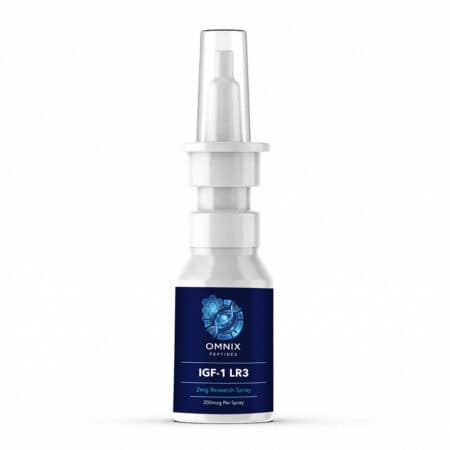
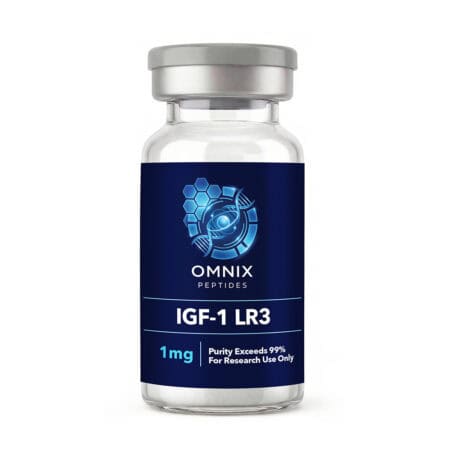
Omnix Peptides supplies IGF-1 LR3 in two research formats. Each lot is independently characterized by HPLC and LC–MS, with a batch-specific Certificate of Analysis available on each product page.
- IGF-1 LR3 Vial — lyophilized powder for reconstitution. Available in 0.1 mg and 1 mg strengths per vial. The vial is the canonical research format for IGF-1 LR3 in both cell-culture supplementation and in vivo research model use.
- IGF-1 LR3 Liquid Spray — mucosal-administration format used in research models evaluating non-injectable delivery routes.
IGF-1 LR3 is classified under the Growth Hormone research category as a downstream effector of the GH/IGF-1 axis. For research framed around overlapping growth-axis pharmacology, see also the related compound hubs for Sermorelin, CJC-1295 No DAC, and Ipamorelin — all of which act upstream at the pituitary to elevate endogenous IGF-1, in contrast to IGF-1 LR3 which acts directly at the IGF-1 receptor.
Amount in the Published Research Literature
The following amount ranges describe the protocols used in the peer-reviewed IGF-1 LR3 literature. They are reported here for research-reference purposes only and do not constitute administration recommendations of any kind.
Cell-culture supplementation. The dominant published use case for IGF-1 LR3 is supplementation of mammalian cell-culture media, typically at 1–100 ng/mL in serum-free or chemically defined formulations. The exact supplementation concentration is cell-line- and application-dependent, with industrial bioprocess applications generally using lower concentrations than basic-research applications.
Francis 1992 in vitro characterization. The original characterization study by Francis and colleagues used L6 myoblast cell-culture systems to compare LR3-IGF-1 and other IGF-1 analogs at low nanomolar concentrations, with cell-protein synthesis as the primary endpoint [1]. The investigators reported that LR3-IGF-1 produced enhanced potency in the presence of cell-secreted IGFBPs, with the magnitude of enhancement attributable to the reduced-IGFBP-binding property of the analog rather than to increased intrinsic receptor potency.
Tomas 1996 in vivo rodent study. Adult rats with experimentally induced protein restriction received either native IGF-1 or LR3-IGF-1 by continuous subcutaneous infusion or by once-daily subcutaneous injection at matched molar amounts, with whole-body protein metabolism and nitrogen balance as the primary endpoints [2]. The investigators reported that LR3-IGF-1 produced greater anabolic effects than native IGF-1 across both administration modes, with the differential most pronounced under once-daily injection conditions. The published amount-range was 100 µg/kg/day to 600 µg/kg/day.
Forbes 2002 receptor binding characterization. Surface plasmon resonance (BIAcore) measurements characterized the binding kinetics of IGF-1 analogs (including LR3) at both the type 1 IGF receptor and at IGFBP-1 through IGFBP-6 [3]. The investigators reported that LR3 showed the lowest IGFBP-binding affinities of the analogs studied while retaining full IGF-1R binding, supporting the molecular model of the bioavailability mechanism.
Adverse-event profile and class considerations. No human clinical trial adverse-event data is available for IGF-1 LR3 specifically. The class profile of agents that elevate IGF-1 signaling applies, including the theoretical concern about IGF-1 as a mitogenic and pro-survival signal in malignant cell populations — a consideration documented in the FDA-approved labels of recombinant human IGF-1 products (mecasermin), which carry contraindications and warnings related to neoplasia. In vivo rodent studies have reported hypoglycemia at higher amounts, consistent with the cross-reactivity of IGF-1 at the insulin receptor at supra-physiologic concentrations.
Frequently Asked Questions
Is IGF-1 LR3 FDA-approved?
No. IGF-1 LR3 is not approved by the FDA, EMA, or any other regulatory authority for any indication. There are no published Phase 1, Phase 2, or Phase 3 clinical trials of IGF-1 LR3 in human participants. The unmodified parent compound, recombinant human IGF-1 (mecasermin), is FDA-approved (2005) for severe primary IGF-1 deficiency and Laron syndrome in pediatric patients, but the modified LR3 analog itself has not been advanced into clinical development.
What is the published evidence base for IGF-1 LR3?
The peer-reviewed IGF-1 LR3 research literature consists of in vitro characterization studies (receptor binding, IGFBP interaction, cell-culture potency) and a small body of rodent in vivo work primarily in cachexia and protein-metabolism models. There are no published controlled human clinical trials of IGF-1 LR3. Researchers should not confuse the LR3 analog evidence base with the substantially larger clinical literature on unmodified recombinant IGF-1 (mecasermin), which is a separate compound.
What does the LR3 modification do?
Two modifications are combined in LR3: a 13-amino-acid N-terminal extension and an arginine-for-glutamate substitution at position 3 (E3R). Together they reduce binding affinity to the six IGF binding proteins (IGFBP-1 through IGFBP-6) by approximately one to two orders of magnitude, while preserving full agonist activity at the type 1 IGF receptor. The net effect is an increased free (bioavailable) IGF fraction at any given total concentration and an extended functional half-life relative to native IGF-1.
What is the mechanism of action of IGF-1 LR3?
IGF-1 LR3 is a full agonist at the type 1 IGF receptor (IGF-1R), a transmembrane receptor tyrosine kinase. Receptor binding activates the PI3K–Akt–mTOR and Ras–Raf–MEK–ERK signaling cascades through IRS-1, IRS-2, and Shc adapter proteins. The structural modifications distinguish LR3 from native IGF-1 at the IGFBP-binding surface but not at the receptor-binding surface; the receptor signaling is therefore equivalent to native IGF-1, while the pharmacokinetic profile is distinct.
How is IGF-1 LR3 used in research?
The dominant practical use of IGF-1 LR3 is as a recombinant supplement to mammalian cell-culture media (typically at 1–100 ng/mL), where it supports growth of CHO and other industrial cell lines. The same reduced-IGFBP-binding property that produces enhanced in vivo potency also produces enhanced cell-culture activity. In animal-model research, the compound has been used in rodent cachexia and protein-metabolism studies as a more potent and longer-acting alternative to native IGF-1.
How does IGF-1 LR3 differ from native IGF-1 (mecasermin)?
Native IGF-1 (mecasermin, recombinant human IGF-1) is the unmodified 70-amino-acid human sequence. IGF-1 LR3 carries a 13-amino-acid N-terminal extension and an arginine substitution at position 3, which together reduce IGFBP binding while preserving IGF-1R agonist activity. The functional consequence is an extended half-life and increased free-ligand bioavailability for LR3 compared with native IGF-1. Mecasermin is FDA-approved (2005) for severe primary IGF-1 deficiency; LR3 has not been advanced into clinical development.
What administration routes have been used in IGF-1 LR3 research?
In vitro studies use direct addition to cell-culture media. In vivo rodent studies have used continuous subcutaneous infusion via osmotic minipump and once-daily subcutaneous injection. The Tomas 1996 study compared the two administration modes and reported greater anabolic effects with LR3 than with native IGF-1 across both modes, with the differential most pronounced under injection conditions [2].
References
- Francis GL, Ross M, Ballard FJ, et al. Novel recombinant fusion protein analogues of insulin-like growth factor (IGF)-I indicate the relative importance of IGF-binding protein and receptor binding for enhanced biological potency. J Mol Endocrinol. 1992;8(3):213-223. doi:10.1677/jme.0.0080213 · PubMed: 1376622
- Tomas FM, Lemmey AB, Read LC, Ballard FJ. Superior potency of infused IGF-I analogues which bind poorly to IGF-binding proteins is maintained when administered by injection. J Endocrinol. 1996;150(1):77-84. doi:10.1677/joe.0.1500077 · PubMed: 8708568
- Forbes BE, Hartfield PJ, McNeil KA, et al. Characteristics of binding of insulin-like growth factor (IGF)-I and IGF-II analogues to the type 1 IGF receptor determined by BIAcore analysis. Eur J Biochem. 2002;269(3):961-968. doi:10.1046/j.0014-2956.2001.02735.x · PubMed: 11846798
For Research Use Only. The products described on this page are sold strictly for in vitro laboratory research and are not intended for human or animal consumption, diagnostic use, or therapeutic use. The published research summarized above is provided as scientific reference material. Nothing on this page constitutes medical advice, a therapeutic claim, or a recommendation for any use outside of a properly resourced and ethically reviewed research setting.