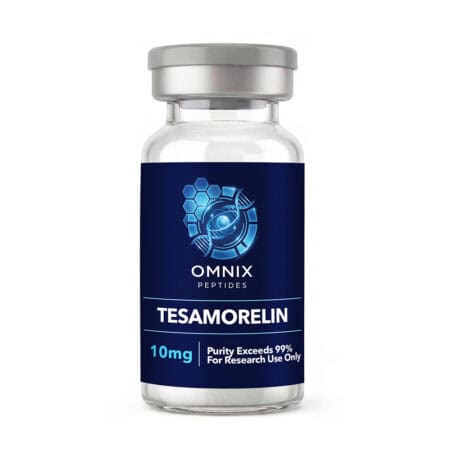
Tesamorelin (CAS 218949-48-5; development code TH9507) is a synthetic 44-amino-acid analog of human growth hormone-releasing hormone (GHRH), modified by attachment of a trans-3-hexenoic acid moiety at the N-terminus to confer resistance to enzymatic degradation. Tesamorelin functions as a selective agonist of the growth hormone-releasing hormone receptor (GHRH-R) on pituitary somatotroph cells, stimulating endogenous pulsatile release of growth hormone (GH) and producing a downstream rise in circulating insulin-like growth factor 1 (IGF-1). Tesamorelin is FDA-approved (2010) for the reduction of excess abdominal fat in adult patients with human immunodeficiency virus (HIV)-associated lipodystrophy.
In the 26-week pivotal Phase 3 trial published by Falutz and colleagues in The New England Journal of Medicine, HIV-infected adults with excess abdominal adiposity received once-daily 2 mg subcutaneous tesamorelin or placebo. The investigators reported a mean 15.2% reduction in visceral adipose tissue (VAT) in the tesamorelin arm versus a 5.0% increase in the placebo arm at week 26, with a corresponding mean rise in IGF-1 of approximately 81% from baseline [1]. In a pooled analysis of two parallel Phase 3 trials published by Falutz and colleagues in The Journal of Clinical Endocrinology & Metabolism, the visceral-fat reductions and metabolic improvements were sustained through 52 weeks of continued treatment, with attenuation observed in participants who crossed over from active treatment to placebo at week 26 [2].
Subsequent randomized investigations have characterized tesamorelin’s effects on intrahepatic lipid content. In the Phase 2 trial published by Stanley and colleagues in The Lancet HIV, 12 months of 2 mg daily tesamorelin produced a reported relative reduction in hepatic fat fraction of approximately 37% versus placebo and prevented the progression of liver fibrosis as measured by FIB-4 score, in HIV-infected adults with non-alcoholic fatty liver disease [3]. Researchers consulting this page should treat tesamorelin as a clinically validated GHRH receptor agonist for its FDA-approved indication, with a body of evidence in HIV-associated metabolic and hepatic conditions and limited published evidence outside that population.
Mechanism of Action
Tesamorelin produces its metabolic effects upstream of growth hormone, by stimulating endogenous pulsatile GH release from pituitary somatotrophs rather than by exogenous GH replacement.
GHRH receptor agonism. Native GHRH is a 44-amino-acid hypothalamic peptide that binds the GHRH receptor (a class B G-protein-coupled receptor) on anterior pituitary somatotroph cells, activating the Gαs/adenylyl cyclase/cAMP pathway and stimulating both the synthesis and the pulsatile secretion of growth hormone. Tesamorelin is the full-length 44-amino-acid native GHRH sequence with an added trans-3-hexenoic acid at the N-terminus. The N-terminal modification confers resistance to cleavage by dipeptidyl peptidase-4 (DPP-4), the enzyme that rapidly inactivates endogenous GHRH in plasma. The resulting compound retains full GHRH receptor agonist activity with substantially extended plasma stability.
Restoration of pulsatile GH secretion. Because tesamorelin acts at the level of the pituitary rather than as a GH replacement, the physiologic pattern of GH release — pulsatile, with intact negative-feedback regulation by somatostatin and IGF-1 — is preserved. This is mechanistically distinct from administration of recombinant human growth hormone (rhGH), which produces a sustained non-pulsatile elevation of circulating GH. In the published HIV-lipodystrophy program, tesamorelin restored mean 24-hour GH and IGF-1 concentrations toward those of HIV-uninfected reference populations, with the IGF-1 standard deviation score generally remaining within physiological range.
Lipolytic and visceral-adipose effects. Growth hormone promotes lipolysis in adipose tissue and is known to preferentially mobilize visceral adipose stores in humans. In HIV-infected patients with antiretroviral-therapy–associated lipodystrophy — a phenotype characterized by reduced 24-hour GH secretion and increased visceral adiposity — the restoration of GH pulsatility through GHRH receptor agonism reduces VAT volume measured by single-slice abdominal CT. The reductions reported in the published trials are accompanied by improvements in triglycerides and in the total-to-HDL cholesterol ratio [1][2].
Hepatic-fat reduction in the NAFLD trial. The mechanism proposed by Stanley and colleagues for the observed reduction in intrahepatic lipid is GH-mediated stimulation of hepatic lipid oxidation combined with reduced delivery of free fatty acids from a smaller visceral adipose depot. The trial reported reduction in hepatic fat fraction without significant change in body weight, supporting an adipose-distribution mechanism rather than a global caloric deficit [3].
Available Forms
Omnix Peptides currently supplies tesamorelin in a single research format. Each lot is independently characterized by HPLC and LC–MS, with a batch-specific Certificate of Analysis available on the product page.
- Tesamorelin Vial — lyophilized powder for reconstitution. The vial is the canonical research format used in the published clinical literature; once-daily subcutaneous administration is the route used in the FDA-approved label and in all published Phase 2 and Phase 3 trials.
Tesamorelin is classified under the Growth Hormone and Metabolic & Weight research categories per its dual mechanism profile (GHRH receptor agonism upstream of the GH axis; visceral-adipose and hepatic-lipid effects downstream). For research framed around overlapping mechanisms, see also the related compound hubs for Sermorelin (parent GHRH(1–29) analog without the N-terminal modification), CJC-1295 No DAC (alternative GHRH(1–29) analog with different stability modifications), and Ipamorelin (growth hormone secretagogue acting at the ghrelin receptor rather than the GHRH receptor).
Amount in the Published Research Literature
The following amount ranges describe the protocols used in the peer-reviewed tesamorelin clinical trial program. They are reported here for research-reference purposes only and do not constitute administration recommendations of any kind.
Falutz 2007 pivotal Phase 3 trial (HIV-associated lipodystrophy). HIV-infected adults with excess abdominal adiposity received once-daily 2 mg subcutaneous tesamorelin or matching placebo for 26 weeks. The 2 mg daily subcutaneous amount was selected based on prior Phase 2 amount-ranging work and has remained the standard protocol across the subsequent published program [1].
Falutz 2010 pooled 52-week analysis. Two parallel Phase 3 trials with safety-extension phases pooled n = 806 participants. Participants randomized to active treatment in the 26-week core phase continued 2 mg daily through week 52; participants randomized to placebo in the core phase were re-randomized at week 26 to either continue placebo or cross over to active treatment. The investigators reported sustained VAT reduction through week 52 in continuous-treatment participants and attenuation of VAT response in participants who discontinued at week 26 [2].
Stanley 2019 NAFLD Phase 2 trial. HIV-infected adults with hepatic steatosis (defined by hepatic fat fraction ≥5% on magnetic resonance spectroscopy) were randomized to 2 mg subcutaneous tesamorelin daily or placebo for 12 months. The protocol used the same 2 mg daily amount as the lipodystrophy program. The investigators reported a significant relative reduction in hepatic fat fraction at 12 months in the active-treatment arm and prevention of fibrosis progression as assessed by FIB-4 [3].
Adverse-event profile across the program. The most commonly reported adverse events in the tesamorelin clinical trial program are injection-site reactions (erythema, pruritus, pain), arthralgia, myalgia, peripheral edema, and paresthesias — broadly consistent with the class profile of agents that elevate IGF-1. Hyperglycemia and reductions in insulin sensitivity have been reported and are addressed in the FDA-approved label as part of the post-marketing risk profile, particularly in patients with pre-existing dysglycemia. The investigators have reported the adverse-event profile as manageable in the HIV-lipodystrophy population over the published treatment durations of up to 12 months.
Researchers planning protocols are referred to the original primary literature cited in the References section for full methodological detail, including randomization schema, exclusion criteria, primary and secondary endpoint definitions, imaging methodology, and adverse-event reporting.
Frequently Asked Questions
Is tesamorelin FDA-approved?
Yes. Tesamorelin is FDA-approved (2010) for the reduction of excess abdominal fat in adult patients with HIV-associated lipodystrophy. It is administered as a 2 mg once-daily subcutaneous injection in the approved label. It is not FDA-approved for any indication outside that population, and the material supplied by Omnix is sold strictly for in vitro laboratory research.
What mechanism of action does tesamorelin use?
Tesamorelin is a selective agonist of the growth hormone-releasing hormone (GHRH) receptor on pituitary somatotroph cells. It is a synthetic 44-amino-acid analog of native GHRH, modified at the N-terminus with a trans-3-hexenoic acid to resist degradation by dipeptidyl peptidase-4. The compound stimulates endogenous pulsatile GH release, with a downstream rise in IGF-1. Because it acts upstream of GH, physiologic GH pulsatility and negative feedback by somatostatin and IGF-1 are preserved.
How does tesamorelin differ from sermorelin?
Both compounds are GHRH receptor agonists. Sermorelin is the 29-amino-acid biologically active N-terminal fragment of native GHRH (GHRH(1–29)NH2). Tesamorelin is the full-length 44-amino-acid GHRH sequence with an added trans-3-hexenoic acid at the N-terminus. The N-terminal modification confers resistance to dipeptidyl peptidase-4 cleavage and gives tesamorelin substantially longer plasma stability than unmodified GHRH(1–29). Tesamorelin reached and retained FDA approval (2010) for HIV-associated lipodystrophy; sermorelin was FDA-approved (1990) and subsequently withdrawn from the U.S. market in 2008 for commercial reasons rather than safety or efficacy.
What does the Falutz 2007 trial show about visceral fat?
The Falutz 2007 trial was a 26-week, double-blind, randomized, placebo-controlled, multicenter Phase 3 trial in 412 HIV-infected adults with excess abdominal adiposity. Participants randomized to once-daily 2 mg subcutaneous tesamorelin showed a mean 15.2% reduction in visceral adipose tissue (VAT, by single-slice abdominal CT) at week 26, compared with a 5.0% increase in the placebo arm. Mean IGF-1 rose approximately 81% from baseline in the tesamorelin arm and returned toward baseline after discontinuation [1].
What does the Stanley 2019 NAFLD trial show about hepatic fat?
The Stanley 2019 trial was a 12-month, double-blind, randomized, placebo-controlled, multicentre Phase 2 trial in 61 HIV-infected adults with non-alcoholic fatty liver disease (hepatic fat fraction ≥5% on magnetic resonance spectroscopy). Participants randomized to 2 mg daily subcutaneous tesamorelin had a significant relative reduction in hepatic fat fraction versus placebo at month 12, and the investigators reported prevention of fibrosis progression assessed by FIB-4 score. Body weight did not change significantly, supporting an adipose-distribution mechanism rather than a global caloric deficit [3].
What is the once-daily administration schedule used in published trials?
The Phase 3 lipodystrophy program (Falutz 2007, Falutz 2010 pooled) and the Phase 2 NAFLD program (Stanley 2019) all used 2 mg subcutaneous tesamorelin administered once daily, without escalating-amount. The FDA-approved label specifies the same 2 mg daily subcutaneous amount. Treatment durations in the published trials range from 26 weeks (Falutz pivotal) to 12 months (Stanley NAFLD).
What are the most common adverse events reported in tesamorelin trials?
The most commonly reported adverse events in the tesamorelin clinical trial program are injection-site reactions (erythema, pruritus, pain), arthralgia, myalgia, peripheral edema, and paresthesias. These are broadly consistent with the class profile of agents that elevate IGF-1. Hyperglycemia and reductions in insulin sensitivity have been reported, particularly in patients with pre-existing dysglycemia, and are addressed in the FDA-approved label as part of the post-marketing risk profile. Full adverse-event reporting is available in the published trial papers cited on this page.
References
- Falutz J, Allas S, Blot K, et al. Metabolic effects of a growth hormone-releasing factor in patients with HIV. N Engl J Med. 2007;357(23):2359-2370. doi:10.1056/NEJMoa072375 · PubMed: 18057338
- Falutz J, Mamputu JC, Potvin D, et al. Effects of tesamorelin (TH9507), a growth hormone-releasing factor analog, in human immunodeficiency virus-infected patients with excess abdominal fat: a pooled analysis of two multicenter, double-blind placebo-controlled phase 3 trials with safety extension data. J Clin Endocrinol Metab. 2010;95(9):4291-4304. doi:10.1210/jc.2010-0490 · PubMed: 20554713
- Stanley TL, Fourman LT, Feldpausch MN, et al. Effects of tesamorelin on non-alcoholic fatty liver disease in HIV: a randomised, double-blind, multicentre, placebo-controlled phase 2 trial. Lancet HIV. 2019;6(12):e821-e830. doi:10.1016/S2352-3018(19)30338-8 · PubMed: 31611038
- Stanley TL, Falutz J, Mamputu JC, Soulban G, Potvin D, Grinspoon SK. Effects of tesamorelin on inflammatory markers in HIV patients with excess abdominal fat: relationship with visceral adipose reduction. AIDS. 2011;25(10):1281-1288. doi:10.1097/QAD.0b013e328347f3f1 · PubMed: 21516030
For Research Use Only. The product described on this page is sold strictly for in vitro laboratory research and is not intended for human or animal consumption, diagnostic use, or therapeutic use. The published research summarized above is provided as scientific reference material; FDA-approved tesamorelin drug products are available only by prescription from a licensed healthcare provider. Nothing on this page constitutes medical advice, a therapeutic claim, or a recommendation for any use outside of a properly resourced and ethically reviewed research setting.