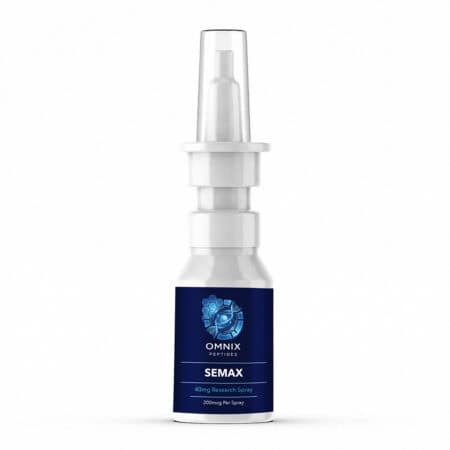
Semax (CAS 80714-61-0) is a synthetic heptapeptide with the sequence Met-Glu-His-Phe-Pro-Gly-Pro, designed as an analog of the N-terminal fragment of adrenocorticotropic hormone (ACTH(4–10): Met-Glu-His-Phe-Arg-Trp-Gly). In semax, the C-terminal Arg-Trp-Gly tripeptide of the parent ACTH fragment is replaced by Pro-Gly-Pro, a substitution that confers resistance to plasma peptidases and eliminates the corticotropic activity of the parent molecule while preserving the reported neurotropic and neuroprotective activity. Semax was developed at the Institute of Molecular Genetics of the Russian Academy of Sciences as part of a research program on ACTH-fragment-derived neuropeptides.
Semax is registered as a prescription pharmaceutical in the Russian Federation for indications including cerebrovascular events, transient ischemic attack, post-stroke recovery, optic nerve atrophy, and disorders of cognition and attention. It is administered as an intranasal solution. The compound is not approved by the FDA, EMA, or any other Western regulatory authority for any indication. The peer-reviewed literature on semax is predominantly Russian-language, with an English-translation corpus appearing primarily in Zhurnal Nevrologii i Psikhiatrii Imeni S.S. Korsakova, Bulletin of Experimental Biology and Medicine, Neuroscience Letters, and related journals.
The most cited English-language clinical study is the Gusev and Skvortsova 1997 paper in Zhurnal Nevrologii i Psikhiatrii Imeni S.S. Korsakova, which evaluated semax administration during the acute phase of hemispheric ischemic stroke and reported clinical and electrophysiological improvements relative to standard care in the study population [1]. A subsequent randomized, double-blind, placebo-controlled trial by Skvortsova and colleagues in the same journal reported reduced 30-day mortality and improved neurological recovery in semax-treated patients with acute ischemic stroke [2]. Researchers consulting this page should interpret the evidence base as predominantly Russian-conducted, with no published trials reviewed by FDA or EMA.
Important Note on the Evidence Base
Important note on the evidence base: The peer-reviewed semax research literature is dominated by Russian-language publications from the Ashmarin, Myasoedov, and Skvortsova research networks and affiliated clinical institutions, with English-translation versions of a subset appearing in indexed journals. The Russian clinical registration for cerebrovascular and cognitive indications was based on Russian-conducted clinical data not subject to FDA or EMA review. The mechanistic literature includes English-language primary research in journals such as Neuroscience Letters and Bulletin of Experimental Biology and Medicine. Researchers consulting this page should weight the evidence base accordingly.
Mechanism of Action
Semax’s pharmacological profile in the published literature is multi-target rather than single-receptor, with mechanistic effects characterized across neurotrophin signaling, monoaminergic neurotransmission, and melanocortin-receptor pharmacology at reduced potency relative to native ACTH.
ACTH(4–10) derivation and corticotropic-activity removal. Native ACTH is a 39-amino-acid peptide whose 24 N-terminal residues are conserved across mammalian species and confer the full corticotropic (cortisol-releasing) activity at the melanocortin-2 receptor (MC2R) in the adrenal cortex. Earlier neurobiology work established that the ACTH(4–10) sequence (Met-Glu-His-Phe-Arg-Trp-Gly) is responsible for the neurotropic and behavioral effects of ACTH, independent of the corticotropic activity. The semax sequence (Met-Glu-His-Phe-Pro-Gly-Pro) replaces the ACTH(4–10) C-terminal Arg-Trp-Gly with the Pro-Gly-Pro stabilization motif, which the Russian group reported as eliminating corticotropic activity at MC2R while preserving the neurotropic activity and substantially extending plasma stability.
BDNF, NGF, and neurotrophin signaling. Published mechanistic work has reported that semax administration in rodent models increases hippocampal expression of brain-derived neurotrophic factor (BDNF) and nerve growth factor (NGF) at the mRNA and protein level, with concurrent activation of downstream TrkB and TrkA signaling. The neurotrophin-upregulation pathway is the most consistently reported molecular mechanism in the English-translation literature and is proposed as the basis for the reported neuroprotective effects in cerebral ischemia models and the nootropic effects in learning-and-memory paradigms.
Monoaminergic neurotransmission. The Dolotov 2006 study in Neuroscience Letters reported that semax administration to rats activated dopaminergic and serotonergic brain systems, with measurable changes in dopamine and serotonin turnover in striatum and cortex following intraperitoneal administration [3]. The monoaminergic effects are interpreted in the published literature as complementing the neurotrophin-mediated mechanism and contributing to the behavioral profile reported in cognitive and attentional research models.
Melanocortin receptors at reduced potency. Semax retains weak affinity at the melanocortin-3 (MC3R) and melanocortin-4 (MC4R) receptors relative to native ACTH, which the published interpretation has framed as a contributing rather than primary mechanism. The complete absence of MC2R activity (responsible for the corticotropic effect of ACTH) is the structural basis for the absence of HPA-axis activation in the published semax administration data.
Opioidergic interactions. Additional published mechanistic work has reported interactions of semax with the endogenous opioid system, including modulation of enkephalin degradation and effects on opioid-receptor signaling that may contribute to the reported antinociceptive and stress-response effects in rodent models.
None of the mechanisms summarized here have been independently verified in adequately powered placebo-controlled clinical trials reviewed by FDA or EMA.
Available Forms
Omnix Peptides currently supplies semax in a single research format. Each lot is independently characterized by HPLC and LC–MS, with a batch-specific Certificate of Analysis available on the product page.
- Semax Vial — lyophilized powder for reconstitution. The vial is the canonical research format and supports the administration flexibility used in published rodent pharmacology studies. The Russian-registered clinical formulation is administered intranasally.
Semax is classified under the Cognitive & Focus research category per its reported nootropic, neuroprotective, and attentional profile. For research framed around overlapping Russian peptide pharmacology, see also the related compound hub for Selank (an unrelated heptapeptide developed by the same research network with tuftsin-derived structure and reported anxiolytic activity).
Amount in the Published Research Literature
The following amount ranges describe the protocols used in the peer-reviewed semax literature. They are reported here for research-reference purposes only and do not constitute administration recommendations of any kind.
Gusev 1997 acute ischemic stroke study. Adult patients in the acute phase of hemispheric ischemic stroke received intranasal semax across a treatment course specified in the trial protocol, with clinical neurological scoring and electrophysiological recording (electroencephalography, evoked potentials) as the primary endpoints [1]. The investigators reported improvements in both endpoint categories relative to standard care.
Skvortsova 2004 randomized stroke trial. A subsequent randomized, double-blind, placebo-controlled trial of intranasal semax in patients with acute ischemic stroke reported reduced 30-day mortality and improved neurological recovery in semax-treated patients [2]. The trial used the Russian-registered intranasal formulation with administration across a 10-day acute-phase treatment course.
Dolotov 2006 rodent neuropharmacology study. Adult rats received semax by intraperitoneal injection at amounts in the microgram-per-kilogram range, with high-performance liquid chromatography measurement of regional brain dopamine, serotonin, and metabolite concentrations as primary endpoints [3]. The investigators reported activation of dopaminergic and serotonergic systems at the amounts studied.
Russian clinical literature for nootropic and attentional indications. The Russian-registered intranasal semax is administered to adult human patients at protocol-specified daily amounts across treatment courses ranging from days (stroke acute phase) to weeks (cognitive and attentional indications). Exact amount and titration details are specified in Russian-language summary of product characteristics and clinical publications; the data have not been submitted to or reviewed by FDA or EMA.
Pharmacokinetic profile. Semax has a short systemic circulatory half-life consistent with other small peptides, with the Pro-Gly-Pro stabilization extending plasma stability relative to native ACTH(4–10). The intranasal route used in the Russian clinical setting provides direct nose-to-brain delivery characterized in the published rodent literature, with substantially higher CNS bioavailability than would be predicted from peripheral plasma kinetics alone.
Adverse-event profile. The published Russian-clinical literature describes semax as having a benign acute adverse-event profile across the registered indications, with absence of HPA-axis activation as a distinguishing feature relative to native ACTH. The available data are not equivalent to a Western Phase 2/3 safety database.
Researchers planning protocols are referred to the original primary literature cited in the References section and to the English-translation journals of the Russian Academy of Sciences for additional methodological detail.
Frequently Asked Questions
Is semax FDA-approved?
No. Semax is not approved by the FDA, EMA, or any other Western regulatory authority for any indication. The compound is registered as a prescription pharmaceutical in the Russian Federation for cerebrovascular events, transient ischemic attack, post-stroke recovery, optic nerve atrophy, and disorders of cognition and attention. It is administered as an intranasal solution. The Russian registration was based on Russian-conducted clinical data that has not been submitted to or reviewed by FDA or EMA.
What mechanism of action does semax use?
Semax is multi-target in the published literature. Reported mechanisms include upregulation of BDNF and NGF neurotrophin expression with downstream TrkB and TrkA signaling, modulation of dopaminergic and serotonergic neurotransmission, weak melanocortin receptor activity at MC3R and MC4R relative to native ACTH (and complete absence of MC2R activity that drives the corticotropic effect of ACTH), and interactions with the endogenous opioid system. The neurotrophin-upregulation pathway is the most consistently reported molecular mechanism in the English-translation literature.
What is semax’s relationship to ACTH?
Semax is an analog of the N-terminal fragment ACTH(4–10) (Met-Glu-His-Phe-Arg-Trp-Gly), in which the C-terminal Arg-Trp-Gly tripeptide is replaced by Pro-Gly-Pro. The substitution confers resistance to plasma peptidases and eliminates the corticotropic (cortisol-releasing) activity that native ACTH produces at the melanocortin-2 receptor in the adrenal cortex, while preserving the reported neurotropic and behavioral activity of the parent fragment.
What is the published evidence base for semax?
The peer-reviewed semax research literature is dominated by Russian-language publications from the Ashmarin, Myasoedov, and Skvortsova research networks and affiliated clinical institutions, with English-translation versions of a subset appearing in indexed journals such as Zhurnal Nevrologii i Psikhiatrii Imeni S.S. Korsakova, Bulletin of Experimental Biology and Medicine, and Neuroscience Letters. The Russian clinical registration was based on Russian-conducted clinical data not subject to FDA or EMA review.
What does the Gusev 1997 stroke study show?
The Gusev 1997 study evaluated intranasal semax administered during the acute phase of hemispheric ischemic stroke. The investigators reported improvements on clinical neurological scoring and on electrophysiological measures (electroencephalography and evoked potentials) in semax-treated patients relative to standard care [1]. The study contributed to the Russian regulatory case for semax in the cerebrovascular-event indication.
What administration routes have been used in semax research?
Published rodent pharmacology studies have used intraperitoneal injection. The Russian-registered clinical formulation is administered intranasally, which provides direct nose-to-brain delivery and substantially higher CNS bioavailability than would be predicted from peripheral plasma kinetics. The intranasal route is the only route characterized in the human-administration literature available in English translation.
How does semax differ from selank?
Both semax and selank are synthetic heptapeptides developed by the same Russian research network, sharing the Pro-Gly-Pro C-terminal stabilization motif. Semax (Met-Glu-His-Phe-Pro-Gly-Pro) is an ACTH(4–10) fragment analog and is framed in the Russian literature as a nootropic and neuroprotective compound. Selank (Thr-Lys-Pro-Arg-Pro-Gly-Pro) is a stabilized tuftsin analog framed as an anxiolytic. The two compounds have distinct parent-peptide sequences and distinct reported pharmacological profiles.
References
- Gusev EI, Skvortsova VI, Miasoedov NF, Nezavibatko VN, Zhuravleva EYu, Vanichkin AV. Effectiveness of Semax in acute period of hemispheric ischemic stroke (a clinical and electrophysiological study). Zh Nevrol Psikhiatr Im S S Korsakova. 1997;97(6):26-34. PubMed: 9381719
- Skvortsova VI, Stakhovskaia LV, Gubskii LV, Shamalov NA, Tikhonova IV, Smychkov AS. A randomized, double-blind, placebo-controlled trial of Semax in patients with acute ischemic stroke. Zh Nevrol Psikhiatr Im S S Korsakova. 2004;Suppl 11:62-66. PubMed: 15554370
- Dolotov OV, Karpenko EA, Inozemtseva LS, et al. Semax, an analog of ACTH(4-10), regulates expression of immediate-early genes in the rat hippocampus. Neurosci Lett. 2006;392(1-2):65-69. doi:10.1016/j.neulet.2005.08.064 · PubMed: 16183201
For Research Use Only. The product described on this page is sold strictly for in vitro laboratory research and is not intended for human or animal consumption, diagnostic use, or therapeutic use. The published research summarized above is provided as scientific reference material. Nothing on this page constitutes medical advice, a therapeutic claim, or a recommendation for any use outside of a properly resourced and ethically reviewed research setting.