PT-141 (international nonproprietary name bremelanotide; CAS 189691-06-3) is a synthetic 7-amino-acid cyclic peptide that functions as a melanocortin receptor agonist, with the strongest activity at the melanocortin-4 receptor (MC4R) and additional activity at MC1R, MC3R, and MC5R. PT-141 is derived from the larger melanocyte-stimulating hormone family of peptides and was developed from earlier melanotan-class research compounds. Bremelanotide is FDA-approved (2019) for the treatment of acquired, generalized hypoactive sexual desire disorder (HSDD) in premenopausal women, with no current approvals for use in men or for any other indication. The approved formulation is an on-demand subcutaneous injection.
In the Phase 3 RECONNECT trial program published by Kingsberg and colleagues in Obstetrics & Gynecology (2019), two pivotal 24-week randomized, double-blind, placebo-controlled trials evaluated subcutaneous bremelanotide 1.75 mg in premenopausal women with HSDD [1]. The trials reported statistically significant improvements over placebo on the co-primary endpoints (Female Sexual Function Index–Desire domain and Female Sexual Distress Scale–Desire/Arousal/Orgasm item 13), supporting the subsequent FDA approval. A 52-week open-label safety extension published in the same journal issue by Simon and colleagues characterized the long-term safety and efficacy profile [2].
Mechanistic and pharmacology work has characterized PT-141 as a central-nervous-system-acting compound that affects sexual function through hypothalamic melanocortin-receptor circuits, rather than through peripheral vascular mechanisms. The Pfaus 2007 mechanism review in the Journal of Sexual Medicine synthesizes the preclinical CNS effects on female sexual function [4]. The Phase 2 amount-finding trial by Clayton and colleagues (2016) characterized the concentration-response relationship that informed the Phase 3 amount selection [3].
Mechanism of Action
PT-141 is mechanistically distinct from the vascular-acting pharmacology of phosphodiesterase-5 (PDE5) inhibitors, which dominate the male sexual-medicine literature. The melanocortin pathway sits upstream of behavioral and motivational aspects of sexual function, in central nervous system circuits rather than peripheral vasculature.
Melanocortin-4 receptor agonism. The melanocortin-4 receptor is expressed in hypothalamic nuclei involved in energy balance, sexual behavior, and reward signaling. The Pfaus 2007 review synthesized the preclinical evidence that MC4R agonism in defined hypothalamic circuits modulates pro-sexual behaviors in female rodent models, independent of effects on peripheral arousal mechanisms [4]. The MC4R also has well-characterized roles in appetite regulation, which is the rationale for melanocortin-targeted obesity research (a separate research literature from the sexual-function literature summarized here).
Central-nervous-system mechanism vs. peripheral mechanism. Bremelanotide is administered subcutaneously and crosses the blood-brain barrier to act on hypothalamic and limbic-system melanocortin receptors. This stands in contrast to PDE5 inhibitors (sildenafil, tadalafil, vardenafil), which act peripherally on smooth-muscle vascular tone in genital tissue. The mechanistic distinction is reflected in the indication populations: PDE5 inhibitors are approved primarily for male erectile dysfunction (a peripheral-vascular condition), while bremelanotide is approved for female HSDD (a desire-disorder condition with proposed central neurochemical contributors).
Cross-receptor activity. Although MC4R is the most clinically relevant target, PT-141 has additional activity at MC1R (the melanocortin receptor expressed on melanocytes, mediating skin pigmentation effects of melanocortin agonists), MC3R, and MC5R. The MC1R activity is the mechanistic basis for the most common reported adverse events in the PT-141 trials (skin hyperpigmentation, focal pigmentation), which are class effects of melanocortin agonists.
Cardiovascular signal. The bremelanotide Phase 3 trials reported transient increases in blood pressure and decreases in heart rate within the hours following subcutaneous administration. This signal is characterized in the approved-product labeling, with caution recommended in patients with uncontrolled hypertension or cardiovascular disease.
Available Forms
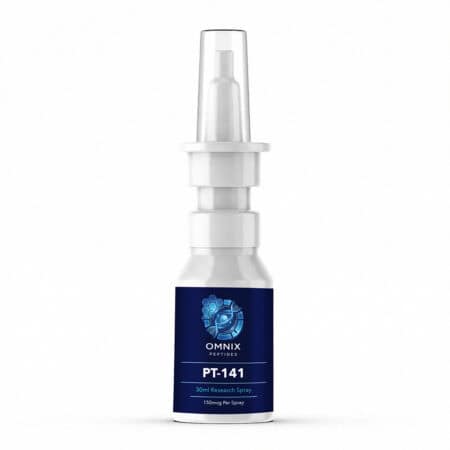
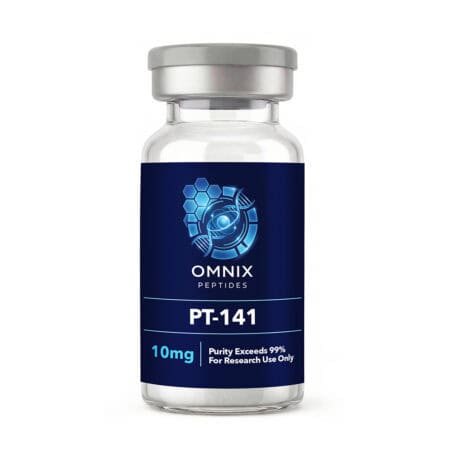
Omnix Peptides supplies PT-141 in two research formats. Each lot is independently characterized by HPLC and LC–MS, with a batch-specific Certificate of Analysis available on each product page.
- PT-141 Vial — lyophilized powder for reconstitution. The vial is the research format corresponding to the subcutaneous administration route used in the published Phase 3 RECONNECT clinical trials and in the Phase 2 amount-finding literature.
- PT-141 Liquid Spray — mucosal-administration format used in research models evaluating non-injectable delivery routes. Note that the FDA-approved bremelanotide product uses subcutaneous administration; intranasal PT-141 was evaluated in early-phase clinical research but was not advanced as the approved formulation, and published peer-reviewed pharmacokinetic data on the intranasal route is more limited.
PT-141 is classified under the Sexual Health research category. For research framed around overlapping melanocortin pharmacology, see also the related compound hub for Melanotan-2, a melanocortin agonist with overlapping receptor activity but a distinct research-application focus.
Amount in the Published Research Literature
The following amount ranges describe the protocols used in the peer-reviewed PT-141 / bremelanotide literature. They are reported here for research-reference purposes only and do not constitute administration recommendations of any kind.
RECONNECT Phase 3 trials (Kingsberg 2019). The two pivotal Phase 3 trials randomized premenopausal women with acquired, generalized HSDD to on-demand subcutaneous bremelanotide 1.75 mg or matching placebo, used at least 45 minutes before anticipated sexual activity and no more than once per 24 hours, over a 24-week treatment period [1]. The 1.75 mg amount was selected based on the Clayton 2016 Phase 2 amount-finding trial [3], which evaluated 0.75, 1.25, and 1.75 mg amounts and identified the 1.75 mg amount as the optimal balance of efficacy and tolerability.
52-week open-label extension (Simon 2019). Participants who completed the Phase 3 trials could continue into a 52-week open-label safety extension at the 1.75 mg amount, with the same on-demand administration pattern [2]. The extension characterized long-term safety, with the most common reported adverse events being nausea, flushing, headache, and injection-site reactions, along with the skin-pigmentation effects characteristic of melanocortin agonists.
Adverse-event profile. The most commonly reported adverse events across the trial program were transient nausea, flushing, headache, and injection-site reactions. Cardiovascular signals (transient blood-pressure increase, heart-rate decrease) were characterized, with the approved-product labeling specifying caution in cardiovascular disease. Focal skin hyperpigmentation has been reported with repeated administration and is a class effect of melanocortin agonists.
Researchers planning protocols are referred to the original primary literature cited in the References section for full methodological detail, including timing relative to anticipated sexual activity, exclusion criteria, and outcome assessment instruments.
Frequently Asked Questions
Is PT-141 (bremelanotide) FDA-approved?
Yes. Bremelanotide (the international nonproprietary name for PT-141) is FDA-approved (2019) for the treatment of acquired, generalized hypoactive sexual desire disorder (HSDD) in premenopausal women. The approved formulation is an on-demand subcutaneous injection at 1.75 mg. There are no current approvals for use in men or for any other indication, and the compound has not received EMA approval.
What does the RECONNECT Phase 3 trial program show?
The RECONNECT trial program consisted of two pivotal 24-week, randomized, double-blind, placebo-controlled Phase 3 trials in premenopausal women with acquired, generalized HSDD. On-demand subcutaneous bremelanotide 1.75 mg produced statistically significant improvements over placebo on the co-primary endpoints (Female Sexual Function Index–Desire domain and Female Sexual Distress Scale–Desire/Arousal/Orgasm item 13) [1]. The trials supported the subsequent FDA approval in 2019.
What mechanism of action does PT-141 use?
PT-141 is a melanocortin receptor agonist that acts on central-nervous-system melanocortin-4 receptor (MC4R) circuits in the hypothalamus and limbic system. The MC4R has well-characterized roles in sexual behavior and motivation [4]. The mechanism is central rather than peripheral, distinguishing PT-141 pharmacologically from PDE5 inhibitors (sildenafil, tadalafil), which act on peripheral vascular smooth muscle in genital tissue. PT-141 also has cross-receptor activity at MC1R, MC3R, and MC5R.
How does PT-141 differ from PDE5 inhibitors like sildenafil?
PT-141 acts on central-nervous-system melanocortin receptors, modulating hypothalamic circuits involved in sexual behavior and motivation. PDE5 inhibitors act on peripheral vascular smooth muscle in genital tissue, increasing local blood flow. The two classes target different aspects of sexual function (central desire vs. peripheral arousal) and are approved for different indications (PT-141 for HSDD in premenopausal women; PDE5 inhibitors for male erectile dysfunction).
What are the most commonly reported adverse events with PT-141?
The most commonly reported adverse events across the bremelanotide Phase 3 trial program were transient nausea, flushing, headache, and injection-site reactions [2]. Cardiovascular signals (transient increase in blood pressure, transient decrease in heart rate) were characterized in the trials and are noted in the approved-product labeling. Focal skin hyperpigmentation has been reported with repeated administration and is a class effect of melanocortin agonists, mediated by MC1R activity on melanocytes.
How does PT-141 differ from Melanotan-2?
PT-141 and Melanotan-2 are both synthetic melanocortin receptor agonists derived from the broader melanotan-class research history; PT-141 was developed from Melanotan-2 with structural modifications that altered the receptor-affinity profile. Both compounds have central nervous system pharmacology relevant to sexual function, but Melanotan-2 has greater MC1R potency (and correspondingly more pronounced pigmentation effects), while PT-141 has been advanced as a clinical compound for HSDD with its amount and route optimized for that indication. See the Melanotan-2 hub for further detail.
What administration routes have been used in PT-141 research?
The pivotal Phase 3 RECONNECT trials used subcutaneous administration, which is the route corresponding to the FDA-approved formulation. Earlier-phase clinical research evaluated intranasal bremelanotide, but the intranasal route was not advanced as the approved formulation. Published peer-reviewed pharmacokinetic data on intranasal PT-141 is more limited than the subcutaneous data. Researchers evaluating mucosal routes should consult the primary pharmacokinetic literature.
References
- Kingsberg SA, Clayton AH, Portman D, et al. Bremelanotide for the treatment of hypoactive sexual desire disorder: two randomized phase 3 trials. Obstet Gynecol. 2019;134(5):899-908. doi:10.1097/AOG.0000000000003500 · PubMed: 31599840
- Simon JA, Kingsberg SA, Portman D, et al. Long-term safety and efficacy of bremelanotide for hypoactive sexual desire disorder. Obstet Gynecol. 2019;134(5):909-917. doi:10.1097/AOG.0000000000003514 · PubMed: 31599851
- Clayton AH, Althof SE, Kingsberg S, et al. Bremelanotide for female sexual dysfunctions in premenopausal women: a randomized, placebo-controlled amount-finding trial. Womens Health (Lond). 2016;12(3):325-337. doi:10.2217/whe-2016-0018 · PubMed: 27225492
- Pfaus J, Giuliano F, Gelez H. Bremelanotide: an overview of preclinical CNS effects on female sexual function. J Sex Med. 2007;4(Suppl 4):269-279. doi:10.1111/j.1743-6109.2007.00610.x · PubMed: 17970996
For Research Use Only. The products described on this page are sold strictly for in vitro laboratory research and are not intended for human or animal consumption, diagnostic use, or therapeutic use. The published research summarized above is provided as scientific reference material; FDA-approved bremelanotide drug products are available only by prescription from a licensed healthcare provider. Nothing on this page constitutes medical advice, a therapeutic claim, or a recommendation for any use outside of a properly resourced and ethically reviewed research setting.