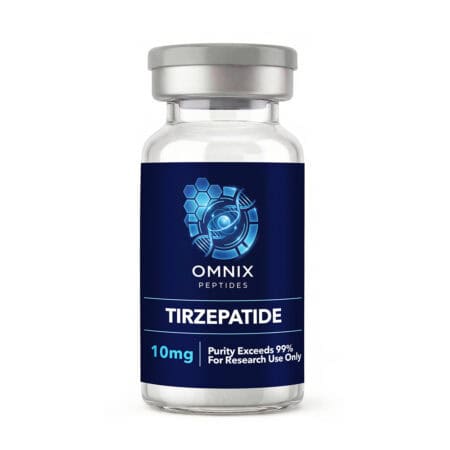
Tirzepatide (CAS 2023788-19-2; development code LY3298176) is a synthetic, once-weekly, fatty-acid-modified 39-amino-acid peptide that functions as a dual glucose-dependent insulinotropic polypeptide (GIP) and glucagon-like peptide-1 (GLP-1) receptor agonist. Tirzepatide is the first agent of its dual-incretin class to reach regulatory approval and is the subject of an extensive Phase 3 clinical trial program in adult human participants, with results published in The New England Journal of Medicine, The Lancet, and other peer-reviewed journals. Tirzepatide is FDA-approved for type 2 diabetes (2022) and for chronic weight management (2023), with corresponding EMA approval in both indications.
In the 72-week SURMOUNT-1 trial published by Jastreboff and colleagues in the New England Journal of Medicine, adults without type 2 diabetes who received once-weekly subcutaneous tirzepatide achieved mean body-weight reductions of 15.0%, 19.5%, and 20.9% at the 5 mg, 10 mg, and 15 mg amounts respectively, compared with 3.1% in the placebo group [1]. In the head-to-head SURPASS-2 trial published by Frías and colleagues, tirzepatide was reported as noninferior and superior to semaglutide
with respect to mean change in glycated hemoglobin in adults with type 2 diabetes [2]. In the 2025 SURPASS-CVOT outcomes trial published by Nicholls and colleagues, tirzepatide met the prespecified noninferiority criterion versus dulaglutide for the primary composite cardiovascular endpoint, with a 16% relative reduction in all-cause mortality reported in the tirzepatide group [3].
Tirzepatide is structurally and pharmacologically distinct from selective GLP-1 receptor agonists such as semaglutide, with a binding profile that engages the GIP receptor with native-GIP-like affinity and the GLP-1 receptor with attenuated affinity but biased signaling toward cyclic AMP [4]. Researchers consulting this page should treat tirzepatide as a clinically validated agent in its FDA-approved indications, with an emerging literature on cardiovascular, renal, hepatic, and sleep-disordered-breathing outcomes that continues to expand.
Mechanism of Action
Tirzepatide produces its metabolic effects through simultaneous agonism of two incretin receptors. Each component of the dual-receptor mechanism contributes to the integrated clinical effect in measurable ways.
Dual incretin receptor engagement. Coskun and colleagues at Eli Lilly characterized tirzepatide’s pharmacological profile across cell-line signaling assays, functional assays in cell lines expressing recombinant or endogenous incretin receptors, and in vivo studies in obese mice and in humans with type 2 diabetes. The investigators reported that the compound activates both GIP and GLP-1 receptor signaling in vitro, lowers blood glucose in mice through actions on both incretin receptors, reduces fasting glucose in humans with type 2 diabetes, and produces greater weight loss in healthy humans than dulaglutide (a selective GLP-1 receptor agonist) [4]. The fatty-acid modification confers reversible binding to serum albumin and a circulatory half-life of approximately five days, enabling once-weekly subcutaneous administration.
GLP-1 receptor pathway. Like selective GLP-1 receptor agonists (semaglutide, liraglutide, dulaglutide), the GLP-1 component of tirzepatide’s activity promotes glucose-dependent insulin secretion from pancreatic beta cells, suppresses inappropriate glucagon release, slows gastric emptying, and produces central-nervous-system effects on appetite and satiety mediated by GLP-1 receptors in hypothalamic and brainstem nuclei. These mechanisms are the basis for both the glycemic and the weight-related effects reported in the published trials.
GIP receptor pathway. The GIP receptor is expressed in pancreatic beta cells, adipocytes, and central-nervous-system regions including the hypothalamus. Preclinical studies have reported that GIP receptor agonism enhances insulin secretion in a glucose-dependent manner, modulates adipose-tissue lipid metabolism, and contributes to central appetite regulation through pathways distinct from but complementary to GLP-1. The clinical hypothesis underlying tirzepatide’s development was that combining GIP and GLP-1 receptor agonism would produce additive or synergistic metabolic effects beyond what either single mechanism could achieve — a hypothesis that the SURMOUNT and SURPASS trial programs have supported with directly measured outcomes.
Biased signaling and receptor occupancy. Subsequent pharmacology work has characterized tirzepatide as an “imbalanced and biased” dual agonist: at clinically efficacious amounts, the calculated receptor occupancy favors the GIP receptor, while at the GLP-1 receptor the compound shows signaling bias toward cyclic AMP with reduced receptor desensitization compared with native GLP-1. This pharmacological profile may help explain the magnitude of weight loss reported in SURMOUNT-1 relative to selective GLP-1 receptor agonists.
Available Forms
Omnix Peptides currently supplies tirzepatide in a single research format. Each lot is independently characterized by HPLC and LC–MS, with a batch-specific Certificate of Analysis available on the product page.
- Tirzepatide Vial — lyophilized powder for reconstitution. Multiple strengths available per vial. The vial is the canonical research format used in the published clinical literature; once-weekly subcutaneous administration is the route used in all published Phase 3 trials.
Tirzepatide is classified under the Metabolic & Weight research category. For research framed around overlapping mechanisms, see also the related compound hubs for Semaglutide (selective GLP-1 receptor agonist), Retatrutide (triple GIP/GLP-1/glucagon receptor agonist in Phase 3 development), and Orforglipron (oral small-molecule GLP-1 receptor agonist).
Amount in the Published Research Literature
The following administration ranges describe the protocols used in the peer-reviewed tirzepatide Phase 3 trial program. They are reported here for research-reference purposes only and do not constitute administration recommendations of any kind.
SURMOUNT-1 obesity trial (Jastreboff 2022). Adults without type 2 diabetes were randomized to once-weekly subcutaneous tirzepatide at 5 mg, 10 mg, or 15 mg, or to placebo, alongside lifestyle intervention, over a 72-week treatment period [1]. The published protocol uses a stepwise escalating-amount schedule, with participants starting at 2.5 mg weekly and increasing in 2.5 mg increments at 4-week intervals until the target maintenance amount is reached, in order to mitigate gastrointestinal adverse events characteristic of incretin-class agents.
SURPASS-2 type 2 diabetes trial (Frías 2021). Adults with type 2 diabetes inadequately controlled on metformin were randomized to once-weekly subcutaneous tirzepatide at 5 mg, 10 mg, or 15 mg, or to once-weekly subcutaneous semaglutide at 1 mg, over a 40-week treatment period [2]. The same stepwise escalating-amount protocol applied.
SURPASS-CVOT cardiovascular outcomes trial (Nicholls 2025). Adults with type 2 diabetes and established atherosclerotic cardiovascular disease were randomized to once-weekly subcutaneous tirzepatide (target amount 15 mg) or once-weekly subcutaneous dulaglutide (target amount 1.5 mg) over a mean follow-up period of approximately four years [3].
Adverse-event profile across the program. The most commonly reported adverse events in the tirzepatide clinical trial program are gastrointestinal — nausea, diarrhea, decreased appetite, vomiting, and constipation — consistent with the class profile of incretin-mimetic agents. These events are most frequent during escalating-amount and tend to attenuate over time at the maintenance amount. The stepwise titration schedule is part of the published protocol specifically because of this profile.
Researchers planning protocols are referred to the original primary literature cited in the References section for full methodological detail, including randomization schema, exclusion criteria, primary and secondary endpoint definitions, and adverse-event reporting.
Frequently Asked Questions
Is tirzepatide FDA-approved?
Yes. Tirzepatide is FDA-approved for type 2 diabetes (2022) and for chronic weight management (2023), with corresponding EMA approval in both indications. It was the first dual GIP and GLP-1 receptor agonist to reach regulatory approval.
How does tirzepatide differ from semaglutide?
Semaglutide is a selective GLP-1 receptor agonist. Tirzepatide is a dual GIP and GLP-1 receptor agonist — it engages both incretin receptors simultaneously. In the head-to-head SURPASS-2 trial in adults with type 2 diabetes, tirzepatide produced greater reductions in HbA1c and body weight than once-weekly semaglutide 1 mg, with the trial authors reporting tirzepatide as noninferior and superior to semaglutide
on the primary glycemic endpoint [2].
What does SURMOUNT-1 show about body weight?
SURMOUNT-1 was a 72-week, double-blind, randomized, placebo-controlled Phase 3 trial in 2,539 adults with obesity (BMI ≥30, or ≥27 with a weight-related complication), excluding individuals with type 2 diabetes. Mean percentage changes in body weight at week 72 were −15.0%, −19.5%, and −20.9% for the 5 mg, 10 mg, and 15 mg tirzepatide amounts respectively, compared with −3.1% in the placebo arm. Approximately 91% of participants in the 15 mg arm achieved at least 5% weight reduction, and 57% achieved at least 20% [1].
What does SURPASS-CVOT show about cardiovascular outcomes?
SURPASS-CVOT was a randomized, double-blind, active-comparator, noninferiority Phase 3 trial in 13,299 adults with type 2 diabetes and established atherosclerotic cardiovascular disease. Tirzepatide was reported as noninferior to dulaglutide for the primary composite outcome of cardiovascular death, non-fatal myocardial infarction, or non-fatal stroke (12.2% vs. 13.1%; HR 0.92; P = 0.003 for noninferiority) over approximately four years of follow-up. The investigators also reported a 16% relative reduction in all-cause mortality in the tirzepatide group [3].
What mechanism of action does tirzepatide use?
Tirzepatide is a dual agonist of the GIP receptor and the GLP-1 receptor. The GLP-1 component promotes glucose-dependent insulin secretion, suppresses inappropriate glucagon release, slows gastric emptying, and produces central appetite-suppressant effects. The GIP component enhances glucose-dependent insulin secretion and modulates adipose-tissue lipid metabolism and central appetite regulation through distinct but complementary pathways. The discovery and mechanism paper is Coskun et al. 2018 in Molecular Metabolism [4].
What is the once-weekly administration schedule used in published trials?
The published Phase 3 protocols use a stepwise escalating-amount schedule. Participants start at 2.5 mg subcutaneously once weekly and increase in 2.5 mg increments at 4-week intervals until the target maintenance amount (5 mg, 10 mg, or 15 mg) is reached. The titration is designed to mitigate gastrointestinal adverse events that are characteristic of incretin-class agents and most frequent during initial escalating-amount.
What are the most common adverse events reported in tirzepatide trials?
The most commonly reported adverse events in the tirzepatide clinical trial program are gastrointestinal — nausea, diarrhea, decreased appetite, vomiting, and constipation — consistent with the class profile of incretin-mimetic agents. These events are most frequent during escalating-amount and tend to attenuate at the maintenance amount. Full adverse-event reporting is available in the published trial papers cited on this page.
References
- Jastreboff AM, Aronne LJ, Ahmad NN, et al; SURMOUNT-1 Investigators. Tirzepatide once weekly for the treatment of obesity. N Engl J Med. 2022;387(3):205-216. doi:10.1056/NEJMoa2206038 · PubMed: 35658024
- Frías JP, Davies MJ, Rosenstock J, et al; SURPASS-2 Investigators. Tirzepatide versus semaglutide once weekly in patients with type 2 diabetes. N Engl J Med. 2021;385(6):503-515. doi:10.1056/NEJMoa2107519 · PubMed: 34170647
- Nicholls SJ, Pavo I, Bhatt DL, et al; SURPASS-CVOT Investigators. Cardiovascular outcomes with tirzepatide versus dulaglutide in type 2 diabetes. N Engl J Med. 2025;393(24):2409-2420. doi:10.1056/NEJMoa2505928 · PubMed: 41406444
- Coskun T, Sloop KW, Loghin C, et al. LY3298176, a novel dual GIP and GLP-1 receptor agonist for the treatment of type 2 diabetes mellitus: from discovery to clinical proof of concept. Mol Metab. 2018;18:3-14. doi:10.1016/j.molmet.2018.09.009 · PubMed: 30473097
For Research Use Only. The product described on this page is sold strictly for in vitro laboratory research and is not intended for human or animal consumption, diagnostic use, or therapeutic use. The published research summarized above is provided as scientific reference material; FDA-approved tirzepatide drug products are available only by prescription from a licensed healthcare provider. Nothing on this page constitutes medical advice, a therapeutic claim, or a recommendation for any use outside of a properly resourced and ethically reviewed research setting.