Orforglipron (development code LY3502970) is an orally active, once-daily small-molecule non-peptide agonist of the glucagon-like peptide-1 (GLP-1) receptor. It is not a peptide — it is a small-molecule compound rationally designed to engage the GLP-1 receptor through the same activation mechanism as peptide GLP-1 receptor agonists, while overcoming the absorption and proteolytic-degradation limitations that have historically prevented oral peptide GLP-1 administration without complex formulation. The compound was discovered by Chugai Pharmaceutical and licensed to Eli Lilly and Company, which is leading the clinical-development program. Because orforglipron is a small molecule rather than a peptide, it is chemically stable in the acidic gastric environment, is not a substrate for proteolytic enzymes such as dipeptidyl peptidase-4, and can be taken without food and water restrictions — a substantial pharmacokinetic distinction from oral peptide GLP-1 agonists.
Orforglipron has advanced through a comprehensive Phase 1, Phase 2, and Phase 3 clinical-development program. Phase 1b results in type 2 diabetes were published by Pratt and colleagues in Diabetes, Obesity and Metabolism in 2023 [1]. The Phase 2 obesity trial (GZGI investigators, Wharton et al.) in 272 adults with obesity or overweight without diabetes was published in the New England Journal of Medicine in 2023 and reported mean body-weight reduction of up to 14.7% at 36 weeks with orforglipron at 12, 24, 36, or 45 mg once daily [2]. The Phase 2 type 2 diabetes trial (Frías et al.) in 383 participants randomized to placebo, orforglipron (3, 12, 24, 36, or 45 mg), or dulaglutide active comparator was published in The Lancet in 2023 and reported HbA1c reductions of up to 2.1% at 26 weeks [3]. The Phase 3 ACHIEVE-1 trial (Rosenstock et al.) in adults with early type 2 diabetes was published in the New England Journal of Medicine in 2025 and reported HbA1c levels of 6.5–6.7% at week 40 with orforglipron 3, 12, or 36 mg once daily [4].
Eli Lilly has reported topline results from additional Phase 3 trials in the ATTAIN obesity program via press release ahead of full peer-reviewed publication. ATTAIN-1 (NCT05869903) in 3,127 adults with obesity or overweight without diabetes read out topline on August 7, 2025, with detailed results presented at the European Association for the Study of Diabetes Annual Meeting in September 2025. The trial reported mean body-weight reduction of 12.4% (27.3 lbs) at 72 weeks with the 36 mg amount using the efficacy estimand. ATTAIN-2 in adults with obesity or overweight and type 2 diabetes read out topline on August 26, 2025, reporting mean body-weight reduction of 10.5% (22.9 lbs) at the 36 mg amount with a mean HbA1c reduction of 1.8%. ATTAIN-MAINTAIN, a weight-maintenance trial in participants who had previously received the highest tolerated amounts of semaglutide or tirzepatide in the SURMOUNT-5 head-to-head trial, read out topline on December 18, 2025. Orforglipron was approved by the FDA on April 1, 2026 for chronic weight management in adults with obesity or overweight with at least one weight-related comorbidity, following the Phase 3 ATTAIN obesity readouts and the ACHIEVE-1 type 2 diabetes trial. It is the first FDA-approved oral small-molecule GLP-1 receptor agonist. EMA review remains in progress as of writing.
Important Note on the Evidence Base
Important note on the evidence base: Orforglipron has a substantial peer-reviewed Phase 1b, Phase 2, and Phase 3 clinical-trial publication record (Pratt 2023, Wharton 2023, Frías 2023, Rosenstock 2025). However, several of the most clinically informative Phase 3 readouts — ATTAIN-1 (August/September 2025), ATTAIN-2 (August 2025), ATTAIN-MAINTAIN (December 2025), and additional ATTAIN and ACHIEVE program readouts — have been reported via press release and conference presentation; peer-reviewed full-dataset publications for some of these trials may still be in preparation or in early publication at the time of writing. Researchers consulting press-release Phase 3 results should treat them as preliminary in the absence of peer-reviewed publication of the full dataset, while recognizing that the program as a whole has advanced through a credible and well-documented Phase 3 development trajectory. On April 1, 2026, the FDA approved orforglipron for chronic weight management in adults with obesity or overweight with at least one weight-related comorbidity, marking the first FDA approval of an oral small-molecule GLP-1 receptor agonist. EMA review remains in progress as of writing.
Mechanism of Action
Orforglipron is a small-molecule agonist of the GLP-1 receptor, the same receptor target as the peptide GLP-1 receptor agonists semaglutide and the GLP-1 component of tirzepatide‘s dual mechanism. The compound was designed to engage the GLP-1 receptor through a rationally designed small-molecule structure that achieves receptor activation while overcoming the pharmacokinetic limitations that have historically prevented oral peptide GLP-1 administration without complex absorption-enhancer formulation strategies.
Receptor activation mechanism and structural basis. The structural basis for GLP-1 receptor activation by LY3502970 / orforglipron has been characterized by X-ray crystallography work (Kawai et al. PNAS 2020), which identified the small-molecule binding pose at the GLP-1 receptor and established that orforglipron occupies a different binding site from the peptide agonist binding pocket while inducing a conformationally similar active state. The compound is a positive modulator at the GLP-1 receptor in the sense that it activates the same downstream G-protein-coupled signaling cascade (Gαs, cAMP elevation, downstream effects on insulin secretion, gastric emptying, and central appetite regulation) as peptide GLP-1 agonists, but through engagement of a structurally distinct binding site.
Oral pharmacokinetics and the non-peptide advantage. Because orforglipron is a small-molecule non-peptide compound, it is chemically stable in the acidic gastric environment and is not a substrate for the proteolytic enzymes (including dipeptidyl peptidase-4, DPP-4) that rapidly degrade peptide GLP-1 in circulation. It is absorbed efficiently from the gastrointestinal tract after oral administration without requiring the absorption-enhancer formulation strategies (such as the sodium N-[8-(2-hydroxybenzoyl)amino]caprylate, or SNAC, used in oral semaglutide). The compound has a reported half-life of approximately 29–49 hours in the Phase 2 obesity work, supporting once-daily oral administration [2]. The non-peptide structure also eliminates the food- and water-intake restrictions associated with oral peptide GLP-1 administration: orforglipron can be taken at any time of day with or without food or water.
Phase 1b and Phase 2 efficacy. The Pratt 2023 Phase 1b trial in type 2 diabetes characterized safety, pharmacokinetics, and pharmacodynamics across repeated administration regimens and established that weekly escalating-amount of daily orforglipron was generally well tolerated, with HbA1c and body-weight reductions consistent with the GLP-1 receptor agonist class [1]. The Wharton 2023 NEJM Phase 2 obesity trial (GZGI investigators) in 272 adults with obesity or overweight without diabetes used orforglipron at 12, 24, 36, or 45 mg once daily for 36 weeks; mean baseline body weight was approximately 108 kg, and mean placebo-corrected body weight reduction reached up to 14.7% at 36 weeks [2]. The Frías 2023 Lancet Phase 2 type 2 diabetes trial in 383 participants randomized to placebo, orforglipron (3, 12, 24, 36, or 45 mg), or once-weekly subcutaneous dulaglutide for 26 weeks reported HbA1c reductions of up to 2.1% and body-weight reductions in the orforglipron arms, with a safety profile consistent with other GLP-1 receptor agonists [3].
Phase 3 ACHIEVE-1 type 2 diabetes trial. The Rosenstock 2025 NEJM publication of ACHIEVE-1 reported the first Phase 3 results for an oral small-molecule GLP-1 receptor agonist to complete a Phase 3 trial. The trial randomized participants 1:1:1:1 to receive orforglipron 3, 12, or 36 mg or placebo once daily for 40 weeks. Participants had type 2 diabetes treated only with diet and exercise, baseline HbA1c of 7.0–9.5%, and BMI ≥23.0. The mean glycated hemoglobin level at week 40 was 6.5–6.7% across the three orforglipron amounts, meeting the primary endpoint of HbA1c reduction from baseline [4]. The ACHIEVE-1 results positioned orforglipron as the first oral non-peptide GLP-1 receptor agonist to demonstrate Phase 3 efficacy and tolerability in the same range as injectable GLP-1 receptor agonists.
Phase 3 ATTAIN obesity program (press-release readouts). The ATTAIN-1 obesity trial (NCT05869903) randomized 3,127 adults with obesity or overweight without diabetes to orforglipron 6, 12, or 36 mg or placebo once daily for 72 weeks. Topline press-release results announced on August 7, 2025 reported mean body-weight reduction of 12.4% (27.3 lbs) at the 36 mg amount, with 59.6% of 36 mg participants losing at least 10% of body weight and 39.6% losing at least 15%, using the efficacy estimand. Among 1,127 participants with prediabetes at baseline, up to 91% of orforglipron-treated participants achieved near-normal blood glucose at 72 weeks compared to 42% on placebo. ATTAIN-2 (in obesity and type 2 diabetes) reported mean body-weight reduction of 10.5% (22.9 lbs) at the 36 mg amount with mean HbA1c reduction of 1.8% on August 26, 2025. ATTAIN-MAINTAIN, evaluating orforglipron for maintenance of weight loss after switching from the highest tolerated amounts of semaglutide or tirzepatide, reported topline results on December 18, 2025. Researchers should consult the corresponding peer-reviewed full-dataset publications as they appear; the press-release data should be treated as preliminary pending full publication.
Available Forms
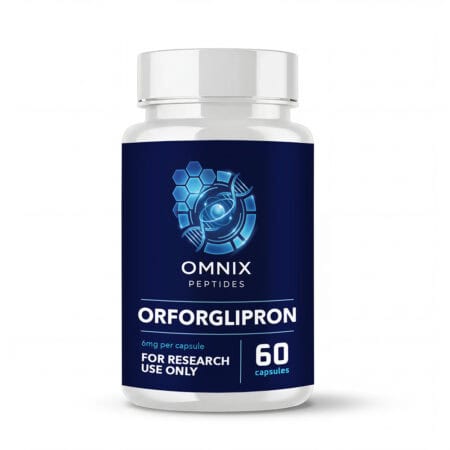
Omnix Peptides supplies orforglipron in a single research format. Each lot is independently characterized by HPLC and LC–MS, with a batch-specific Certificate of Analysis available on the product page.
- Orforglipron Capsules 6 mg, 60-count — oral capsule format at the 6 mg strength that corresponds to one of the active amounts in the ATTAIN-1 Phase 3 obesity trial. The oral capsule format reflects orforglipron’s intended once-daily oral administration route as a small-molecule non-peptide compound.
Orforglipron is classified under the Metabolic & Weight Research research category. For research framed around the injectable peptide GLP-1 and dual/triple incretin receptor agonist classes, see the semaglutide, tirzepatide, and retatrutide hubs. For research framed around the central-monoaminergic small-molecule weight-loss mechanism class, see the tesofensine hub.
Amount in the Published Clinical-Trial Literature
The following amount ranges describe the protocols used in the peer-reviewed clinical-trial literature on orforglipron. They are reported here for research-reference purposes only and do not constitute administration recommendations of any kind. No human-equivalent amount translation outside of the published trial protocols has been validated in the peer-reviewed literature, and amount selection in clinical practice will be governed by regulatory approval and labeling once any such approval is granted.
Wharton 2023 NEJM Phase 2 obesity trial (GZGI investigators). The Phase 2 obesity trial randomized 272 adults with obesity or with overweight plus at least one weight-related coexisting condition (and without diabetes) to orforglipron at one of four amounts — 12, 24, 36, or 45 mg — or placebo once daily for 36 weeks. The primary endpoint was percentage change from baseline in body weight at week 26, with a secondary endpoint at week 36. Mean placebo-corrected body weight reduction reached up to 14.7% at the highest amount by week 36 [2].
Frías 2023 Lancet Phase 2 type 2 diabetes trial. The Phase 2 T2D trial randomized 383 participants with type 2 diabetes to orforglipron at one of five amounts — 3, 12, 24, 36, or 45 mg — once daily for 26 weeks, with placebo and once-weekly subcutaneous dulaglutide as comparators. The primary endpoint was change in HbA1c from baseline at week 26; HbA1c reductions of up to 2.1% were reported in the highest orforglipron arms, with body-weight reductions and a safety profile consistent with other GLP-1 receptor agonists [3].
Rosenstock 2025 NEJM Phase 3 ACHIEVE-1 trial. The Phase 3 ACHIEVE-1 trial used three orforglipron amounts — 3, 12, and 36 mg — once daily for 40 weeks, with placebo as comparator, in participants with type 2 diabetes treated only with diet and exercise (baseline HbA1c 7.0–9.5%). The primary endpoint was change in HbA1c from baseline to week 40; mean HbA1c at week 40 was 6.5–6.7% across the three orforglipron amounts [4]. The ACHIEVE-1 amount selection was informed by the Phase 2 concentration-response data from the Frías 2023 Lancet trial.
ATTAIN Phase 3 obesity program amounts (press-release data). ATTAIN-1 used orforglipron 6, 12, or 36 mg once daily for 72 weeks. ATTAIN-2 used the same amount-range in adults with obesity and type 2 diabetes. ATTAIN-MAINTAIN used the maximum tolerated amount of orforglipron (24 or 36 mg) in participants previously treated with the highest tolerated amounts of semaglutide or tirzepatide. Full concentration-response analyses are reported in the corresponding peer-reviewed publications as they appear; researchers consulting press-release readouts should treat the headline numbers as preliminary.
Researchers planning protocols are referred to the original primary literature cited in the References section for full methodological detail, including titration schedules (orforglipron Phase 3 trials have used multi-week escalating-amount protocols to mitigate gastrointestinal adverse events characteristic of the GLP-1 receptor agonist class) and adverse-event monitoring methods.
Frequently Asked Questions
Is orforglipron FDA-approved?
Yes. On April 1, 2026, the FDA approved orforglipron for chronic weight management in adults with obesity or overweight with at least one weight-related comorbidity, following positive Phase 3 results from the ATTAIN obesity program and the ACHIEVE-1 type 2 diabetes trial (Rosenstock 2025 NEJM). It is the first FDA-approved oral small-molecule GLP-1 receptor agonist. EMA review remains in progress as of writing.
Is orforglipron a peptide?
No. Orforglipron is a small-molecule non-peptide compound, despite acting at the GLP-1 receptor — the same receptor that peptide GLP-1 agonists (semaglutide, tirzepatide, dulaglutide) target. This is the central pharmacochemical distinction of the compound: it engages the GLP-1 receptor through a rationally designed small-molecule structure that achieves activation while overcoming the absorption and proteolytic-degradation limitations that have historically prevented oral peptide GLP-1 administration without complex formulation. As a small molecule, orforglipron is chemically stable in the acidic gastric environment, is not a substrate for proteolytic enzymes such as dipeptidyl peptidase-4, can be taken without food and water restrictions, and does not require absorption-enhancer formulations such as SNAC (used in oral semaglutide).
What is the clinical development trajectory of orforglipron?
Orforglipron was discovered by Chugai Pharmaceutical and licensed to Eli Lilly and Company, which is leading the clinical-development program. The Pratt 2023 Phase 1b trial in type 2 diabetes was published in Diabetes, Obesity and Metabolism. The Wharton 2023 Phase 2 obesity trial (GZGI investigators) was published in the New England Journal of Medicine and reported up to 14.7% body weight reduction at 36 weeks. The Frías 2023 Phase 2 type 2 diabetes trial was published in The Lancet and reported HbA1c reductions of up to 2.1%. The Phase 3 ACHIEVE-1 trial (Rosenstock 2025 NEJM) was the first Phase 3 trial of an oral small-molecule GLP-1 receptor agonist to read out, with HbA1c levels of 6.5–6.7% at week 40. Additional Phase 3 trials in the ATTAIN obesity program — ATTAIN-1 (August/September 2025), ATTAIN-2 (August 2025), ATTAIN-MAINTAIN (December 2025) — have read out topline via press release with peer-reviewed full-dataset publications appearing as the program progresses.
How does orforglipron compare to semaglutide and tirzepatide?
Orforglipron, semaglutide, and tirzepatide all act on the GLP-1 receptor as a primary or contributing mechanism. The key distinctions are pharmacochemical and pharmacokinetic. Orforglipron is a small-molecule non-peptide compound taken as a once-daily oral capsule without food or water restrictions. Semaglutide is a peptide GLP-1 receptor agonist available as a once-weekly subcutaneous injection or as a once-daily oral tablet (requiring a SNAC absorption-enhancer formulation and food/water restrictions). Tirzepatide is a peptide dual GIP and GLP-1 receptor agonist available as a once-weekly subcutaneous injection. In published clinical trials, orforglipron at the highest tested amounts produces body-weight reductions in a range comparable to subcutaneous semaglutide and broadly comparable to tirzepatide, though direct head-to-head comparisons across the full amount-range have not been published in the same trial.
What were the key Phase 3 readout dates and headline numbers for orforglipron?
ACHIEVE-1 (Phase 3 type 2 diabetes monotherapy, NCT05971940): topline announced April 17, 2025; peer-reviewed publication Rosenstock 2025 NEJM, reporting mean HbA1c 6.5–6.7% at week 40 across three orforglipron amounts (3, 12, 36 mg). ATTAIN-1 (Phase 3 obesity without diabetes, NCT05869903): topline announced August 7, 2025; detailed results presented at EASD 2025 in September 2025, reporting 12.4% mean body weight reduction (27.3 lbs) at 72 weeks with the 36 mg amount. ATTAIN-2 (Phase 3 obesity with type 2 diabetes): topline announced August 26, 2025, reporting 10.5% mean body weight reduction (22.9 lbs) at the 36 mg amount with HbA1c reduction of 1.8%. ATTAIN-MAINTAIN (NCT06584916, Phase 3b weight maintenance after semaglutide or tirzepatide): topline announced December 18, 2025.
What is the adverse-event profile of orforglipron?
The orforglipron adverse-event profile across the Phase 1b, Phase 2, and Phase 3 trials has been characterized as consistent with the GLP-1 receptor agonist class. The most common adverse events have been gastrointestinal: nausea, diarrhea, vomiting, constipation, and dyspepsia, predominantly during escalating-amount phases and generally mild to moderate in severity. The Phase 3 trials have used multi-week escalating-amount titration protocols to mitigate these GI events. Treatment discontinuation rates in ATTAIN-1 ranged from 21.9% at 6 mg to 24.4% at 36 mg, compared to 29.9% with placebo. No hepatic safety signal was reported in ATTAIN-1. Researchers consulting the primary publications should review the full adverse-event tables for the trial-specific event rates and severity gradings.
How does orforglipron differ from oral semaglutide?
Both orforglipron and oral semaglutide are once-daily oral GLP-1 receptor agonists, but they differ fundamentally in molecular structure and formulation requirements. Oral semaglutide is a peptide formulation that requires the absorption-enhancer SNAC (sodium N-[8-(2-hydroxybenzoyl)amino]caprylate) to achieve sufficient oral bioavailability, and must be taken on an empty stomach with limited water followed by a fasting interval. Orforglipron is a small-molecule non-peptide compound that does not require absorption-enhancer formulation, is chemically stable in the acidic gastric environment, is not a substrate for proteolytic enzymes such as DPP-4, and can be taken at any time of day without food or water restrictions. The Phase 3 efficacy of orforglipron at the highest tested amounts approaches or matches the published efficacy of injectable semaglutide and substantially exceeds the published efficacy of oral semaglutide at currently approved amounts.
References
- Pratt E, Ma X, Liu R, et al. Orforglipron (LY3502970), a novel, oral non-peptide glucagon-like peptide-1 receptor agonist: a Phase 1b, multicentre, blinded, placebo-controlled, randomized, multi-escalating-amount study in people with type 2 diabetes. Diabetes Obes Metab. 2023;25(9):2642-2649. doi:10.1111/dom.15150 · PubMed: 37264711
- Wharton S, Blevins T, Connery L, et al; GZGI Investigators. Daily oral GLP-1 receptor agonist orforglipron for adults with obesity. N Engl J Med. 2023;389(10):877-888. doi:10.1056/NEJMoa2302392 · PubMed: 37351564
- Frías JP, Hsia S, Eyde S, et al. Efficacy and safety of oral orforglipron in patients with type 2 diabetes: a multicentre, randomised, concentration-response, phase 2 study. Lancet. 2023;402(10400):472-483. doi:10.1016/S0140-6736(23)01302-8 · PubMed: 37369232
- Rosenstock J, Cox D, Denning M, et al. Orforglipron, an oral small-molecule GLP-1 receptor agonist, in early type 2 diabetes. N Engl J Med. 2025;393(11):1065-1076. doi:10.1056/NEJMoa2505669 · PubMed: 40544435
- Kawai T, Sun B, Yoshino H, et al. Structural basis for GLP-1 receptor activation by LY3502970, an orally active nonpeptide agonist. Proc Natl Acad Sci USA. 2020;117(47):29959-29967. doi:10.1073/pnas.2014879117 · PubMed: 33177239
For Research Use Only. The products described on this page are sold strictly for in vitro laboratory research and are not intended for human or animal consumption, diagnostic use, or therapeutic use. The published research summarized above is provided as scientific reference material. Nothing on this page constitutes medical advice, a therapeutic claim, or a recommendation for any use outside of a properly resourced and ethically reviewed research setting.