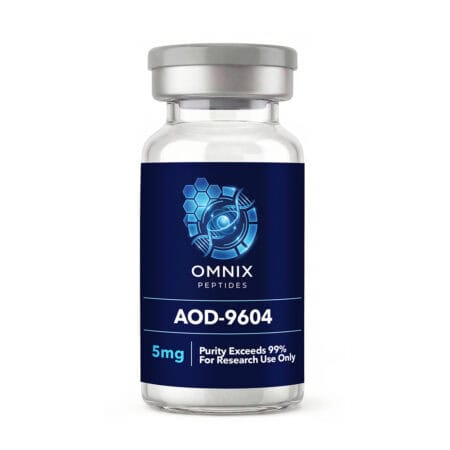
AOD-9604 (CAS 221231-10-3) is a synthetic 16-amino-acid peptide derived from the C-terminal fragment of human growth hormone (hGH 177–191) with an N-terminal tyrosine added to enhance stability. The compound was engineered to isolate the lipolytic signaling domain of growth hormone from the receptor-binding region responsible for its anabolic and glucose-handling effects. AOD-9604 occupies a distinct position in the metabolic research landscape: unlike the incretin-class peptides that dominate contemporary obesity research (selective GLP-1 receptor agonists, dual GIP/GLP-1 agonists, triple GIP/GLP-1/glucagon agonists), AOD-9604 was developed to act downstream of growth hormone signaling on adipose tissue itself, with a mechanism of action that has been mapped to the β3-adrenergic receptor (β3-AR) pathway.
The headline mechanistic finding in the published AOD-9604 literature is from a 2001 study in Endocrinology, in which Heffernan and colleagues reported that chronic AOD-9604 administration reduced body weight gain, decreased adipose tissue mass, and increased fat oxidation in diet-induced obese C57BL/6J mice, with effect sizes comparable to those of full-length human growth hormone, and that these effects were abolished in β3-AR knockout mice, implicating β3-AR signaling as a required component of the mechanism [1]. Critically, AOD-9604 produced these lipid-metabolism effects without altering IGF-1 levels or glucose homeostasis — the pharmacological signature that motivated the compound’s development as a research tool for selectively isolating growth hormone’s metabolic effects from its growth-promoting and diabetogenic effects.
AOD-9604 was advanced through Phase 1 safety trials and a Phase 2b obesity efficacy trial by the Australian biotechnology company Metabolic Pharmaceuticals (in collaboration with Monash University) between approximately 2003 and 2007, enrolling roughly 900 participants in total across the clinical program. The program demonstrated a favorable safety profile but the Phase 2b obesity endpoint did not differentiate sufficiently from placebo to support continued development for obesity; the compound was subsequently withdrawn from the obesity development pipeline. More recent peer-reviewed research has investigated AOD-9604 in chondroprotection and osteoarthritis research models, with the compound retaining active use as a research tool for investigating β3-AR-mediated lipid metabolism. AOD-9604 is not approved by the FDA, EMA, or any other regulatory authority for any indication.
Important Note on the Evidence Base
Important note on the evidence base: The preclinical AOD-9604 literature in obese mouse and Zucker rat models is consistent and reproducible across multiple independent rodent studies and ex vivo adipose tissue assays. The human evidence is more limited and more mixed. The Metabolic Pharmaceuticals Phase 2b obesity trial reported modest mean weight reductions in treated groups (approximately 2.6 kg) that did not meaningfully exceed placebo (approximately 0.8 kg) over 24 weeks, and the program did not advance to Phase 3. The chondroprotection research literature is preclinical and limited to a small number of rabbit-model studies. Researchers consulting this page should weight study design and model accordingly, and should consult the cited primary literature in the References section.
Mechanism of Action
The AOD-9604 mechanism literature is unusual among peptide research compounds in that the upstream receptor question was resolved with an unusually clean knockout-mouse experiment. The downstream signaling that produces the lipid-metabolism phenotype, by contrast, remains less fully characterized.
β3-adrenergic receptor as the obligate mechanism. The β3-adrenergic receptor is expressed at high density on brown and white adipocytes and is a well-characterized regulator of lipolysis and thermogenesis in mammalian adipose tissue. The Heffernan 2001 study established the β3-AR pathway as an obligate component of AOD-9604’s lipid-metabolism effects through the use of β3-AR knockout mice: chronic daily AOD-9604 administration produced significant reductions in body weight gain, decreases in adipose mass, and increases in fat oxidation in diet-induced obese wild-type C57BL/6J mice, and these effects were entirely abolished in β3-AR knockout littermates [1]. The same study reported that AOD-9604 did not affect IGF-1 levels, glucose homeostasis, or somatic growth in either genotype — consistent with the compound’s lack of growth-hormone receptor binding.
Selective lipolysis without growth-hormone receptor engagement. Unlike full-length human growth hormone, AOD-9604 does not bind the growth hormone receptor and has no measurable somatogenic or diabetogenic activity in the published preclinical literature. This selectivity profile was the rationale for AOD-9604’s original development at Monash University: the published characterization work by Ng and colleagues demonstrated that the lipolytic signaling motif of hGH (residues 177–191) could be isolated and used independently of the receptor-binding domains that confer growth-promoting and insulin-resistance effects [3]. The Ng study reported that AOD-9604 stimulated lipolysis in isolated adipocytes and produced more than 50% reduction in body weight gain in chronically treated obese Zucker rats relative to untreated controls, without effects on insulin sensitivity or IGF-1.
Oral activity and ex vivo human adipose tissue. A 2000 study by Heffernan and colleagues in the American Journal of Physiology — Endocrinology and Metabolism reported that orally administered AOD-9604 retained measurable lipid-metabolism activity in rodent models and that direct application of the compound to ex vivo human adipose tissue produced concentration-dependent increases in lipolysis [2]. The ex vivo human-tissue finding was important methodologically because it confirmed that the lipolytic signaling motif within the hGH 177–191 sequence retained activity in human-derived tissue under controlled conditions, not solely in rodent adipocytes.
Chondroprotection — the post-obesity research repurposing. Following the discontinuation of the Phase 2b obesity program, AOD-9604 has been investigated in cartilage and joint-research models. The Kwon and Park 2015 study, published in the Annals of Clinical and Laboratory Science, reported that intra-articular injection of AOD-9604 in a rabbit osteoarthritis model produced macroscopic, histologic, and biomechanical evidence of cartilage preservation relative to untreated controls, with the combination of AOD-9604 plus hyaluronic acid yielding the most consistent chondroprotective effect [4]. The molecular mechanism of the cartilage effect has not been characterized as thoroughly as the β3-AR lipolytic mechanism; the chondroprotection literature is currently limited to a small number of preclinical reports and the mechanism remains an area of active research.
Position relative to the contemporary incretin landscape. AOD-9604 is mechanistically and pharmacologically distinct from the incretin-class peptides that have come to dominate metabolic and obesity research over the past decade. Incretin-class compounds (selective GLP-1 receptor agonists such as semaglutide, dual GIP/GLP-1 receptor agonists such as tirzepatide, and triple GIP/GLP-1/glucagon receptor agonists such as retatrutide) act through pancreatic, hepatic, gastrointestinal, and central-nervous-system mechanisms on glucose handling, insulin secretion, gastric emptying, and appetite. AOD-9604 acts at the adipocyte through β3-AR-mediated lipolysis without an incretin-axis component. The two mechanism classes target different points in the metabolic system and would in principle be additive rather than redundant.
Available Forms
Omnix Peptides currently supplies AOD-9604 in a single research format. Each lot is independently characterized by HPLC and LC–MS, with a batch-specific Certificate of Analysis available on the product page.
- AOD-9604 Vial — lyophilized powder for reconstitution. Available in 5 mg and 10 mg strengths per vial. The vial is the canonical research format used in the published preclinical and clinical literature; subcutaneous and intra-articular routes have been the standard administration approaches in the published research models.
AOD-9604 is classified under the Metabolic & Weight research category. For research framed around the incretin axis as an alternative metabolic mechanism, see the related compound hubs for Semaglutide (selective GLP-1 receptor agonist), Tirzepatide (dual GIP/GLP-1 receptor agonist), and Retatrutide (triple GIP/GLP-1/glucagon receptor agonist). For research framed around mitochondrial metabolism as a separate metabolic mechanism class, see the MOTS-c compound hub.
Amount in the Published Research Literature
The following administration ranges describe the protocols used in the peer-reviewed AOD-9604 literature. They are reported here for research-reference purposes only and do not constitute administration recommendations of any kind.
Heffernan 2001 β3-AR mouse study. Diet-induced obese C57BL/6J mice and β3-AR knockout mice received daily AOD-9604 administration over a 14-day treatment period [1]. The published protocol described daily subcutaneous administration with body weight, adipose mass, fat oxidation, IGF-1, and glucose-homeostasis endpoints assessed at the end of the treatment period. The genotype-dependence of the lipolytic phenotype was the primary mechanistic finding.
Heffernan 2000 oral administration and ex vivo lipolysis study. Rodent models received oral AOD-9604 administration with body fat and fat oxidation as outcome measures; isolated human adipose tissue ex vivo received direct application of AOD-9604 at multiple concentrations to assess concentration-dependent lipolysis [2]. The published protocol established methodological proof-of-concept for both the oral route in rodents and the human-tissue activity of the compound.
Ng 2000 obese Zucker rat chronic treatment. Obese Zucker rats received chronic daily AOD-9604 treatment with body weight gain, lipolysis in isolated adipocytes, insulin sensitivity, and IGF-1 as outcome measures over the treatment period [3]. The protocol reported reductions in body weight gain exceeding 50% relative to untreated controls without effects on insulin sensitivity or IGF-1.
Kwon 2015 rabbit osteoarthritis intra-articular protocol. The chondroprotection study used intra-articular injection of AOD-9604, with and without co-administration of hyaluronic acid, in a rabbit osteoarthritis model [4]. The published protocol described macroscopic, histologic, and biomechanical assessment of cartilage at the end of the treatment period.
Metabolic Pharmaceuticals Phase 2b obesity program. The clinical development program evaluated subcutaneous AOD-9604 in adults with obesity over a 24-week treatment period, with mean weight change as the primary endpoint [1]. The trial reported a mean weight reduction in treated groups of approximately 2.6 kg compared with approximately 0.8 kg in the placebo group, an effect size that did not support continued development for obesity. The program established a favorable safety profile across approximately 900 participants in total across all Phase 1 and Phase 2 studies. The specific amount-allocation schedule used in the Phase 2b trial is not summarized here in the absence of full peer-reviewed publication of the trial protocol.
Researchers planning protocols are referred to the original primary literature cited in the References section for full methodological detail, including vehicle composition, injection volume, treatment-timing relative to model induction, and outcome assessment timepoints.
Frequently Asked Questions
Is AOD-9604 FDA-approved?
No. AOD-9604 is not approved by the FDA, EMA, or any other regulatory authority for any indication. The Australian biotechnology company Metabolic Pharmaceuticals advanced AOD-9604 through Phase 1 safety trials and a Phase 2b obesity efficacy trial enrolling approximately 900 participants in total; the Phase 2b endpoint did not differentiate sufficiently from placebo to support continued development for obesity, and the compound was withdrawn from the obesity pipeline. FDA reportedly granted GRAS status for one specific oral formulation, but not for the injectable peptide. There are no completed Phase 3 trials.
What is the published evidence base for AOD-9604?
The preclinical AOD-9604 literature spans obese mouse and Zucker rat models, isolated adipocyte assays, ex vivo human adipose tissue, and rabbit osteoarthritis models. The human clinical literature is dominated by the Metabolic Pharmaceuticals Phase 1 and Phase 2 program (approximately 900 participants total) which established safety but did not demonstrate Phase 2b obesity efficacy sufficient for registration. Studies have been published in journals including Endocrinology, the American Journal of Physiology — Endocrinology and Metabolism, Hormone Research, and the Annals of Clinical and Laboratory Science.
What mechanism of action has been characterized for AOD-9604 in the research literature?
AOD-9604 acts on adipocyte lipid metabolism through the beta-3 adrenergic receptor (β3-AR) pathway. The Heffernan 2001 study established β3-AR signaling as an obligate component of the mechanism: AOD-9604’s lipolytic effects in obese wild-type mice were entirely abolished in β3-AR knockout mice. Unlike full-length human growth hormone, AOD-9604 does not bind the growth hormone receptor and has no measurable effect on IGF-1 levels, glucose homeostasis, or somatic growth in the published preclinical literature. A separate preclinical literature has reported chondroprotective effects of intra-articular AOD-9604 in rabbit osteoarthritis models, with a less fully characterized molecular mechanism.
How does AOD-9604 differ from GLP-1 receptor agonists like semaglutide and tirzepatide?
AOD-9604 and the incretin-class peptides are mechanistically and pharmacologically distinct. AOD-9604 is a 16-amino-acid C-terminal fragment of human growth hormone that acts on adipocyte lipid metabolism through the β3-adrenergic receptor pathway, without effects on glucose homeostasis or IGF-1. Selective GLP-1 receptor agonists such as semaglutide and dual GIP/GLP-1 receptor agonists such as tirzepatide act at incretin receptors expressed in pancreatic beta cells, gastrointestinal tissue, and the central nervous system, with effects on insulin secretion, glucagon suppression, gastric emptying, and appetite. The two mechanism classes target different points in the metabolic system.
What does the AOD-9604 research literature say about chondroprotection?
Following the discontinuation of the obesity development program, AOD-9604 has been investigated in cartilage and joint-research models. The Kwon and Park 2015 study reported that intra-articular injection of AOD-9604 in a rabbit osteoarthritis model produced macroscopic, histologic, and biomechanical evidence of cartilage preservation relative to untreated controls, with the combination of AOD-9604 plus hyaluronic acid yielding the most consistent chondroprotective effect. The molecular mechanism of the cartilage effect has not been characterized as thoroughly as the β3-AR lipolytic mechanism; the chondroprotection literature remains preclinical and limited to a small number of reports.
Why did the Metabolic Pharmaceuticals Phase 2b obesity program not advance to Phase 3?
The Phase 2b obesity trial reported a mean weight reduction in treated groups of approximately 2.6 kg compared with approximately 0.8 kg in the placebo group over a 24-week treatment period. The trial established a favorable safety profile but the magnitude of the placebo-corrected weight-loss effect did not meet the threshold required for regulatory approval. AOD-9604 was subsequently withdrawn from the obesity development pipeline, though it has remained in active use as a research tool for investigating β3-AR-mediated lipid metabolism and, more recently, chondroprotection.
What administration routes have been used in AOD-9604 research?
Published AOD-9604 research has used subcutaneous injection (the route used in the Metabolic Pharmaceuticals clinical program and in most rodent studies), oral administration (in the Heffernan 2000 rodent and ex vivo human tissue study), and intra-articular injection (in the Kwon 2015 rabbit chondroprotection study). The vial is the canonical research format across these administration routes.
References
- Heffernan M, Summers RJ, Thorburn A, et al. The effects of human GH and its lipolytic fragment (AOD9604) on lipid metabolism following chronic treatment in obese mice and beta(3)-AR knock-out mice. Endocrinology. 2001;142(12):5182-5189. doi:10.1210/endo.142.12.8617 · PubMed: 11713213
- Heffernan MA, Jiang WJ, Thorburn AW, Ng FM. Effects of oral administration of a synthetic fragment of human growth hormone on lipid metabolism. Am J Physiol Endocrinol Metab. 2000;279(3):E501-E507. doi:10.1152/ajpendo.2000.279.3.E501 · PubMed: 10913051
- Ng FM, Sun J, Sharma L, Libinaka R, Jiang WJ, Gianello R. Metabolic studies of a synthetic lipolytic domain (AOD9604) of human growth hormone. Horm Res. 2000;53(6):274-278. doi:10.1159/000053183 · PubMed: 11146367
- Kwon DR, Park GY. Effect of intra-articular injection of AOD9604 with or without hyaluronic acid in rabbit osteoarthritis model. Ann Clin Lab Sci. 2015;45(4):426-432. PubMed: 26275695
For Research Use Only. The products described on this page are sold strictly for in vitro laboratory research and are not intended for human or animal consumption, diagnostic use, or therapeutic use. The published research summarized above is provided as scientific reference material. Nothing on this page constitutes medical advice, a therapeutic claim, or a recommendation for any use outside of a properly resourced and ethically reviewed research setting.