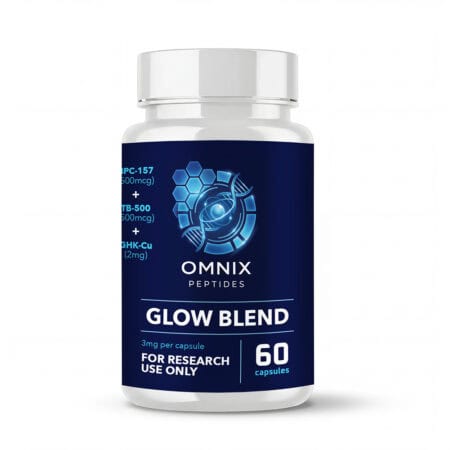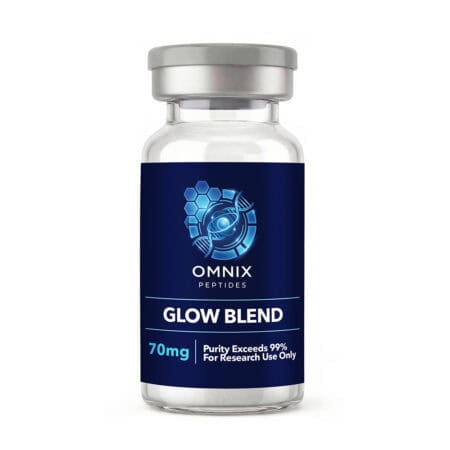
The Glow Blend is a research-format combination of three peptides positioned for skin- and hair-research applications: GHK-Cu (the copper-binding tripeptide glycyl-L-histidyl-L-lysine in complex with copper(II)), BPC-157 (a 15-amino-acid peptide derived from a human gastric protein), and TB-500 (a synthetic peptide based on the actin-binding domain of thymosin β4). The three constituents have been investigated in independent research programs spanning dermal wound healing, collagen and matrix remodeling, angiogenesis, and cell migration. The blend documents this multi-mechanism rationale for skin and connective-tissue research; it does not represent a single compound with its own characterized pharmacology.
There is no peer-reviewed clinical or preclinical literature on the three-constituent GHK-Cu + BPC-157 + TB-500 combination as a fixed-ratio research product. The published research base consists of separate literatures on each constituent: a large body of dermatology and gene-expression research for GHK-Cu (Pickart and collaborators since 1973, plus the Maquart group in Reims), the predominantly rodent and in vitro BPC-157 literature (the Sikiric laboratory in Croatia), and the foundational thymosin β4 / TB-500 pharmacology work (the Goldstein, Kleinman, and Riley laboratories). The combination rationale is mechanistic: GHK-Cu mechanistic work has converged on collagen and glycosaminoglycan synthesis, matrix metalloproteinase modulation, and broad gene-expression reprogramming favoring regenerative pathways; BPC-157 work has centered on the VEGFR2–Akt–eNOS angiogenic axis and FAK–paxillin fibroblast migration; thymosin β4 / TB-500 work has centered on G-actin sequestration and cell migration. These are non-overlapping mechanism classes.
None of the three constituents is approved by the FDA, EMA, or any other regulatory authority as a research-grade injectable peptide for any indication. GHK-Cu has been used for several decades as a cosmetic-formulation ingredient in topical skin-care products, where it is regulated as a cosmetic ingredient rather than as a drug; the injectable peptide form supplied here is a separate research format. BPC-157 was investigated in Phase 1 and Phase 2 trials for inflammatory bowel disease by Pliva. Thymosin β4 has been investigated in clinical trials for ophthalmic, cardiac, and dermal repair under development codes including RGN-259 and RGN-352. Researchers should interpret the combination blend as a research-format product with no head-to-head combination data and should consult the constituent compound hubs for full mechanistic detail.
Important Note on the Evidence Base
Important note on the evidence base: No peer-reviewed clinical or preclinical study has compared the three-constituent GHK-Cu + BPC-157 + TB-500 fixed-ratio combination against any single constituent, against any two-constituent subset, or against placebo, in any model. Claims that the combination produces additive or synergistic effects on skin or connective-tissue endpoints rest on mechanistic plausibility (the three constituents act through non-overlapping pathways) rather than on direct empirical comparison. The published research summarized below is the constituent-level literature; readers should interpret it accordingly and consult the individual compound hubs (GHK-Cu, BPC-157, TB-500) for full constituent-level depth.
Mechanism of Action
The proposed rationale for combining GHK-Cu, BPC-157, and TB-500 in a single skin- and connective-tissue research format rests on the observation that the three constituents act through molecularly distinct repair pathways. This section summarizes each constituent’s mechanism at the level needed to understand the combination rationale; full constituent-level detail is available on the individual compound hubs.
GHK-Cu — collagen synthesis, matrix remodeling, and broad gene-expression reprogramming. GHK is a tripeptide first isolated from human plasma by Pickart in 1973 and shown to form a high-affinity complex with copper(II). In a foundational 1988 study published in FEBS Letters, Maquart, Pickart, and colleagues reported that GHK-Cu stimulated collagen synthesis by fibroblasts in culture at concentrations between 10−12 and 10−9 M, independent of any change in cell number [4]. Subsequent work has characterized GHK-Cu effects on glycosaminoglycan synthesis, matrix metalloproteinase (MMP) modulation, dermal fibroblast function, and broad gene-expression patterns. In a 2018 review published in the International Journal of Molecular Sciences, Pickart and Margolina synthesized gene-expression data indicating that GHK-Cu modulates the expression of a large fraction of human genes (analyses based on the Broad Institute Connectivity Map approach), with the modulated genes enriched for tissue-regeneration, anti-inflammatory, and antioxidant pathways [5]. The GHK-Cu mechanistic literature spans skin, lung, bone, liver, and gastrointestinal tissue.
BPC-157 — angiogenesis via VEGFR2 and fibroblast migration via FAK–paxillin. Hsieh and colleagues reported that BPC-157 promotes angiogenesis in chick chorioallantoic membrane and tube-formation assays and accelerates blood-flow recovery in a rat hindlimb ischemia model, with the effect attributed to upregulation of VEGFR2 and downstream activation of the Akt–eNOS pathway [1]. The angiogenic mechanism is mechanistically distinct from the GHK-Cu collagen-synthesis mechanism: BPC-157 acts on the endothelial cell, while GHK-Cu acts on the fibroblast and the surrounding matrix. A separate line of BPC-157 work has characterized fibroblast migration via FAK–paxillin phosphorylation, which overlaps functionally (but not molecularly) with the GHK-Cu effects on fibroblast behavior.
TB-500 / thymosin β4 — G-actin sequestration and dermal wound healing. Thymosin β4 is the major G-actin-sequestering protein in eukaryotic cells; TB-500 is a synthetic peptide derived from the active actin-binding domain. Goldstein, Hannappel, and Kleinman characterized the molecule in a Trends in Molecular Medicine review as having well-documented activity in dermal- and corneal-wound healing models, with the actin-sequestration activity providing the basis for effects on cytoskeletal dynamics and directed cell migration [2]. Malinda and colleagues reported that topical or intraperitoneal thymosin β4 administration in a rat full-thickness wound model increased reepithelialization by 42% over saline controls at 4 days and by 61% at 7 days post-wounding, with increased collagen deposition and angiogenesis in the treated wounds [3]. The wound-healing mechanism is mechanistically distinct from both GHK-Cu and BPC-157: TB-500 acts on the actin cytoskeleton and on keratinocyte migration, not on collagen biosynthesis directly or on the VEGFR2 axis specifically.
Combination rationale for skin and connective-tissue research. The mechanistic case for combining the three constituents in a single skin-focused research format rests on the non-overlapping molecular profiles. GHK-Cu drives fibroblast collagen and glycosaminoglycan synthesis and broad regenerative gene-expression reprogramming. BPC-157 drives endothelial-cell angiogenesis and a complementary line of fibroblast migration. TB-500 drives keratinocyte and fibroblast migration via actin-cytoskeletal dynamics. The three mechanism classes operate on different cell types (fibroblast, endothelial cell, keratinocyte) and on different molecular substrates (matrix components, growth-factor signaling, cytoskeletal proteins). Whether this multi-mechanism non-overlap translates to additive or synergistic effects on any specific dermal-research endpoint has not been directly tested in the peer-reviewed literature.
Available Forms
Omnix Peptides supplies the Glow Blend in two research formats. Each lot is independently characterized by HPLC and LC–MS, with a batch-specific Certificate of Analysis available on each product page.
- Glow Blend Vial — lyophilized powder for reconstitution. 70 mg total peptide per vial in fixed-ratio combination of GHK-Cu, BPC-157, and TB-500. The vial is the canonical research format for studies of injectable or topical reconstituted delivery.
- Glow Blend Capsules — 2 mg total peptide per capsule, 60-count bottle. Oral format used in research models evaluating enteral delivery of the three-constituent combination.
The Glow Blend is classified under the Skin & Hair research category. For research framed around the constituents individually, see the GHK-Cu, BPC-157, and TB-500 compound hubs. For research framed around tissue repair more broadly without the GHK-Cu dermal-specific mechanism, see the BPC+TB Blend hub.
Amount in the Published Research Literature
The following administration ranges describe the protocols used in the peer-reviewed literature on the individual constituents. They are reported here for research-reference purposes only and do not constitute administration recommendations of any kind. No combination-specific amount protocols have been published in the peer-reviewed literature for the three-constituent GHK-Cu + BPC-157 + TB-500 formulation.
GHK-Cu fibroblast culture protocols. The Maquart 1988 collagen-synthesis study used GHK-Cu concentrations across the range 10−12 to 10−9 M in fibroblast culture, with maximal stimulation observed at 10−9 M [4]. Subsequent in vivo wound-healing studies and topical-application research have used GHK-Cu concentrations in the microgram-to-milligram-per-milliliter range depending on the model. The Pickart and Margolina 2018 review summarizes the broader amount literature across the multiple tissue models in which GHK-Cu has been investigated [5].
BPC-157 rodent injury and tissue-repair protocols. The published Sikiric-laboratory rodent literature has typically administered BPC-157 at 10 µg/kg or 10 ng/kg, with both ranges reported to produce measurable effects across tendon, ligament, gastrointestinal, and cardiovascular injury models. Administration routes have included intraperitoneal injection, intragastric (oral) gavage, oral administration in drinking water, and topical application. Full BPC-157 amount-protocol detail is available on the BPC-157 compound hub.
TB-500 / thymosin β4 rodent wound-healing protocols. The Malinda 1999 wound-healing study administered thymosin β4 topically (5 µg per wound in PBS) and intraperitoneally (150 µg per animal) in a rat full-thickness wound model, with reepithelialization assessed at 4 and 7 days post-wounding [3]. Subsequent thymosin β4 clinical trials have used intravenous administration in the milligram range over short courses for cardiac- and ocular-repair indications.
Combination protocols. The published research base does not contain peer-reviewed studies of fixed-ratio GHK-Cu + BPC-157 + TB-500 combination administration in any model. Researchers planning combination protocols are referred to the constituent literature on each compound and should treat any combination administration as exploratory in the absence of head-to-head data.
Researchers planning protocols are referred to the original primary literature cited in the References section for full methodological detail, including vehicle composition, application route, treatment-timing relative to injury or culture stimulus, and outcome assessment timepoints.
Frequently Asked Questions
Is the Glow Blend FDA-approved?
No. None of the three constituents (GHK-Cu, BPC-157, TB-500) is approved by the FDA, EMA, or any other regulatory authority as a research-grade injectable peptide for any indication, and no fixed-ratio combination product has been advanced into regulatory review. GHK-Cu has been used for several decades as a cosmetic-formulation ingredient in topical skin-care products, where it is regulated as a cosmetic ingredient rather than as a drug; the injectable peptide form supplied here is a separate research format.
Is there peer-reviewed research on the three-constituent Glow Blend combination?
No peer-reviewed clinical or preclinical study has compared the three-constituent GHK-Cu + BPC-157 + TB-500 fixed-ratio combination against any single constituent, against any two-constituent subset, or against placebo, in any model. The published research base consists of separate literatures on each constituent. The rationale for combining the three compounds in a single research format is mechanistic — they act through non-overlapping molecular pathways on different cell types — but additive or synergistic effects on dermal or connective-tissue endpoints have not been empirically demonstrated.
What does the GHK-Cu research literature describe?
GHK-Cu is a copper-binding tripeptide first isolated from human plasma by Pickart in 1973. The Maquart 1988 study reported that GHK-Cu stimulates collagen synthesis in fibroblast cultures at picomolar to nanomolar concentrations. Subsequent work has characterized GHK-Cu effects on glycosaminoglycan synthesis, matrix metalloproteinase modulation, dermal fibroblast function, and broad gene-expression patterns. The Pickart and Margolina 2018 comprehensive review synthesized gene-expression data indicating that GHK-Cu modulates a large fraction of human genes, with the modulated genes enriched for tissue-regeneration, anti-inflammatory, and antioxidant pathways.
Why are GHK-Cu, BPC-157, and TB-500 combined in the Glow Blend?
The combination rationale rests on the observation that the three constituents act through molecularly distinct repair pathways on different cell types relevant to dermal and connective-tissue research. GHK-Cu drives fibroblast collagen and glycosaminoglycan synthesis and broad regenerative gene-expression reprogramming. BPC-157 drives endothelial-cell angiogenesis via the VEGFR2–Akt–eNOS pathway and a complementary line of fibroblast migration. TB-500 drives keratinocyte and fibroblast migration via actin-cytoskeletal dynamics. The three mechanism classes operate on different cell types (fibroblast, endothelial cell, keratinocyte) and on different molecular substrates.
How does the Glow Blend differ from the BPC+TB Blend?
The Glow Blend is a three-constituent combination of GHK-Cu, BPC-157, and TB-500, classified under Skin & Hair research, with the GHK-Cu component contributing dermal-specific collagen-synthesis and matrix-remodeling mechanisms. The BPC+TB Blend is a two-constituent combination of BPC-157 and TB-500, classified under Recovery & Healing research, without the GHK-Cu component. The two blends share two constituents (BPC-157, TB-500) but address different research framings. Neither combination has peer-reviewed combination data.
What administration routes have been used for the constituent compounds?
GHK-Cu has been investigated in topical and subcutaneous research formats in addition to its use as a cosmetic-formulation ingredient. BPC-157 has been investigated in intraperitoneal, intragastric (oral), drinking-water, and topical research formats in rodent studies. TB-500 / thymosin β4 has been investigated in topical and intraperitoneal research formats in rodent wound-healing studies and in intravenous administration in clinical trials for cardiac and ocular indications. The Omnix research formats (vial, capsule) support reconstituted-injectable and oral research workflows respectively.
What mechanism of action has been characterized for the BPC-157 component?
Mechanistic studies have proposed pro-angiogenic activity for BPC-157 via upregulation of VEGFR2 with downstream Akt–eNOS pathway activation, increased fibroblast migration and survival via FAK–paxillin phosphorylation, and modulation of the nitric oxide system. These mechanisms have been characterized primarily in rat and in vitro systems. Within the Glow Blend, BPC-157 contributes the endothelial-cell angiogenesis component of the combination rationale alongside the GHK-Cu fibroblast/matrix component and the TB-500 cytoskeletal/migration component.
References
- Hsieh MJ, Liu HT, Wang CN, et al. Therapeutic potential of pro-angiogenic BPC157 is associated with VEGFR2 activation and up-regulation. J Mol Med (Berl). 2017;95(3):323-333. doi:10.1007/s00109-016-1488-y · PubMed: 27847966
- Goldstein AL, Hannappel E, Kleinman HK. Thymosin beta4: actin-sequestering protein moonlights to repair injured tissues. Trends Mol Med. 2005;11(9):421-429. doi:10.1016/j.molmed.2005.07.004 · PubMed: 16099219
- Malinda KM, Sidhu GS, Mani H, et al. Thymosin beta4 accelerates wound healing. J Invest Dermatol. 1999;113(3):364-368. doi:10.1046/j.1523-1747.1999.00708.x · PubMed: 10469335
- Maquart FX, Pickart L, Laurent M, Gillery P, Monboisse JC, Borel JP. Stimulation of collagen synthesis in fibroblast cultures by the tripeptide-copper complex glycyl-L-histidyl-L-lysine-Cu2+. FEBS Lett. 1988;238(2):343-346. doi:10.1016/0014-5793(88)80509-x · PubMed: 3169264
- Pickart L, Margolina A. Regenerative and protective actions of the GHK-Cu peptide in the light of the new gene data. Int J Mol Sci. 2018;19(7):1987. doi:10.3390/ijms19071987 · PubMed: 29986520
For Research Use Only. The products described on this page are sold strictly for in vitro laboratory research and are not intended for human or animal consumption, diagnostic use, or therapeutic use. The published research summarized above is provided as scientific reference material. Nothing on this page constitutes medical advice, a therapeutic claim, or a recommendation for any use outside of a properly resourced and ethically reviewed research setting.