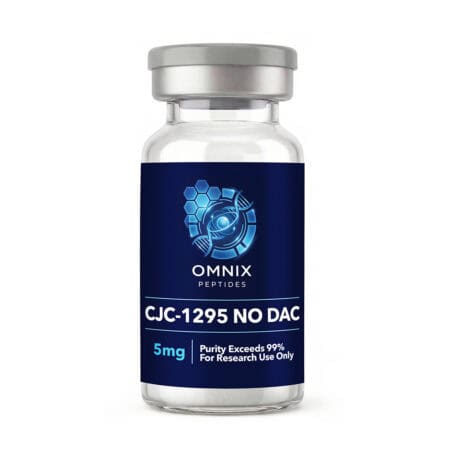
CJC-1295 (no DAC) — also known as Modified GRF (1-29) or Mod GRF 1-29 — is a synthetic 30-amino-acid peptide analog of the bioactive portion of human growth hormone–releasing hormone (GHRH). It contains four amino-acid substitutions at positions 2, 8, 15, and 27 (relative to native GHRH(1–29)NH2) that confer enhanced enzymatic stability and modestly extended in vivo half-life, but it does NOT contain the maleimidopropionyl “Drug Affinity Complex” (DAC) linker present in the DAC-modified version of CJC-1295. As a result, the no-DAC version has a circulatory half-life on the order of 30 minutes (vs. approximately 8 days for the DAC version), producing pulsatile rather than continuous GH-releasing stimulation in research models.
The peer-reviewed clinical pharmacology literature for the CJC-1295 family was established with the DAC-modified version, including the Phase 1/2 escalating-amount trial published by Teichman and colleagues in the Journal of Clinical Endocrinology & Metabolism (2006) [1], the pulsatility-during-continuous-stimulation study by Ionescu and Frohman in the same journal (2006) [2], the serum-protein-profile work by Sackmann-Sala and colleagues in Growth Hormone & IGF Research (2009) [3], and the GHRH-knockout-mouse growth-restoration study by Alba and colleagues in the American Journal of Physiology — Endocrinology and Metabolism (2006) [4]. These studies characterized the GHRH-receptor pharmacology and the GH/IGF-1 axis activation profile that the no-DAC version shares pharmacologically, with the central difference being the magnitude and persistence of plasma exposure.
CJC-1295 (in both DAC and no-DAC forms) is not approved by the FDA, EMA, or any other regulatory authority for any indication. It is available as a research-use chemical for laboratory investigations of GHRH-receptor pharmacology and the GH/IGF-1 axis.
Important Note on the Evidence Base
Important note on the evidence base: The published clinical and preclinical literature cited on this page evaluates the DAC-modified version of CJC-1295. The no-DAC version (Mod GRF 1-29) shares the same modified GHRH-29 backbone and the same GHRH-receptor pharmacology, but lacks the maleimidopropionyl linker that produces covalent albumin binding and the multi-day circulatory half-life characteristic of the DAC version. Published peer-reviewed clinical pharmacokinetic data specifically on the no-DAC version is more limited than on the DAC version. Researchers should treat receptor-mechanism findings from the cited literature as applicable to both forms while treating pharmacokinetic and administration protocols as version-specific.
Mechanism of Action
CJC-1295 (no DAC) is a GHRH-receptor agonist. The molecule binds to the GHRH receptor (a class B G-protein-coupled receptor) on somatotroph cells in the anterior pituitary, where activation triggers cyclic-AMP-mediated GH synthesis and release. This is the same receptor and the same downstream signaling pathway through which native GHRH acts.
GHRH-receptor agonism and the GH/IGF-1 axis. The Teichman 2006 escalating-amount trial in healthy adults established that CJC-1295 (with DAC) produces sustained elevation of plasma GH and IGF-1 in a concentration-dependent manner, with effects measurable for multiple days after a single subcutaneous amount [1]. The investigators reported prolonged stimulation of GH and IGF-I secretion
across the amount-range studied. The no-DAC version produces the same receptor activation but with a substantially shorter duration, resulting in pulsatile GH release that more closely resembles physiological GHRH signaling.
Pulsatility preservation under continuous stimulation. A counter-intuitive finding from the Ionescu and Frohman 2006 study is that even continuous GHRH-receptor stimulation by long-acting CJC-1295 (with DAC) does NOT eliminate the underlying pulsatile pattern of GH secretion [2]. The investigators reported that pulsatile secretion of GH persists during continuous stimulation by CJC-1295
, indicating that pulsatility is regulated by mechanisms downstream of GHRH-receptor activation (likely involving somatostatin tone). This finding has implications for the comparison between DAC and no-DAC versions: the no-DAC version’s short half-life produces explicit pulsatility through plasma exposure, while the DAC version preserves underlying pulsatility through somatostatin counterregulation despite continuous receptor exposure.
Downstream effects on the GH/IGF-1 axis. The Sackmann-Sala 2009 study characterized the serum-protein-profile changes produced by CJC-1295 (with DAC) activation of the GH/IGF-1 axis in healthy adults, identifying patterns of change in GH-responsive serum proteins consistent with sustained somatotropic-axis activation [3]. These findings are relevant to research on GH/IGF-1 axis biomarkers.
In vivo validation in GHRH-knockout mice. The Alba 2006 study used a GHRH-knockout mouse model — in which native GHRH activity is genetically absent — to evaluate whether once-daily administration of CJC-1295 (with DAC) could restore normal growth [4]. The investigators reported that the once-daily long-acting GHRH analog normalized longitudinal growth and IGF-1 levels in the knockout mice, providing direct in vivo evidence that CJC-1295 acts as a functional GHRH-receptor agonist sufficient to drive the somatotropic axis in the absence of endogenous GHRH.
Implications for the no-DAC version. The receptor pharmacology established in the DAC-version literature applies to the no-DAC version because both molecules share the same GHRH-29 modified backbone and the same GHRH-receptor binding profile. The expected difference is in duration: the no-DAC version’s 30-minute half-life produces GH pulses that decay rapidly, more closely paralleling endogenous GHRH pulses, whereas the DAC version produces sustained receptor occupancy via albumin binding.
Available Forms
Omnix Peptides currently supplies CJC-1295 (no DAC) in a single research format. Each lot is independently characterized by HPLC and LC–MS, with a batch-specific Certificate of Analysis available on the product page.
- CJC-1295 (no DAC) Vial — lyophilized powder for reconstitution. The vial is the canonical research format for the no-DAC peptide; subcutaneous administration is the route used in research protocols evaluating GHRH-axis pharmacology with short-half-life GHRH analogs. Researchers should note that Omnix supplies the no-DAC version specifically; the DAC version (with the maleimidopropionyl linker and the multi-day half-life characterized in the cited literature) is a structurally distinct compound.
CJC-1295 (no DAC) is classified under the Growth Hormone Axis research category. For research framed around overlapping growth-hormone-axis pharmacology, see also the related compound hubs for Ipamorelin (a selective GH secretagogue / ghrelin-mimetic, often paired with GHRH analogs in research protocols), Sermorelin (a shorter GHRH(1–29) analog), and Tesamorelin (a stabilized GHRH analog approved for HIV-associated lipodystrophy).
Amount in the Published Research Literature
The following amount ranges describe the protocols used in the peer-reviewed CJC-1295 literature. They are reported here for research-reference purposes only and do not constitute administration recommendations of any kind. As noted in the evidence-base disclosure above, the cited amount ranges describe the DAC-modified version; protocols for the no-DAC version differ.
Teichman 2006 escalating-amount trial — DAC version. Healthy adult volunteers received single subcutaneous amounts of CJC-1295 (with DAC) across an escalating-amount range, with serial measurement of plasma GH and IGF-1 over multiple days post-amount [1]. The investigators reported sustained elevation of GH and IGF-1 across the amount-range, consistent with the multi-day plasma half-life conferred by the maleimidopropionyl albumin-binding linker.
Ionescu & Frohman 2006 pulsatility study — DAC version. The mechanism-focused study evaluated GH-secretion patterns during continuous receptor stimulation produced by repeated administration of CJC-1295 (with DAC), with high-frequency serial sampling to characterize pulsatility [2]. The finding that pulsatility persists despite continuous receptor stimulation has mechanistic implications discussed in the previous section.
Alba 2006 GHRH-knockout mouse model — DAC version. Once-daily administration of CJC-1295 (with DAC) in GHRH-knockout mice normalized longitudinal growth and IGF-1 levels [4]. The once-daily administration interval was made possible by the multi-day half-life of the DAC version.
Implications for no-DAC administration protocols. Research protocols using the no-DAC version typically employ more frequent administration intervals (commonly multiple times daily) to compensate for the substantially shorter circulatory half-life. The peer-reviewed pharmacokinetic literature specifically on the no-DAC version is more limited; researchers planning no-DAC protocols are referred to the broader GHRH-analog pharmacology literature, including the literature on the structurally simpler sermorelin (GHRH(1–29)NH2) for relevant pharmacokinetic context.
Researchers planning protocols are referred to the original primary literature cited in the References section for full methodological detail.
Frequently Asked Questions
Is CJC-1295 (no DAC) FDA-approved?
No. CJC-1295 in either DAC-modified or no-DAC form is not approved by the FDA, EMA, or any other regulatory authority for any indication. It is available as a research-use chemical for laboratory investigations of GHRH-receptor pharmacology and the growth hormone / IGF-1 axis.
What is the difference between CJC-1295 with DAC and CJC-1295 no DAC?
Both versions share the same modified GHRH-29 amino-acid backbone (with four substitutions at positions 2, 8, 15, and 27 relative to native GHRH(1–29)NH2). The DAC version additionally contains a maleimidopropionyl linker that binds covalently to circulating serum albumin, producing a multi-day circulatory half-life (~8 days). The no-DAC version (also called Mod GRF 1-29) lacks this linker and has a circulatory half-life on the order of 30 minutes, producing pulsatile rather than continuous GH-releasing stimulation. Receptor pharmacology is identical; pharmacokinetics differ substantially.
What mechanism of action does CJC-1295 use?
CJC-1295 binds to the growth hormone–releasing hormone (GHRH) receptor on somatotroph cells in the anterior pituitary, where activation triggers cyclic-AMP-mediated growth hormone synthesis and release. This is the same receptor and the same downstream signaling pathway through which native GHRH acts. The compound activates the GH/IGF-1 axis through prolonged or pulsatile receptor stimulation depending on which version is used.
What does the Teichman 2006 trial show?
The Teichman 2006 escalating-amount trial in healthy adults established that CJC-1295 (with DAC) produces concentration-dependent sustained elevation of plasma growth hormone and IGF-1, with effects measurable for multiple days after a single subcutaneous amount [1]. The trial characterized the pharmacokinetic profile of the DAC version and established the foundational clinical pharmacology that has informed subsequent CJC-1295 research. The no-DAC version was not the subject of this trial.
How does CJC-1295 (no DAC) pair with ipamorelin?
CJC-1295 (no DAC) is a GHRH-receptor agonist, while ipamorelin is a selective ghrelin-receptor agonist (GH secretagogue) that acts through a distinct receptor pathway. The two compounds are frequently paired in research protocols because they act through complementary receptors that converge on GH release from the anterior pituitary, with each compound producing GH release independently and the combination producing additive or synergistic effects in some research models. Both share short half-lives suitable for pulsatile-stimulation research protocols. See the Ipamorelin hub for further detail.
Why is pulsatility important in growth hormone research?
Endogenous growth hormone secretion is pulsatile, with most GH released during sleep in discrete bursts and very low levels between pulses. Continuous (rather than pulsatile) GH exposure produces distinct downstream effects on the GH/IGF-1 axis and on GH-responsive tissues. Research protocols using short-half-life GHRH analogs (such as the no-DAC version of CJC-1295) attempt to mimic physiological pulsatile stimulation; long-half-life analogs (such as the DAC version) produce sustained receptor exposure that diverges from the physiological pattern. The Ionescu and Frohman 2006 study showed that pulsatile secretion of GH persists during continuous stimulation by CJC-1295
, mediated by downstream somatostatin counterregulation [2].
What is the most common administration route in CJC-1295 research?
Subcutaneous administration is the route used in all of the published clinical CJC-1295 literature. The DAC version is typically administered once weekly or less frequently due to its multi-day half-life; the no-DAC version is typically administered more frequently in research protocols, reflecting the shorter circulatory half-life. Intramuscular administration has also been used in research models. Oral administration is not used because GHRH analogs are not orally bioavailable.
References
- Teichman SL, Neale A, Lawrence B, Gagnon C, Castaigne JP, Frohman LA. Prolonged stimulation of growth hormone (GH) and insulin-like growth factor I secretion by CJC-1295, a long-acting analog of GH-releasing hormone, in healthy adults. J Clin Endocrinol Metab. 2006;91(3):799-805. doi:10.1210/jc.2005-1536
- Ionescu M, Frohman LA. Pulsatile secretion of growth hormone (GH) persists during continuous stimulation by CJC-1295, a long-acting GH-releasing hormone analog. J Clin Endocrinol Metab. 2006;91(12):4792-4797. doi:10.1210/jc.2006-1702
- Sackmann-Sala L, Ding J, Frohman LA, Kopchick JJ. Activation of the GH/IGF-1 axis by CJC-1295, a long-acting GHRH analog, results in serum protein profile changes in normal adult subjects. Growth Horm IGF Res. 2009;19(6):471-477. doi:10.1016/j.ghir.2009.03.001
- Alba M, Fintini D, Sagazio A, et al. Once-daily administration of CJC-1295, a long-acting growth hormone-releasing hormone (GHRH) analog, normalizes growth in the GHRH knockout mouse. Am J Physiol Endocrinol Metab. 2006;291(6):E1290-E1294. doi:10.1152/ajpendo.00201.2006
For Research Use Only. The product described on this page is sold strictly for in vitro laboratory research and is not intended for human or animal consumption, diagnostic use, or therapeutic use. The published research summarized above is provided as scientific reference material. Nothing on this page constitutes medical advice, a therapeutic claim, or a recommendation for any use outside of a properly resourced and ethically reviewed research setting.