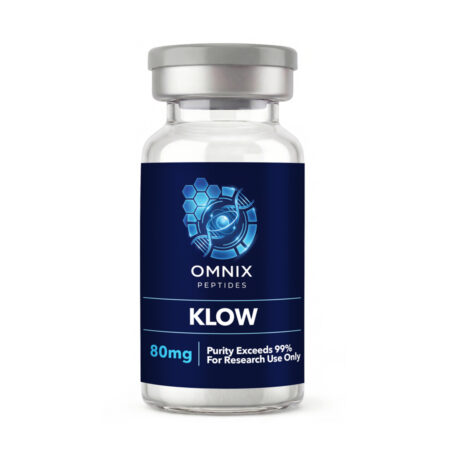
KLOW is a research-grade blend combining four individually studied peptides in a single vial: BPC-157, TB-500, GHK-Cu, and KPV. It is supplied by Omnix Peptides strictly as research-grade material for in vitro and laboratory research use only. KLOW is not a single compound with its own research literature; it is a combination of four peptides, each with its own separate preclinical research base.
Because KLOW is a blend, there is no independent body of published research on “KLOW” as a distinct entity. The research context for KLOW is the sum of the research on its four components. This page summarizes each component and links to its dedicated research hub.
Blend Composition
KLOW combines four research peptides at the following per-vial quantities (80mg total):
- BPC-157 — 10mg: a synthetic 15-amino-acid peptide studied in tissue-repair and gastrointestinal research models
- TB-500 — 10mg: a synthetic fragment of thymosin β4 studied in cell-migration and tissue-repair research
- GHK-Cu — 50mg: a naturally occurring copper-binding tripeptide studied in skin, remodeling, and wound-research models
- KPV — 10mg: the C-terminal tripeptide of α-MSH studied in anti-inflammatory research, principally intestinal-inflammation models
Research Rationale for the Combination
Blends like KLOW are formulated for research convenience, combining peptides whose individual literatures span complementary research domains — tissue repair (BPC-157, TB-500), extracellular-matrix and skin research (GHK-Cu), and anti-inflammatory signaling (KPV). Researchers studying multi-peptide combinations should note that the published research on each component was conducted with that peptide individually. There is no published research on this specific four-peptide combination as a fixed formulation; combination effects are not established in the literature.
The Four Components
BPC-157
A synthetic pentadecapeptide (15 amino acids) derived from a protein fragment identified in gastric juice. BPC-157’s preclinical literature centers on angiogenesis and tissue-repair research in rodent injury models. See the full BPC-157 research hub.
TB-500
A synthetic, acetylated heptapeptide corresponding to the actin-binding region (residues 17–23) of thymosin β4. Its research centers on cell migration and tissue-repair models. See the full TB-500 research hub.
GHK-Cu
A naturally occurring copper-binding tripeptide (glycyl-L-histidyl-L-lysine) studied in skin, extracellular-matrix, and remodeling research. See the full GHK-Cu research hub.
KPV
The C-terminal tripeptide (lysine-proline-valine) of α-MSH, studied in anti-inflammatory research, most extensively in intestinal-inflammation models. See the full KPV research hub.
Research Handling and Storage
Standard research-peptide handling applies to the blend. KLOW is supplied as a lyophilized powder and reconstituted for laboratory research use.
- Lyophilized storage: 2–8°C short term; −20°C for long-term storage
- Reconstituted storage: 2–8°C, used within the protocol’s stability window
- Reconstitution: bacteriostatic water is the common research diluent
- Handling: minimize freeze-thaw cycles; protect from light and heat
For methodology, see the reconstitution math guide.
Research-Grade Purity
Omnix Peptides supplies KLOW as research-grade material. Each batch is analyzed by reverse-phase HPLC with a Certificate of Analysis reporting the quantity and purity of each component in the blend. See the product’s COA for lot-specific analytical data.
Frequently Asked Questions
Q: What is KLOW?
A: KLOW is a research-grade blend of four peptides — BPC-157, TB-500, GHK-Cu, and KPV — supplied in a single vial for laboratory research use only.
Q: Is there research on KLOW specifically?
A: No. KLOW is a blend; there is no published research on this specific four-peptide combination. The relevant research is the separate literature on each of the four components, linked from this page.
Q: What are the quantities of each peptide in KLOW?
A: Per 80mg vial: BPC-157 10mg, TB-500 10mg, GHK-Cu 50mg, and KPV 10mg. See the lot-specific COA for measured quantities.
Q: How is KLOW stored and handled in research?
A: As a lyophilized powder at 2–8°C short term or −20°C long term, reconstituted with bacteriostatic water for laboratory use, minimizing freeze-thaw cycles.