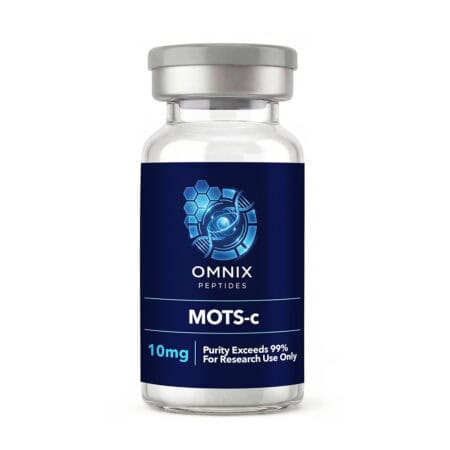
MOTS-c (Mitochondrial Open Reading Frame of the Twelve S rRNA-c; CAS 1627580-64-6) is a 16-amino-acid mitochondrial-derived peptide with the sequence MRWQEMGYIFYPRKLR, encoded within the 12S ribosomal RNA gene of mitochondrial DNA. MOTS-c was identified and originally characterized by Lee, Zeng, and colleagues in the Cohen laboratory at the University of Southern California, who reported its identity, regulation, and metabolic activity in Cell Metabolism (2015) [1]. The compound is one of a small family of mitochondrial-derived peptides (MDPs) that includes humanin and the small humanin-like peptides (SHLPs); MOTS-c is the only MDP encoded within the 12S rRNA gene.
The published mechanistic work on MOTS-c characterizes the peptide as a metabolic regulator that promotes metabolic homeostasis and reduces obesity and insulin resistance
in mouse models, with the molecular mechanism centered on activation of AMP-activated protein kinase (AMPK) and modulation of the folate–methionine cycle through the intermediate AICAR [1]. Subsequent work from the same laboratory and collaborators reported that MOTS-c is an exercise-responsive peptide whose plasma concentrations rise with acute exercise in mice and humans, with the peptide proposed as a regulator of muscle metabolic adaptation to exercise [2].
MOTS-c is not approved by the FDA, EMA, or any other regulatory authority for any indication. There are no completed Phase 2 or Phase 3 clinical trials of MOTS-c. The compound is supplied as a research-use chemical for in vitro and in vivo investigation of mitochondrial-derived peptide biology, AMPK pathway pharmacology, and the metabolic-aging interface. Researchers consulting this page should interpret the evidence base as predominantly preclinical, with most published in vivo data in mouse models.
Important Note on the Evidence Base
Important note on the evidence base: The peer-reviewed MOTS-c research literature is predominantly preclinical, with most in vivo work in C57BL/6 mice and in vitro work in cultured cell lines (3T3-L1 adipocytes, HepG2 hepatocytes, L6 myotubes). Published human-physiology data is limited to plasma-concentration measurements in exercise studies and small observational cohorts. There are no completed Phase 2 or Phase 3 controlled clinical trials of exogenous MOTS-c administration in human participants. Researchers consulting this page should weight the evidence base accordingly.
Mechanism of Action
MOTS-c’s published mechanism centers on metabolic regulation via the AMPK pathway, with additional reported activity in mitochondrial-nuclear retrograde signaling and exercise-responsive muscle adaptation.
Mitochondrial origin and translation. MOTS-c is encoded within the mitochondrial 12S rRNA gene, in a small open reading frame that uses the mitochondrial genetic code. The Cohen-laboratory characterization study reported that MOTS-c is translated in mitochondria using the mitochondrial ribosomal apparatus, with the mature peptide subsequently exported to the cytoplasm and the extracellular space [1]. The peptide is detectable in human plasma and in multiple peripheral tissues, with concentrations that vary with age and metabolic state.
AMPK activation and folate-methionine cycle modulation. The published mechanistic interpretation of MOTS-c’s metabolic effects involves activation of AMP-activated protein kinase (AMPK) in skeletal muscle and other peripheral tissues, with the AMPK activation traced to an upstream modulation of the folate–methionine cycle through the intermediate AICAR (5-aminoimidazole-4-carboxamide ribonucleotide). AMPK is a central energy-sensing kinase whose activation promotes glucose uptake, fatty-acid oxidation, and mitochondrial biogenesis, and inhibits anabolic energy-consuming pathways. The Lee 2015 study reported that MOTS-c administration to obese mice on a high-fat diet improved glucose tolerance, reduced fat mass, and reversed diet-induced insulin resistance, with the effects attributable to AMPK activation in skeletal muscle.
Mitochondrial-nuclear retrograde signaling. Subsequent mechanistic work has reported that MOTS-c translocates from the mitochondrion to the nucleus under metabolic stress conditions, where it modulates the expression of nuclear-encoded antioxidant-response and metabolic-adaptation genes through interaction with stress-responsive transcription factors. The retrograde-signaling pathway is proposed as a mechanism by which the mitochondrion communicates its metabolic and oxidative state to the nuclear gene-expression program, and MOTS-c is characterized as one of the molecular vectors of this communication.
Exercise responsiveness and muscle adaptation. The Reynolds 2021 study in Nature Communications reported that MOTS-c plasma concentrations rise acutely with exercise in mice and in humans, and that exogenous MOTS-c administration to aged mice improves running endurance, grip strength, and metabolic flexibility [2]. The investigators characterized MOTS-c as an exercise-induced mitochondrial-encoded regulator of age-dependent physical decline and muscle homeostasis
, with the proposed mechanism involving AMPK-mediated effects on muscle metabolic gene expression and mitochondrial biogenesis. The exercise-responsive framing has driven much of the subsequent research interest in MOTS-c as a candidate exercise-mimetic compound.
Cellular-senescence interactions. Additional work from the Cohen laboratory and collaborators has reported that MOTS-c modulates cellular-senescence markers in in vitro systems, with proposed implications for the metabolic-aging interface [3]. The cellular-senescence work positions MOTS-c within the broader longevity-research framework that also includes humanin and the other mitochondrial-derived peptides.
None of the mechanisms summarized here have been independently verified in adequately powered human clinical trials.
Available Forms
Omnix Peptides currently supplies MOTS-c in a single research format. Each lot is independently characterized by HPLC and LC–MS, with a batch-specific Certificate of Analysis available on the product page.
- MOTS-c Vial — lyophilized powder for reconstitution. The vial is the canonical research format for MOTS-c and supports the amount flexibility used in published rodent metabolic and exercise-physiology studies. Intraperitoneal and intravenous administration are the routes used in the published preclinical literature.
MOTS-c is classified under the Metabolic & Weight and Longevity & Anti-Aging research categories per its dual mechanism profile (AMPK-mediated glucose and adipose metabolism; mitochondrial-derived peptide biology relevant to metabolic-aging research). For research framed around overlapping AMPK pathway pharmacology, see also the related compound hubs for 5-Amino-1MQ (NNMT inhibitor with downstream effects on cellular methylation and metabolism) and Epithalon (telomerase-modulating peptide with broader longevity-research framing).
Amount in the Published Research Literature
The following amount ranges describe the protocols used in the peer-reviewed MOTS-c literature. They are reported here for research-reference purposes only and do not constitute administration recommendations of any kind.
Lee 2015 diet-induced obesity study. Adult C57BL/6 mice on a high-fat diet received intraperitoneal MOTS-c at 0.5 mg/kg/day or vehicle over a multi-week treatment period, with whole-body composition (NMR spectroscopy), glucose and insulin tolerance, and tissue-level molecular endpoints measured at sacrifice [1]. The investigators reported reductions in fat mass and improvements in insulin sensitivity at the studied amount.
Reynolds 2021 exercise and aged-mouse muscle study. Aged C57BL/6 mice received intraperitoneal MOTS-c administration on a study-protocol-specified schedule, with running endurance, grip strength, and metabolic-flexibility endpoints measured against age-matched controls [2]. The investigators reported improvements in physical function and muscle metabolic gene expression in MOTS-c-treated aged mice.
In vitro cell-culture studies. Published in vitro work has typically used MOTS-c at concentrations in the 1–10 µM range in 3T3-L1 adipocyte, HepG2 hepatocyte, and L6 myotube systems, with glucose uptake, AMPK phosphorylation, and downstream metabolic gene expression as primary endpoints. Cell-culture concentrations are not directly translatable to in vivo amounts and are reported for completeness only.
Pharmacokinetic profile. Endogenous MOTS-c is detectable in human plasma at concentrations in the low nanogram-per-milliliter range, with reported variation by age and metabolic state. The pharmacokinetics of exogenous administration are characterized predominantly in rodent studies; published human pharmacokinetic data for exogenous MOTS-c administration is not available.
Adverse-event profile. No human clinical trial adverse-event data is available for MOTS-c. The published rodent literature has not reported overt toxicity at the studied amounts, but the available data are not equivalent to a regulated Phase 1/2 safety database.
Researchers planning protocols are referred to the original primary literature cited in the References section for full methodological detail, including vehicle composition, injection schedule, animal model selection, and primary versus secondary endpoint definitions.
Frequently Asked Questions
Is MOTS-c FDA-approved?
No. MOTS-c is not approved by the FDA, EMA, or any other regulatory authority for any indication. There are no completed Phase 2 or Phase 3 clinical trials of MOTS-c administration in human participants. The compound is supplied as a research-use chemical for in vitro and in vivo investigation of mitochondrial-derived peptide biology, AMPK pathway pharmacology, and the metabolic-aging interface.
What is MOTS-c?
MOTS-c is a 16-amino-acid mitochondrial-derived peptide encoded within the 12S ribosomal RNA gene of mitochondrial DNA. It was identified and originally characterized by Lee, Zeng, and colleagues in the Cohen laboratory at the University of Southern California in Cell Metabolism (2015) [1]. MOTS-c is one of a small family of mitochondrial-derived peptides that also includes humanin and the small humanin-like peptides (SHLPs).
What mechanism of action does MOTS-c use?
The published mechanistic interpretation centers on activation of AMP-activated protein kinase (AMPK) in skeletal muscle and other peripheral tissues, with the AMPK activation traced to upstream modulation of the folate–methionine cycle through the intermediate AICAR. AMPK activation promotes glucose uptake, fatty-acid oxidation, and mitochondrial biogenesis. Additional published mechanisms include mitochondrial-to-nuclear retrograde signaling under metabolic stress and exercise-responsive regulation of muscle metabolic adaptation.
What does the Lee 2015 discovery paper show?
The Lee 2015 study reported the identity of MOTS-c as a 16-amino-acid peptide encoded within the mitochondrial 12S rRNA gene, characterized its translation and tissue distribution, and reported that intraperitoneal administration to obese mice on a high-fat diet improved glucose tolerance, reduced fat mass, and reversed diet-induced insulin resistance [1]. The investigators attributed the metabolic effects to AMPK activation in skeletal muscle.
What does the Reynolds 2021 exercise paper show?
The Reynolds 2021 study in Nature Communications reported that MOTS-c plasma concentrations rise acutely with exercise in mice and in humans, and that exogenous MOTS-c administration to aged mice improves running endurance, grip strength, and metabolic flexibility [2]. The investigators characterized MOTS-c as an exercise-induced mitochondrial-encoded regulator of age-dependent physical decline and muscle homeostasis
.
How is MOTS-c related to humanin?
MOTS-c and humanin are both mitochondrial-derived peptides (MDPs) encoded within mitochondrial DNA. Humanin is a 24-amino-acid peptide encoded within the 16S rRNA gene; MOTS-c is a 16-amino-acid peptide encoded within the 12S rRNA gene. They have distinct sequences and distinct primary mechanisms (humanin is characterized in the cytoprotective/anti-apoptotic literature; MOTS-c is characterized in the metabolic-regulation literature), but both fall within the broader MDP research framework on mitochondrial-to-organism communication.
What administration routes have been used in MOTS-c research?
Published rodent in vivo studies have used intraperitoneal injection as the primary administration route. In vitro studies use direct addition to cell-culture media at concentrations in the 1–10 µM range. Published human pharmacokinetic data for exogenous MOTS-c administration is not available.
References
- Lee C, Zeng J, Drew BG, et al. The mitochondrial-derived peptide MOTS-c promotes metabolic homeostasis and reduces obesity and insulin resistance. Cell Metab. 2015;21(3):443-454. doi:10.1016/j.cmet.2015.02.009 · PubMed: 25738459
- Reynolds JC, Lai RW, Woodhead JST, et al. MOTS-c is an exercise-induced mitochondrial-encoded regulator of age-dependent physical decline and muscle homeostasis. Nat Commun. 2021;12(1):470. doi:10.1038/s41467-020-20790-0 · PubMed: 33473109
- Kim SJ, Mehta HH, Wan J, et al. Mitochondrial peptides modulate mitochondrial function during cellular senescence. Aging (Albany NY). 2018;10(6):1239-1256. doi:10.18632/aging.101463 · PubMed: 29886458
For Research Use Only. The product described on this page is sold strictly for in vitro laboratory research and is not intended for human or animal consumption, diagnostic use, or therapeutic use. The published research summarized above is provided as scientific reference material. Nothing on this page constitutes medical advice, a therapeutic claim, or a recommendation for any use outside of a properly resourced and ethically reviewed research setting.