BPC-157 (Body Protection Compound-157; CAS 137525-51-0) is a synthetic 15-amino-acid peptide with the sequence GEPPPGKPADDAGLV, derived from a protective protein originally isolated from human gastric juice. The published research on BPC-157 consists predominantly of animal-model studies (primarily rats) and in vitro cell-culture experiments investigating tissue repair, angiogenesis, and gastrointestinal protection. There are no completed Phase III human clinical trials of BPC-157, and the compound is not approved by the FDA, EMA, or any other regulatory authority for any indication.
The most cited mechanistic finding is from a 2017 study published in the Journal of Molecular Medicine, in which Hsieh and colleagues reported that BPC-157 promotes angiogenesis in CAM assay and tube formation assay
and accelerated blood-flow recovery in a rat hindlimb ischemia model, with the effect attributed to activation of the VEGFR2–Akt–eNOS signaling pathway [1]. Subsequent controlled rat studies have reported promoted Achilles tendon-to-bone healing [3] and improved medial collateral ligament healing across a 90-day post-transection timeline [4].
BPC-157 was advanced into clinical development by the Croatian pharmaceutical company Pliva under the designations PL-10, PLD-116, and PL 14736 for inflammatory bowel disease research. Published Phase I safety data in healthy volunteers appeared in conference proceedings; a Phase II trial of the PL 14736 formulation in ulcerative colitis was completed but full peer-reviewed efficacy results have not been published. Readers should interpret the research summarized on this page as predominantly preclinical.
Important Note on the Evidence Base
Important note on the evidence base: Peer-reviewed BPC-157 research has been conducted predominantly in rodent models (Sprague-Dawley and Wistar rats), with a smaller body of in vitro work on isolated fibroblasts, endothelial cells, and tendon explants. Findings from these models do not establish efficacy or safety in humans. Researchers consulting this page should weight study design and model accordingly, and should consult the cited primary literature in the References section.
Mechanism of Action
Multiple research groups have investigated the molecular pathways through which BPC-157 produces its reported tissue-repair effects in animal models. The mechanistic literature converges on several interconnected pathways rather than a single receptor target.
Angiogenesis via the VEGFR2–Akt–eNOS axis. The Hsieh et al. (2017) study used a chick chorioallantoic membrane assay, an endothelial tube-formation assay, and a rat hindlimb ischemia model assessed by laser Doppler scanning. The investigators attributed BPC-157’s pro-angiogenic effects to upregulation of vascular endothelial growth factor receptor 2 (VEGFR2), with downstream activation of the protein kinase B (Akt) and endothelial nitric oxide synthase (eNOS) pathway [1]. This pathway is well-characterized in the broader vascular biology literature and provides a plausible mechanistic basis for accelerated tissue recovery in injury models.
Fibroblast migration via the FAK–paxillin pathway. In an in vitro study of tendon fibroblasts isolated from Achilles tendons of male Sprague-Dawley rats, Chang and colleagues reported that BPC-157 significantly accelerated the outgrowth of tendon explants
and amount-dependently increased the in vitro migration of tendon fibroblasts [2]. Fibroblast survival under hydrogen peroxide oxidative stress was significantly enhanced in BPC-157-treated cultures compared with controls, although direct cell proliferation was not significantly altered. Western blot analysis in the same study reported concentration-dependent increases in the phosphorylation of focal adhesion kinase (FAK) and paxillin, with no change in total protein expression, leading the investigators to conclude that the migration effect is likely mediated by activation of the FAK–paxillin signaling pathway. The Chang study provides a mechanistic complement to the in vivo tendon-healing findings reported by Krivic and colleagues.
Growth hormone receptor expression and the NO system. Subsequent mechanistic work from the same laboratory has reported that BPC-157 amount- and time-dependently upregulates growth hormone receptor expression in tendon fibroblasts at both the mRNA and protein level, and that the addition of growth hormone to BPC-157-treated cells produces amount- and time-dependent increases in cell proliferation [5]. The investigators have interpreted this finding as a mechanistic basis for the synergy between BPC-157 and circulating growth hormone observed in some research models. Separate studies have reported that BPC-157 modulates the nitric oxide (NO) system across multiple injury models, opposing the deleterious effects of NO synthase inhibition by L-NAME and reinforcing the effects of NO substrate by L-arginine. The published literature also describes BPC-157 as stable in human gastric juice without enzymatic degradation, which the investigators have proposed as a mechanistic basis for the compound’s reported oral bioavailability in research models.
Gastrointestinal protection — the foundational research framing. BPC-157 was originally identified as a fragment of a larger gastric protein and was first characterized for its protective effects against experimentally induced gastrointestinal lesions in rat models (restraint stress, cysteamine, ethanol, NSAIDs). It was this gastrointestinal-protection profile that motivated the Pliva clinical development program (PL-10, PLD-116, PL 14736) for inflammatory bowel disease. The mechanistic framework for the gastrointestinal effects overlaps with the tissue-repair framework: NO-system modulation, mucosal microcirculation, and angiogenic-pathway support all appear in both literatures.
The convergence of these mechanistic findings on angiogenesis, fibroblast behavior, oxidative stress, and the NO system provides a plausible framework for the in vivo tendon, ligament, gastric-mucosal, and ischemia findings reported in rat studies. None of these mechanisms have been independently verified in adequately powered human clinical trials.
Available Forms
Omnix Peptides supplies BPC-157 in three research formats. Each lot is independently characterized by HPLC and LC–MS, with a batch-specific Certificate of Analysis available on each product page.
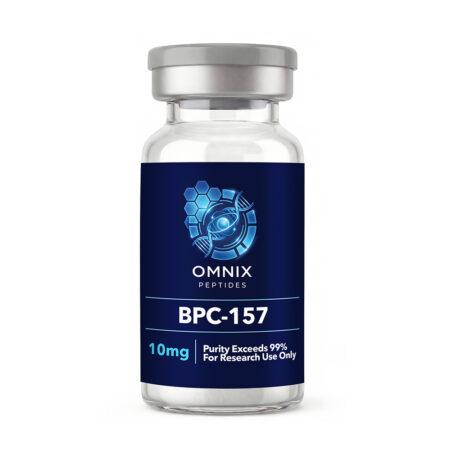
- BPC-157 Vial — lyophilized powder for reconstitution. Available in 5 mg, 10 mg, and 15 mg strengths per vial. The vial is the canonical research format used in most of the published preclinical literature.
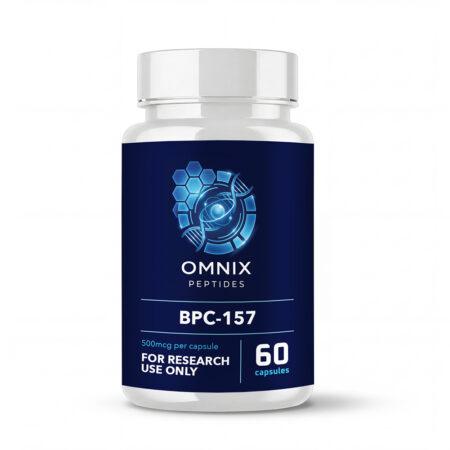
- BPC-157 Capsules — 500 mcg per capsule, 60-count bottle. Oral format used in animal studies where chronic gastrointestinal-localized exposure is the variable of interest.
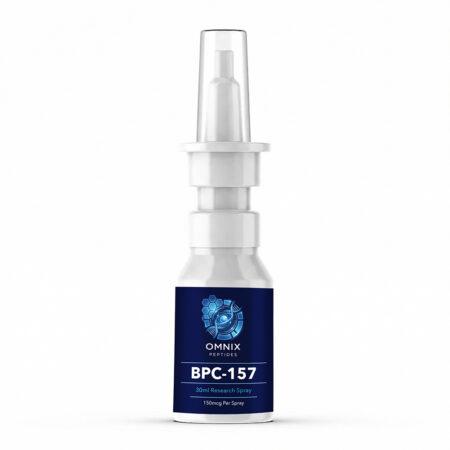
- BPC-157 Liquid Spray — 30 mg per 30 mL bottle. Mucosal-administration format used in research models evaluating non-injectable delivery routes.
For research framed around tissue repair more broadly, see also the related compound hubs for TB-500, GHK-Cu, and the combination BPC+TB Blend. All four are classified under the Recovery & Healing research category.
Amount in the Published Research Literature
The following administration ranges describe the protocols used in the peer-reviewed BPC-157 literature. They are reported here for research-reference purposes only and do not constitute administration recommendations of any kind.
Rodent injury and tissue-repair studies. The published Sikiric-laboratory rodent literature has typically administered BPC-157 in one of two amount ranges: a microgram-per-kilogram range (commonly 10 µg/kg) and a nanogram-per-kilogram range (commonly 10 ng/kg), with both ranges reported to produce measurable effects in tendon, ligament, gastrointestinal, and cardiovascular injury models. Administration routes in these studies include intraperitoneal injection, intragastric (oral) gavage, and topical application as a thin cream layer, with the choice of route depending on the experimental model.
Cerovecki ligament study — three-route protocol detail. In their controlled rat study of medial collateral ligament healing, Cerovecki and colleagues administered BPC-157 by three routes over the 90-day post-injury period [4]. The published protocol specifies once-daily intraperitoneal administration at 10 µg/kg or 10 ng/kg; topical application of 1.0 µg dissolved in distilled water per gram of commercial neutral cream applied at the injury site; and per-oral administration at 0.16 µg/mL in the drinking water (approximately 12 mL/day per rat). First application was made 30 minutes after surgery and the final application 24 hours before sacrifice. The investigators reported macroscopic, microscopic, and biomechanical healing improvements across all three administration routes.
Krivic Achilles tendon study. In the Krivic rat Achilles-detachment study, BPC-157 was administered without a carrier; the investigators reported that BPC 157 alone (without carrier) ameliorates healing of tendon and bone
, with macroscopic, microscopic, and biomechanical assessment all consistent with recovery not observed in untreated controls [3].
Pliva clinical program. The Pliva clinical development program for the PL 14736 formulation evaluated higher absolute amounts in humans for inflammatory bowel disease indications. Phase I safety data have been reported in conference proceedings; full Phase II efficacy data have not been published in the peer-reviewed literature. The amounts used in that program are not directly comparable to the rodent literature and are not summarized here in the absence of complete published data.
Researchers planning protocols are referred to the original primary literature cited in the References section for full methodological detail, including vehicle composition, injection volume, treatment timing relative to injury, and outcome assessment timepoints.
Frequently Asked Questions
Is BPC-157 FDA-approved?
No. BPC-157 is not approved by the FDA, EMA, or any other regulatory authority for any indication. The Croatian pharmaceutical company Pliva advanced a BPC-157 formulation (PL 14736) into Phase I and Phase II trials for inflammatory bowel disease; Phase I safety data appeared in conference proceedings, but full Phase II efficacy results have not been published in the peer-reviewed literature.
What is the published evidence base for BPC-157?
Peer-reviewed BPC-157 research consists predominantly of animal-model studies, primarily in Sprague-Dawley and Wistar rats, and in vitro experiments on isolated fibroblasts, endothelial cells, and tendon explants. Studies have been published in journals including the Journal of Molecular Medicine, the Journal of Applied Physiology, and the Journal of Orthopaedic Research. There are no completed Phase III human clinical trials.
What mechanism of action has been proposed for BPC-157 in the research literature?
Mechanistic studies have proposed pro-angiogenic activity via upregulation of VEGFR2 with downstream activation of the Akt–eNOS pathway, increased fibroblast migration and survival under oxidative stress, modulation of the nitric oxide system, and upregulation of growth hormone receptor expression in tendon fibroblasts. These mechanisms have been characterized primarily in rat and in vitro systems.
What administration routes have been used in BPC-157 research?
Published rodent studies have used intraperitoneal injection, intragastric (oral) gavage, oral administration in drinking water, and topical application as a thin cream layer. The Cerovecki ligament-healing study reported improved healing across all three administration routes (intraperitoneal, oral, topical). BPC-157 has been described in the literature as stable in human gastric juice without enzymatic degradation.
What does the BPC-157 research literature say about gastrointestinal protection?
BPC-157 was originally characterized in rat models for its protective effects against experimentally induced gastrointestinal lesions, including restraint stress, cysteamine, ethanol, and NSAID-induced damage. The gastrointestinal-protection profile motivated the Pliva clinical development program (PL-10, PLD-116, PL 14736) for inflammatory bowel disease. Phase I safety data were reported in conference proceedings; the Phase II ulcerative colitis trial was completed but full peer-reviewed efficacy results have not been published.
How stable is BPC-157 in research models?
BPC-157 has been described in the published literature as stable in human gastric juice without enzymatic degradation, and as effective in rodent research models when administered without a delivery carrier. The investigators have proposed that this stability profile underlies the compound’s reported activity by multiple administration routes (intraperitoneal, oral, topical) in animal models. Stability of the lyophilized powder under appropriate research storage conditions is supported by the batch-specific Certificate of Analysis available on each product page.
How does BPC-157 differ from TB-500?
BPC-157 and TB-500 are structurally unrelated peptides studied in overlapping but distinct injury and tissue-repair models. BPC-157 is a 15-amino-acid synthetic peptide derived from a gastric protein; TB-500 is a synthetic fragment of thymosin beta-4. The mechanistic literature for TB-500 focuses on actin-binding and cell migration via thymosin beta-4 pathways, while BPC-157 mechanistic work focuses on VEGFR2-mediated angiogenesis and the NO system. The two are sometimes combined in research blends — see the BPC+TB Blend hub.
What are the available research formats of BPC-157?
Omnix Peptides supplies BPC-157 as a lyophilized vial (5 mg, 10 mg, or 15 mg per vial), as 500 mcg oral capsules (60-count bottle), and as a 30 mg / 30 mL liquid spray. The vial is the canonical research format used in most of the published preclinical literature; the capsule and spray formats are used in research models evaluating oral and mucosal delivery routes respectively.
References
- Hsieh MJ, Liu HT, Wang CN, et al. Therapeutic potential of pro-angiogenic BPC157 is associated with VEGFR2 activation and up-regulation. J Mol Med (Berl). 2017;95(3):323-333. doi:10.1007/s00109-016-1488-y · PubMed: 27847966
- Chang CH, Tsai WC, Lin MS, Hsu YH, Pang JHS. The promoting effect of pentadecapeptide BPC 157 on tendon healing involves tendon outgrowth, cell survival, and cell migration. J Appl Physiol (1985). 2011;110(3):774-780. doi:10.1152/japplphysiol.00945.2010 · PubMed: 21030672
- Krivic A, Anic T, Seiwerth S, Huljev D, Sikiric P. Achilles detachment in rat and stable gastric pentadecapeptide BPC 157: promoted tendon-to-bone healing and opposed corticosteroid aggravation. J Orthop Res. 2006;24(5):982-989. doi:10.1002/jor.20096 · PubMed: 16583442
- Cerovecki T, Bojanic I, Brcic L, Radic B, Vukoja I, Seiwerth S, Sikiric P. Pentadecapeptide BPC 157 (PL 14736) improves ligament healing in the rat. J Orthop Res. 2010;28(9):1155-1161. doi:10.1002/jor.21107 · PubMed: 20225319
- Chang CH, Tsai WC, Hsu YH, Pang JHS. Pentadecapeptide BPC 157 enhances the growth hormone receptor expression in tendon fibroblasts. Molecules. 2014;19(11):19066-19077. doi:10.3390/molecules191119066 · PubMed: 25415472
For Research Use Only. The products described on this page are sold strictly for in vitro laboratory research and are not intended for human or animal consumption, diagnostic use, or therapeutic use. The published research summarized above is provided as scientific reference material. Nothing on this page constitutes medical advice, a therapeutic claim, or a recommendation for any use outside of a properly resourced and ethically reviewed research setting.