
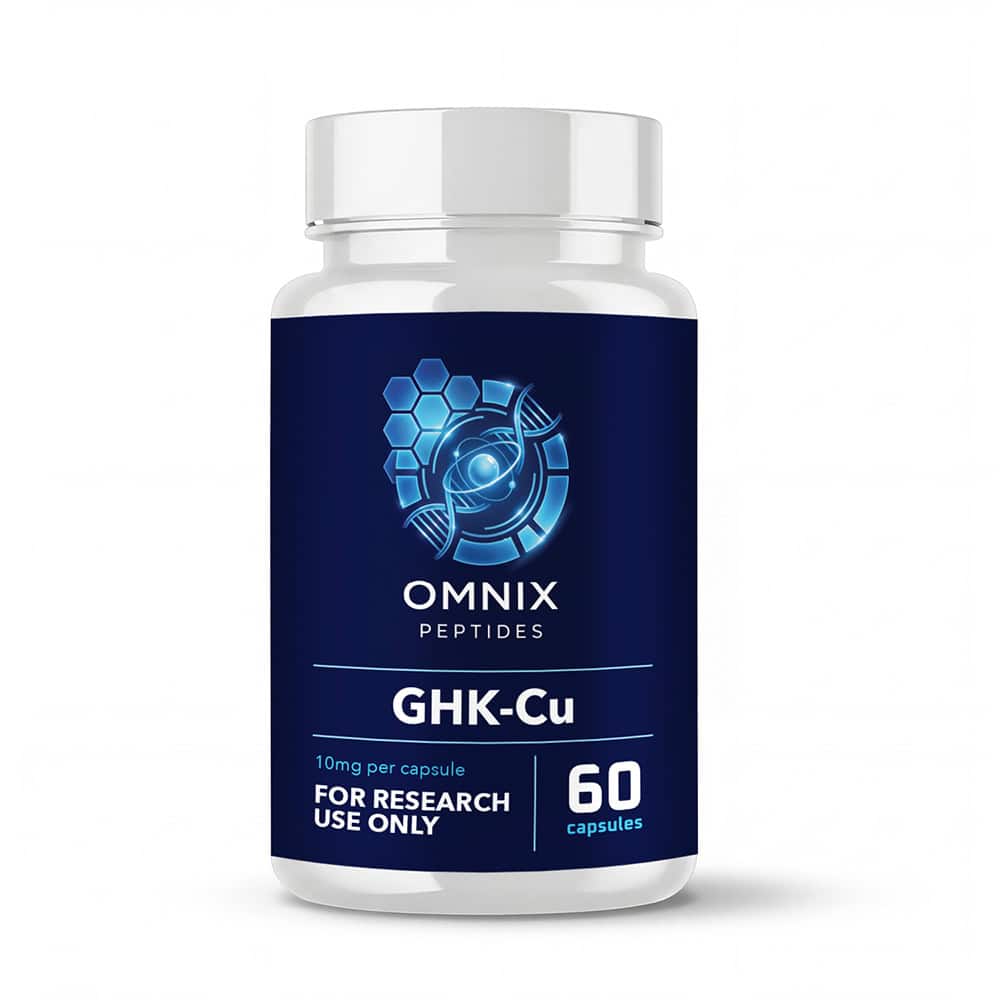
GHK-Cu Capsules 2mg
Oral research format of the copper-binding tripeptide GHK-Cu. Supports preclinical study of systemic copper-peptide administration, complementing the more common topical and injectable copper-peptide research models. HPLC-tested, third-party COA per batch.
$99.99
In stock
Research goals: Recovery & Healing, Skin & Hair
Description
GHK-Cu (CAS 89030-95-5; tripeptide CAS 49557-75-7) is the copper(II) complex of the naturally occurring human tripeptide glycyl-L-histidyl-L-lysine (GHK), originally isolated from human plasma in 1973 by Dr. Loren Pickart. GHK and its copper complex are present in human plasma, saliva, and urine at concentrations that decline with age — from approximately 200 ng/mL at age 20 to approximately 80 ng/mL by age 60. The compound has been the subject of multiple peer-reviewed studies in human participants and in vitro systems, with results published in BioMed Research International, the Archives of Facial Plastic Surgery, and dermatology and cosmetic-science literature.
In a comprehensive 2015 review published in BioMed Research International, Pickart and colleagues integrated three decades of preclinical and clinical research on GHK-Cu, reporting that the molecule stimulates collagen, elastin, glycosaminoglycan, and decorin synthesis in human dermal fibroblasts; modulates matrix metalloproteinase activity; and accelerates wound healing across cell-culture, animal, and human cosmetic-science studies [1].
Published Research on GHK-Cu
The following peer-reviewed studies are summarized below. Full citations and direct links to each publication appear in the References section. Each summary identifies the experimental model used.
Comprehensive Mechanism Review — Pickart et al., BioMed Research International (2015)
Pickart, Vasquez-Soltero, and Margolina conducted an integrative review of GHK-Cu research spanning the 1973 isolation of the tripeptide through subsequent decades of mechanistic and clinical work. The review synthesized findings from cell-culture experiments (human dermal fibroblasts, keratinocytes, irradiated fibroblasts), animal models (rats, mice, pigs, dogs), and human cosmetic-science studies of topical formulations.
The authors concluded that GHK-Cu accelerates wound healing and skin repair
through coordinated effects on collagen and glycosaminoglycan turnover, modulation of metalloproteinase activity, attraction of immune and endothelial cells to injury sites, and restoration of replicative vitality in irradiated fibroblasts [1]. Subsequent gene-expression analyses cited in the review identified GHK-Cu as modulating expression of approximately one-third of human genes, with a pattern consistent with reversal of age-related transcriptomic shifts.
Read the full review: GHK Peptide as a Natural Modulator of Multiple Cellular Pathways in Skin Regeneration (BioMed Research International 2015).
CO2 Laser-Resurfaced Skin — Miller et al., Archives of Facial Plastic Surgery (2006)
Miller and colleagues evaluated the effect of topical copper-tripeptide complex on wound healing following carbon-dioxide laser facial resurfacing — a procedure that creates a controlled superficial burn requiring extended recovery and characterized by prolonged post-treatment erythema. The trial compared standard post-procedure care with a regimen incorporating topical GHK-Cu in adults undergoing CO2 laser resurfacing for photoaging.
The investigators reported faster reepithelialization and reduced post-treatment erythema in the GHK-Cu arm compared with standard care, consistent with prior clinical trials of GHK-Cu in diabetic ulcers and Mohs surgical wounds [2]. The results extended the wound-healing literature on GHK-Cu from chronic-wound contexts into the post-procedural cosmetic-surgery setting.
Read the full study: Effects of Topical Copper Tripeptide Complex on CO2 Laser-Resurfaced Skin (Arch Facial Plast Surg 2006).
Photoaged Skin Trial — Leyden et al., Cosmetic Dermatology / cited in Pickart 2015
Leyden and colleagues conducted a 12-week, vehicle-controlled trial of topical GHK-Cu cream in 71 women with photoaged facial skin. Skin density, thickness, laxity, and fine-line appearance were assessed by clinician evaluation and instrumental measurement at baseline and after 12 weeks of twice-daily application.
The investigators reported improvements in skin density, dermal thickness, laxity (firmness), and reduction of fine lines in the GHK-Cu arm compared with vehicle control over the 12-week treatment period [3]. The trial established the use of topical GHK-Cu in cosmetic dermatology and is among the most widely cited human clinical studies in the GHK-Cu literature.
This trial is detailed in the comprehensive review by Pickart et al. (2015) cited above and in cosmetic-dermatology literature.
Nano-Lipid Carrier Delivery — Badenhorst et al., Journal of Cosmetic Dermatology (2016)
Badenhorst and colleagues evaluated GHK-Cu encapsulated in nano-lipid carrier (NLC) formulations against control serum in a controlled clinical trial measuring facial wrinkle volume and depth. Wrinkle metrics were assessed by quantitative imaging at baseline and after the treatment period across matched skin regions.
The authors reported a 55.8% reduction in facial wrinkle volume and a 32.8% reduction in wrinkle depth compared with control serum, alongside in vitro evidence that GHK-Cu increased both collagen and elastin production in human dermal fibroblasts at concentrations as low as 0.01 nM [4]. The findings suggested that delivery vehicle has a substantial influence on the bioavailability and clinical effect of topical GHK-Cu formulations.
This study is cited in the Pickart 2015 review and in the cosmetic-dermatology literature.
About the Compound
GHK-Cu is the copper(II) chelate complex of the human tripeptide glycyl-L-histidyl-L-lysine (Gly-His-Lys). The free tripeptide GHK has a high affinity for divalent copper ions and exists in human plasma predominantly as the GHK-Cu complex. The molecule was first isolated by Pickart in 1973 as the active component of human albumin fraction responsible for inducing older liver tissue to synthesize proteins characteristic of younger tissue — an observation that led to subsequent decades of research into GHK-Cu’s effects on wound healing, skin regeneration, gene expression, and cellular senescence.
The published research literature describes GHK-Cu as exerting effects through multiple coordinated mechanisms: stimulation of fibroblast proliferation and migration; upregulation of collagen, elastin, decorin, and glycosaminoglycan synthesis; modulation of matrix metalloproteinase (MMP) activity and their tissue inhibitors (TIMPs); attraction of immune and endothelial cells to injury sites; suppression of TNF-α-induced inflammatory cytokine secretion; and broad transcriptional effects, with gene-expression analyses identifying modulation of expression patterns associated with antioxidant defense, DNA repair, and tissue remodeling.
- CAS Number: 89030-95-5 (GHK-Cu complex); 49557-75-7 (free GHK tripeptide)
- Molecular Formula: C14H23CuN6O4 (complex); C14H24N6O4 (free tripeptide)
- Molecular Weight: 402.91 g/mol (complex); 340.38 g/mol (free tripeptide)
- Sequence: Glycyl-L-histidyl-L-lysine (Gly-His-Lys)
- Synonyms: Copper tripeptide-1, GHK copper, prezatide copper acetate, lamin
- Mechanisms investigated in research literature: Collagen/elastin/glycosaminoglycan synthesis; MMP/TIMP modulation; fibroblast migration and proliferation; gene-expression modulation; antioxidant defense pathway upregulation
- Regulatory status (as of publication): Not approved as a drug in the United States. Widely used as an active ingredient in cosmetic and skincare formulations; available as a research-use chemical.
Product Specifications
Omnix Peptides supplies GHK-Cu as encapsulated material in sealed amber bottles intended exclusively for in vitro laboratory research. Each production lot is independently characterized using high-performance liquid chromatography (HPLC) and liquid chromatography–mass spectrometry (LC–MS) protocols.
- Format: Capsules
- Strength: 2 mg per capsule
- Count: 60 capsules per bottle
- Verified Purity: >99% (HPLC, LC–MS)
- Container: Sealed amber bottle
- Documentation: Batch-specific Certificate of Analysis (COA) available
Storage, handling, intended-use, and regulatory information are provided in the corresponding tabs on this product page.
References
- Pickart L, Vasquez-Soltero JM, Margolina A. GHK peptide as a natural modulator of multiple cellular pathways in skin regeneration. Biomed Res Int. 2015;2015:648108. doi:10.1155/2015/648108
- Miller TR, Wagner JD, Baack BR, Eisbach KJ. Effects of topical copper tripeptide complex on CO2 laser-resurfaced skin. Arch Facial Plast Surg. 2006;8(4):252-259. doi:10.1001/archfaci.8.4.252
- Leyden J, Stephens TJ, Finkey MB, Barkovic S. Skin care benefits of copper peptide containing facial cream. American Academy of Dermatology Annual Meeting, 2002. Cited in Pickart L, et al. Biomed Res Int. 2015;2015:648108.
- Badenhorst T, Svirskis D, Wu Z. Physicochemical characterization of native glycyl-L-histidyl-L-lysine tripeptide for wound healing and anti-aging: a pre-formulation study for dermal delivery. Pharm Dev Technol. 2016;21(2):152-160. doi:10.3109/10837450.2014.979944
Preparation and storage
Research-only handling information. GHK-Cu is sold strictly for in vitro laboratory research. The handling and storage guidance below reflects standard practice in published peptide research literature. GHK-Cu is not a drug, supplement, or food product, and is not for human consumption, veterinary use, or medical applications.
Format
- Form: Capsules
- Available strengths: 60ct
- Verified purity: >99% (HPLC, LC–MS)
- Documentation: Batch-specific Certificate of Analysis (COA) included
Handling for Research Use
GHK-Cu capsules ship as a pre-encapsulated, dry oral-research format. No reconstitution is required. The capsules can be opened for analytical or assay work that requires the dry powder.
Storage & Handling
- Upon receipt: Store in a cool, dry place away from direct light.
- Short-term storage: Room temperature in a sealed container is acceptable for several months.
- Long-term storage: Refrigeration at 4 °C (39 °F) extends shelf stability. Capsules do not require freezing.
- Humidity: Keep the original desiccant-sealed container closed when not in use. Excess moisture can compromise capsule integrity.
- Light exposure: Minimize exposure to direct light during handling.
Important Notice
All Omnix Peptides products are sold for laboratory, research, or analytical purposes only. They are not for human consumption, veterinary use, or medical applications. Researchers and laboratory professionals must follow all applicable institutional, local, state, and federal regulations governing the handling of research compounds.
Citations
Citations and reference data. Omnix Peptides supplies research-grade compounds for use by qualified laboratory professionals. The references below cite published preclinical research conducted in animal models and in vitro systems. They are not intended to represent clinical evidence in humans, and GHK-Cu has not been approved by the FDA, EMA, or any other regulatory authority for any indication.
Compound Reference Data
- Compound: GHK-Cu
- CAS Number: 89030-95-5 (GHK-Cu complex); 49557-75-7 (free GHK tripeptide)
- Molecular Formula: C14H23CuN6O4 (complex); C14H24N6O4 (free tripeptide)
- Molecular Weight: 402.91 g/mol (complex); 340.38 g/mol (free tripeptide)
- Sequence: Glycyl-L-histidyl-L-lysine (Gly-His-Lys)
- Synonyms: Copper tripeptide-1, GHK copper, prezatide copper acetate, lamin
Selected Published Studies
The following peer-reviewed studies were conducted using animal models or in vitro cell-culture systems. They are listed here as a reference for researchers investigating GHK-Cu. None of these studies should be interpreted as recommending GHK-Cu for human use, treatment, or any clinical purpose.
- Pickart L, Vasquez-Soltero JM, Margolina A. GHK peptide as a natural modulator of multiple cellular pathways in skin regeneration. Biomed Res Int. 2015;2015:648108. doi:10.1155/2015/648108
- Miller TR, Wagner JD, Baack BR, Eisbach KJ. Effects of topical copper tripeptide complex on CO2 laser-resurfaced skin. Arch Facial Plast Surg. 2006;8(4):252-259. doi:10.1001/archfaci.8.4.252
- Leyden J, Stephens TJ, Finkey MB, Barkovic S. Skin care benefits of copper peptide containing facial cream. American Academy of Dermatology Annual Meeting, 2002. Cited in Pickart L, et al. Biomed Res Int. 2015;2015:648108.
- Badenhorst T, Svirskis D, Wu Z. Physicochemical characterization of native glycyl-L-histidyl-L-lysine tripeptide for wound healing and anti-aging: a pre-formulation study for dermal delivery. Pharm Dev Technol. 2016;21(2):152-160. doi:10.3109/10837450.2014.979944
Evidence-Base Disclosure
The published evidence base for GHK-Cu consists predominantly of preclinical research — animal models (often rats or mice) and in vitro cell-culture experiments. Where Phase I or Phase II human trials exist, they are noted in the compound page summary. Researchers should interpret the cited literature within the experimental context of each individual study.
Frequently asked questions
Frequently asked questions about the GHK-Cu Capsules. Questions on this page cover handling, storage, documentation, and ordering. GHK-Cu is sold for laboratory, research, or analytical purposes only — not for human consumption, veterinary use, or medical applications.
Why does Omnix offer GHK-Cu in a capsule format?
Capsule format is used in oral-research and analytical contexts where dry, pre-measured administration is preferred over a reconstituted solution. The capsules contain the same research-grade compound supplied in the vial format and are tested to the same purity specification.
Do the GHK-Cu capsules require refrigeration?
Capsules are stable at room temperature for several months when kept in a cool, dry place away from direct light. Refrigeration at 4 °C (39 °F) extends shelf stability and is recommended for long-term storage. Capsules do not require freezing.
Can the capsules be opened to access the dry powder?
Yes. The capsule shell can be opened for analytical or assay work that requires direct handling of the dry powder. Once opened, the powder should be used immediately or transferred to a sealed, light-protected container.
Is GHK-Cu approved by the FDA?
No. GHK-Cu is not approved by the FDA, EMA, or any other regulatory authority for any indication. GHK-Cu is sold by Omnix Peptides strictly for laboratory, research, or analytical purposes. It is not for human consumption, veterinary use, or medical applications.
What is included with each GHK-Cu Capsules?
Each order includes the sealed product container and a batch-specific Certificate of Analysis (COA) verifying identity and purity by HPLC and LC–MS. The full COA library for Omnix Peptides is available at /coa-lab-reports/.
What is a Certificate of Analysis (COA), and how do I read it?
A COA is a batch-specific lab report that documents the identity, purity, and quality control results for the production lot you receive. The COA lists the compound name, CAS number, lot number, analytical methods used (HPLC, LC–MS), and the measured purity percentage. Every Omnix order includes the COA for the lot shipped.
What is the CAS number for GHK-Cu?
The CAS number for GHK-Cu is 89030-95-5 (GHK-Cu complex); 49557-75-7 (free GHK tripeptide). Researchers can use this identifier to locate published literature in PubMed and other scientific databases.
How does Omnix Peptides ship orders?
Orders ship from a US-based facility with tracked domestic shipping. Free shipping is offered on orders over $99. Lyophilized vials and capsules ship at ambient temperature; sprays ship insulated when seasonal conditions require it. Tracking information is provided by email after the order ships.
What if my product arrives damaged or the seal is broken?
Contact Omnix Peptides within 48 hours of delivery. Product damaged in transit or arriving with a compromised seal will be replaced at no cost. See the Shipping & Return Policy at /shipping-return-policy/ for full terms.
Where can I find published research on GHK-Cu?
Peer-reviewed studies relevant to GHK-Cu are listed in the Citations tab on this product page. The same studies can be located independently on PubMed using the CAS number (89030-95-5 (GHK-Cu complex); 49557-75-7 (free GHK tripeptide)) or the compound name.
Customer reviews
Certificate of Analysis
Third-party HPLC purity analysis performed by an independent laboratory for this batch.
Reviews
There are no reviews yet.