SLU-PP-332 is a synthetic small-molecule pan-agonist of the three estrogen-related receptors (ERRα, ERRβ, ERRγ), a family of orphan nuclear receptors that regulates mitochondrial biogenesis, fatty acid oxidation, and the transcriptional program activated by aerobic exercise. The compound was identified and characterized in the laboratory of Thomas P. Burris at Saint Louis University School of Medicine (with subsequent work at Washington University in St. Louis and the University of Florida), and was named for its origin at SLU. In a 2023 paper published in ACS Chemical Biology, Billon and colleagues reported that SLU-PP-332 binds the ERR ligand-binding domain with highest potency at ERRα, activates an acute aerobic-exercise transcriptional program in mouse skeletal muscle, increases the proportion of type IIa oxidative muscle fibers, and enhances exercise endurance in treadmill exhaustion testing — effects that depend on functional ERRα signaling, as demonstrated by loss-of-effect in ERRα-knockout mice [1].
SLU-PP-332 has not been investigated in human clinical trials. The published research base is entirely preclinical — mouse exercise-capacity studies, mouse diet-induced obesity and ob/ob obesity models, in vitro mitochondrial respiration assays in C2C12 myoblasts, and structure–activity / cardiac-function follow-up work. SLU-PP-332 is not approved by the FDA, EMA, or any other regulatory authority for any indication, and is not in active regulatory development as a drug candidate. The compound has been classified by the World Anti-Doping Agency as a prohibited substance under the metabolic-modulator category in sports contexts.
The compound is widely described in the research literature as an “exercise mimetic” because its transcriptional readout in skeletal muscle overlaps substantially with the gene-expression signature produced by endurance exercise. The mechanism class — nuclear-receptor activation of mitochondrial biogenesis and fatty acid oxidation — is distinct from the mitochondrial protonophore uncoupler class (which includes BAM15) and from the mitochondrial-derived peptide class (which includes MOTS-c).
Important Note on the Evidence Base
Important note on the evidence base: The SLU-PP-332 research literature is entirely preclinical, consisting of mouse skeletal-muscle exercise-capacity studies, mouse diet-induced obesity and ob/ob metabolic-syndrome models, in vitro receptor-binding and transcriptional-activation assays, and follow-up work in cardiac and renal systems. There are no human clinical trials of SLU-PP-332. The “exercise mimetic” framing that appears widely in popular coverage of the compound describes the transcriptional and physiologic-readout overlap between SLU-PP-332 administration and endurance exercise in mouse skeletal muscle — not a clinically validated equivalence between SLU-PP-332 treatment and exercise as an intervention. Researchers planning protocols should treat the rodent findings as scientific reference for the published model systems, not as guidance for any other context.
Mechanism of Action
SLU-PP-332 activates the three estrogen-related receptors (ERRα, ERRβ, ERRγ), with the highest potency at ERRα. The ERRs are orphan nuclear receptors — they share substantial structural homology with the estrogen receptors but do not bind estradiol or other classical estrogen-receptor ligands. They function as master transcriptional regulators of mitochondrial metabolism and exercise-responsive gene expression, with ERRα in particular driving the transcription of genes governing fatty acid oxidation, mitochondrial biogenesis, and oxidative phosphorylation in skeletal muscle, heart, and liver.
Receptor-binding and transcriptional activation. Billon and colleagues characterized SLU-PP-332 in HEK293 cotransfection assays as activating ERRα with greatest potency, with measurable activity at ERRβ and ERRγ. Downstream gene-expression readouts in C2C12 myoblasts include upregulation of pyruvate dehydrogenase kinase 4 (PDK4) and other ERR-target genes, consistent with a shift toward fatty acid oxidation as a fuel substrate. Mechanistic specificity was confirmed by loss-of-effect in ERRα-knockout mice, which failed to show the exercise-endurance enhancement that wild-type mice showed in response to the compound [1].
Skeletal muscle adaptation and exercise endurance. Administration of SLU-PP-332 to mice over a multi-week protocol produced a shift toward type IIa oxidative skeletal muscle fibers — the fiber type predominantly increased by endurance exercise training in both rodents and humans. The shift was accompanied by upregulation of oxidative enzyme expression, mitochondrial biogenesis markers, and fatty acid oxidation capacity. Treadmill exhaustion testing showed enhanced exercise endurance in SLU-PP-332-treated mice compared to vehicle-treated controls [1].
Diet-induced obesity and metabolic syndrome. A follow-up study by Billon and colleagues, published in the Journal of Pharmacology and Experimental Therapeutics in 2024, examined SLU-PP-332 in mouse models of diet-induced obesity and in ob/ob mice (a genetic leptin-deficiency model of obesity). In both models, SLU-PP-332 administration increased whole-body energy expenditure and fatty acid oxidation, decreased fat-mass accumulation, and improved glucose tolerance and insulin sensitivity [2]. The metabolic-syndrome findings extend the skeletal-muscle exercise-mimetic readouts into the obesity-research context, though whether the metabolic effects are entirely accounted for by skeletal-muscle ERRα activation or also involve hepatic and other tissue contributions remains an active research question.
Cardiac fatty acid metabolism. Subsequent work has extended the SLU-PP-332 mechanism into cardiac systems, with Xu and colleagues reporting in Circulation in 2024 that pan-ERR agonist treatment enhanced cardiac fatty acid metabolism and mitochondrial function in mouse heart-failure models [3]. The cardiac and metabolic findings reinforce the broader characterization of ERR activation as upstream of multiple oxidative-metabolism programs across tissues.
Available Forms
Omnix Peptides supplies SLU-PP-332 in a single research format. Each lot is independently characterized by HPLC and LC–MS, with a batch-specific Certificate of Analysis available on the product page.
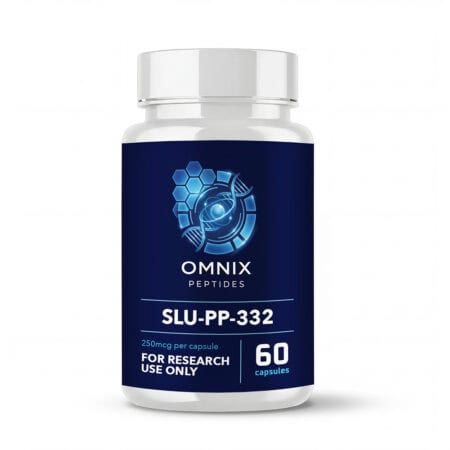
- SLU-PP-332 Capsules 250 mcg, 60-count — oral capsule format. The capsule format supports in vitro and ex vivo research workflows; the published rodent literature has used intraperitoneal injection as the primary administration route in the mouse exercise-capacity and metabolic-syndrome studies.
SLU-PP-332 is classified under the Metabolic & Weight Research research category. For research framed around different mitochondrial mechanism classes in the metabolic neighborhood, see the MOTS-c hub (a mitochondrial-derived peptide with proposed AMPK-mediated effects) and the 5-Amino-1MQ hub (a small-molecule NNMT inhibitor with proposed NAD+-axis effects). For the protonophore-uncoupler mechanism class, see the BAM15 hub.
Amount in the Published Research Literature
The following administration ranges describe the protocols used in the peer-reviewed rodent literature on SLU-PP-332. They are reported here for research-reference purposes only and do not constitute administration recommendations of any kind. SLU-PP-332 has not been investigated in human clinical trials, and no human-equivalent amount translation has been published in the peer-reviewed literature.
Billon 2023 — mouse exercise-capacity protocols. The Billon 2023 study that introduced and characterized SLU-PP-332 as a pan-ERR agonist used intraperitoneal injection in C57BL/6J mice for the in vivo exercise-endurance experiments, with mice receiving the compound prior to treadmill exhaustion testing or over multi-day protocols for the gene-expression and muscle-fiber-type readouts. The in vitro C2C12 myoblast work used concentration-response treatments to characterize the PDK4 transcriptional response and mitochondrial respiration effects, with effects measurable in the sub-micromolar to low-micromolar range in cell systems [1].
Billon 2024 — diet-induced obesity and ob/ob protocols. The follow-up Billon 2024 study in the metabolic-syndrome models used intraperitoneal SLU-PP-332 at 50 mg/kg twice daily in C57BL/6J mice on a high-fat diet for 28 days, and in ob/ob mice for 12 days. The protocol produced the energy-expenditure, fatty-acid-oxidation, and fat-mass-reduction readouts cited in the mechanism section above. Amount selection was justified in the paper by reference to the prior Billon 2023 pharmacokinetic and pharmacodynamic characterization in the exercise-capacity studies [2].
Combination and tissue-specific protocols. The Xu 2024 Circulation work on cardiac fatty acid metabolism used distinct mouse heart-failure protocols with corresponding compound-administration regimens; researchers planning cardiac-focused work should consult the primary paper for the specific model systems and administration detail [3].
Researchers planning protocols are referred to the original primary literature cited in the References section for full methodological detail, including vehicle composition (the Billon 2024 vehicle was DMSO-based for intraperitoneal injection), administration timing relative to exercise or metabolic-stimulus protocols, and outcome assessment timepoints.
Frequently Asked Questions
Is SLU-PP-332 FDA-approved?
No. SLU-PP-332 is not approved by the FDA, EMA, or any other regulatory authority for any indication, and is not in active regulatory development as a drug candidate. The published research base is entirely preclinical — mouse exercise-capacity studies, mouse diet-induced obesity and ob/ob metabolic-syndrome models, in vitro receptor-binding and transcriptional-activation assays, and cardiac fatty-acid-metabolism work. SLU-PP-332 has not been investigated in human clinical trials.
What does the “exercise mimetic” framing mean for SLU-PP-332?
The exercise mimetic framing describes the transcriptional and physiologic-readout overlap between SLU-PP-332 administration and endurance exercise in mouse skeletal muscle — the compound activates a gene-expression program that substantially overlaps with the program activated by endurance training, with downstream effects including type IIa oxidative muscle fiber shift, increased mitochondrial biogenesis, and enhanced treadmill exhaustion-test performance. The framing should not be read as a clinically validated equivalence between SLU-PP-332 treatment and exercise as an intervention. SLU-PP-332 has not been studied in humans, and the rodent transcriptional-overlap findings have not been translated into any clinical outcome.
What are estrogen-related receptors and how do they differ from estrogen receptors?
The estrogen-related receptors (ERRα, ERRβ, ERRγ) are orphan nuclear receptors that share substantial structural homology with the estrogen receptors (ERα, ERβ) but do not bind estradiol or other classical estrogen-receptor ligands. They function as master transcriptional regulators of mitochondrial metabolism and exercise-responsive gene expression, with ERRα in particular driving transcription of genes governing fatty acid oxidation, mitochondrial biogenesis, and oxidative phosphorylation in skeletal muscle, heart, and liver. SLU-PP-332 activates all three ERRs with highest potency at ERRα; it is not active at the classical estrogen receptors. The two receptor families are mechanistically distinct despite the structural homology and naming convention.
What rodent models has SLU-PP-332 been studied in?
Three primary mouse model classes appear in the published SLU-PP-332 literature. First, the skeletal-muscle exercise-capacity model — used in Billon 2023 to characterize the type IIa oxidative fiber shift, mitochondrial biogenesis, and treadmill exhaustion-test performance. Second, the diet-induced obesity and ob/ob metabolic-syndrome models — used in Billon 2024 to characterize energy expenditure, fatty acid oxidation, fat-mass reduction, and insulin-sensitivity readouts. Third, mouse heart-failure models — used in Xu 2024 to characterize cardiac fatty acid metabolism and mitochondrial function. In vitro work has used C2C12 myoblasts for receptor-binding and transcriptional-activation assays.
How does SLU-PP-332 differ from BAM15?
BAM15 and SLU-PP-332 both appear in the mitochondrial-metabolism research literature, but they operate through entirely different mechanism classes. BAM15 is a mitochondrial protonophore uncoupler that acts directly on the inner mitochondrial membrane, dissipating the proton gradient and uncoupling nutrient oxidation from ATP synthesis (the same mechanism class as 2,4-dinitrophenol, though BAM15 is structurally distinct). SLU-PP-332 is a nuclear-receptor agonist that acts on the three estrogen-related receptors to drive transcription of mitochondrial-biogenesis and fatty-acid-oxidation genes. The protonophore mechanism class carries acute mammalian toxicity risk that does not apply to ERR agonists. The two literatures are entirely separate.
Why is SLU-PP-332 prohibited by the World Anti-Doping Agency?
SLU-PP-332 has been classified by WADA under the metabolic-modulator and exercise-mimetic prohibited-substance category in sports contexts. The classification reflects the published rodent data showing enhanced exercise endurance and oxidative muscle fiber adaptation in response to SLU-PP-332 administration — readouts that would be considered performance-enhancing if reproduced in humans. WADA-related metabolite characterization work has been published to support doping-control detection methods. The WADA classification is independent of any regulatory approval status; it applies in sports-governance contexts regardless of whether a compound has been approved as a drug.
References
- Billon C, Sitaula S, Banerjee S, et al. Synthetic ERRα/β/γ agonist induces an ERRα-dependent acute aerobic exercise response and enhances exercise capacity. ACS Chem Biol. 2023;18(4):756-771. doi:10.1021/acschembio.2c00720 · PubMed: 36988910
- Billon C, Schoepke E, Avdagic A, et al. A synthetic ERR agonist alleviates metabolic syndrome. J Pharmacol Exp Ther. 2024;388(2):232-240. doi:10.1124/jpet.123.001733 · PubMed: 37739806
- Xu W, Billon C, Li H, et al. Novel pan-ERR agonists ameliorate heart failure through enhancing cardiac fatty acid metabolism and mitochondrial function. Circulation. 2024;149(3):227-250. doi:10.1161/CIRCULATIONAHA.123.066542 · PubMed: 37961903
For Research Use Only. The products described on this page are sold strictly for in vitro laboratory research and are not intended for human or animal consumption, diagnostic use, or therapeutic use. The published research summarized above is provided as scientific reference material. Nothing on this page constitutes medical advice, a therapeutic claim, or a recommendation for any use outside of a properly resourced and ethically reviewed research setting.