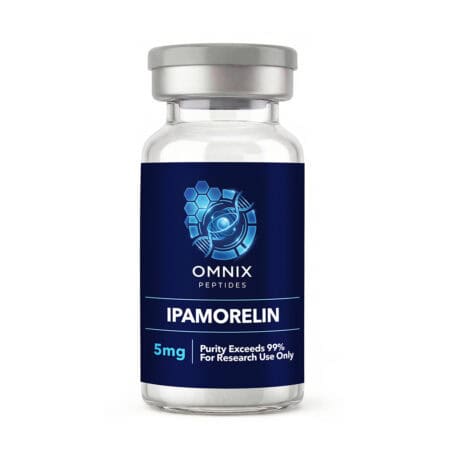
Ipamorelin (development code NNC 26-0161; CAS 170851-70-4) is a synthetic pentapeptide (Aib-His-D-2-Nal-D-Phe-Lys-NH2) that functions as a selective growth hormone secretagogue, acting through the ghrelin receptor (GHSR1a, also called the GH-secretagogue receptor). Ipamorelin was originally characterized by Raun and colleagues at Novo Nordisk and described in European Journal of Endocrinology (1998) as the first selective growth hormone secretagogue
: at GH-releasing amounts, ipamorelin does not produce the elevations in adrenocorticotropic hormone (ACTH), cortisol, or prolactin that limited the clinical development of earlier GH-releasing peptides (GHRP-2, GHRP-6) [1].
The peer-reviewed research literature on ipamorelin includes preclinical bone-growth and bone-mineral-content studies in rats published in Growth Hormone & IGF Research (Johansen 1999) [3] and the Journal of Endocrinology (Svensson 2000) [4], and one Phase 2 proof-of-concept trial in postoperative ileus published by Beck and colleagues in International Journal of Colorectal Disease (2014) [2]. The Phase 2 postoperative-ileus trial did not meet its primary efficacy endpoint, and clinical development of ipamorelin for that indication was subsequently discontinued.
Ipamorelin is not approved by the FDA, EMA, or any other regulatory authority for any indication. It is available as a research-use chemical for laboratory investigations of ghrelin-receptor pharmacology, GH-secretagogue biology, and the GH/IGF-1 axis. In growth-hormone-axis research, ipamorelin is frequently studied in combination with GHRH-receptor agonists (such as sermorelin or CJC-1295) because the two compound classes act through distinct receptors that converge on GH release.
Important Note on the Evidence Base
Important note on the evidence base: The published peer-reviewed ipamorelin research literature consists primarily of preclinical pharmacology and rodent-model studies (Raun 1998 in vitro and in vivo characterization, Johansen 1999 longitudinal bone growth in rats, Svensson 2000 bone mineral content in rats) and one Phase 2 human trial (Beck 2014 postoperative ileus) that did not meet its primary endpoint. There are no published Phase 3 trials of ipamorelin, and clinical development for postoperative ileus was discontinued after the Phase 2 result. Researchers consulting this page should weight the evidence base accordingly: receptor pharmacology and rodent in vivo effects are reasonably well characterized; controlled human data is limited.
Mechanism of Action
Ipamorelin acts as a synthetic ghrelin mimetic at the ghrelin receptor (GHSR1a), which is expressed on somatotroph cells in the anterior pituitary, in the hypothalamus, and in multiple peripheral tissues. The receptor is the same one through which endogenous ghrelin signals.
Ghrelin-receptor agonism. The Raun 1998 foundational pharmacology study characterized ipamorelin’s receptor-binding profile and its functional GH-releasing activity in vitro (rat pituitary cells) and in vivo (multiple species) [1]. The investigators reported that ipamorelin produces GH release at potencies comparable to GHRP-6 but with substantially greater selectivity, with the compound described as the first selective growth hormone secretagogue
in the contemporaneous literature. The mechanism involves Gαq-coupled activation of phospholipase C and intracellular calcium mobilization in somatotroph cells, leading to exocytosis of stored GH.
Selectivity over ACTH/cortisol/prolactin. The distinguishing pharmacological feature of ipamorelin relative to earlier GH-releasing peptides (GHRP-6, hexarelin) is that GH-releasing amounts do not produce the parallel elevations in ACTH, cortisol, or prolactin that were observed with the earlier compounds. This selectivity was framed at the time as a desirable property for clinical development, since the off-target endocrine effects of earlier GHRPs were a barrier to therapeutic use.
Complementarity with GHRH-receptor agonism. Ghrelin-receptor and GHRH-receptor agonists act on different receptors that converge on GH release from the same somatotroph cells. In rodent and in vitro models, simultaneous activation of both receptors produces GH release greater than the sum of either agonist alone, consistent with synergistic signaling through complementary intracellular pathways. This pharmacological rationale underlies the common pairing of ipamorelin with GHRH analogs (sermorelin, CJC-1295) in growth-hormone-axis research protocols.
Bone-growth effects in rats. The Johansen 1999 study evaluated longitudinal bone growth in rats receiving subcutaneous ipamorelin and reported concentration-dependent increases in tibial growth rate, consistent with a functional anabolic effect of GH-axis activation by ipamorelin [3]. The Svensson 2000 study evaluated bone mineral content in adult female rats receiving ipamorelin or GHRP-6 and reported increases in bone mineral content with both compounds, with ipamorelin’s effect mediated through the GH-axis activation pathway [4]. These preclinical findings establish ipamorelin’s in vivo GH/IGF-1-axis activity and the downstream skeletal effects characteristic of GH-axis stimulation.
Phase 2 postoperative-ileus trial. The Beck 2014 Phase 2 proof-of-concept study tested ipamorelin in adults undergoing bowel-resection surgery, on the hypothesis that ghrelin-receptor agonism would accelerate post-surgical recovery of gastrointestinal motility through ghrelin’s known prokinetic effects [2]. The trial did not meet its primary efficacy endpoint, and the program was subsequently discontinued. The trial is nonetheless informative as the most rigorous published human data on ipamorelin to date, with characterization of pharmacokinetics, safety, and biomarker effects in the postoperative population.
Available Forms
Omnix Peptides currently supplies ipamorelin in a single research format. Each lot is independently characterized by HPLC and LC–MS, with a batch-specific Certificate of Analysis available on the product page.
- Ipamorelin Vial — lyophilized powder for reconstitution. The vial is the canonical research format for ipamorelin; subcutaneous administration is the route used in the peer-reviewed clinical (Beck 2014) and preclinical (Johansen 1999, Svensson 2000) literature.
Ipamorelin is classified under the Growth Hormone Axis research category. For research framed around overlapping growth-hormone-axis pharmacology, see also the related compound hubs for CJC-1295 (no DAC) (a GHRH-receptor agonist commonly paired with ipamorelin in research protocols), Sermorelin (GHRH(1–29)NH2), and Tesamorelin (a stabilized GHRH analog approved for HIV-associated lipodystrophy).
Amount in the Published Research Literature
The following amount ranges describe the protocols used in the peer-reviewed ipamorelin literature. They are reported here for research-reference purposes only and do not constitute administration recommendations of any kind.
Raun 1998 foundational pharmacology. The original characterization study used multiple in vivo species (rats, pigs, dogs) with subcutaneous or intravenous ipamorelin administration across a range of amounts, evaluating GH release, ACTH/cortisol/prolactin selectivity, and concentration-response relationships [1]. The study established the concentration-response curves that informed subsequent preclinical and clinical development.
Johansen 1999 longitudinal bone growth in rats. Young rats received subcutaneous ipamorelin (and comparator GH-releasing peptides) over multi-week treatment periods, with tibial growth rate measured by fluorochrome-labeling techniques and serum IGF-1 measured as a secondary endpoint [3]. The investigators reported concentration-dependent increases in longitudinal bone growth across the amount-range studied.
Svensson 2000 bone mineral content in rats. Adult female rats received subcutaneous ipamorelin (or GHRP-6) over a multi-week treatment period, with dual-energy X-ray absorptiometry (DEXA) and chemical analysis of bone mineral content used as primary endpoints [4]. The investigators reported increases in bone mineral content with both compounds.
Beck 2014 Phase 2 postoperative-ileus trial. The Phase 2 trial in adults undergoing bowel-resection surgery used intravenous ipamorelin administration in the immediate post-surgical period, with the amount and infusion schedule specified in the trial protocol [2]. The trial did not meet its primary endpoint of time to recovery of gastrointestinal function.
Pharmacokinetic considerations. Ipamorelin has a short circulatory half-life (approximately 2 hours in published pharmacokinetic data), with peak GH-releasing effects within approximately 30–60 minutes of administration. Research protocols evaluating sustained GH-axis activation typically use multiple-daily administration or continuous-infusion strategies. Researchers planning protocols are referred to the original primary literature cited in the References section for full methodological detail.
Frequently Asked Questions
Is ipamorelin FDA-approved?
No. Ipamorelin is not approved by the FDA, EMA, or any other regulatory authority for any indication. The most advanced published clinical trial — the Beck 2014 Phase 2 proof-of-concept study in postoperative ileus — did not meet its primary efficacy endpoint, and clinical development for that indication was discontinued. Ipamorelin is available as a research-use chemical for laboratory investigations of ghrelin-receptor pharmacology and the GH/IGF-1 axis.
What mechanism of action does ipamorelin use?
Ipamorelin is a synthetic ghrelin mimetic that acts as a selective agonist at the ghrelin receptor (GHSR1a). The receptor is expressed on somatotroph cells in the anterior pituitary, in the hypothalamus, and in multiple peripheral tissues. Receptor activation triggers Gαq-coupled phospholipase C signaling and intracellular calcium mobilization, leading to exocytosis of stored growth hormone. It is the same receptor through which endogenous ghrelin signals.
What makes ipamorelin a “selective” growth hormone secretagogue?
Ipamorelin was characterized in the Raun 1998 foundational pharmacology paper as the first selective growth hormone secretagogue
— producing GH release without parallel elevations in ACTH, cortisol, or prolactin at GH-releasing amounts [1]. Earlier compounds in the class (GHRP-6, hexarelin) produced parallel elevations in these off-target hormones, which was a barrier to clinical development. This selectivity is the defining pharmacological feature of ipamorelin within the GH-secretagogue compound family.
How does ipamorelin pair with CJC-1295 or sermorelin?
Ipamorelin acts at the ghrelin receptor (GHSR1a); CJC-1295 and sermorelin act at the GHRH receptor. The two receptors are expressed on the same somatotroph cells in the anterior pituitary and signal through complementary intracellular pathways that converge on growth hormone release. In rodent and in vitro models, simultaneous activation of both receptors produces GH release greater than the sum of either agonist alone, consistent with synergistic signaling. This pharmacological rationale underlies the common pairing of ipamorelin with GHRH analogs in research protocols.
What does the Beck 2014 Phase 2 trial show?
The Beck 2014 Phase 2 proof-of-concept trial evaluated ipamorelin in adults undergoing bowel-resection surgery, on the hypothesis that ghrelin-receptor agonism would accelerate post-surgical recovery of gastrointestinal motility. The trial did not meet its primary endpoint of time to recovery of gastrointestinal function [2]. Despite the negative primary result, the trial provides the most rigorous published human pharmacokinetic and safety data on ipamorelin to date.
What do the rat bone-growth studies show?
The Johansen 1999 study in young rats reported concentration-dependent increases in tibial longitudinal growth rate and serum IGF-1 with subcutaneous ipamorelin administration [3]. The Svensson 2000 study in adult female rats reported increases in bone mineral content with ipamorelin (and the comparator GHRP-6) [4]. Both findings are consistent with the expected downstream skeletal effects of GH/IGF-1-axis activation.
What is the pharmacokinetic profile of ipamorelin?
Ipamorelin has a short circulatory half-life (approximately 2 hours in published pharmacokinetic data), with peak GH-releasing effects within approximately 30 to 60 minutes of administration. Research protocols evaluating sustained GH-axis activation typically use multiple-daily administration or continuous-infusion strategies. The compound is not orally bioavailable; subcutaneous and intravenous administration are the routes used in the published literature.
References
- Raun K, Hansen BS, Johansen NL, et al. Ipamorelin, the first selective growth hormone secretagogue. Eur J Endocrinol. 1998;139(5):552-561. doi:10.1530/eje.0.1390552
- Beck DE, Sweeney WB, McCarter MD; Ipamorelin 201 Study Group. Prospective, randomized, controlled, proof-of-concept study of the ghrelin mimetic ipamorelin for the management of postoperative ileus in bowel resection patients. Int J Colorectal Dis. 2014;29(12):1527-1534. doi:10.1007/s00384-014-2030-8 · PubMed: 25331030
- Johansen PB, Nowak J, Skjærbæk C, et al. Ipamorelin, a new growth-hormone-releasing peptide, induces longitudinal bone growth in rats. Growth Horm IGF Res. 1999;9(2):106-113. doi:10.1054/ghir.1999.9998 · PubMed: 10373343
- Svensson J, Lall S, Dickson SL, et al. The GH secretagogues ipamorelin and GH-releasing peptide-6 increase bone mineral content in adult female rats. J Endocrinol. 2000;165(3):569-577. doi:10.1677/joe.0.1650569 · PubMed: 10810325
For Research Use Only. The product described on this page is sold strictly for in vitro laboratory research and is not intended for human or animal consumption, diagnostic use, or therapeutic use. The published research summarized above is provided as scientific reference material. Nothing on this page constitutes medical advice, a therapeutic claim, or a recommendation for any use outside of a properly resourced and ethically reviewed research setting.