GHK-Cu (copper tripeptide-1; CAS 89030-95-5) is a small synthetic tripeptide complex composed of glycyl-L-histidyl-L-lysine bound to a copper(II) ion. The parent GHK peptide was originally isolated from human plasma, where its concentration declines markedly with age (from approximately 200 ng/mL at age 20 to approximately 80 ng/mL at age 60). GHK-Cu has been the subject of peer-reviewed research investigating its effects on skin regeneration, wound healing, and copper-dependent gene-expression modulation, with the most comprehensive published mechanistic synthesis appearing in BioMed Research International (2015) and controlled clinical data in Archives of Facial Plastic Surgery (2006).
In a 2006 controlled trial published by Miller and colleagues in Archives of Facial Plastic Surgery, a copper tripeptide complex applied twice daily after CO2 laser skin resurfacing produced significantly accelerated recovery on multiple post-procedure metrics compared with vehicle control [2]. The Pickart 2015 comprehensive mechanism review reported that GHK and GHK-Cu modulate the expression of more than 4,000 human genes
based on gene-expression-profile analysis, with consistent effects on tissue-repair, anti-inflammatory, and antioxidant pathways [1].
GHK-Cu is not approved by the FDA, EMA, or any other regulatory authority as a drug for any indication. It is widely used as a cosmetic ingredient in topical skin-care formulations and is available as a research-use chemical for laboratory investigations of copper-peptide biology, skin-fibroblast behavior, and wound-healing mechanisms.
Important Note on the Evidence Base
Important note on the evidence base: Peer-reviewed GHK-Cu research includes a substantial mechanistic literature (cell-culture, gene-expression-profile, and animal studies), a smaller clinical literature in topical-skincare applications, and limited published human data on injectable or oral administration routes. There are no published Phase 3 trials of GHK-Cu as a drug for any indication. The Miller 2006 trial is one of the few controlled human trials of a topical copper-tripeptide formulation in a defined clinical setting (post-laser-resurfacing recovery). Researchers consulting this page should weight the evidence base accordingly.
Mechanism of Action
GHK-Cu participates in multiple cellular pathways that are difficult to attribute to a single receptor target. The published mechanistic literature describes the compound as a copper-delivery vehicle and a transcriptional modulator with effects on tissue-repair, extracellular-matrix remodeling, and antioxidant gene expression.
Copper delivery. The GHK peptide forms a high-affinity complex with copper(II) ions. Copper is a required cofactor for multiple enzymes involved in connective-tissue synthesis (lysyl oxidase, which crosslinks collagen and elastin), antioxidant defense (Cu/Zn-superoxide dismutase), and angiogenesis. The GHK-Cu complex is thought to deliver copper into cells in a controlled manner, supporting copper-dependent enzymatic processes that are critical to tissue repair.
Gene-expression modulation. The Pickart 2015 review synthesized data from genome-wide expression profiling studies that have reported GHK modulates the expression of more than 4,000 human genes, with the strongest signals in pathways governing tissue remodeling, anti-inflammatory gene programs, antioxidant defense, and DNA repair [1]. The review characterized GHK as a natural modulator of multiple cellular pathways in skin regeneration
, with the gene-expression effects providing a mechanistic framework for the diverse phenotypic effects reported in the experimental literature.
Collagen and extracellular-matrix synthesis. Multiple cell-culture studies have reported that GHK-Cu stimulates dermal-fibroblast collagen synthesis, increases glycosaminoglycan production, and supports dermal extracellular-matrix remodeling. These effects have been characterized in primary human dermal fibroblasts and in skin-explant models, and provide the mechanistic basis for the cosmetic-application literature.
Wound-healing and post-procedure recovery. The Miller 2006 controlled trial in patients undergoing full-face CO2 laser resurfacing applied a copper tripeptide formulation twice daily for 5 days post-procedure, with vehicle-only control on contralateral test sites [2]. The investigators reported significant improvements in measures of post-procedure recovery in the copper-peptide-treated sites compared with controls. A similar finding in photoaged-skin trials cited within the Pickart review reported improvements on multiple skin-quality metrics with GHK-Cu-containing topical formulations [3].
Formulation and dermal delivery. A 2016 physicochemical-characterization study by Badenhorst and colleagues investigated formulation parameters relevant to dermal delivery of GHK [4]. The study characterized the peptide’s solubility profile, partition coefficient, and stability across pH conditions relevant to topical formulation, providing pre-formulation guidance for researchers developing GHK-based topical research products.
Available Forms
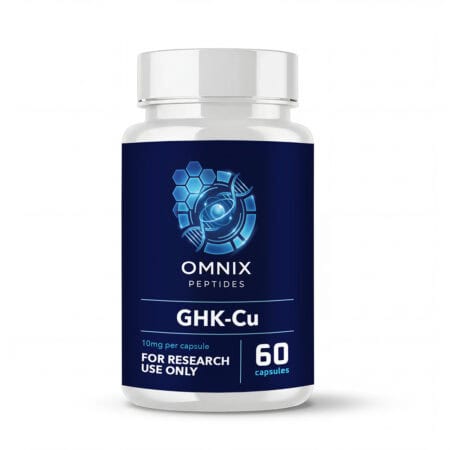
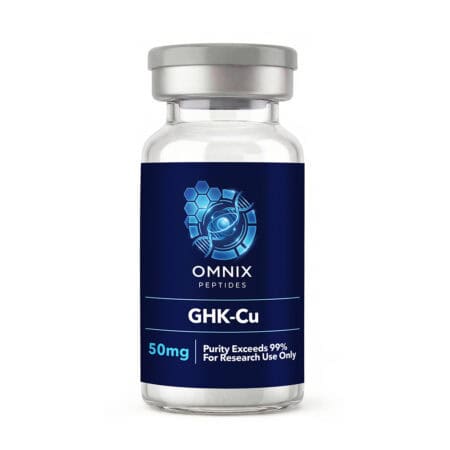
Omnix Peptides supplies GHK-Cu in two research formats. Each lot is independently characterized by HPLC and LC–MS, with a batch-specific Certificate of Analysis available on each product page.
- GHK-Cu Vial — lyophilized powder for reconstitution. The vial is the canonical research format used in cell-culture and animal-model research evaluating the GHK-Cu complex directly.
- GHK-Cu Capsules — oral format used in research models evaluating systemic GHK-Cu exposure. Note that published peer-reviewed pharmacokinetic data on oral GHK-Cu administration is sparse; researchers evaluating this route should consult the primary pharmacokinetic literature.
GHK-Cu is classified under the Skin & Hair research category. For research framed around tissue repair more broadly, see also the related compound hubs for BPC-157, TB-500, and BPC+TB Blend — all classified under the recovery and tissue-repair research category, with overlapping mechanistic interest in dermal-fibroblast behavior and extracellular-matrix remodeling.
Amount in the Published Research Literature
The following amount and concentration ranges describe the protocols used in the peer-reviewed GHK-Cu literature. They are reported here for research-reference purposes only and do not constitute administration recommendations of any kind.
Cell-culture studies. The mechanistic literature on GHK-Cu in primary human dermal fibroblasts and skin-explant models has typically used GHK-Cu concentrations in the nanomolar to low-micromolar range, with biological effects on collagen synthesis, fibroblast proliferation, and gene expression reported at sub-toxic concentrations. The Pickart 2015 review provides citations to specific concentration ranges used across the cell-culture mechanism literature [1].
Miller 2006 controlled trial — topical post-laser-resurfacing. Subjects who underwent full-face CO2 laser resurfacing applied a copper tripeptide complex cream twice daily for 5 days post-procedure, with a vehicle-only control formulation applied to randomized contralateral test sites [2]. Outcome measures included erythema, edema, transepidermal water loss, and clinical-grader assessments of recovery.
Photoaged-skin topical studies. The photoaged-skin trial cited within the Pickart review evaluated a topical copper-peptide-containing facial cream applied twice daily over a 12-week treatment period, with improvements reported on measures of fine lines, skin texture, photo-damage, and dermal density [3].
Pre-formulation characterization (Badenhorst 2016). The physicochemical characterization study evaluated GHK in aqueous solution across a range of pH conditions, characterizing solubility, octanol–water partition coefficient, and stability behavior relevant to topical formulation development [4].
Researchers planning protocols are referred to the original primary literature cited in the References section for full methodological detail, including concentrations, vehicle composition, and outcome assessment methods.
Frequently Asked Questions
Is GHK-Cu FDA-approved?
No. GHK-Cu is not approved by the FDA, EMA, or any other regulatory authority as a drug for any indication. It is widely used as a cosmetic ingredient in topical skin-care formulations (where it is subject to cosmetic-product regulations, not drug-approval pathways) and is available as a research-use chemical for laboratory investigations.
What is the published evidence base for GHK-Cu?
Peer-reviewed GHK-Cu research includes a substantial mechanistic literature (cell-culture, gene-expression-profile, and animal studies), a smaller clinical literature in topical-skincare applications including the Miller 2006 controlled post-laser-resurfacing trial, and limited published human data on injectable or oral administration routes. The most comprehensive mechanism synthesis is the Pickart 2015 review in BioMed Research International.
What mechanism of action does GHK-Cu use?
GHK-Cu acts as a copper-delivery vehicle and a transcriptional modulator. Copper is a required cofactor for connective-tissue enzymes (including lysyl oxidase, which crosslinks collagen and elastin) and antioxidant enzymes (Cu/Zn-superoxide dismutase). Genome-wide expression profiling has reported that GHK modulates the expression of more than 4,000 human genes, with the strongest signals in pathways governing tissue remodeling, anti-inflammatory programs, antioxidant defense, and DNA repair [1].
What does the Miller 2006 post-laser-resurfacing trial show?
The Miller 2006 controlled trial in patients undergoing full-face CO2 laser resurfacing applied a copper tripeptide formulation twice daily for 5 days post-procedure, with a vehicle-only control formulation applied to contralateral test sites. The investigators reported significant improvements on measures of post-procedure recovery in the copper-peptide-treated sites compared with controls [2].
How does GHK-Cu relate to age-related decline in copper-peptide levels?
The parent GHK peptide was originally isolated from human plasma, where its concentration declines markedly with age — from approximately 200 ng/mL at age 20 to approximately 80 ng/mL at age 60. This age-related decline is one of the mechanistic frameworks invoked in the longevity-research literature on copper peptides, though direct causal links between plasma GHK levels and clinical aging endpoints have not been established in adequately powered human trials.
What research formats of GHK-Cu are available?
Omnix Peptides supplies GHK-Cu as a lyophilized vial for reconstitution (the canonical research format used in cell-culture and animal-model research) and as oral capsules for research models evaluating systemic exposure. Published peer-reviewed pharmacokinetic data on oral GHK-Cu administration is sparse; researchers evaluating this route should consult the primary pharmacokinetic literature. Topical research formulations are typically prepared from the lyophilized powder.
How does GHK-Cu differ from BPC-157 and TB-500?
GHK-Cu, BPC-157, and TB-500 are structurally unrelated peptides studied in overlapping tissue-repair research areas. GHK-Cu is a 3-amino-acid copper-binding tripeptide originally isolated from human plasma, with mechanistic emphasis on gene-expression modulation and copper-dependent enzymatic processes. BPC-157 is a 15-amino-acid peptide derived from a gastric protein, with mechanistic emphasis on VEGFR2-mediated angiogenesis and fibroblast migration. TB-500 is a synthetic fragment of thymosin beta-4, with mechanistic emphasis on actin-binding and cell migration.
References
- Pickart L, Vasquez-Soltero JM, Margolina A. GHK peptide as a natural modulator of multiple cellular pathways in skin regeneration. Biomed Res Int. 2015;2015:648108. doi:10.1155/2015/648108
- Miller TR, Wagner JD, Baack BR, Eisbach KJ. Effects of topical copper tripeptide complex on CO2 laser-resurfaced skin. Arch Facial Plast Surg. 2006;8(4):252-259. doi:10.1001/archfaci.8.4.252
- Leyden J, Stephens TJ, Finkey MB, Barkovic S. Skin care benefits of copper peptide containing facial cream. American Academy of Dermatology Annual Meeting, 2002. Cited in Pickart L, et al. Biomed Res Int. 2015;2015:648108.
- Badenhorst T, Svirskis D, Wu Z. Physicochemical characterization of native glycyl-L-histidyl-L-lysine tripeptide for wound healing and anti-aging: a pre-formulation study for dermal delivery. Pharm Dev Technol. 2016;21(2):152-160. doi:10.3109/10837450.2014.979944
For Research Use Only. The products described on this page are sold strictly for in vitro laboratory research and are not intended for human or animal consumption, diagnostic use, or therapeutic use. The published research summarized above is provided as scientific reference material. Nothing on this page constitutes medical advice, a therapeutic claim, or a recommendation for any use outside of a properly resourced and ethically reviewed research setting.