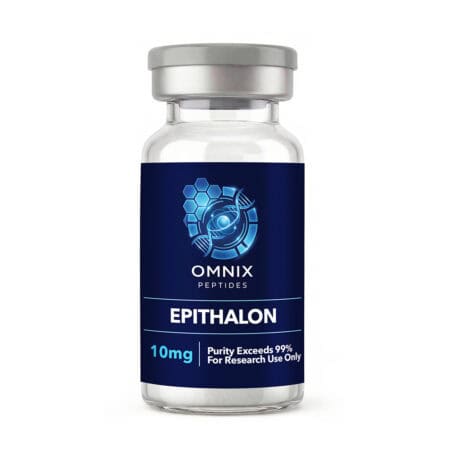
Epithalon (Epitalon; AEDG-peptide; CAS 307297-39-8) is a synthetic tetrapeptide with the sequence Ala-Glu-Asp-Gly, developed at the Saint Petersburg Institute of Bioregulation and Gerontology in Russia as a short-peptide analog derived from the bovine pineal-gland extract Epithalamin. Epithalon was characterized by the Khavinson research group as a peptide bioregulator
with reported effects on telomerase activity, neuroendocrine regulation, and age-associated functional decline in animal models.
The most cited mechanistic finding is the Khavinson, Bondarev, and Butyugov 2003 study in Bulletin of Experimental Biology and Medicine, in which the investigators reported that incubation of cultured human somatic cells with epithalon induced telomerase enzymatic activity and produced measurable elongation of telomeres in cells that had previously reached the Hayflick replicative limit [1]. The finding has been the basis for subsequent research positioning epithalon as a candidate longevity-research compound, though independent replication outside the Khavinson research network is limited.
Epithalon is not approved by the FDA, EMA, or any other Western regulatory authority for any indication. There are no published Phase 2 or Phase 3 controlled clinical trials of epithalon in Western regulatory jurisdictions. The compound has been the subject of Russian-conducted clinical and observational studies in geriatric populations, with results reported predominantly in Russian-language journals and English-translation summaries.
Important Note on the Evidence Base
Important note on the evidence base: The peer-reviewed epithalon research literature is dominated by publications from the Khavinson research group at the Saint Petersburg Institute of Bioregulation and Gerontology, with English-translation versions appearing primarily in Bulletin of Experimental Biology and Medicine and Neuroendocrinology Letters. Independent replication of the central mechanistic findings (telomerase induction, telomere elongation in somatic cells) outside the Khavinson network is limited. There are no Phase 2 or Phase 3 controlled clinical trials of epithalon in any Western regulatory jurisdiction. Researchers consulting this page should weight the evidence base accordingly.
Mechanism of Action
The published mechanistic work on epithalon focuses on telomerase regulation, neuroendocrine modulation through the pineal-pituitary axis, and broader gene-expression effects characteristic of the Khavinson group’s “peptide bioregulator” framework.
Telomerase induction in somatic cells. The Khavinson 2003 study reported that incubation of cultured human fetal fibroblasts with epithalon at low nanomolar concentrations induced telomerase enzymatic activity in cells that had previously become telomerase-negative on reaching the Hayflick limit, and that the induction was accompanied by measurable telomere elongation over subsequent population doublings [1]. The investigators interpreted the finding as evidence that the tetrapeptide modulates the expression of the telomerase reverse transcriptase (TERT) gene through a transcriptional or epigenetic mechanism. The molecular details of the proposed transcriptional mechanism have not been fully characterized in independent publications.
Pineal–pituitary axis modulation. Epithalon is structurally derived from the bovine pineal extract Epithalamin, and the Russian research framing positions it within a broader pineal-axis-modulation theory of age-associated functional decline. Published rodent and non-human primate studies have reported that epithalon administration restores age-related disturbances in pineal melatonin secretion, gonadotropin release, and circadian rhythm parameters [2]. The non-human primate work in senescent rhesus monkeys reported normalization of disturbed neuroendocrine regulation in the pineal–pituitary–gonadal axis after epithalon administration [3].
Gene-expression and chromatin effects. Subsequent mechanistic work from the Khavinson group has reported that short peptides of the AEDG and related sequences interact with DNA at specific binding sites and modulate the expression of clusters of genes in a sequence-specific manner. The interpretation is that these tetrapeptides act as small-molecule modulators of chromatin and gene expression rather than as classical receptor ligands. The mechanistic model is internally consistent across the Khavinson publication series but has limited independent corroboration in the broader chromatin and gene-expression literature.
None of the mechanisms summarized here have been independently verified in adequately powered placebo-controlled clinical trials reviewed by FDA or EMA.
Available Forms
Omnix Peptides currently supplies epithalon in a single research format. Each lot is independently characterized by HPLC and LC–MS, with a batch-specific Certificate of Analysis available on the product page.
- Epithalon Vial — lyophilized powder for reconstitution. The vial is the canonical research format for epithalon and supports the amount flexibility used in published rodent, non-human primate, and cell-culture studies. Subcutaneous and intramuscular administration are the routes used in the published preclinical and Russian-clinical literature.
Epithalon is classified under the Longevity & Anti-Aging research category per its reported telomerase-modulation and neuroendocrine-restoration profile. For research framed around overlapping longevity and mitochondrial-aging pharmacology, see also the related compound hubs for MOTS-c (mitochondrial-derived peptide regulating AMPK and metabolic-aging endpoints) and 5-Amino-1MQ (selective NNMT inhibitor with reported effects on cellular methylation and adipose metabolism).
Amount in the Published Research Literature
The following amount ranges describe the protocols used in the peer-reviewed epithalon literature. They are reported here for research-reference purposes only and do not constitute administration recommendations of any kind.
Khavinson 2003 telomerase induction study. Cultured human fetal fibroblasts were incubated with epithalon at low nanomolar concentrations in the cell-culture medium, with telomerase activity (PCR-based assay) and telomere length (Southern blot) as primary endpoints across multiple population doublings [1]. The investigators reported telomerase induction and telomere elongation at the concentrations studied.
Goncharova 2005 non-human primate study. Senescent female rhesus monkeys received subcutaneous epithalon administration on a study-protocol-specified schedule, with melatonin secretion patterns, gonadotropin profiles, and glucose-tolerance parameters as primary endpoints [3]. The investigators reported restoration of age-disrupted endocrine rhythms toward those of younger reference animals.
Russian clinical literature. Russian-conducted clinical and observational studies in geriatric populations have administered epithalon by intramuscular or subcutaneous injection in short treatment courses across multiple consecutive years, with end-of-study and long-term outcomes reported in Russian-language journals and in Neuroendocrinology Letters English-translation summaries. The amount and treatment-course parameters are specified in the original Russian publications. The data have not been submitted to or reviewed by FDA or EMA.
Pharmacokinetic profile. Epithalon has a short circulatory half-life consistent with other small tetrapeptides lacking stabilization modifications. The Khavinson group’s peptide-bioregulator framework proposes that the short circulatory half-life is compatible with the proposed mechanism because the active concentration window for chromatin and gene-expression modulation does not require sustained plasma levels.
Adverse-event profile. The published Russian-clinical literature describes epithalon as having a benign acute adverse-event profile across the studied geriatric populations. The available data are not equivalent to a Western Phase 1/2/3 safety database.
Researchers planning protocols are referred to the original primary literature cited in the References section and to the English-translation journals of the Russian Academy of Sciences for additional methodological detail.
Frequently Asked Questions
Is epithalon FDA-approved?
No. Epithalon is not approved by the FDA, EMA, or any other Western regulatory authority for any indication. There are no published Phase 2 or Phase 3 controlled clinical trials of epithalon in Western regulatory jurisdictions. The compound has been the subject of Russian-conducted clinical and observational studies in geriatric populations, with results reported predominantly in Russian-language journals and English-translation summaries.
What is epithalon?
Epithalon is a synthetic tetrapeptide with the sequence Ala-Glu-Asp-Gly (AEDG), developed at the Saint Petersburg Institute of Bioregulation and Gerontology in Russia as a short-peptide analog derived from the bovine pineal-gland extract Epithalamin. The compound is classified within the Khavinson group’s “peptide bioregulator” framework, which proposes that short peptides modulate gene expression through sequence-specific DNA interactions rather than through classical receptor pharmacology.
What does the Khavinson 2003 telomerase study show?
The Khavinson 2003 study reported that incubation of cultured human fetal fibroblasts with epithalon at low nanomolar concentrations induced telomerase enzymatic activity in cells that had previously become telomerase-negative on reaching the Hayflick replicative limit. The investigators reported accompanying measurable telomere elongation over subsequent population doublings [1]. The molecular details of the proposed transcriptional mechanism have not been fully characterized in independent publications outside the Khavinson research network.
What is the published evidence base for epithalon?
The peer-reviewed epithalon research literature is dominated by publications from the Khavinson research group at the Saint Petersburg Institute of Bioregulation and Gerontology, with English-translation versions appearing primarily in Bulletin of Experimental Biology and Medicine and Neuroendocrinology Letters. Independent replication of the central mechanistic findings outside the Khavinson network is limited. There are no Phase 2 or Phase 3 controlled clinical trials in any Western regulatory jurisdiction.
What administration routes have been used in epithalon research?
Published preclinical studies have used subcutaneous injection in rodents and non-human primates, and direct addition to cell-culture media in vitro. The Russian clinical literature uses intramuscular or subcutaneous injection in short treatment courses. Oral administration has not been a primary route in the published literature on the linear AEDG peptide.
What is epithalon’s mechanism of action?
The published mechanistic framework centers on three reported activities: induction of telomerase enzymatic activity and telomere elongation in cultured somatic cells, restoration of age-disrupted pineal-pituitary-gonadal axis function in non-human primates, and sequence-specific DNA interactions that modulate gene expression. The Khavinson group’s interpretation is that AEDG and related short peptides act as small-molecule modulators of chromatin and gene expression rather than as classical receptor ligands. The mechanistic model is internally consistent across the Khavinson publication series but has limited independent corroboration in the broader chromatin and gene-expression literature.
References
- Khavinson VK, Bondarev IE, Butyugov AA. Epithalon peptide induces telomerase activity and telomere elongation in human somatic cells. Bull Exp Biol Med. 2003;135(6):590-592. doi:10.1023/A:1025493705728 · PubMed: 12937682
- Khavinson VK, Goncharova N, Lapin B. Synthetic tetrapeptide epitalon restores disturbed neuroendocrine regulation in senescent monkeys. Neuro Endocrinol Lett. 2001;22(4):251-254. PubMed: 11524631
- Goncharova ND, Vengerin AA, Khavinson VK, Lapin BA. Pineal peptides restore the age-related disturbances of hormonal functions of the pineal gland and pancreas in old monkeys. Bull Exp Biol Med. 2005;140(2):207-209. doi:10.1007/s10517-005-0445-5 · PubMed: 16283011
For Research Use Only. The product described on this page is sold strictly for in vitro laboratory research and is not intended for human or animal consumption, diagnostic use, or therapeutic use. The published research summarized above is provided as scientific reference material. Nothing on this page constitutes medical advice, a therapeutic claim, or a recommendation for any use outside of a properly resourced and ethically reviewed research setting.