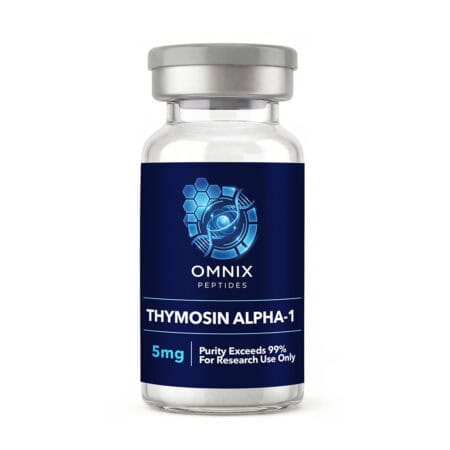
Thymosin Alpha-1 (Tα1; CAS 62304-98-7) is a synthetic 28-amino-acid acetylated peptide, identical in sequence to a natural peptide originally isolated from bovine thymus extract by Allan Goldstein and colleagues in the 1970s. The mature peptide is the acetylated N-terminal product Ac-Ser-Asp-Ala-Ala-Val-Asp-Thr-Ser-Ser-Glu-Ile-Thr-Thr-Lys-Asp-Leu-Lys-Glu-Lys-Lys-Glu-Val-Val-Glu-Glu-Ala-Glu-Asn. Thymosin alpha-1 functions as a pleiotropic immunomodulator, with reported effects on T-cell differentiation and maturation, dendritic cell function, Th1 cytokine production, and Toll-like receptor (TLR)-mediated innate immune signaling.
Thymosin alpha-1 has a dual regulatory status that researchers should understand. The compound is approved in more than 30 countries for chronic hepatitis B and as an adjunctive immunotherapy in selected oncology and infectious-disease settings, including initial regulatory approval in Italy in 1996 and subsequent approval in China, India, multiple Latin American and Asia-Pacific markets, and additional European jurisdictions. The compound has not received FDA approval for any indication in the United States. A U.S. Phase 3 program in chronic hepatitis B did not achieve the regulatory bar for approval, and a subsequent U.S./European randomized Phase 3 trial in severe sepsis was discontinued during the development program. Clinical trial activity has continued internationally, with published reports of randomized studies in hepatitis B, hepatitis C, severe sepsis, and as an adjunct to chemotherapy and cancer immunotherapy.
The most cited mechanistic review is the Goldstein and Goldstein 2009 paper in Expert Opinion on Biological Therapy, which characterized thymosin alpha-1 as a multi-target immunomodulator with effects spanning T-cell differentiation, NK-cell activity, and innate immune signaling [1]. The Wu and colleagues 2013 multicenter randomized trial in severe sepsis published in Critical Care reported reduced 28-day mortality in thymosin alpha-1-treated patients compared with the standard-care control, with the most pronounced effect in the subset with severe sepsis without septic shock [2]. Researchers consulting this page should interpret the evidence base as substantial in international jurisdictions and limited in U.S. FDA-regulated trials.
Important Note on the Evidence Base and Regulatory Status
Important note on the evidence base and regulatory status: Thymosin alpha-1 is approved in more than 30 countries (initial approval Italy 1996; subsequent approval in China, India, multiple Asia-Pacific and Latin American jurisdictions) for chronic hepatitis B and as an adjunctive immunotherapy in selected oncology and infectious-disease settings. The compound is NOT FDA-approved in the United States. The U.S. Phase 3 program in chronic hepatitis B did not achieve the regulatory bar for approval, and the U.S./European Phase 3 severe-sepsis program was discontinued during clinical development. Peer-reviewed clinical trials have been published in hepatitis B, hepatitis C, severe sepsis, and oncology-adjunctive settings, with study quality varying across jurisdictions. Researchers consulting this page should weight the evidence base accordingly.
Mechanism of Action
Thymosin alpha-1 is a pleiotropic immunomodulator rather than a single-receptor agonist. The published mechanistic literature characterizes effects across multiple immune-cell populations and signaling pathways, with the converging interpretation that the compound restores or enhances immune-system competence in contexts of immunological dysregulation.
T-cell differentiation and maturation. The original characterization of thymosin alpha-1 in the Goldstein laboratory established that the peptide promotes maturation of thymocytes toward functional CD4+ and CD8+ T-cell phenotypes, with measurable increases in T-cell receptor expression, IL-2 receptor expression, and downstream cytokine-production competence. The T-cell differentiation activity is the historically foundational mechanism and informs the framing of thymosin alpha-1 as a thymic-replacement immunomodulator in clinical contexts where T-cell function is compromised (advanced age, chronic viral infection, chemotherapy-induced immunosuppression).
Th1 cytokine polarization. The compound shifts the balance of helper T-cell cytokine production toward a Th1-dominant profile, with reported increases in interferon-γ and IL-2 production and reductions in Th2 cytokines. The Th1 polarization is mechanistically relevant to the chronic-viral-hepatitis indications in which the compound has international regulatory approval, because effective control of hepatitis B virus replication is associated with a Th1-dominant antiviral response.
Dendritic cell function and TLR signaling. Subsequent mechanistic work has reported that thymosin alpha-1 activates plasmacytoid and myeloid dendritic cells, restores Toll-like receptor (TLR)-mediated signaling in TLR-tolerized cells, and enhances dendritic-cell antigen presentation to T-cells. The dendritic-cell activation pathway is interpreted as the molecular basis for the compound’s adjunctive activity in combination with cancer immunotherapy and vaccine settings.
NK-cell activity. Published in vitro and ex vivo work has reported that thymosin alpha-1 increases natural killer (NK)-cell cytotoxic activity, contributing to innate antiviral and anti-tumor effects in research models.
Anti-inflammatory and sepsis-relevant mechanisms. In sepsis-relevant research models, thymosin alpha-1 has been reported to restore immune competence in lymphopenic and immunoparalyzed states characteristic of late-phase severe sepsis, with reductions in markers of inflammatory dysregulation and improvements in T-cell function. This mechanistic framing motivated the multiple published sepsis clinical trials, including the Wu 2013 ETASS multicenter randomized trial and the subsequent discontinued international Phase 3 program [2].
None of the mechanisms summarized here have been characterized in adequately powered placebo-controlled clinical trials reviewed by FDA for any indication.
Available Forms
Omnix Peptides currently supplies thymosin alpha-1 in a single research format. Each lot is independently characterized by HPLC and LC–MS, with a batch-specific Certificate of Analysis available on the product page.
- Thymosin Alpha-1 Vial — lyophilized powder for reconstitution. The vial is the canonical research format for thymosin alpha-1 and corresponds to the formulation used in the published clinical trial program in chronic hepatitis B, severe sepsis, and oncology-adjunctive settings. Subcutaneous injection is the route used in the published clinical literature.
Thymosin alpha-1 is classified under the Recovery & Healing research category per its immunomodulatory profile relevant to recovery from infectious and inflammatory challenges. The compound’s mechanism distinguishes it from the other compounds in the Omnix catalog, which act through receptor-agonist or receptor-antagonist pharmacology rather than through pleiotropic immune-cell modulation.
Amount in the Published Research Literature
The following amount ranges describe the protocols used in the peer-reviewed thymosin alpha-1 literature. They are reported here for research-reference purposes only and do not constitute administration recommendations of any kind.
Chronic hepatitis B clinical trials. The published hepatitis B clinical trial program, which supported international regulatory approvals in Italy (1996), China, and subsequent markets, used 1.6 mg subcutaneous thymosin alpha-1 administered twice weekly over treatment courses of 6–12 months, typically as monotherapy or in combination with interferon-α. End-of-treatment and sustained virological response endpoints were the primary efficacy measures.
Wu 2013 ETASS severe-sepsis trial. The multicenter, single-blind, randomized controlled trial in 361 adult patients with severe sepsis evaluated subcutaneous thymosin alpha-1 (1.6 mg twice daily for five days, followed by 1.6 mg once daily for the next two days) in addition to standard sepsis care, versus standard sepsis care alone [2]. The investigators reported reduced 28-day all-cause mortality in the thymosin alpha-1 arm. The subsequent larger U.S./European Phase 3 program was discontinued during clinical development.
Oncology-adjunctive trial program. Smaller Phase 2 and Phase 3 trials of thymosin alpha-1 as an adjunct to chemotherapy or to other immunotherapy in malignant melanoma, non-small-cell lung cancer, and hepatocellular carcinoma have used the standard 1.6 mg subcutaneous twice-weekly schedule. Results across the oncology-adjunctive program are mixed and have not supported regulatory approval for cancer indications in the United States.
Pharmacokinetic profile. Thymosin alpha-1 has a short circulatory half-life of approximately two hours after subcutaneous administration, consistent with the small acetylated peptide structure. The published clinical-trial administration schedules use multi-times-per-week or once-daily subcutaneous administration to maintain therapeutic exposure across treatment courses.
Adverse-event profile. The published clinical trial program describes thymosin alpha-1 as having a benign acute adverse-event profile, with injection-site reactions as the most commonly reported event and serious adverse events generally not exceeding placebo-arm rates. The available international post-marketing safety data span more than two decades since the 1996 Italian approval. The U.S. FDA has not independently reviewed the safety database.
Researchers planning protocols are referred to the original primary literature cited in the References section for full methodological detail.
Frequently Asked Questions
Is thymosin alpha-1 FDA-approved?
No. Thymosin alpha-1 is not FDA-approved in the United States for any indication. The U.S. Phase 3 program in chronic hepatitis B did not achieve the regulatory bar for approval, and the U.S./European Phase 3 severe-sepsis program was discontinued during clinical development. The compound IS approved in more than 30 countries internationally (initial approval Italy 1996, subsequent approval in China, India, and multiple Asia-Pacific and Latin American jurisdictions) for chronic hepatitis B and as an adjunctive immunotherapy in selected oncology and infectious-disease settings.
What mechanism of action does thymosin alpha-1 use?
Thymosin alpha-1 is a pleiotropic immunomodulator rather than a single-receptor agonist. The published mechanisms span T-cell differentiation and maturation (CD4+ and CD8+ phenotypes), Th1 cytokine polarization (increased interferon-γ and IL-2 production), dendritic-cell activation and restoration of Toll-like receptor signaling in TLR-tolerized states, increased natural killer (NK)-cell cytotoxic activity, and restoration of immune competence in lymphopenic states. The converging interpretation is that the compound restores or enhances immune-system competence in contexts of immunological dysregulation.
What does the Wu 2013 ETASS sepsis trial show?
The Wu 2013 ETASS trial was a multicenter, single-blind, randomized controlled trial in 361 adult patients with severe sepsis across multiple Chinese hospitals. Patients received subcutaneous thymosin alpha-1 (1.6 mg twice daily for five days, then 1.6 mg once daily for two days) in addition to standard sepsis care, versus standard sepsis care alone [2]. The investigators reported reduced 28-day all-cause mortality in the thymosin alpha-1 arm. The subsequent larger U.S./European Phase 3 program was discontinued during clinical development.
What is the published evidence base for thymosin alpha-1?
The peer-reviewed clinical trial literature for thymosin alpha-1 spans chronic hepatitis B (supporting the international regulatory approvals from 1996 onward), severe sepsis (the Wu 2013 ETASS trial showing mortality benefit, and the subsequent larger discontinued international Phase 3 program), chronic hepatitis C, and oncology-adjunctive settings (mixed results in melanoma, non-small-cell lung cancer, and hepatocellular carcinoma). Mechanistic work spans T-cell differentiation, Th1 polarization, dendritic-cell activation, and TLR signaling restoration.
How does thymosin alpha-1 differ from thymosin beta-4 / TB-500?
Thymosin alpha-1 and thymosin beta-4 are distinct peptides that share the “thymosin” name only because of their common origin in thymus extracts characterized in the 1970s. Thymosin alpha-1 is a 28-amino-acid acetylated peptide with pleiotropic immunomodulatory activity and international regulatory approvals for hepatitis B and adjunctive immunotherapy. Thymosin beta-4 is a 43-amino-acid peptide whose primary biological activity is intracellular actin binding, and the related research compound TB-500 (the C-terminal active fragment) is characterized in the tissue-repair and wound-healing literature rather than the immunomodulation literature. The two peptides have distinct sequences, distinct mechanisms, and distinct research applications.
What administration routes have been used in thymosin alpha-1 research?
Subcutaneous injection is the route used in the published clinical trial program across hepatitis B, severe sepsis, and oncology-adjunctive settings. The compound is not orally bioavailable. The pharmacokinetic profile (approximately two-hour circulatory half-life) supports the multi-times-per-week or once-daily subcutaneous administration schedules used in the published trials.
Why did the U.S. Phase 3 programs not result in FDA approval?
The U.S. Phase 3 program in chronic hepatitis B did not achieve the regulatory bar for approval in the U.S. The subsequent U.S./European Phase 3 program in severe sepsis was discontinued during clinical development. Specific reasons reported in the trial literature and developer communications include not achieving primary endpoint statistical significance in the hepatitis B program and pre-specified futility or commercial reasons for the sepsis program discontinuation. The international regulatory approvals (Italy 1996 onward) were based on regulatory frameworks that accepted the data submitted in those jurisdictions.
References
- Goldstein AL, Goldstein AL Jr. From lab to bedside: emerging clinical applications of thymosin alpha 1. Expert Opin Biol Ther. 2009;9(5):593-608. doi:10.1517/14712590902911412 · PubMed: 19392576
- Wu J, Zhou L, Liu J, et al. The efficacy of thymosin alpha 1 for severe sepsis (ETASS): a multicenter, single-blind, randomized and controlled trial. Crit Care. 2013;17(1):R8. doi:10.1186/cc11932 · PubMed: 23327199
- Camerini R, Garaci E. Historical review of thymosin α 1 in infectious diseases. Expert Opin Biol Ther. 2015;15(Suppl 1):S117-S127. doi:10.1517/14712598.2015.1033393 · PubMed: 26098768
For Research Use Only. The product described on this page is sold strictly for in vitro laboratory research and is not intended for human or animal consumption, diagnostic use, or therapeutic use. The published research summarized above is provided as scientific reference material. Thymosin alpha-1 is approved as a prescription drug product in international jurisdictions outside the United States; in those jurisdictions the compound is available only by prescription from a licensed healthcare provider. Nothing on this page constitutes medical advice, a therapeutic claim, or a recommendation for any use outside of a properly resourced and ethically reviewed research setting.