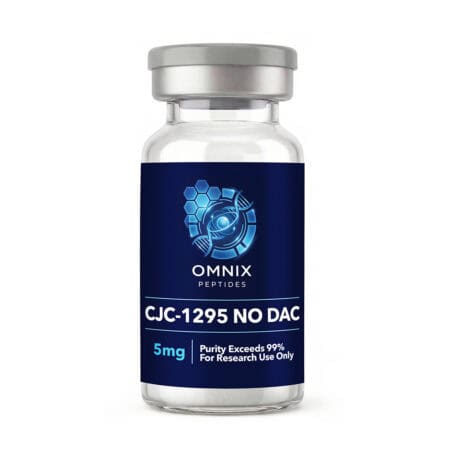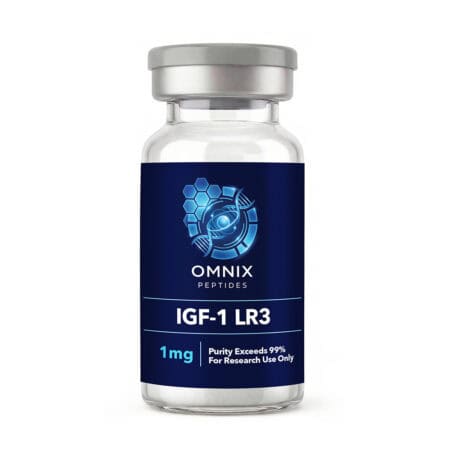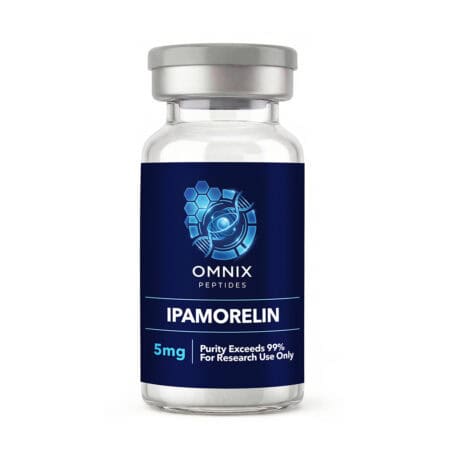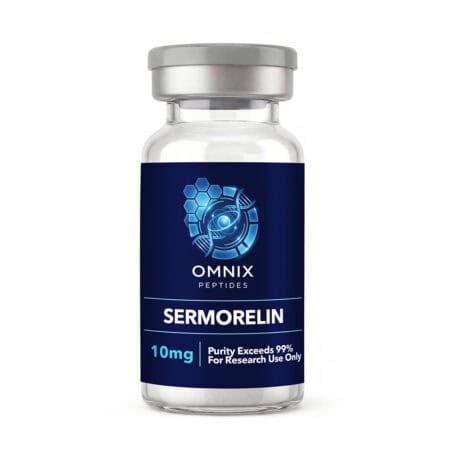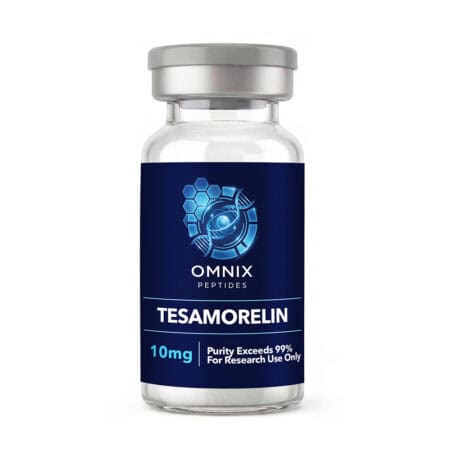
Growth hormone axis research peptides are compounds investigated in the peer-reviewed literature for their effects on pituitary growth-hormone secretion, IGF-1 signaling, and downstream metabolic and tissue effects. Research has investigated the following peptides in the context of GH-axis preclinical and clinical models: Sermorelin, Tesamorelin, CJC-1295 (No DAC), Ipamorelin, and IGF-1 LR3.
The GH-axis category has a deeper clinical literature than most peptide-research categories. Sermorelin (GHRH 1–29) and Tesamorelin (stabilized GHRH 1–44) are both FDA-approved at the formulation level — Sermorelin historically for pediatric GH deficiency (discontinued in 2008 for commercial, not safety, reasons) and Tesamorelin for HIV-associated lipodystrophy. CJC-1295 and Ipamorelin have published Phase I/II data; IGF-1 LR3 is a long-acting analog of recombinant IGF-1 (mecasermin, FDA-approved for severe primary IGF-1 deficiency).
What Peer-Reviewed Research Investigates in This Category
GH-axis-category research in the published literature investigates two principal mechanistic targets:
- GHRH receptor agonism (the “GHRH-analog” branch) — Sermorelin (native GHRH 1–29), Tesamorelin (trans-3-hexenoyl modified GHRH 1–44), and CJC-1295 (a tetra-substituted GHRH 1–29 analog with extended half-life from DPP-IV resistance, with or without the DAC albumin-binding linker). Mechanism: stimulation of endogenous pulsatile GH release from anterior pituitary somatotrophs.
- Ghrelin receptor agonism (GHS-R1a; the “GHRP” or “ghrelin-mimetic” branch) — Ipamorelin and earlier GHRPs (GHRP-2, GHRP-6, hexarelin) stimulate GH release through a pathway parallel to and distinct from GHRH. Ipamorelin’s defining pharmacological feature, established by Raun et al. (1998), is selectivity: it does not produce the cortisol, ACTH, prolactin, or aldosterone elevations characteristic of earlier GHRPs.
- IGF-1 receptor signaling — IGF-1 LR3 is a recombinant analog of insulin-like growth factor 1 with an N-terminal extension and an Arg→Glu substitution that reduces binding to IGFBPs, prolonging the active circulating half-life.
The GH-axis literature uses standard endocrinology endpoints: serum GH AUC, IGF-1, IGFBP-3, and downstream metabolic and body-composition measurements. Several compounds in this category have published clinical safety and pharmacokinetic data.
Compounds Studied in Growth Hormone Axis Research
Sermorelin
Sermorelin (GHRH 1–29; CAS 86168-78-7) is the truncated active fragment of endogenous human GHRH. It was FDA-approved for pediatric growth-hormone deficiency in 1997; commercial production was discontinued in 2008 for non-safety reasons. The published clinical literature includes diagnostic GH-stimulation studies in children and adults and limited adult-GH-deficiency replacement work.1
Tesamorelin
Tesamorelin (CAS 218949-48-5) is a stabilized analog of GHRH(1–44) with an N-terminal trans-3-hexenoyl modification conferring DPP-IV resistance. FDA-approved for the reduction of excess abdominal fat in HIV-infected patients with lipodystrophy. The pivotal trials (Falutz et al., NEJM 2007) established efficacy on visceral adipose tissue reduction.2 Also classified under metabolic research.
CJC-1295 (No DAC)
CJC-1295 is a synthetic tetra-substituted GHRH(1–29) analog (D-Ala²-Gln⁸-Ala¹⁵-Leu²⁷). The “No DAC” variant lacks the Drug Affinity Complex maleimide linker that, in the original CJC-1295 (with DAC) construct, covalently binds serum albumin to extend half-life to multi-day duration. Without the DAC linker, the molecule retains the four DPP-IV-resistant substitutions but has a shorter half-life — roughly 30 minutes. Teichman et al. (2006, JCEM) published the pharmacokinetic and pharmacodynamic profile of CJC-1295 with DAC in healthy volunteers.3
Ipamorelin
Ipamorelin (CAS 170851-70-4) is a synthetic five-amino-acid peptide (Aib-His-D-2-Nal-D-Phe-Lys-NH₂) developed by Novo Nordisk as a selective GHS-R1a agonist. The defining pharmacological feature established in Raun et al. (1998, Eur J Endocrinol) is selectivity: at therapeutically relevant and supraphysiological amounts, ipamorelin stimulates pulsatile GH release without the cortisol, ACTH, prolactin, or aldosterone elevations seen with earlier GHRPs.4
IGF-1 LR3
IGF-1 LR3 (Long-R3-IGF-1) is a recombinant analog of human insulin-like growth factor 1 with an N-terminal 13-amino-acid extension and an Arg³→Glu³ substitution. These modifications reduce binding to insulin-like growth factor binding proteins (IGFBPs), prolonging the active circulating half-life and increasing IGF-1 receptor signaling per molecule. Used primarily as a research-grade tool in cell culture (potentiation of growth factor effects on cell proliferation) and animal studies of muscle hypertrophy and IGF-1 receptor signaling.5 The unmodified recombinant IGF-1 (mecasermin) is FDA-approved for severe primary IGF-1 deficiency.
Frequently Asked Research Questions
What peptides are studied in growth-hormone-axis research?
The peer-reviewed GH-axis research literature focuses on two pathways. GHRH-receptor agonists — Sermorelin, Tesamorelin, and CJC-1295 — stimulate pulsatile pituitary GH release through the GHRH receptor. Ghrelin-receptor agonists — Ipamorelin and earlier GHRPs — stimulate GH release through the GHS-R1a receptor, a parallel pathway. IGF-1 LR3 is a long-acting recombinant analog acting downstream at the IGF-1 receptor itself.
Which GH-axis peptides have FDA approval?
Tesamorelin is FDA-approved for HIV-associated lipodystrophy. Sermorelin was FDA-approved for pediatric GH deficiency and discontinued in 2008 for commercial (not safety) reasons. Recombinant IGF-1 (mecasermin) is FDA-approved for severe primary IGF-1 deficiency — this is the unmodified parent molecule, not the IGF-1 LR3 research analog. CJC-1295 and Ipamorelin are not FDA-approved.
What is the difference between CJC-1295 with DAC and CJC-1295 No DAC?
Both share the same tetra-substituted GHRH(1–29) peptide backbone with four DPP-IV-resistant substitutions. CJC-1295 with DAC adds a Drug Affinity Complex maleimide linker that covalently binds circulating serum albumin, extending the half-life to multi-day duration and producing a sustained “bleed” of GH rather than pulsatile release. CJC-1295 No DAC lacks the linker and has a much shorter half-life (~30 minutes), which preserves pulsatile GH release. The pharmacology is materially different despite the shared base molecule.
Why is Ipamorelin described as “selective”?
Earlier GHRPs (GHRP-6, GHRP-2, hexarelin) stimulate GH release but also elevate cortisol, ACTH, prolactin, and aldosterone — likely through receptor cross-reactivity. Raun et al. (1998) reported that ipamorelin stimulates GH release at therapeutically relevant and supraphysiological amounts without elevating these other pituitary or adrenal hormones. This selectivity profile is the defining feature of ipamorelin’s pharmacology in the published literature.
Why is tesamorelin classified under both growth-hormone and metabolic research?
Tesamorelin is pharmacologically a GHRH analog (growth-hormone axis), but its FDA-approved indication and primary published clinical research concern visceral adipose tissue reduction in HIV-associated lipodystrophy — a metabolic indication. It appears in both category hubs to support researchers approaching it from either pharmacological or indication-led angles.
References
- Walker RF. Sermorelin: a better approach to management of adult-onset growth hormone insufficiency? Clin Interv Aging. 2006;1(4):307–308. PubMed.
- Falutz J, Allas S, Blot K, et al. Metabolic effects of a growth hormone-releasing factor in patients with HIV. N Engl J Med. 2007;357(23):2359–2370. PubMed.
- Teichman SL, Neale A, Lawrence B, Gagnon C, Castaigne JP, Frohman LA. Prolonged stimulation of growth hormone (GH) and insulin-like growth factor I secretion by CJC-1295, a long-acting analog of GH-releasing hormone, in healthy adults. J Clin Endocrinol Metab. 2006;91(3):799–805. PubMed.
- Raun K, Hansen BS, Johansen NL, et al. Ipamorelin, the first selective growth hormone secretagogue. Eur J Endocrinol. 1998;139(5):552–561. PubMed.
- Tomas FM, Knowles SE, Owens PC, et al. Insulin-like growth factor-I (IGF-I) and especially IGF-I variants are anabolic in dexamethasone-treated rats. Biochem J. 1992;282(Pt 1):91–97. PubMed.