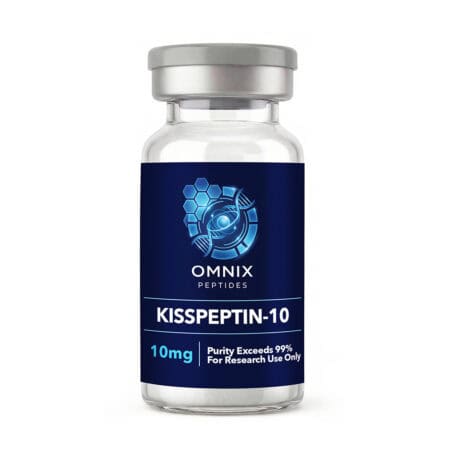
Kisspeptin-10 (CAS 374675-21-5; also referred to as metastin 45–54) is a synthetic, C-terminally amidated 10-amino-acid peptide with the sequence YNWNSFGLRF-NH2, corresponding to the minimal C-terminal fragment of the larger kisspeptin precursor encoded by the human KISS1 gene. The compound has been characterized in the published literature as the shortest kisspeptin sequence retaining full intrinsic agonist activity at the kisspeptin receptor (KISS1R, also known as GPR54). Kisspeptin-10 has been investigated in healthy adult human volunteers, men and women with reproductive disorders, and rodent and primate models, with published studies appearing in journals including the New England Journal of Medicine, the Proceedings of the National Academy of Sciences, the Journal of Clinical Endocrinology & Metabolism, the Journal of Clinical Investigation, and JAMA Network Open.
In a 2011 concentration-response study published in the Journal of Clinical Endocrinology & Metabolism, George and colleagues at the Medical Research Council Human Reproductive Sciences Unit (Edinburgh) reported that intravenous bolus kisspeptin-10 in healthy men produced a rapid and concentration-dependent rise in serum luteinizing hormone (LH), with maximal stimulation at 1 µg/kg (peak mean LH approximately 12.4 IU/L compared with a baseline of 4.1 IU/L), and that continuous intravenous infusion at 1.5 µg/kg/h increased LH pulse frequency and pulse size [4]. The investigators interpreted these findings as evidence that kisspeptin-10 is a potent stimulator of LH
in human males and a key regulator of pulsatile gonadotropin-releasing hormone (GnRH) secretion.
Kisspeptin signaling was first connected to human reproductive function in 2003, when two independent groups — de Roux and colleagues in PNAS and Seminara and colleagues in the New England Journal of Medicine — reported that loss-of-function mutations in the KISS1R gene caused isolated hypogonadotropic hypogonadism in humans, establishing kisspeptin–KISS1R signaling as an obligate upstream regulator of the hypothalamic-pituitary-gonadal (HPG) axis [1] [2]. The published kisspeptin-10 research base is the most clinically developed of any compound in the Omnix hormonal research category, though no kisspeptin product has received regulatory approval for any indication.
Important Note on the Evidence Base
Important note on the evidence base: The kisspeptin research literature spans foundational human genetics, rodent and non-human primate pharmacology, and Phase 1 and Phase 2 human investigative-medicine trials conducted predominantly at Imperial College London (Hammersmith Hospital) and the University of Edinburgh. Most published human trials have used short-duration intravenous administration in tightly controlled inpatient research settings. There are no completed Phase 3 trials of kisspeptin-10 or kisspeptin-54 for any indication, and no kisspeptin product has been approved by the FDA, EMA, or any other regulatory authority. Researchers consulting this page should weight study design, sample size, and route of administration accordingly, and should consult the cited primary literature in the References section.
Mechanism of Action
The kisspeptin literature converges on a small number of interconnected mechanisms, with the upstream action at hypothalamic GnRH neurons being the most extensively characterized. The behavioral and limbic effects reported in more recent human work appear to operate through partially overlapping but anatomically distinct kisspeptin receptor populations outside the hypothalamus.
KISS1R/GPR54 receptor identity and the HPG-axis pathway. Kisspeptin-10 acts as an agonist at the kisspeptin receptor (KISS1R/GPR54), a G protein-coupled receptor expressed at high density on hypothalamic GnRH neurons. Activation of KISS1R on these neurons stimulates the release of GnRH from nerve terminals in the median eminence, which in turn drives pulsatile secretion of LH and follicle-stimulating hormone (FSH) from the anterior pituitary. The foundational human-genetics evidence for this pathway came from the 2003 reports by de Roux et al. and Seminara et al., which identified families with inactivating KISS1R mutations who presented with isolated hypogonadotropic hypogonadism, absent or arrested puberty, and infertility [1] [2]. The mirror-image phenotype — activating KISS1R mutations associated with central precocious puberty — has subsequently been reported in independent kindreds.
Stimulation of pulsatile GnRH secretion. The George 2011 study used iv bolus and continuous-infusion administration in healthy adult men, with LH pulse frequency and pulse size quantified by deconvolution analysis [4]. Intravenous bolus amounts of 0.01 µg/kg through 3 µg/kg produced concentration-dependent LH responses, with the response curve plateauing at 1 µg/kg and decreasing at higher amounts (consistent with receptor desensitization at supraphysiological exposures). At a continuous infusion of 1.5 µg/kg/h, kisspeptin-10 increased both LH pulse frequency (from 0.7 to 1.0 pulses/h) and secretory burst mass, with parallel rises in serum testosterone. The investigators interpreted these findings as evidence for a direct action of kisspeptin-10 on GnRH neurons rather than at the pituitary, consistent with the high-density KISS1R expression localized to the hypothalamus rather than the pituitary in mammalian models.
Sex- and cycle-phase-dependent pharmacology. Subsequent work from the Imperial College London group has reported that the kisspeptin response is more pronounced in women during the preovulatory phase of the menstrual cycle than in the follicular or luteal phases, consistent with the proposed role of an endogenous kisspeptin signal in generating the preovulatory LH surge. Kisspeptin-54 administration in women with hypothalamic amenorrhea has been reported to stimulate gonadotropin secretion, and short-course kisspeptin-54 has been used as an alternative to human chorionic gonadotropin as an oocyte-maturation trigger in women undergoing in vitro fertilization (IVF) [5].
Extrahypothalamic kisspeptin signaling — limbic and sexual processing. KISS1R expression has been characterized outside the hypothalamus in regions including the amygdala, hippocampus, and other limbic structures. In a 2017 randomized double-blind placebo-controlled crossover study published in the Journal of Clinical Investigation, Comninos and colleagues administered kisspeptin-54 by intravenous infusion to healthy male volunteers during functional MRI scanning, with the investigators reporting that kisspeptin modulates sexual and emotional brain processing in humans
, with task-dependent enhancement of activity in limbic regions during exposure to sexual and bonding stimuli, and attenuation of negative-mood-associated brain activity [6]. A 2023 randomized double-blind placebo-controlled trial by Mills et al. extended this work to men with hypoactive sexual desire disorder (HSDD), with intravenous kisspeptin-54 at 1 nmol/kg/h over 75 minutes reported to modulate brain activity in key structures of the sexual-processing network and to increase penile tumescence in response to sexual stimuli relative to placebo [7]. A parallel 2022 trial by Thurston et al. in premenopausal women with HSDD reported analogous modulations of sexual and attraction brain processing relative to placebo under the same infusion paradigm [9]. The extrahypothalamic literature is still developing and is currently dominated by short-duration intravenous infusion paradigms in the controlled-research setting.
Kisspeptin-10 vs. kisspeptin-54 — structure-function relationship. The native kisspeptin precursor protein is cleaved to yield several biologically active fragments, of which the 54-amino-acid form (kisspeptin-54, also called metastin) and the 10-amino-acid form (kisspeptin-10) are the most studied. Kisspeptin-10 is the minimal sequence that retains full agonist activity at KISS1R. A direct head-to-head comparison published by Narayanaswamy and colleagues in the Imperial College London group reported that at matched intravenous infusion rates, kisspeptin-10 and kisspeptin-54 produced similar levels of gonadotropin secretion in healthy men, with kisspeptin-54 typically associated with a longer plasma half-life and more sustained signaling profile. Both isoforms have been used across the published human research literature, with kisspeptin-54 favored for subcutaneous bolus applications (e.g., IVF oocyte-maturation triggers) and kisspeptin-10 favored for iv bolus or short-infusion concentration-response work.
Available Forms
Omnix Peptides currently supplies kisspeptin-10 in a single research format. Each lot is independently characterized by HPLC and LC–MS, with a batch-specific Certificate of Analysis available on the product page.
- Kisspeptin-10 Vial — lyophilized powder for reconstitution. Available in 5 mg and 10 mg strengths per vial. The vial is the canonical research format used in the published preclinical and human investigative-medicine literature; intravenous bolus and continuous-infusion routes have been the standard administration approaches in published human studies.
Kisspeptin-10 is classified under the Sexual Health research category. For research framed around sexual-function pathways via a distinct mechanism, see the related compound hub for PT-141 (a melanocortin receptor agonist studied for sexual response in both women and men). For research framed around the broader hypothalamic-pituitary axis, see the compound hubs for the growth-hormone–axis peptides Sermorelin, Ipamorelin, and Tesamorelin, which act on a different hypothalamic-pituitary axis (the somatotropic axis) through GHRH-receptor and ghrelin-receptor pathways.
Amount in the Published Research Literature
The following administration ranges describe the protocols used in the peer-reviewed kisspeptin-10 and kisspeptin-54 human research literature. They are reported here for research-reference purposes only and do not constitute administration recommendations of any kind.
George 2011 concentration-response in healthy men (iv bolus). Healthy adult male volunteers received intravenous bolus amounts of kisspeptin-10 across the range 0.01–3 µg/kg, with serial blood sampling for LH, FSH, and testosterone [4]. Maximal LH stimulation was reported at 1 µg/kg; the 3 µg/kg amount produced an attenuated response consistent with KISS1R desensitization at high exposure. The published protocol describes administration via peripheral iv cannula in a clinical research facility with continuous monitoring.
George 2011 continuous infusion in healthy men. The same study evaluated continuous iv infusion of kisspeptin-10 at 1.5 µg/kg/h for up to 22.5 h [4]. LH pulse frequency increased from 0.7 to 1.0 pulses/h and secretory burst mass increased approximately threefold, with parallel rises in serum testosterone (16.6 nmol/L to 24.0 nmol/L). At a higher infusion rate of 4 µg/kg/h, mean LH increased approximately fourfold but the pulsatile structure was obscured by the high background secretion rate.
Dhillo 2005 kisspeptin-54 infusion in healthy men. In the first published human kisspeptin pharmacology study, Dhillo and colleagues administered kisspeptin-54 by 90-minute intravenous infusion at 4 pmol/kg/min to healthy male volunteers in a double-blind placebo-controlled crossover design [3]. The protocol produced significant increases in plasma LH, FSH, and testosterone relative to saline control, establishing the human bioactivity of kisspeptin-54 and laying the methodological foundation for the subsequent kisspeptin-10 and kisspeptin-54 human research program.
Jayasena 2014 kisspeptin-54 in IVF (subcutaneous bolus). In a Phase 2 clinical trial of kisspeptin-54 as an alternative oocyte-maturation trigger during IVF, Jayasena, Abbara and colleagues administered single subcutaneous bolus amounts of kisspeptin-54 at 1.6, 3.2, 6.4, or 12.8 nmol/kg to 53 women undergoing IVF, with oocyte retrieval 36 h after kisspeptin-54 administration [5]. Egg maturation rates of approximately 75–85% were reported across the amount-range; the trial included subsequent fertilization, embryo transfer, and reported pregnancies. A follow-up adaptive-design trial extended the administration work to women at high risk of ovarian hyperstimulation syndrome [8].
Comninos 2017 and Mills 2023 limbic and HSDD infusion protocols. The functional-MRI studies in the Imperial College London program have used continuous intravenous infusion of kisspeptin-54 at 1 nmol/kg/h over 75 minutes during scanning [6] [7]. This infusion rate produces circulating kisspeptin levels comparable to those observed in the late follicular phase of the menstrual cycle in healthy women, and was selected to deliver a sustained physiological signal during the imaging window.
Stability and administration-route notes. Kisspeptin-10 and kisspeptin-54 are characterized in the published literature as having short plasma half-lives (minutes to tens of minutes depending on the isoform), with degradation primarily by matrix metalloproteinase-mediated cleavage. The literature describes both isoforms as orally inactive, with all published human pharmacology studies using parenteral routes (intravenous bolus, intravenous infusion, or subcutaneous bolus). Continuous high-rate infusion of kisspeptin-10 has been reported to produce KISS1R desensitization in both human and primate studies, which the investigators have interpreted as a mechanistic feature with potential reproductive-pharmacology applications.
Researchers planning protocols are referred to the original primary literature cited in the References section for full methodological detail, including vehicle composition, infusion-pump configuration, sampling intervals, and outcome assessment.
Frequently Asked Questions
Is kisspeptin-10 FDA-approved?
No. Kisspeptin-10 is not approved by the FDA, EMA, or any other regulatory authority for any indication. The compound has been investigated in Phase 1 and Phase 2 human investigative-medicine trials conducted predominantly at Imperial College London (Hammersmith Hospital) and the University of Edinburgh, with published studies in healthy volunteers and in patient populations including women undergoing IVF and men with hypoactive sexual desire disorder. There are no completed Phase 3 trials of kisspeptin-10 for any indication.
What is the difference between kisspeptin-10 and kisspeptin-54?
Kisspeptin-10 and kisspeptin-54 are two of the biologically active fragments produced by proteolytic processing of the native kisspeptin precursor encoded by the KISS1 gene. Kisspeptin-10 is the minimal C-terminal 10-amino-acid sequence that retains full agonist activity at the kisspeptin receptor (KISS1R, also known as GPR54). Kisspeptin-54 is the 54-amino-acid form (also called metastin), which has a longer plasma half-life and is typically used in studies requiring sustained signaling, such as the IVF oocyte-maturation trigger work. At matched intravenous infusion rates, the two isoforms produce similar levels of gonadotropin secretion in healthy men.
What is the published evidence base for kisspeptin-10?
The published kisspeptin literature spans foundational human genetics (de Roux 2003, Seminara 2003), pharmacology in healthy volunteers (Dhillo 2005, George 2011), clinical-trial work in women undergoing IVF (Jayasena 2014, Abbara 2015), and functional-MRI and behavioral studies in men and women (Comninos 2017, Mills 2023, Thurston 2022). Studies have been published in journals including the New England Journal of Medicine, the Proceedings of the National Academy of Sciences, the Journal of Clinical Endocrinology & Metabolism, the Journal of Clinical Investigation, and JAMA Network Open. There are no completed Phase 3 trials.
What mechanism of action has been proposed for kisspeptin-10 in the research literature?
Kisspeptin-10 acts as an agonist at the kisspeptin receptor (KISS1R/GPR54), a G protein-coupled receptor expressed at high density on hypothalamic gonadotropin-releasing hormone (GnRH) neurons. Receptor activation stimulates GnRH release, which in turn drives pulsatile secretion of LH and FSH from the anterior pituitary. The foundational evidence for this pathway came from human-genetics studies in 2003 identifying families with inactivating KISS1R mutations who presented with hypogonadotropic hypogonadism. Subsequent work has characterized additional KISS1R expression in limbic brain regions and reported behavioral and emotional effects of kisspeptin administration that appear partially distinct from the canonical HPG-axis effects.
What does the kisspeptin research literature say about reproductive function?
Kisspeptin signaling has been characterized in the published literature as an obligate upstream regulator of pulsatile GnRH secretion, with loss-of-function KISS1R mutations producing hypogonadotropic hypogonadism and activating mutations producing central precocious puberty. Pharmacological administration of kisspeptin-10 or kisspeptin-54 in humans stimulates LH and FSH secretion. Kisspeptin-54 has been used in published Phase 2 clinical trials as an alternative oocyte-maturation trigger during IVF, with reported egg-maturation rates between roughly 75% and 85% and reported pregnancies.
What does the kisspeptin research literature say about sexual brain processing?
Functional-MRI studies in the Imperial College London program have reported that intravenous infusion of kisspeptin-54 modulates activity in limbic brain regions associated with sexual and emotional processing in healthy men. A 2023 randomized double-blind placebo-controlled trial reported that kisspeptin administration in men with hypoactive sexual desire disorder (HSDD) modulated brain activity in key structures of the sexual-processing network and increased penile tumescence in response to sexual stimuli relative to placebo. The corresponding 2022 trial in premenopausal women with HSDD reported analogous modulations of sexual-processing brain activity. These trials are short-duration single-session studies in the controlled-research setting.
How does kisspeptin-10 differ from PT-141?
Kisspeptin-10 and PT-141 (bremelanotide) are structurally and pharmacologically unrelated peptides studied in overlapping but distinct sexual-function and reproductive-research models. Kisspeptin-10 is a 10-amino-acid agonist at the KISS1R/GPR54 receptor with primary action at hypothalamic GnRH neurons. PT-141 is a melanocortin receptor agonist (primarily at MC3R and MC4R) with action at central melanocortin pathways implicated in sexual response. The two compounds have been studied in independent research programs targeting distinct receptors.
References
- de Roux N, Genin E, Carel JC, Matsuda F, Chaussain JL, Milgrom E. Hypogonadotropic hypogonadism due to loss of function of the KiSS1-derived peptide receptor GPR54. Proc Natl Acad Sci U S A. 2003;100(19):10972-10976. doi:10.1073/pnas.1834399100 · PubMed: 12944565
- Seminara SB, Messager S, Chatzidaki EE, et al. The GPR54 gene as a regulator of puberty. N Engl J Med. 2003;349(17):1614-1627. doi:10.1056/NEJMoa035322 · PubMed: 14573733
- Dhillo WS, Chaudhri OB, Patterson M, et al. Kisspeptin-54 stimulates the hypothalamic-pituitary gonadal axis in human males. J Clin Endocrinol Metab. 2005;90(12):6609-6615. doi:10.1210/jc.2005-1468 · PubMed: 16174713
- George JT, Veldhuis JD, Roseweir AK, et al. Kisspeptin-10 is a potent stimulator of LH and increases pulse frequency in men. J Clin Endocrinol Metab. 2011;96(8):E1228-E1236. doi:10.1210/jc.2011-0089 · PubMed: 21632807
- Jayasena CN, Abbara A, Comninos AN, et al. Kisspeptin-54 triggers egg maturation in women undergoing in vitro fertilization. J Clin Invest. 2014;124(8):3667-3677. doi:10.1172/JCI75730 · PubMed: 25036713
- Comninos AN, Wall MB, Demetriou L, et al. Kisspeptin modulates sexual and emotional brain processing in humans. J Clin Invest. 2017;127(2):709-719. doi:10.1172/JCI89519 · PubMed: 28112678
- Mills EG, Ertl N, Wall MB, et al. Effects of kisspeptin on sexual brain processing and penile tumescence in men with hypoactive sexual desire disorder: a randomized clinical trial. JAMA Netw Open. 2023;6(2):e2254313. doi:10.1001/jamanetworkopen.2022.54313 · PubMed: 36735255
- Abbara A, Jayasena CN, Christopoulos G, et al. Efficacy of kisspeptin-54 to trigger oocyte maturation in women at high risk of ovarian hyperstimulation syndrome (OHSS) during in vitro fertilization (IVF) therapy. J Clin Endocrinol Metab. 2015;100(9):3322-3331. doi:10.1210/jc.2015-2332 · PubMed: 26192876
- Thurston L, Hunjan T, Ertl N, et al. Effects of kisspeptin administration in women with hypoactive sexual desire disorder: a randomized clinical trial. JAMA Netw Open. 2022;5(10):e2236131. doi:10.1001/jamanetworkopen.2022.36131 · PubMed: 36287566
For Research Use Only. The products described on this page are sold strictly for in vitro laboratory research and are not intended for human or animal consumption, diagnostic use, or therapeutic use. The published research summarized above is provided as scientific reference material. Nothing on this page constitutes medical advice, a therapeutic claim, or a recommendation for any use outside of a properly resourced and ethically reviewed research setting.