Selank (designations TP-7 and TP-7AS; CAS 129954-34-3) is a synthetic heptapeptide with the sequence Thr-Lys-Pro-Arg-Pro-Gly-Pro, designed as a stabilized analog of the endogenous immunomodulatory tetrapeptide tuftsin (Thr-Lys-Pro-Arg, residues 289–292 of the heavy chain of immunoglobulin G). Selank was developed at the V.N. Orekhovich Institute of Biomedical Chemistry and the Institute of Molecular Genetics of the Russian Academy of Sciences as part of a broader peptide drug-discovery program by the Myasoedov group, and was characterized as an anxiolytic compound with reported absence of the sedation, motor impairment, dependence, and withdrawal effects associated with benzodiazepine-class anxiolytics.
Selank is registered as a prescription pharmaceutical in the Russian Federation for the treatment of generalized anxiety disorder and asthenic conditions, administered as an intranasal solution. It is not approved by the FDA, EMA, or any other Western regulatory authority for any indication. The compound has been the subject of preclinical pharmacology studies in rodent models (active-avoidance, elevated plus-maze, conditioned-defensive-burying), and of clinical studies in Russian psychiatric and neurological settings. The peer-reviewed literature is predominantly Russian-language, with a smaller English-translation corpus appearing in journals such as Bulletin of Experimental Biology and Medicine, Neuroscience and Behavioral Physiology, and Molecular Biology.
The most cited preclinical English-language paper is the Kozlovskii and Danchev 2003 study in Neuroscience and Behavioral Physiology, which reported that selank administration produced an optimizing effect on a conditioned active-avoidance reflex in rats at amounts below those producing sedation, consistent with an anxiolytic-without-sedation pharmacological profile [1]. Researchers consulting this page should interpret the evidence base as predominantly preclinical (rodent behavioral pharmacology) and clinical (Russian psychiatric prescribing-base data), with a limited body of English-language peer-reviewed primary research.
Important Note on the Evidence Base
Important note on the evidence base: The peer-reviewed selank research literature is dominated by Russian-language publications from the Myasoedov, Ashmarin, and Seredenin laboratories and affiliated institutions, with English-translation versions of a subset appearing in indexed journals (Bulletin of Experimental Biology and Medicine, Neuroscience and Behavioral Physiology). There are no published Phase 2 or Phase 3 trials of selank in any Western regulatory jurisdiction. The compound’s Russian registration was based on Russian-conducted clinical data not subject to FDA or EMA review. Researchers consulting this page should weight the evidence base accordingly.
Mechanism of Action
Selank’s pharmacological profile spans anxiolytic-relevant central-nervous-system effects and tuftsin-related immunomodulatory effects, with the published mechanistic work converging on several interconnected pathways.
Tuftsin homology and proteolytic stability. Endogenous tuftsin (Thr-Lys-Pro-Arg) is generated by cleavage of the Fc fragment of immunoglobulin G and has well-characterized immunomodulatory activity, but it is rapidly degraded in plasma by leucine aminopeptidase and other peptidases. Selank extends the tuftsin sequence with a C-terminal Pro-Gly-Pro tripeptide, which the Russian group reported as conferring substantial resistance to enzymatic degradation while preserving the tuftsin-related biological activity. The Pro-Gly-Pro motif itself has been characterized as a stabilizing scaffold in the broader Russian peptide pharmacology literature.
GABA-A receptor expression and serotonin/dopamine modulation. Mechanistic studies from the Myasoedov group and collaborators have reported that selank administration modulates the expression of genes encoding GABA-A ionotropic receptor subunits in the rat hippocampus and cortex, with effects observed at the mRNA level within hours of administration. Additional rodent pharmacology work has reported modulation of serotonergic and dopaminergic neurotransmission in brain regions associated with anxiety and emotional regulation, including the medial prefrontal cortex and hippocampus. The published interpretation is that selank’s anxiolytic profile reflects multi-system neuromodulation rather than direct receptor agonism or antagonism at a single GABA-A or other ionotropic receptor.
Immunomodulatory effects. Selank retains tuftsin-like activity on peripheral immune cells in cell-culture systems, including reported modulation of cytokine production by mononuclear cells. The Russian literature has framed this as a complementary mechanism, with the rationale that anxiety and depressive-spectrum disorders involve dysregulated inflammatory signaling and that compounds with combined CNS-anxiolytic and peripheral-immunomodulatory activity may produce broader therapeutic effects than either mechanism alone.
Absence of sedation and withdrawal. A distinguishing feature of selank in the published preclinical literature is the absence of the motor-impairment, sedation, and physical-dependence phenotypes characteristic of benzodiazepine-class GABA-A positive allosteric modulators. In the Kozlovskii 2003 active-avoidance study, the anxiolytic-relevant behavioral effect was observed at amounts that did not produce concurrent reductions in locomotor activity or in conditioned-reflex acquisition, supporting the multi-mechanism (rather than direct GABA-A agonist) interpretation of selank’s pharmacology [1].
None of the mechanisms summarized here have been independently verified in adequately powered placebo-controlled clinical trials reviewed by FDA or EMA.
Available Forms
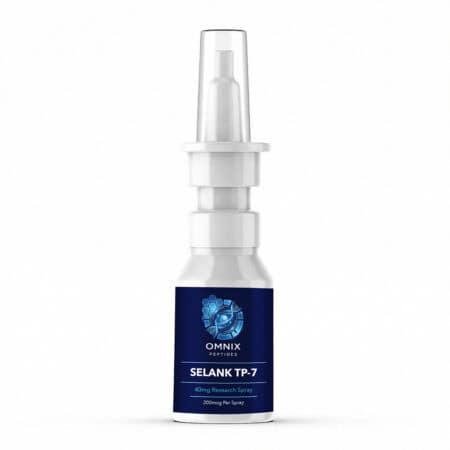
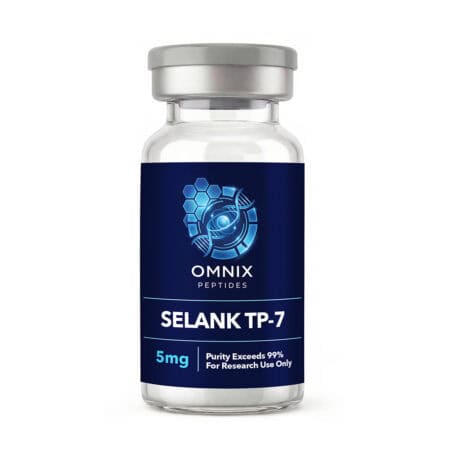
Omnix Peptides supplies selank in two research formats. Each lot is independently characterized by HPLC and LC–MS, with a batch-specific Certificate of Analysis available on each product page.
- Selank Vial — lyophilized powder for reconstitution. The vial format supports the administration flexibility used in published rodent pharmacology studies.
- Selank Liquid Spray — intranasal-administration format consistent with the route used in the Russian clinical-prescribing literature.
Selank is classified under the Cognitive & Focus research category per its anxiolytic and CNS-modulatory profile. For research framed around overlapping Russian peptide pharmacology, see also the related compound hub for Semax (an unrelated heptapeptide developed by the same research network with ACTH(4–10)-derived structure and reported nootropic and neuroprotective activity).
Amount in the Published Research Literature
The following amount ranges describe the protocols used in the peer-reviewed selank literature. They are reported here for research-reference purposes only and do not constitute administration recommendations of any kind.
Kozlovskii 2003 active-avoidance rat study. Adult rats received selank by intraperitoneal injection at amounts in the microgram-per-kilogram range, with conditioned active-avoidance learning, retention, and extinction as the primary behavioral endpoints [1]. The investigators reported optimizing effects on the conditioned reflex at amounts below those producing measurable sedation or motor impairment.
Russian clinical literature. The Russian-registered intranasal selank formulation is administered to adult human patients at protocol-specified daily amounts across treatment courses of 14–21 days for generalized anxiety and related indications. Exact amount and titration details are specified in the Russian-language summary of product characteristics and in Russian-language clinical publications; the data have not been submitted to or reviewed by FDA or EMA.
Pharmacokinetic profile. Selank has a short circulatory half-life consistent with other small peptides, with the Pro-Gly-Pro stabilization extending plasma stability relative to tuftsin but not to the multi-day half-lives characteristic of fatty-acid-modified or albumin-binding peptides. The intranasal route used in the Russian clinical setting bypasses systemic first-pass effects and is the only route characterized in the human-administration literature.
Adverse-event profile. The published preclinical and Russian-clinical literature describe selank as having a benign acute adverse-event profile, with absence of sedation, motor impairment, or withdrawal phenomena as the distinguishing characteristics relative to benzodiazepine-class anxiolytics. The available data are not equivalent to a Western Phase 2/3 safety database; researchers should not infer Western-regulatory-grade safety conclusions from the published Russian data.
Researchers planning protocols are referred to the original primary literature cited in the References section and to the English-translation journals of the Russian Academy of Sciences for additional methodological detail.
Frequently Asked Questions
Is selank FDA-approved?
No. Selank is not approved by the FDA, EMA, or any other Western regulatory authority for any indication. The compound is registered as a prescription pharmaceutical in the Russian Federation for the treatment of generalized anxiety disorder and asthenic conditions, administered as an intranasal solution. The Russian registration was based on Russian-conducted clinical data that has not been submitted to or reviewed by FDA or EMA.
What mechanism of action does selank use?
Selank’s published mechanistic profile is multi-system rather than single-target. Reported mechanisms include modulation of expression of genes encoding GABA-A ionotropic receptor subunits, modulation of serotonergic and dopaminergic neurotransmission in cortical and hippocampal regions, and tuftsin-like immunomodulatory effects on peripheral immune cells. A distinguishing feature in the published preclinical work is the reported absence of the sedation, motor impairment, and physical-dependence phenotypes characteristic of benzodiazepine-class GABA-A positive allosteric modulators.
What is selank’s relationship to tuftsin?
Selank is the heptapeptide Thr-Lys-Pro-Arg-Pro-Gly-Pro, designed as a stabilized analog of the endogenous immunomodulatory tetrapeptide tuftsin (Thr-Lys-Pro-Arg, generated by cleavage of the Fc fragment of immunoglobulin G). The added C-terminal Pro-Gly-Pro tripeptide confers resistance to plasma peptidases while preserving the tuftsin-related biological activity that the parent tetrapeptide loses through rapid degradation.
What is the published evidence base for selank?
The peer-reviewed selank research literature is dominated by Russian-language publications from the Myasoedov, Ashmarin, and Seredenin laboratories and affiliated institutions, with English-translation versions of a subset appearing in indexed journals such as Bulletin of Experimental Biology and Medicine and Neuroscience and Behavioral Physiology. There are no published Phase 2 or Phase 3 trials of selank in any Western regulatory jurisdiction.
What administration routes have been used in selank research?
Published rodent pharmacology studies have used intraperitoneal injection. The Russian-registered clinical formulation is administered intranasally. The intranasal route bypasses systemic first-pass effects and is the only route characterized in the human-administration literature available in English translation.
How does selank differ from semax?
Both selank and semax are synthetic heptapeptides developed by the same Russian research network. Selank (Thr-Lys-Pro-Arg-Pro-Gly-Pro) is a stabilized analog of the immunomodulatory tetrapeptide tuftsin and is framed in the Russian literature as an anxiolytic. Semax (Met-Glu-His-Phe-Pro-Gly-Pro) is a fragment of ACTH(4–10) with a C-terminal Pro-Gly-Pro stabilization and is framed as a nootropic and neuroprotective compound. The two compounds share the Pro-Gly-Pro stabilization motif and the same developmental research network but have distinct parent-peptide sequences and distinct reported pharmacological profiles.
References
- Kozlovskii II, Danchev ND. The optimizing action of the synthetic peptide selank on a conditioned active avoidance reflex in rats. Neurosci Behav Physiol. 2003;33(7):639-643. doi:10.1023/A:1024435729146 · PubMed: 14552538
- Kolomin TA, Shadrina MI, Slominsky PA, Limborska SA, Myasoedov NF. A new generation of drugs: synthetic peptides based on natural regulatory peptides. Neurosci Med. 2013;4(4):223-252. doi:10.4236/nm.2013.44035
- Medvedev VE, Tereshchenko OM, Israelyan AYu, Chobanu IK, Kost NV, Sokolov OY, Myasoedov NF. Optimization of therapy for patients with anxiety disorders combining anxiolytic and immunomodulatory effects of the peptide preparation selank. Zh Nevrol Psikhiatr Im S S Korsakova. 2015;115(6):33-40. doi:10.17116/jnevro20151156133-40 · PubMed: 26356627
For Research Use Only. The products described on this page are sold strictly for in vitro laboratory research and are not intended for human or animal consumption, diagnostic use, or therapeutic use. The published research summarized above is provided as scientific reference material. Nothing on this page constitutes medical advice, a therapeutic claim, or a recommendation for any use outside of a properly resourced and ethically reviewed research setting.