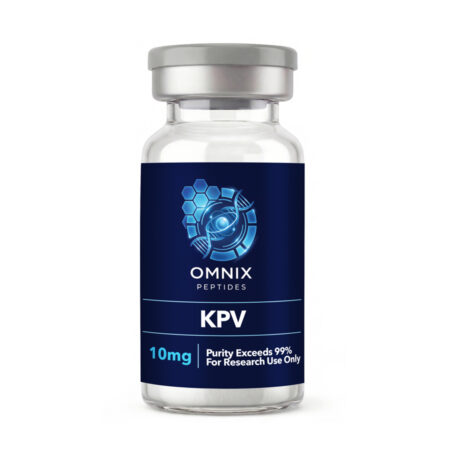
KPV (lysine-proline-valine) is a synthetic tripeptide corresponding to the C-terminal three amino acids of alpha-melanocyte-stimulating hormone (α-MSH). It is studied in preclinical research as an anti-inflammatory signaling peptide, most extensively in laboratory models of intestinal inflammation. KPV is supplied by Omnix Peptides strictly as research-grade material for in vitro and laboratory research use only.
KPV is the subject of a focused but well-developed preclinical literature, concentrated in gastrointestinal inflammation research (colitis models) and, to a lesser extent, skin and systemic inflammation research. It is not approved by the FDA for any use, and the research described on this page was conducted in cell-culture and animal models, not in humans.
Scope of the Research Literature
The KPV research base is real but narrow in focus. The great majority of published KPV studies examine intestinal inflammation in rodent colitis models, with a smaller set addressing the peptide’s parent-molecule (α-MSH) anti-inflammatory biology and nanoparticle-delivery research. Researchers should note that KPV’s evidence base is concentrated in gut-inflammation contexts and is thinner outside that domain. This page describes what has been studied; it makes no claim about outcomes in any other context.
What KPV Is
KPV is a synthetic tripeptide with the sequence lysine-proline-valine (Lys-Pro-Val), corresponding to residues 11–13 — the C-terminal fragment — of α-melanocyte-stimulating hormone. α-MSH is a 13-amino-acid peptide derived from proopiomelanocortin (POMC) with documented anti-inflammatory activity in preclinical research. Research has attributed a significant portion of α-MSH’s anti-inflammatory activity to this three-amino-acid C-terminal sequence.
- Sequence: Lys-Pro-Val (KPV)
- Length: 3 amino acids
- Parent molecule: α-MSH (11–13 fragment)
- Molecular formula: C₁₆H₃₀N₄O₄
- Molecular weight: ~342.4 g/mol
- Common research form: Lyophilized powder for reconstitution
A key distinction in the research literature: KPV lacks the melanocortin-receptor-binding portion of α-MSH, so it does not produce the pigmentation effects associated with the parent peptide. Research by Getting and colleagues specifically dissected the anti-inflammatory contribution of the core versus the C-terminal (KPV) portion of α-MSH, characterizing KPV’s activity as distinct from receptor-mediated melanocortin signaling [6].
Proposed Mechanism in Research Models
The mechanistic picture for KPV in the research literature centers on two features: its transport into cells and its intracellular anti-inflammatory activity. The mechanisms below reflect findings in cell-culture and animal models.
PepT1-mediated transport. The foundational mechanistic study, published by Dalmasso and colleagues in Gastroenterology in 2008, identified PepT1 — a di/tripeptide transporter expressed in the intestine and upregulated in the colon during inflammation — as the primary route by which KPV enters intestinal epithelial cells [1]. The research reported that KPV, taken up via PepT1, reduced inflammation in cell-culture and mouse colitis models. A notable feature reported in this research thread is that PepT1 expression increases in inflamed intestinal tissue, meaning uptake in these models concentrated where inflammation was present.
Intracellular anti-inflammatory activity. In the same research, nanomolar concentrations of KPV inhibited activation of the NF-κB and MAP-kinase inflammatory signaling pathways in human intestinal epithelial cell lines and immune cells in vitro [1]. This positions KPV in the research literature as an intracellular modulator of inflammatory signaling rather than a cell-surface receptor agonist.
Receptor-independence. Research on the parent α-MSH biology, including work by Kannengiesser and colleagues, reported that KPV’s anti-inflammatory effect in colitis models persisted in animals lacking functional MC1R (a melanocortin receptor), supporting the interpretation that KPV’s activity in these models is at least partially independent of classical melanocortin-receptor signaling [2].
Research Applications
KPV appears in the peer-reviewed literature across the following research contexts. Each represents a laboratory or preclinical research application, not a demonstrated outcome in humans.
Intestinal Inflammation Research
This is the most developed KPV research area by a wide margin. KPV has been studied in the two standard rodent colitis models — DSS-induced colitis and TNBS-induced colitis — where the published research reported reductions in histological inflammation, pro-inflammatory cytokine expression, and disease-activity measures [1] [2]. The Kannengiesser research additionally examined a CD45RBhi transfer-colitis model. These are among the most widely used and accepted models in inflammatory bowel disease research.
Colitis-Associated Cancer Research
A 2016 study by Viennois and colleagues in Cellular and Molecular Gastroenterology and Hepatology examined PepT1’s role in colitis-associated cancer using an AOM/DSS mouse model, reporting that KPV administration reduced tumorigenesis in wild-type mice but produced no such effect in PepT1-knockout mice — reinforcing the PepT1-dependence of KPV’s activity in these models [5]. This is preclinical mechanistic research in genetically defined mouse models.
Targeted-Delivery Research
Because KPV’s most-studied applications involve the gut, a body of research has examined oral and targeted delivery systems for the peptide. Xiao and colleagues (2017) studied hyaluronic-acid-functionalized nanoparticles as a delivery vehicle for KPV in an ulcerative-colitis mouse model, reporting targeted delivery to colonic epithelial cells and macrophages [4]. This research thread concerns pharmaceutical delivery science in animal models.
Skin and Systemic Inflammation Research
Drawing on the broader α-MSH anti-inflammatory literature reviewed by Brzoska and colleagues, KPV has been examined in research contexts beyond the gut, including inflammatory skin-model research [3]. This literature is less developed than the intestinal-inflammation research and is largely rooted in the parent α-MSH biology rather than KPV-specific studies.
Research Handling and Storage
Standard research-peptide handling applies. KPV is supplied as a lyophilized powder and reconstituted for laboratory research use.
- Lyophilized storage: 2–8°C short term; −20°C for long-term storage
- Reconstituted storage: 2–8°C, used within the stability window established by the research protocol
- Reconstitution: bacteriostatic water is the common research diluent; consult the research protocol for concentration
- Handling: minimize freeze-thaw cycles; protect from light and heat
For reconstitution methodology, see the reconstitution math guide and the reconstitution solvent comparison.
Research-Grade Purity
Omnix Peptides supplies KPV as research-grade material. Each batch is analyzed by reverse-phase HPLC with a Certificate of Analysis available for the corresponding lot. Research-grade KPV is certified at high purity by RP-HPLC with identity confirmation. See the product’s COA for lot-specific analytical data.
Frequently Asked Questions
Q: What is KPV in research terms?
A: KPV is a synthetic tripeptide (lysine-proline-valine) corresponding to the C-terminal fragment of α-MSH, studied in preclinical research as an anti-inflammatory signaling peptide, most extensively in intestinal-inflammation models.
Q: How does KPV differ from α-MSH in the research literature?
A: KPV is the three-amino-acid C-terminal fragment of α-MSH. Research indicates it retains a significant portion of the parent peptide’s anti-inflammatory activity while lacking the melanocortin-receptor-binding region responsible for α-MSH’s pigmentation effects.
Q: What is PepT1 and why does it appear in KPV research?
A: PepT1 is a di/tripeptide transporter expressed in the intestine and upregulated in inflamed colonic tissue. Research identified it as the primary route of KPV uptake into intestinal cells, which is central to the peptide’s most-studied research applications.
Q: What research models has KPV been studied in?
A: Primarily DSS-induced and TNBS-induced colitis models in mice, a CD45RBhi transfer-colitis model, and an AOM/DSS colitis-associated-cancer model, alongside in vitro human intestinal cell-line work. All published KPV research is preclinical.
Q: Is there human research on KPV?
A: The published KPV literature is preclinical — conducted in cell-culture and animal models. This page describes that research and makes no claim about effects in humans.
Q: What purity is research-grade KPV?
A: Research-grade synthetic KPV is typically certified at ≥98–99% purity by RP-HPLC with mass-spectrometric identity confirmation. See the lot-specific COA.
Related Research Compounds
- BPC-157 — studied in tissue-repair and gastrointestinal research models
- TB-500 — thymosin β4 fragment studied in cell-migration and repair research
- GHK-Cu — copper tripeptide studied in skin and remodeling research
- KLOW — research blend combining BPC-157, TB-500, GHK-Cu, and KPV
References
- Dalmasso G, Charrier-Hisamuddin L, Nguyen HTT, Yan Y, Sitaraman S, Merlin D. “PepT1-mediated tripeptide KPV uptake reduces intestinal inflammation.” Gastroenterology 2008;134(1):166-178. PMID: 18061177 | DOI: 10.1053/j.gastro.2007.10.026
- Kannengiesser K, Maaser C, Heidemann J, et al. “Melanocortin-derived tripeptide KPV has anti-inflammatory potential in murine models of inflammatory bowel disease.” Inflamm Bowel Dis 2008;14(3):324-331. DOI: 10.1002/ibd.20334
- Brzoska T, Luger TA, Maaser C, Abels C, Böhm M. “α-Melanocyte-stimulating hormone and related tripeptides: biochemistry, antiinflammatory and protective effects in vitro and in vivo, and future perspectives for the treatment of immune-mediated inflammatory diseases.” Endocr Rev 2008;29(5):581-602. PMID: 18612139 | DOI: 10.1210/er.2007-0027
- Xiao B, Xu Z, Viennois E, et al. “Orally Targeted Delivery of Tripeptide KPV via Hyaluronic Acid-Functionalized Nanoparticles Efficiently Alleviates Ulcerative Colitis.” Mol Ther 2017;25(7):1628-1640. PMID: 28143741 | DOI: 10.1016/j.ymthe.2016.11.020
- Viennois E, Ingersoll SA, Ayyadurai S, et al. “Critical Role of PepT1 in Promoting Colitis-Associated Cancer and Therapeutic Benefits of the Anti-inflammatory PepT1-Mediated Tripeptide KPV in a Murine Model.” Cell Mol Gastroenterol Hepatol 2016;2(3):340-357. DOI: 10.1016/j.jcmgh.2016.01.006
- Getting SJ, Schiöth HB, Perretti M. “Dissection of the anti-inflammatory effect of the core and C-terminal (KPV) alpha-melanocyte-stimulating hormone peptides.” J Pharmacol Exp Ther 2003;306(2):631-637. DOI: 10.1124/jpet.103.051623
- Luger TA, Scholzen TE, Brzoska T, Böhm M. “New insights into the functions of α-MSH and related peptides in the immune system.” Ann N Y Acad Sci 2003;994:133-140. DOI: 10.1111/j.1749-6632.2003.tb03172.x