Semaglutide (CAS 910463-68-2) is a synthetic, long-acting glucagon-like peptide-1 (GLP-1) receptor agonist with approximately 94% amino acid sequence homology to native human GLP-1, modified at positions 8 and 26 and acylated with a C-18 fatty diacid chain to confer resistance to enzymatic degradation by dipeptidyl peptidase-4 (DPP-4) and a circulatory half-life of approximately seven days. Semaglutide is the subject of an extensive Phase 3 clinical trial program in adult human participants, with results published in The New England Journal of Medicine, The Lancet, Diabetes, Obesity and Metabolism, and other peer-reviewed journals. Semaglutide is FDA-approved for type 2 diabetes — initial approval in 2017 for the once-weekly subcutaneous formulation and in 2019 for the once-daily oral formulation — and for chronic weight management (2021, subcutaneous), with corresponding EMA approval in these indications.
In the 68-week STEP 1 trial published by Wilding and colleagues in the New England Journal of Medicine, adults with obesity who received once-weekly subcutaneous semaglutide 2.4 mg demonstrated substantial, sustained, clinically relevant mean weight loss of 14.9%
, compared with 2.4% in the placebo group; approximately half of treated participants (50.5%) achieved a weight reduction of 15% or greater [1]. In the SELECT cardiovascular outcomes trial published by Lincoff and colleagues in 2023, weekly subcutaneous semaglutide 2.4 mg was reported as superior to placebo
in reducing the incidence of a composite primary endpoint of cardiovascular death, non-fatal myocardial infarction, and non-fatal stroke in 17,604 adults with overweight or obesity and established cardiovascular disease but without type 2 diabetes [2].
Semaglutide has separately demonstrated cardiovascular benefit in adults with type 2 diabetes (SUSTAIN-6, Marso 2016 [3]) and mechanistic effects on appetite, energy intake, and control of eating in healthy-weight humans (Friedrichsen 2021 [4]). Researchers consulting this page should treat semaglutide as a clinically validated agent in its FDA-approved indications, with an expanding literature on cardiovascular, renal, and metabolic-disease outcomes.
Mechanism of Action
Semaglutide is a GLP-1 receptor agonist, mimicking the action of native human glucagon-like peptide-1 with structural modifications that extend its half-life and enable once-weekly administration. The mechanistic literature on GLP-1 receptor agonism is well-developed, and the contribution of each component is identifiable in the published clinical record.
Glucose-dependent insulinotropic activity. Semaglutide activates the GLP-1 receptor on pancreatic beta cells, enhancing glucose-stimulated insulin secretion in hyperglycemic states. The “glucose-dependent” qualifier matters: GLP-1 receptor agonists do not stimulate insulin secretion at normoglycemia, which limits the risk of hypoglycemia when used as monotherapy. Semaglutide simultaneously suppresses inappropriate glucagon release from pancreatic alpha cells in hyperglycemic or euglycemic states.
Delayed gastric emptying and central appetite regulation. GLP-1 receptors are expressed not only on pancreatic islets but on the vagus nerve, brainstem (area postrema, nucleus tractus solitarius), and hypothalamic appetite centers. Semaglutide’s effects on body weight arise from this central appetite-regulation mechanism combined with peripheral effects on gastric emptying. In a Phase 1 mechanism trial, Friedrichsen and colleagues reported that, in adults with obesity, semaglutide 2.4 mg suppressed appetite, improved control of eating, and reduced food cravings
, ad libitum energy intake, and body weight when compared with placebo [4]. Notably, the authors did not observe evidence of delayed gastric emptying at week 20 (assessed indirectly via paracetamol absorption), suggesting that the long-term weight-related effects may be primarily centrally mediated rather than primarily peripheral.
Structural basis for the long half-life. Two amino-acid substitutions differentiate semaglutide from native GLP-1: at position 8, alanine is replaced with 2-aminoisobutyric acid (Aib), conferring resistance to DPP-4 cleavage; at position 34, lysine is substituted with arginine. A C-18 fatty diacid chain is attached at position 26 via a γ-glutamic acid spacer. These modifications produce strong, reversible binding to serum albumin, giving semaglutide a circulatory half-life of approximately seven days — the basis for the once-weekly subcutaneous administration schedule used in the SUSTAIN, STEP, and SELECT trial programs.
Cardiovascular mechanism. The cardiovascular benefit reported in SUSTAIN-6 [3] and SELECT [2] is not fully explained by weight reduction or glycemic improvement alone. Hypothesized mechanisms in the published literature include direct anti-inflammatory effects, endothelial-function improvements, attenuation of atherosclerotic plaque progression, blood-pressure reduction, and lipid-profile improvements. The 2023 SELECT publication, in particular, demonstrated cardiovascular benefit in a population without type 2 diabetes, suggesting that GLP-1 receptor activation produces cardiovascular effects independent of glycemic control.
Available Forms
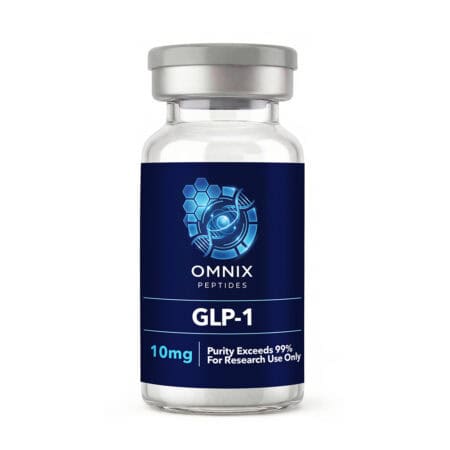
Omnix Peptides currently supplies semaglutide in a single research format. Each lot is independently characterized by HPLC and LC–MS, with a batch-specific Certificate of Analysis available on the product page.
- Semaglutide Vial — lyophilized powder for reconstitution. Multiple strengths available per vial (5 mg, 10 mg, 15 mg, 20 mg, 30 mg). The vial is the canonical research format used in the published clinical literature; once-weekly subcutaneous administration is the route used in the SUSTAIN, STEP, and SELECT Phase 3 trial programs.
Semaglutide is classified under the Metabolic & Weight research category. For research framed around overlapping mechanisms, see also the related compound hubs for Tirzepatide (dual GIP/GLP-1 receptor agonist), Retatrutide (triple GIP/GLP-1/glucagon receptor agonist in Phase 3 development), and Orforglipron (oral small-molecule GLP-1 receptor agonist in late-stage development).
Amount in the Published Research Literature
The following administration ranges describe the protocols used in the peer-reviewed semaglutide Phase 3 trial program. They are reported here for research-reference purposes only and do not constitute administration recommendations of any kind.
STEP 1 obesity trial (Wilding 2021). Adults with a BMI of 30 or greater (or 27 or greater with a weight-related comorbidity), excluding individuals with type 2 diabetes, were randomized 2:1 to once-weekly subcutaneous semaglutide 2.4 mg or placebo, both alongside lifestyle intervention, over a 68-week treatment period [1]. The published protocol uses a stepwise escalating-amount schedule: 0.25 mg weekly for 4 weeks, then 0.5 mg for 4 weeks, then 1.0 mg for 4 weeks, then 1.7 mg for 4 weeks, then maintenance at 2.4 mg weekly. This 16-week titration is designed to mitigate gastrointestinal adverse events characteristic of GLP-1-class agents and most frequent during early escalating-amount.
SELECT cardiovascular outcomes trial (Lincoff 2023). Adults aged 45 or older with overweight or obesity (BMI ≥27) and established cardiovascular disease, but without type 2 diabetes, were randomized to once-weekly subcutaneous semaglutide 2.4 mg or placebo over a mean follow-up of 39.8 months [2]. The same stepwise titration to 2.4 mg applied.
SUSTAIN-6 type 2 diabetes cardiovascular outcomes trial (Marso 2016). Patients with type 2 diabetes and elevated cardiovascular risk were randomized to once-weekly subcutaneous semaglutide at 0.5 mg or 1.0 mg or to volume-matched placebo over a 104-week treatment period [3]. The 1.0 mg maintenance amount used in this T2D-focused trial is lower than the 2.4 mg amount used in the obesity-focused STEP and SELECT trials.
Adverse-event profile across the program. The most commonly reported adverse events in the semaglutide clinical trial program are gastrointestinal — nausea, diarrhea, vomiting, constipation, and abdominal pain — consistent with the class profile of GLP-1 receptor agonists. These events are most frequent during escalating-amount and tend to attenuate over time at the maintenance amount. The stepwise titration schedules in the STEP and SELECT protocols are designed specifically to mitigate this profile.
Researchers planning protocols are referred to the original primary literature cited in the References section for full methodological detail, including randomization schema, exclusion criteria, primary and secondary endpoint definitions, and adverse-event reporting.
Frequently Asked Questions
Is semaglutide FDA-approved?
Yes. Semaglutide is FDA-approved for type 2 diabetes — initial approval in 2017 for the once-weekly subcutaneous formulation and in 2019 for the once-daily oral formulation — and for chronic weight management in 2021 (subcutaneous). It has corresponding EMA approval in these indications.
What does STEP 1 show about body weight in obesity?
STEP 1 was a 68-week, double-blind, randomized, placebo-controlled Phase 3 trial conducted at 129 sites across 16 countries in 1,961 adults with obesity (BMI ≥30, or ≥27 with a weight-related comorbidity), excluding individuals with type 2 diabetes. Adults receiving once-weekly subcutaneous semaglutide 2.4 mg demonstrated a mean body-weight reduction of 14.9%, compared with 2.4% in the placebo group. Approximately half of treated participants (50.5%) achieved a weight reduction of 15% or greater, compared with 4.9% in placebo [1].
What does SELECT show about cardiovascular outcomes?
SELECT was a multicenter, double-blind, randomized, placebo-controlled Phase 3 trial in 17,604 adults aged 45 or older with overweight or obesity (BMI ≥27) and established cardiovascular disease, but without type 2 diabetes. Over a mean follow-up of 39.8 months, weekly subcutaneous semaglutide 2.4 mg was superior to placebo
in reducing the incidence of a composite primary endpoint of cardiovascular death, non-fatal myocardial infarction, and non-fatal stroke [2]. SELECT was the first cardiovascular outcomes trial of a GLP-1 receptor agonist in a population without type 2 diabetes.
How does semaglutide compare with tirzepatide?
Semaglutide is a selective GLP-1 receptor agonist. Tirzepatide is a dual GIP and GLP-1 receptor agonist — it engages both incretin receptors simultaneously. In the head-to-head SURPASS-2 trial in adults with type 2 diabetes inadequately controlled on metformin, tirzepatide produced greater reductions in HbA1c and body weight than once-weekly semaglutide 1 mg. Direct head-to-head trials in obesity-focused amounts (semaglutide 2.4 mg vs. tirzepatide 15 mg) are ongoing. See the Tirzepatide hub for the dual-incretin literature.
What mechanism of action does semaglutide use?
Semaglutide activates the GLP-1 receptor on pancreatic beta cells (enhancing glucose-dependent insulin secretion), pancreatic alpha cells (suppressing inappropriate glucagon release), and central-nervous-system regions including the brainstem and hypothalamus (suppressing appetite and food cravings, improving control of eating). It also slows gastric emptying early in the administration course. Its structural modifications confer DPP-4 resistance and serum albumin binding, producing a circulatory half-life of approximately seven days that enables once-weekly subcutaneous administration.
What administration schedule is used in published semaglutide trials?
The obesity-focused STEP and SELECT trials used a stepwise escalating-amount schedule: 0.25 mg weekly for 4 weeks, then 0.5 mg, then 1.0 mg, then 1.7 mg (each for 4 weeks), then maintenance at 2.4 mg weekly. The diabetes-focused SUSTAIN-6 trial used maintenance amounts of 0.5 mg or 1.0 mg weekly. The 16-week titration in STEP and SELECT is designed to mitigate gastrointestinal adverse events characteristic of GLP-1-class agents.
What are the most common adverse events reported in semaglutide trials?
The most commonly reported adverse events in the semaglutide clinical trial program are gastrointestinal — nausea, diarrhea, vomiting, constipation, and abdominal pain — consistent with the class profile of GLP-1 receptor agonists. These events are most frequent during escalating-amount and tend to attenuate at the maintenance amount. Full adverse-event reporting is available in the published trial papers cited on this page.
References
- Wilding JPH, Batterham RL, Calanna S, et al; STEP 1 Study Group. Once-weekly semaglutide in adults with overweight or obesity. N Engl J Med. 2021;384(11):989-1002. doi:10.1056/NEJMoa2032183 · PubMed: 33567185
- Lincoff AM, Brown-Frandsen K, Colhoun HM, et al; SELECT Trial Investigators. Semaglutide and cardiovascular outcomes in obesity without diabetes. N Engl J Med. 2023;389(24):2221-2232. doi:10.1056/NEJMoa2307563 · PubMed: 37952131
- Marso SP, Bain SC, Consoli A, et al; SUSTAIN-6 Investigators. Semaglutide and cardiovascular outcomes in patients with type 2 diabetes. N Engl J Med. 2016;375(19):1834-1844. doi:10.1056/NEJMoa1607141 · PubMed: 27633186
- Friedrichsen M, Breitschaft A, Tadayon S, Wizert A, Skovgaard D. The effect of semaglutide 2.4 mg once weekly on energy intake, appetite, control of eating, and gastric emptying in adults with obesity. Diabetes Obes Metab. 2021;23(3):754-762. doi:10.1111/dom.14280 · PubMed: 33269530
For Research Use Only. The product described on this page is sold strictly for in vitro laboratory research and is not intended for human or animal consumption, diagnostic use, or therapeutic use. The published research summarized above is provided as scientific reference material; FDA-approved semaglutide drug products are available only by prescription from a licensed healthcare provider. Nothing on this page constitutes medical advice, a therapeutic claim, or a recommendation for any use outside of a properly resourced and ethically reviewed research setting.