
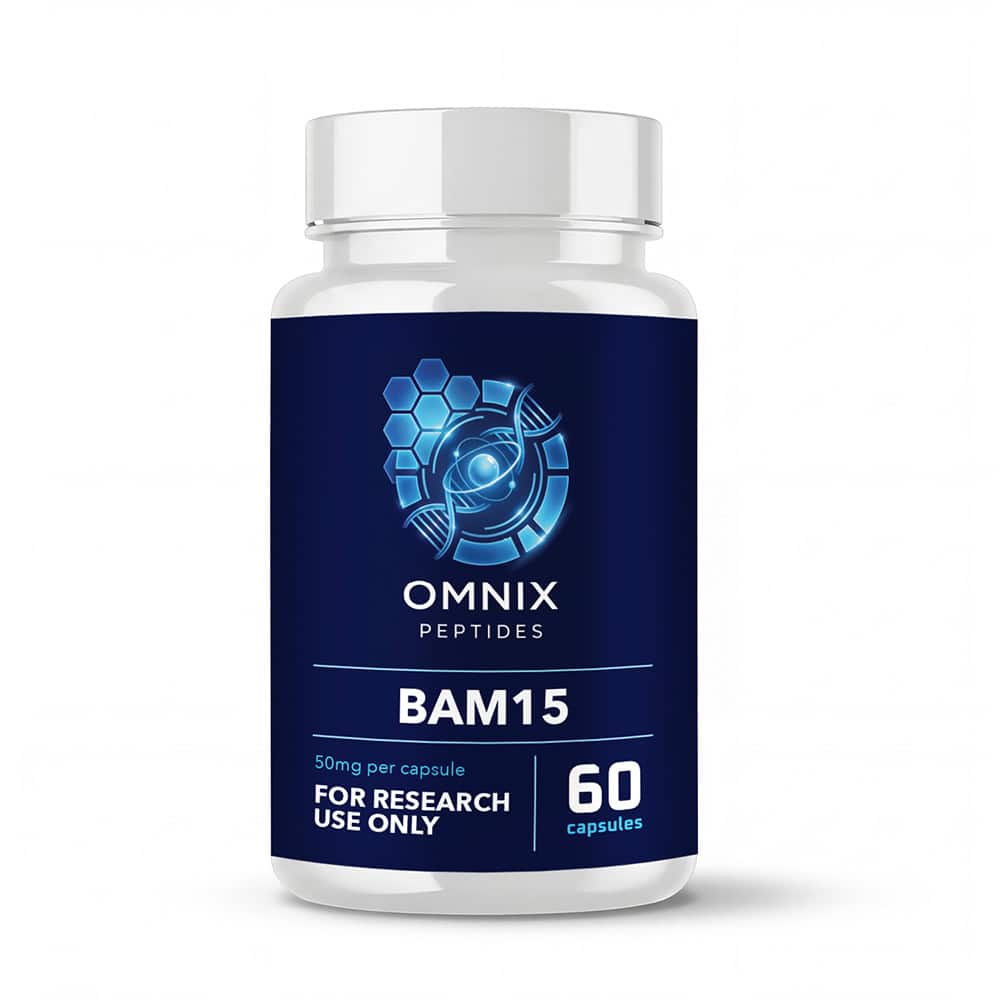
BAM15 Capsules 50mg
BAM15 (N5,N6-bis(2-fluorophenyl)-[1,2,5]oxadiazolo[3,4-b]pyrazine-5,6-diamine) is a small-molecule mitochondrial protonophore that uncouples oxidative phosphorylation from ATP synthesis without depolarizing the plasma membrane.
$159.99
In stock
Research goals: Metabolic & Weight
Description
BAM15 (N5,N6-bis(2-fluorophenyl)-[1,2,5]oxadiazolo[3,4-b]pyrazine-5,6-diamine) is a small-molecule mitochondrial protonophore that uncouples oxidative phosphorylation from ATP synthesis without depolarizing the plasma membrane. Originally identified by Kenwood and colleagues at the University of Virginia in 2014, BAM15 was developed as a safer alternative to the historical uncoupler 2,4-dinitrophenol (DNP), which was discontinued in humans in the 1930s due to a narrow therapeutic window and lethal hyperthermia. BAM15 has been characterized in multiple peer-reviewed mouse studies as orally bioavailable and effective against diet-induced obesity, hepatic steatosis, and insulin resistance.
The strongest preclinical finding comes from the Alexopoulos et al. Nature Communications study: in C57BL/6J mice on a Western diet, oral BAM15 reversed diet-induced obesity, decreased hepatic fat and inflammatory lipids, and improved insulin sensitivity in multiple tissues — without altering food intake, lean body mass, or body temperature.2
Important Note on the Evidence Base
The published evidence base for BAM15 is preclinical. All controlled studies referenced below were conducted in cell culture (L6 myoblasts, hepatocytes, primary cardiomyocytes) or rodent models (diet-induced obese C57BL/6J mice, db/db mice, NASH models). No human clinical trials of BAM15 have been published in peer-reviewed journals as of 2026, and the compound’s pharmacokinetics, safety, and efficacy in humans remain uncharacterized in the published literature. Mitochondrial uncouplers as a drug class carry historical safety concerns (DNP) related to hyperthermia and cardiovascular adverse effects, although BAM15 specifically has shown a wider therapeutic window in preclinical models. This product is for laboratory research only.
Published Research on BAM15
Original Identification and Characterization — Kenwood et al., Molecular Metabolism (2014)
The foundational paper that introduced BAM15 as a mitochondrial protonophore that uncouples oxidative phosphorylation without depolarizing the plasma membrane — the key pharmacological distinction from FCCP and CCCP that gives BAM15 a wider effective concentration range in living cells. In L6 myoblast mitochondria, BAM15 had an EC50 of 270 nM. Compared with FCCP, BAM15 stimulated a higher maximum rate of mitochondrial respiration before inducing respiratory inhibition. The authors framed the membrane-selectivity profile as the basis for therapeutic development of mitochondrial uncouplers in obesity, NAFLD, and metabolic disease.1
Reversal of Diet-Induced Obesity in Mice — Alexopoulos et al., Nature Communications (2020)
This study tested oral BAM15 in C57BL/6J mice on a Western diet and demonstrated that the compound increased nutrient oxidation and decreased body fat mass without altering food intake, lean body mass, or body temperature. BAM15 also decreased hepatic fat, decreased inflammatory lipids, and exerted antioxidant effects. Hyperinsulinemic-euglycemic clamp studies showed BAM15 improved insulin sensitivity in multiple tissue types. The findings established pharmacologic mitochondrial uncoupling as a tractable approach to reverse obesity in mice without compromising lean mass.2
Body Composition and Glycemic Control — Axelrod et al., EMBO Molecular Medicine (2020)
This independent confirmation study, published in parallel with the Alexopoulos work, showed BAM15 was orally bioavailable, selectively distributed to lipid-rich tissues, and protected mice against diet-induced obesity. Notably, the improvements in body composition and glycemic control were observed independently of weight loss, suggesting tissue-selective effects on lipid storage and insulin sensitivity beyond simple caloric inefficiency. BAM15 enhanced mitochondrial respiratory kinetics, improved insulin action, and stimulated nutrient uptake by sustained activation of AMPK in vitro.3
Therapeutic Potential for NAFLD and NASH — Goedeke & Shulman, Molecular Metabolism (2021)
This Yale-led review synthesizes the preclinical case for mitochondrial uncouplers as a class of treatment for metabolic-associated fatty liver disease and NASH, with detailed coverage of BAM15 and its second-generation derivatives (compound 10b, SHS4121705). In a STAM murine model of NASH, BAM15 derivatives at 25 mg/kg/day for 21 days decreased hepatic triglyceride content and improved markers of liver toxicity including plasma ALT, hepatic inflammation, fibrosis, and NAFLD activity score — independently of changes in food intake, body weight, or body temperature. The review situates BAM15 within the broader pipeline of selective mitochondrial uncouplers in development for human metabolic disease.4
About the Compound
BAM15 is a small-molecule (non-peptide) mitochondrial uncoupler from the oxadiazolopyrazine class. Its mechanism is direct protonophore activity: BAM15 transports protons across the inner mitochondrial membrane via a pathway independent of ATP synthase, dissipating the proton gradient that normally drives ATP production. Because the inner mitochondrial membrane is uncoupled, electron transport runs at high rate while producing less ATP per unit of substrate oxidized; the cell compensates by burning more nutrients (fat, glucose) to maintain energy homeostasis. The compound’s defining property versus older protonophores (DNP, FCCP, CCCP) is its lack of plasma membrane depolarization, which substantially widens the effective concentration range and reduces non-mitochondrial off-target effects.
- Compound class: small-molecule mitochondrial protonophore uncoupler; oxadiazolopyrazine
- IUPAC name: N5,N6-bis(2-fluorophenyl)-[1,2,5]oxadiazolo[3,4-b]pyrazine-5,6-diamine
- CAS Number: 210302-17-3
- Molecular Formula: C16H10F2N6O
- Molecular Weight: 340.30 g/mol
- Solubility: soluble in DMSO; low aqueous solubility (lipophilic, membrane-permeable)
- Mechanism: mitochondrial proton transport without plasma membrane depolarization; uncouples oxidative phosphorylation from ATP synthesis
- Regulatory status: not approved by the FDA or EMA. No human clinical trials published as of 2026
Product Specifications
- Format: capsules
- Strength: 50 mg per capsule
- Count: 60 capsules per bottle
- Purity: ≥98% (HPLC verified)
- Container: sealed amber bottle
- Certificate of Analysis: lot-specific COA available
See the FDA Disclosure, Storage Instructions, and RUO tabs for handling, storage, and regulatory information.
References
- Kenwood BM, Weaver JL, Bajwa A, et al. Identification of a novel mitochondrial uncoupler that does not depolarize the plasma membrane. Mol Metab. 2014;3(2):114-123. doi:10.1016/j.molmet.2013.11.005
- Alexopoulos SJ, Chen SY, Brandon AE, et al. Mitochondrial uncoupler BAM15 reverses diet-induced obesity and insulin resistance in mice. Nat Commun. 2020;11(1):2397. doi:10.1038/s41467-020-16298-2
- Axelrod CL, King WT, Davuluri G, et al. BAM15-mediated mitochondrial uncoupling protects against obesity and improves glycemic control. EMBO Mol Med. 2020;12(7):e12088. doi:10.15252/emmm.202012088
- Goedeke L, Shulman GI. Therapeutic potential of mitochondrial uncouplers for the treatment of metabolic associated fatty liver disease and NASH. Mol Metab. 2021;46:101178. doi:10.1016/j.molmet.2021.101178
Preparation and storage
Research-only handling information. BAM15 is sold strictly for in vitro laboratory research. The handling and storage guidance below reflects standard practice in published peptide research literature. BAM15 is not a drug, supplement, or food product, and is not for human consumption, veterinary use, or medical applications.
Format
- Form: Capsules
- Available strengths: 60ct
- Verified purity: >99% (HPLC, LC–MS)
- Documentation: Batch-specific Certificate of Analysis (COA) included
Handling for Research Use
BAM15 capsules ship as a pre-encapsulated, dry oral-research format. No reconstitution is required. The capsules can be opened for analytical or assay work that requires the dry powder.
Storage & Handling
- Upon receipt: Store in a cool, dry place away from direct light.
- Short-term storage: Room temperature in a sealed container is acceptable for several months.
- Long-term storage: Refrigeration at 4 °C (39 °F) extends shelf stability. Capsules do not require freezing.
- Humidity: Keep the original desiccant-sealed container closed when not in use. Excess moisture can compromise capsule integrity.
- Light exposure: Minimize exposure to direct light during handling.
Important Notice
All Omnix Peptides products are sold for laboratory, research, or analytical purposes only. They are not for human consumption, veterinary use, or medical applications. Researchers and laboratory professionals must follow all applicable institutional, local, state, and federal regulations governing the handling of research compounds.
Citations
Citations and reference data. Omnix Peptides supplies research-grade compounds for use by qualified laboratory professionals. The references below cite published preclinical research conducted in animal models and in vitro systems. They are not intended to represent clinical evidence in humans, and BAM15 has not been approved by the FDA, EMA, or any other regulatory authority for any indication.
Compound Reference Data
- Compound: BAM15
- CAS Number: 210302-17-3
- Molecular Formula: C16H10F2N6O
- Molecular Weight: 340.30 g/mol
- Sequence: —
- Synonyms: —
Selected Published Studies
The following peer-reviewed studies were conducted using animal models or in vitro cell-culture systems. They are listed here as a reference for researchers investigating BAM15. None of these studies should be interpreted as recommending BAM15 for human use, treatment, or any clinical purpose.
- Kenwood BM, Weaver JL, Bajwa A, et al. Identification of a novel mitochondrial uncoupler that does not depolarize the plasma membrane. Mol Metab. 2014;3(2):114-123. doi:10.1016/j.molmet.2013.11.005
- Alexopoulos SJ, Chen SY, Brandon AE, et al. Mitochondrial uncoupler BAM15 reverses diet-induced obesity and insulin resistance in mice. Nat Commun. 2020;11(1):2397. doi:10.1038/s41467-020-16298-2
- Axelrod CL, King WT, Davuluri G, et al. BAM15-mediated mitochondrial uncoupling protects against obesity and improves glycemic control. EMBO Mol Med. 2020;12(7):e12088. doi:10.15252/emmm.202012088
- Goedeke L, Shulman GI. Therapeutic potential of mitochondrial uncouplers for the treatment of metabolic associated fatty liver disease and NASH. Mol Metab. 2021;46:101178. doi:10.1016/j.molmet.2021.101178
Evidence-Base Disclosure
The published evidence base for BAM15 consists predominantly of preclinical research — animal models (often rats or mice) and in vitro cell-culture experiments. Where Phase I or Phase II human trials exist, they are noted in the compound page summary. Researchers should interpret the cited literature within the experimental context of each individual study.
Frequently asked questions
Frequently asked questions about the BAM15 Capsules. Questions on this page cover handling, storage, documentation, and ordering. BAM15 is sold for laboratory, research, or analytical purposes only — not for human consumption, veterinary use, or medical applications.
Why does Omnix offer BAM15 in a capsule format?
Capsule format is used in oral-research and analytical contexts where dry, pre-measured administration is preferred over a reconstituted solution. The capsules contain the same research-grade compound supplied in the vial format and are tested to the same purity specification.
Do the BAM15 capsules require refrigeration?
Capsules are stable at room temperature for several months when kept in a cool, dry place away from direct light. Refrigeration at 4 °C (39 °F) extends shelf stability and is recommended for long-term storage. Capsules do not require freezing.
Can the capsules be opened to access the dry powder?
Yes. The capsule shell can be opened for analytical or assay work that requires direct handling of the dry powder. Once opened, the powder should be used immediately or transferred to a sealed, light-protected container.
Is BAM15 approved by the FDA?
No. BAM15 is not approved by the FDA, EMA, or any other regulatory authority for any indication. BAM15 is sold by Omnix Peptides strictly for laboratory, research, or analytical purposes. It is not for human consumption, veterinary use, or medical applications.
What is included with each BAM15 Capsules?
Each order includes the sealed product container and a batch-specific Certificate of Analysis (COA) verifying identity and purity by HPLC and LC–MS. The full COA library for Omnix Peptides is available at /coa-lab-reports/.
What is a Certificate of Analysis (COA), and how do I read it?
A COA is a batch-specific lab report that documents the identity, purity, and quality control results for the production lot you receive. The COA lists the compound name, CAS number, lot number, analytical methods used (HPLC, LC–MS), and the measured purity percentage. Every Omnix order includes the COA for the lot shipped.
What is the CAS number for BAM15?
The CAS number for BAM15 is 210302-17-3. Researchers can use this identifier to locate published literature in PubMed and other scientific databases.
How does Omnix Peptides ship orders?
Orders ship from a US-based facility with tracked domestic shipping. Free shipping is offered on orders over $99. Lyophilized vials and capsules ship at ambient temperature; sprays ship insulated when seasonal conditions require it. Tracking information is provided by email after the order ships.
What if my product arrives damaged or the seal is broken?
Contact Omnix Peptides within 48 hours of delivery. Product damaged in transit or arriving with a compromised seal will be replaced at no cost. See the Shipping & Return Policy at /shipping-return-policy/ for full terms.
Where can I find published research on BAM15?
Peer-reviewed studies relevant to BAM15 are listed in the Citations tab on this product page. The same studies can be located independently on PubMed using the CAS number (210302-17-3) or the compound name.
Customer reviews
Certificate of Analysis
Certificate of Analysis (COA) for this batch is available on request. Email orders@omnixpeptides.com with your order number to receive a copy. COAs include HPLC purity analysis performed by an independent third-party laboratory.
Reviews
There are no reviews yet.