
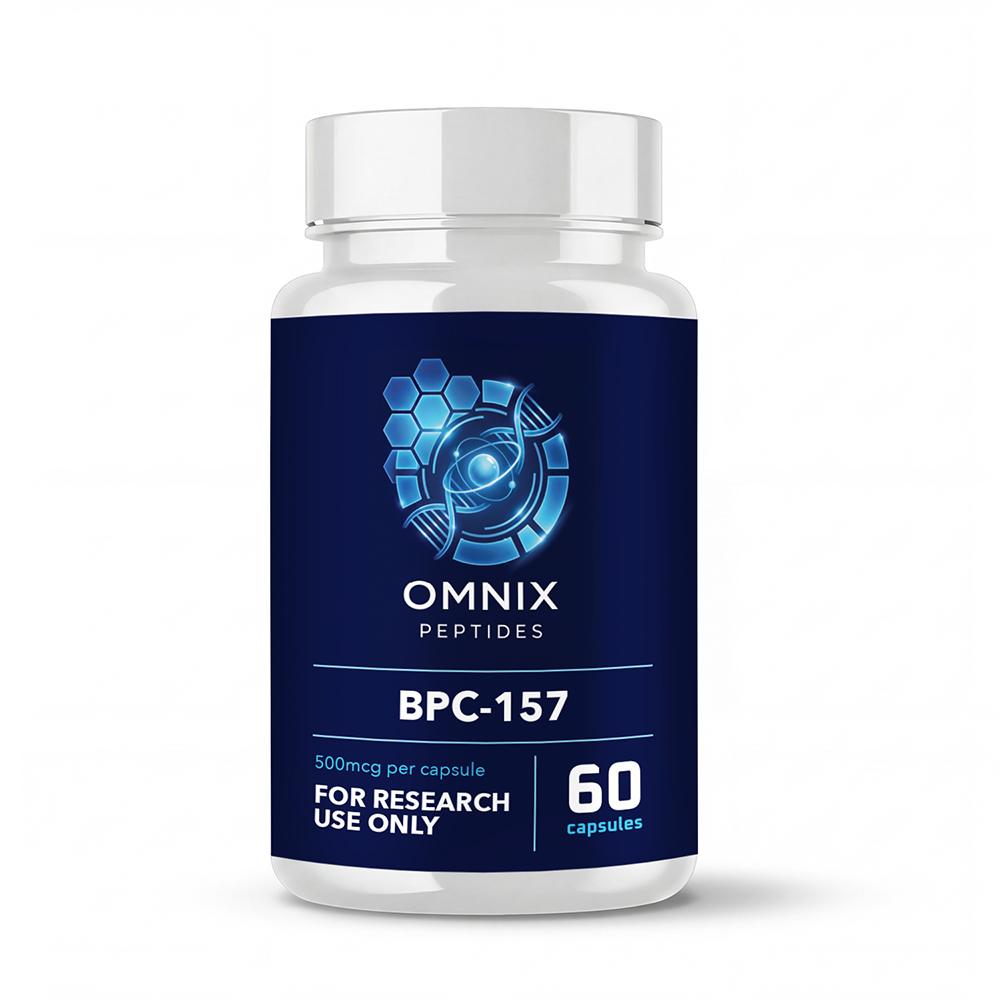
BPC-157 Capsules 500mcg
Oral research format of Body Protection Compound peptide. Capsules suit chronic-dosing study designs and gut-localized delivery models, where BPC-157's effects on intestinal-tract tissue have been investigated in published preclinical literature. HPLC-tested, third-party COA per batch.
$99.99
In stock
Research goals: Recovery & Healing
Description
BPC-157 (Body Protection Compound-157; CAS 137525-51-0) is a synthetic 15-amino-acid peptide (sequence: GEPPPGKPADDAGLV) derived from a protective protein originally isolated from human gastric juice. Peer-reviewed research has investigated BPC-157 across animal models and in vitro cell-culture systems, with published studies appearing in journals including the Journal of Molecular Medicine, the Journal of Applied Physiology, and the Journal of Orthopaedic Research.
In a 2017 study published in the Journal of Molecular Medicine, Hsieh and colleagues reported that BPC-157 promoted angiogenesis in chick chorioallantoic membrane and endothelial tube-formation assays and accelerated blood-flow recovery in a rat hindlimb ischemia model, with the effect attributed to activation of the VEGFR2-Akt-eNOS signaling pathway [1].
Important Note on the Evidence Base
Important note on the evidence base: The published research on BPC-157 consists predominantly of animal-model studies (primarily rats) and in vitro cell-culture experiments. A Phase I safety study and a Phase II ulcerative colitis trial of the BPC-157 formulation PL 14736 were conducted by the Croatian pharmaceutical company Pliva, but full peer-reviewed Phase II efficacy results have not been published. The studies summarized below are preclinical and should be interpreted accordingly.
Published Research on BPC-157
The following peer-reviewed studies are summarized below. Full citations and direct links to each publication appear in the References section. Each summary identifies the experimental model used.
Angiogenesis & VEGFR2 Mechanism — Hsieh et al., Journal of Molecular Medicine (2017)
Hsieh and colleagues investigated the pro-angiogenic effects of BPC-157 across multiple experimental systems: a chick chorioallantoic membrane (CAM) assay, an endothelial tube-formation assay, and a rat hindlimb ischemia model assessed by laser Doppler scanning. The study sought to clarify the molecular pathway underlying BPC-157’s reported tissue-repair effects.
The authors observed that BPC 157 promotes angiogenesis in CAM assay and tube formation assay
, with corresponding acceleration of blood-flow recovery and increased vessel density in the ischemic rat hindlimb model [1]. The investigators attributed the angiogenic effect to upregulation of vascular endothelial growth factor receptor 2 (VEGFR2) and activation of the Akt–endothelial nitric oxide synthase (eNOS) signaling pathway.
Read the full study: Therapeutic Potential of Pro-Angiogenic BPC157 is Associated with VEGFR2 Activation and Up-Regulation (J Mol Med 2017).
Tendon Fibroblast Outgrowth — Chang et al., Journal of Applied Physiology (2011)
Chang and colleagues conducted an in vitro study using tendon fibroblasts isolated from the Achilles tendons of male Sprague-Dawley rats. The investigators evaluated tendon-explant outgrowth, fibroblast proliferation (MTT assay), cell survival under hydrogen peroxide oxidative stress, and fibroblast migration (transwell filter migration assay) in the presence and absence of BPC-157.
The authors reported that BPC 157 significantly accelerated the outgrowth of tendon explants
and amount-dependently increased the in vitro migration of tendon fibroblasts [2]. While direct cell proliferation was not significantly altered, fibroblast survival under oxidative stress was significantly enhanced in BPC-157-treated cultures compared with controls.
Read the full study: The Promoting Effect of Pentadecapeptide BPC 157 on Tendon Healing Involves Tendon Outgrowth, Cell Survival, and Cell Migration (J Appl Physiol 2011).
Achilles Tendon-to-Bone Healing — Krivic et al., Journal of Orthopaedic Research (2006)
Krivic and colleagues, working at the Laboratory for Experimental Surgery at the University of Zagreb Medical School, conducted a controlled rat study examining BPC-157’s effect on Achilles tendon-to-bone healing. The investigators surgically detached the Achilles tendon from its calcaneal insertion in rats — an injury that does not heal spontaneously — and assessed recovery with and without BPC-157 administration.
The authors reported that BPC 157 alone (without carrier) ameliorates healing of tendon and bone
in the experimental rat model, with macroscopic, microscopic, and biomechanical assessments showing recovery of the tendon-to-bone unit that was not observed in untreated controls [3]. The study also examined corticosteroid-induced healing impairment and reported that BPC-157 opposed the aggravating effects of methylprednisolone.
Read the full study: Achilles Detachment in Rat and Stable Gastric Pentadecapeptide BPC 157 (J Orthop Res 2006).
Medial Collateral Ligament Healing — Cerovecki et al., Journal of Orthopaedic Research (2010)
Cerovecki and colleagues conducted a controlled rat study evaluating BPC-157 in medial collateral ligament (MCL) healing following surgical transection. Investigators administered BPC-157 by three routes — intraperitoneal injection, oral administration in drinking water, and topical application as a thin cream layer — with assessment over a 90-day post-injury period.
The authors reported that they improved medial collateral ligament (MCL) healing throughout 90 days after surgical transection
using BPC-157 administered without a carrier [4]. Healing was evaluated by macroscopic appearance, microscopic histology, and biomechanical testing across the 90-day timeline.
Read the full study: Pentadecapeptide BPC 157 (PL 14736) Improves Ligament Healing in the Rat (J Orthop Res 2010).
About the Compound
BPC-157 is a synthetic 15-amino-acid peptide with the sequence Gly-Glu-Pro-Pro-Pro-Gly-Lys-Pro-Ala-Asp-Asp-Ala-Gly-Leu-Val (GEPPPGKPADDAGLV). It represents a partial sequence of a larger protein known as Body Protection Compound (BPC), originally isolated from human gastric juice. Unlike many peptides used in research, BPC-157 has been described in the published literature as stable in human gastric juice without enzymatic degradation, and as effective in research models when administered without a delivery carrier.
The molecule was advanced into clinical development by the Croatian pharmaceutical company Pliva under the designations PL-10, PLD-116, and PL 14736 for inflammatory bowel disease research; published Phase I safety data in healthy volunteers were reported in conference proceedings, while completed Phase II efficacy results have not appeared in peer-reviewed literature.
- CAS Number: 137525-51-0
- Molecular Formula: C62H98N16O22
- Molecular Weight: 1419.55 g/mol
- Sequence: GEPPPGKPADDAGLV
- Synonyms: Body Protection Compound-157, BPC-157, PL-10, PLD-116, PL 14736, Bepecin
- Mechanisms investigated in research literature: VEGFR2-mediated angiogenesis; Akt–eNOS signaling; nitric oxide system modulation; growth-hormone-receptor upregulation; fibroblast migration and survival
Product Specifications
Omnix Peptides supplies BPC-157 as encapsulated material in sealed amber bottles intended exclusively for in vitro laboratory research. Each production lot is independently characterized using high-performance liquid chromatography (HPLC) and liquid chromatography–mass spectrometry (LC–MS) protocols.
- Format: Capsules
- Strength: 500 mcg per capsule
- Count: 60 capsules per bottle
- Verified Purity: >99% (HPLC, LC–MS)
- Container: Sealed amber bottle
- Documentation: Batch-specific Certificate of Analysis (COA) available
Storage, handling, intended-use, and regulatory information are provided in the corresponding tabs on this product page.
References
- Hsieh MJ, Liu HT, Wang CN, et al. Therapeutic potential of pro-angiogenic BPC157 is associated with VEGFR2 activation and up-regulation. J Mol Med (Berl). 2017;95(3):323-333. doi:10.1007/s00109-016-1488-y
- Chang CH, Tsai WC, Lin MS, Hsu YH, Pang JHS. The promoting effect of pentadecapeptide BPC 157 on tendon healing involves tendon outgrowth, cell survival, and cell migration. J Appl Physiol (1985). 2011;110(3):774-780. doi:10.1152/japplphysiol.00945.2010
- Krivic A, Anic T, Seiwerth S, Huljev D, Sikiric P. Achilles detachment in rat and stable gastric pentadecapeptide BPC 157: promoted tendon-to-bone healing and opposed corticosteroid aggravation. J Orthop Res. 2006;24(5):982-989. doi:10.1002/jor.20096
- Cerovecki T, Bojanic I, Brcic L, Radic B, Vukoja I, Seiwerth S, Sikiric P. Pentadecapeptide BPC 157 (PL 14736) improves ligament healing in the rat. J Orthop Res. 2010;28(9):1155-1161. doi:10.1002/jor.21107
Preparation and storage
Research-only handling information. BPC-157 is sold strictly for in vitro laboratory research. The handling and storage guidance below reflects standard practice in published peptide research literature. BPC-157 is not a drug, supplement, or food product, and is not for human consumption, veterinary use, or medical applications.
Format
- Form: Capsules
- Available strengths: 60ct
- Verified purity: >99% (HPLC, LC–MS)
- Documentation: Batch-specific Certificate of Analysis (COA) included
Handling for Research Use
BPC-157 capsules ship as a pre-encapsulated, dry oral-research format. No reconstitution is required. The capsules can be opened for analytical or assay work that requires the dry powder.
Storage & Handling
- Upon receipt: Store in a cool, dry place away from direct light.
- Short-term storage: Room temperature in a sealed container is acceptable for several months.
- Long-term storage: Refrigeration at 4 °C (39 °F) extends shelf stability. Capsules do not require freezing.
- Humidity: Keep the original desiccant-sealed container closed when not in use. Excess moisture can compromise capsule integrity.
- Light exposure: Minimize exposure to direct light during handling.
Important Notice
All Omnix Peptides products are sold for laboratory, research, or analytical purposes only. They are not for human consumption, veterinary use, or medical applications. Researchers and laboratory professionals must follow all applicable institutional, local, state, and federal regulations governing the handling of research compounds.
Citations
Citations and reference data. Omnix Peptides supplies research-grade compounds for use by qualified laboratory professionals. The references below cite published preclinical research conducted in animal models and in vitro systems. They are not intended to represent clinical evidence in humans, and BPC-157 has not been approved by the FDA, EMA, or any other regulatory authority for any indication.
Compound Reference Data
- Compound: BPC-157
- CAS Number: 137525-51-0
- Molecular Formula: C62H98N16O22
- Molecular Weight: 1419.55 g/mol
- Sequence: GEPPPGKPADDAGLV
- Synonyms: Body Protection Compound-157, BPC-157, PL-10, PLD-116, PL 14736, Bepecin
Selected Published Studies
The following peer-reviewed studies were conducted using animal models or in vitro cell-culture systems. They are listed here as a reference for researchers investigating BPC-157. None of these studies should be interpreted as recommending BPC-157 for human use, treatment, or any clinical purpose.
- Hsieh MJ, Liu HT, Wang CN, et al. Therapeutic potential of pro-angiogenic BPC157 is associated with VEGFR2 activation and up-regulation. J Mol Med (Berl). 2017;95(3):323-333. doi:10.1007/s00109-016-1488-y
- Chang CH, Tsai WC, Lin MS, Hsu YH, Pang JHS. The promoting effect of pentadecapeptide BPC 157 on tendon healing involves tendon outgrowth, cell survival, and cell migration. J Appl Physiol (1985). 2011;110(3):774-780. doi:10.1152/japplphysiol.00945.2010
- Krivic A, Anic T, Seiwerth S, Huljev D, Sikiric P. Achilles detachment in rat and stable gastric pentadecapeptide BPC 157: promoted tendon-to-bone healing and opposed corticosteroid aggravation. J Orthop Res. 2006;24(5):982-989. doi:10.1002/jor.20096
- Cerovecki T, Bojanic I, Brcic L, Radic B, Vukoja I, Seiwerth S, Sikiric P. Pentadecapeptide BPC 157 (PL 14736) improves ligament healing in the rat. J Orthop Res. 2010;28(9):1155-1161. doi:10.1002/jor.21107
Evidence-Base Disclosure
The published evidence base for BPC-157 consists predominantly of preclinical research — animal models (often rats or mice) and in vitro cell-culture experiments. Where Phase I or Phase II human trials exist, they are noted in the compound page summary. Researchers should interpret the cited literature within the experimental context of each individual study.
Frequently asked questions
Frequently asked questions about the BPC-157 Capsules. Questions on this page cover handling, storage, documentation, and ordering. BPC-157 is sold for laboratory, research, or analytical purposes only — not for human consumption, veterinary use, or medical applications.
Why does Omnix offer BPC-157 in a capsule format?
Capsule format is used in oral-research and analytical contexts where dry, pre-measured administration is preferred over a reconstituted solution. The capsules contain the same research-grade compound supplied in the vial format and are tested to the same purity specification.
Do the BPC-157 capsules require refrigeration?
Capsules are stable at room temperature for several months when kept in a cool, dry place away from direct light. Refrigeration at 4 °C (39 °F) extends shelf stability and is recommended for long-term storage. Capsules do not require freezing.
Can the capsules be opened to access the dry powder?
Yes. The capsule shell can be opened for analytical or assay work that requires direct handling of the dry powder. Once opened, the powder should be used immediately or transferred to a sealed, light-protected container.
Is BPC-157 approved by the FDA?
No. BPC-157 is not approved by the FDA, EMA, or any other regulatory authority for any indication. BPC-157 is sold by Omnix Peptides strictly for laboratory, research, or analytical purposes. It is not for human consumption, veterinary use, or medical applications.
What is included with each BPC-157 Capsules?
Each order includes the sealed product container and a batch-specific Certificate of Analysis (COA) verifying identity and purity by HPLC and LC–MS. The full COA library for Omnix Peptides is available at /coa-lab-reports/.
What is a Certificate of Analysis (COA), and how do I read it?
A COA is a batch-specific lab report that documents the identity, purity, and quality control results for the production lot you receive. The COA lists the compound name, CAS number, lot number, analytical methods used (HPLC, LC–MS), and the measured purity percentage. Every Omnix order includes the COA for the lot shipped.
What is the CAS number for BPC-157?
The CAS number for BPC-157 is 137525-51-0. Researchers can use this identifier to locate published literature in PubMed and other scientific databases.
How does Omnix Peptides ship orders?
Orders ship from a US-based facility with tracked domestic shipping. Free shipping is offered on orders over $99. Lyophilized vials and capsules ship at ambient temperature; sprays ship insulated when seasonal conditions require it. Tracking information is provided by email after the order ships.
What if my product arrives damaged or the seal is broken?
Contact Omnix Peptides within 48 hours of delivery. Product damaged in transit or arriving with a compromised seal will be replaced at no cost. See the Shipping & Return Policy at /shipping-return-policy/ for full terms.
Where can I find published research on BPC-157?
Peer-reviewed studies relevant to BPC-157 are listed in the Citations tab on this product page. The same studies can be located independently on PubMed using the CAS number (137525-51-0) or the compound name.
Customer reviews
Certificate of Analysis
Third-party HPLC purity analysis performed by an independent laboratory for this batch.
Reviews
There are no reviews yet.