
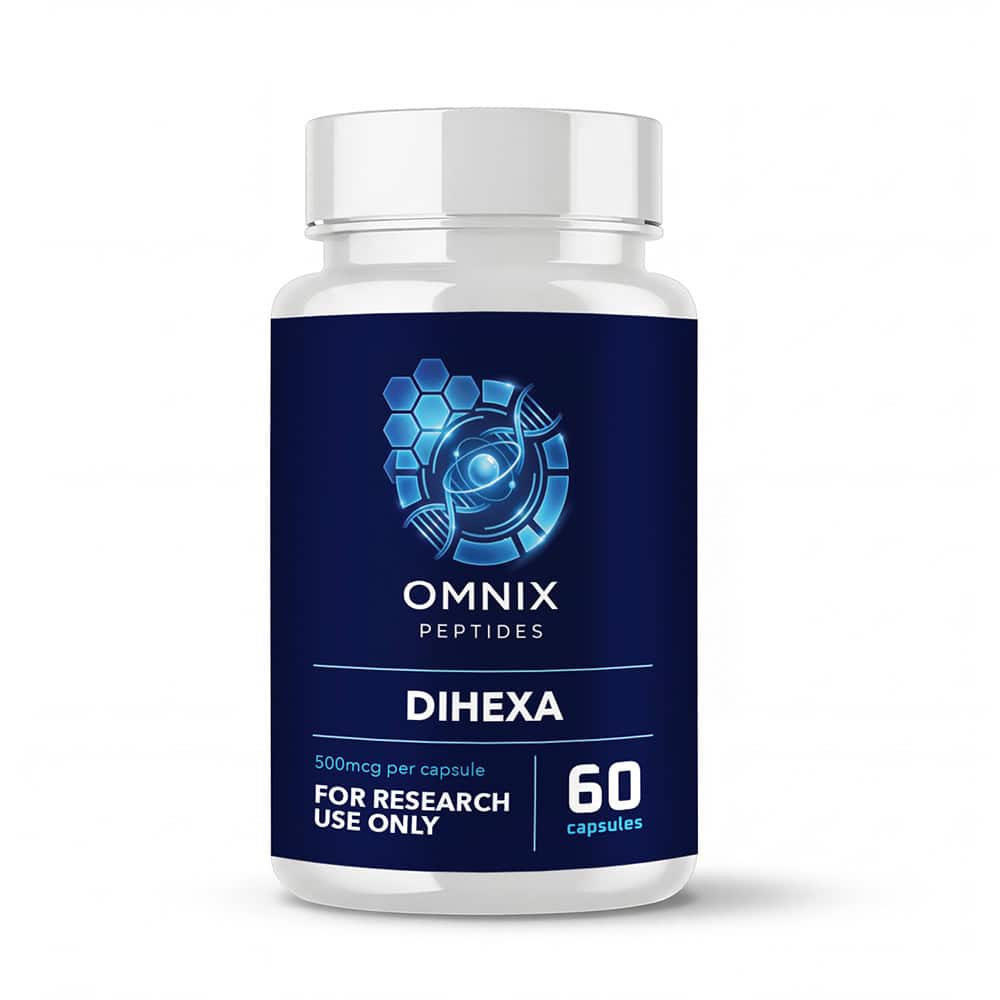
Dihexa Capsules 10mg
Dihexa (N-hexanoic-Tyr-Ile-(6) aminohexanoic amide; developmental code PNB-0408) is a synthetic small oligopeptide derived from angiotensin IV (AngIV), engineered to overcome AngIV's limitations as a research tool by adding lipophilic modifications that confer oral bioavailability and blood-brain barrier permeability.
$120.00
Research goals: Cognitive & Focus
Description
Dihexa (N-hexanoic-Tyr-Ile-(6) aminohexanoic amide; developmental code PNB-0408) is a synthetic small oligopeptide derived from angiotensin IV (AngIV), engineered to overcome AngIV’s limitations as a research tool by adding lipophilic modifications that confer oral bioavailability and blood-brain barrier permeability. The compound was synthesized at Washington State University in the laboratory of Joseph W. Harding to test whether a stable, brain-penetrant AngIV analogue could recapitulate AngIV’s reported cognitive effects in mammalian models. Dihexa’s working mechanism centers on activation of the hepatocyte growth factor (HGF) and its receptor c-Met (the HGF/c-Met system), a growth-factor signaling axis with established roles in neural circuit formation and synaptic plasticity. Reading the disclosure block below before the published research summary is strongly recommended.
The cleanest peer-reviewed positive finding from a research group fully independent of the original developing laboratory comes from Sun et al. at China Pharmaceutical University and Nanjing First Hospital: oral Dihexa restored spatial learning and memory in the APP/PS1 transgenic mouse model of Alzheimer’s disease via the PI3K/AKT signaling pathway, reduced neuroinflammation, and preserved hippocampal synaptophysin expression (Sun et al., Brain Sciences 2021).1
Important Note on the Evidence Base — Documented Research Integrity Issues
This compound carries the heaviest evidence-base disclosure in this catalog. Researchers evaluating Dihexa should be aware of the following:
- Retracted foundational paper. The 2014 paper by Benoist et al. in the Journal of Pharmacology and Experimental Therapeutics (which established Dihexa’s HGF/c-Met mechanism via Morris water maze rescue with HGF antagonist blockade) was the subject of an Expression of Concern in 2021 and was formally retracted in April 2025 by the publishing journal following investigation into image manipulation. The retraction is permanent and the paper should no longer be cited as evidence for the HGF/c-Met mechanism, although the underlying mechanism has been corroborated in subsequent independent work (e.g., Sun et al. 2021, cited below).
- Expression of Concern, not retracted. The 2013 paper by McCoy et al. in the Journal of Pharmacology and Experimental Therapeutics (the original cognitive-effects paper showing scopolamine-induced spatial learning deficit reversal in rats) has been under formal Expression of Concern since September 2021. As of 2026, the paper has not been formally retracted, but the Expression of Concern remains in force.
- Investigation findings. A special committee investigation by the relevant institutions found that Leen Kawas (first author on Benoist 2014, co-author on McCoy 2013, and at the time CEO of the biotech commercializing a Dihexa derivative) had altered images in her doctoral dissertation and at least four published research papers from the Harding laboratory between approximately 2008 and 2012. Washington State University subsequently revoked her Ph.D.
- Commercial fraud settlements. Athira Pharma (formerly M3 Biotechnology), the WSU spinout founded to commercialize Dihexa-derivative compounds, paid approximately $4 million in a False Claims Act settlement in January 2025 after a whistleblower exposed concealment of the research misconduct from federal grant agencies, and approximately $10 million in a separate class-action settlement to investors. The company’s stock collapsed from a $17 IPO price (September 2020) to under $1.
- Distinguishing Dihexa from fosgonimeton. Athira’s lead clinical candidate, fosgonimeton (formerly ATH-1017 / NDX-1017), is a structurally distinct phosphate prodrug of Dihexa — not Dihexa itself. Some clinical results commonly attributed to “Dihexa” in marketing or popular press are actually fosgonimeton results. Notably, fosgonimeton’s Phase 2/3 LIFT-AD trial in mild-to-moderate Alzheimer’s disease missed its primary endpoint in topline results released in 2023.
- Independent literature is thin. A substantial fraction of Dihexa’s primary published evidence base originates from the Harding laboratory and direct collaborators. Fully independent peer-reviewed replication of Dihexa’s specific potency claims (including the widely cited
7 orders of magnitude more potent than BDNF
figure from the original work) is limited. The Sun et al. 2021 Brain Sciences paper from China Pharmaceutical University and Nanjing First Hospital is the strongest fully independent positive finding identified for this product description; we have intentionally relied on it as the lead anchor for this reason. - No human clinical trials. No human clinical trials of Dihexa itself have been published in peer-reviewed literature as of 2026. All Dihexa-specific cognitive evidence is preclinical (cell culture and rodent). Human clinical work cited in popular press is generally fosgonimeton work, not Dihexa work.
Dihexa is not approved by the FDA or EMA. This product is for laboratory research only. We have chosen to disclose the above explicitly because researchers will encounter the retraction, the Athira/Kawas matter, and the fosgonimeton distinction during literature review — and we believe transparent disclosure serves the research community better than omission.
Published Research on Dihexa
Cognitive Rescue in APP/PS1 Alzheimer’s Mice — Sun et al., Brain Sciences (2021)
This study from China Pharmaceutical University and Nanjing First Hospital is the strongest positive Dihexa finding from a research group fully independent of the original Harding laboratory. The authors administered oral Dihexa to APP/PS1 transgenic mice (a standard amyloidopathy model of Alzheimer’s disease) and showed that brain AngIV levels were elevated relative to wild-type after Dihexa administration, that spatial learning and memory were restored on Morris water maze testing, that hippocampal neuronal density and synaptophysin protein expression were preserved, that astrocyte and microglial activation were reduced, and that pro-inflammatory cytokines (IL-1β, TNF-α) decreased while anti-inflammatory IL-10 increased. Mechanistic experiments using the PI3K inhibitor wortmannin demonstrated that PI3K/AKT signaling is required for the anti-inflammatory and anti-apoptotic effects, identifying the brain AngIV/PI3K/AKT axis as the proximate mechanism in this model.1
Original Procognitive Characterization — McCoy et al., Journal of Pharmacology and Experimental Therapeutics (2013)
This paper has been under Expression of Concern since 2021 (see disclosure block above). It is summarized here for completeness because subsequent work, including Sun et al. 2021 above, was framed against it. The McCoy et al. paper introduced Dihexa as a metabolically stabilized AngIV analogue and reported reversal of scopolamine-induced spatial learning deficits in rats and improved spatial learning in aged rats following oral administration. In hippocampal neuron cultures, Dihexa was reported to induce spinogenesis and synaptogenesis at picomolar concentrations — the basis for the widely-cited seven orders of magnitude more potent than BDNF
potency figure. Researchers should weigh these claims with the caveat that this paper carries an active Expression of Concern.2
Otoprotection in Zebrafish Lateral Line Hair Cells — Uribe et al., Frontiers in Cellular Neuroscience (2015)
This paper from the Coffin laboratory (with WSU co-authors) tested whether Dihexa could protect zebrafish lateral line hair cells (homologous to mammalian inner ear hair cells) from aminoglycoside-induced ototoxicity. A Dihexa concentration of 1 μM conferred optimal protection from acute neomycin or gentamicin exposure. Dihexa did not alter aminoglycoside entry into hair cells but attenuated cell death through HGF-dependent intracellular signaling, with downstream contributions from the Akt, mTOR, and MEK pathways. The work supports the broader HGF/c-Met mechanism beyond the hippocampal cognitive context, and the zebrafish protection model has been further studied in subsequent work in mammalian systems.3
HGF/c-Met System Review — AlzForum / Wright & Harding, Progress in Neurobiology (2015)
This narrative review covers the development of small-molecule angiotensin IV analogues for Alzheimer’s and Parkinson’s diseases, with Dihexa as the lead candidate at the time of writing. The review situates Dihexa within the renin-angiotensin system’s central nervous system arm, summarizes the HGF/c-Met activation hypothesis, and surveys behavioral pharmacology in rodent cognitive models. Note that the senior author is Wright, the principal investigator of the Harding laboratory; the review is therefore not independent of the original developing group, and findings discussed in it should be evaluated together with the disclosures above.4
About the Compound
Dihexa is a small synthetic oligopeptide derived from the three N-terminal residues of angiotensin IV (Nle-Tyr-Ile), with structural modifications that block enzymatic degradation, increase lipophilicity, and confer oral bioavailability and blood-brain barrier permeability. The compound is a hexanoyl-Tyr-Ile core with a 6-aminohexanoic acid amide tail. Its working mechanism is allosteric facilitation of HGF/c-Met signaling: Dihexa binds HGF with high affinity (reported Kd ~65 pM in the original work) and is proposed to potentiate HGF dimerization and c-Met phosphorylation at subthreshold endogenous HGF concentrations. Downstream signaling involves PI3K/AKT, MAPK/ERK, and PLC-γ pathways, which are well-characterized drivers of synaptogenesis, dendritic spine maturation, and neuronal survival. Primary research applications include cognitive impairment models, HGF/c-Met signaling studies, and neurodegeneration research in rodent models.
- Compound class: synthetic small oligopeptide; angiotensin IV analogue
- Sequence (formal name): N-hexanoic-Tyr-Ile-(6) aminohexanoic amide
- IUPAC name: 6-[(2S,3S)-2-[(2S)-2-hexanamido-3-(4-hydroxyphenyl)propanamido]-3-methylpentanamido]hexanamide
- Synonyms: PNB-0408, Hexanoyl-Tyr-Ile-Ahx-NH2, MM-201 (older designation)
- CAS Number: 1401708-83-5
- Molecular Formula: C27H44N4O5
- Molecular Weight: 504.66 g/mol
- Solubility: slightly soluble in DMSO and methanol; commonly reconstituted in sterile water or buffer for research use
- Mechanism (working): allosteric potentiation of HGF/c-Met signaling; activation of PI3K/AKT downstream pathway driving synaptogenesis and anti-apoptotic effects in hippocampus
- Regulatory status: not approved by the FDA or EMA. No human clinical trials of Dihexa itself published as of 2026. Phase 2/3 trial of structurally distinct prodrug fosgonimeton (Athira ATH-1017) missed primary endpoint in 2023
Product Specifications
- Format: capsules
- Strength: 10 mg per capsule
- Count: 30 capsules per bottle
- Purity: ≥98% (HPLC verified)
- Container: sealed amber bottle
- Certificate of Analysis: lot-specific COA available
See the FDA Disclosure, Storage Instructions, and RUO tabs for handling, storage, and regulatory information.
References
- Sun X, Deng Y, Fu X, Wang S, Duan R, Zhang Y. AngIV-analog Dihexa rescues cognitive impairment and recovers memory in the APP/PS1 mouse via the PI3K/AKT signaling pathway. Brain Sci. 2021;11(11):1487. doi:10.3390/brainsci11111487
- McCoy AT, Benoist CC, Wright JW, et al. Evaluation of metabolically stabilized angiotensin IV analogs as procognitive/antidementia agents. J Pharmacol Exp Ther. 2013;344(1):141-154. doi:10.1124/jpet.112.199497 [Notice of Concern issued September 2021; not retracted as of 2026.]
- Uribe PM, Kawas LH, Harding JW, Coffin AB. Hepatocyte growth factor mimetic protects lateral line hair cells from aminoglycoside exposure. Front Cell Neurosci. 2015;9:3. doi:10.3389/fncel.2015.00003
- Wright JW, Kawas LH, Harding JW. The development of small molecule angiotensin IV analogs to treat Alzheimer’s and Parkinson’s diseases. Prog Neurobiol. 2015;125:26-46. doi:10.1016/j.pneurobio.2014.11.004
- Retraction notice (Benoist et al. 2014): Benoist CC, Kawas LH, Zhu M, et al. The procognitive and synaptogenic effects of angiotensin IV-derived peptides are dependent on activation of the hepatocyte growth factor/c-Met system. J Pharmacol Exp Ther. 2014;351(2):390-402. doi:10.1124/jpet.114.218735. RETRACTED April 2025. See retraction notice in J Pharmacol Exp Ther. 2025;392(4):103567.
Preparation and storage
Research-only handling information. Dihexa is sold strictly for in vitro laboratory research. The handling and storage guidance below reflects standard practice in published peptide research literature. Dihexa is not a drug, supplement, or food product, and is not for human consumption, veterinary use, or medical applications.
Format
- Form: Capsules
- Available strengths: 30ct
- Verified purity: >99% (HPLC, LC–MS)
- Documentation: Batch-specific Certificate of Analysis (COA) included
Handling for Research Use
Dihexa capsules ship as a pre-encapsulated, dry oral-research format. No reconstitution is required. The capsules can be opened for analytical or assay work that requires the dry powder.
Storage & Handling
- Upon receipt: Store in a cool, dry place away from direct light.
- Short-term storage: Room temperature in a sealed container is acceptable for several months.
- Long-term storage: Refrigeration at 4 °C (39 °F) extends shelf stability. Capsules do not require freezing.
- Humidity: Keep the original desiccant-sealed container closed when not in use. Excess moisture can compromise capsule integrity.
- Light exposure: Minimize exposure to direct light during handling.
Important Notice
All Omnix Peptides products are sold for laboratory, research, or analytical purposes only. They are not for human consumption, veterinary use, or medical applications. Researchers and laboratory professionals must follow all applicable institutional, local, state, and federal regulations governing the handling of research compounds.
Citations
Citations and reference data. Omnix Peptides supplies research-grade compounds for use by qualified laboratory professionals. The references below cite published preclinical research conducted in animal models and in vitro systems. They are not intended to represent clinical evidence in humans, and Dihexa has not been approved by the FDA, EMA, or any other regulatory authority for any indication.
Compound Reference Data
- Compound: Dihexa
- CAS Number: 1401708-83-5
- Molecular Formula: C27H44N4O5
- Molecular Weight: 504.66 g/mol
- Sequence: —
- Synonyms: —
Selected Published Studies
The following peer-reviewed studies were conducted using animal models or in vitro cell-culture systems. They are listed here as a reference for researchers investigating Dihexa. None of these studies should be interpreted as recommending Dihexa for human use, treatment, or any clinical purpose.
- Sun X, Deng Y, Fu X, Wang S, Duan R, Zhang Y. AngIV-analog Dihexa rescues cognitive impairment and recovers memory in the APP/PS1 mouse via the PI3K/AKT signaling pathway. Brain Sci. 2021;11(11):1487. doi:10.3390/brainsci11111487
- McCoy AT, Benoist CC, Wright JW, et al. Evaluation of metabolically stabilized angiotensin IV analogs as procognitive/antidementia agents. J Pharmacol Exp Ther. 2013;344(1):141-154. doi:10.1124/jpet.112.199497 [Notice of Concern issued September 2021; not retracted as of 2026.]
- Uribe PM, Kawas LH, Harding JW, Coffin AB. Hepatocyte growth factor mimetic protects lateral line hair cells from aminoglycoside exposure. Front Cell Neurosci. 2015;9:3. doi:10.3389/fncel.2015.00003
- Wright JW, Kawas LH, Harding JW. The development of small molecule angiotensin IV analogs to treat Alzheimer's and Parkinson's diseases. Prog Neurobiol. 2015;125:26-46. doi:10.1016/j.pneurobio.2014.11.004
Evidence-Base Disclosure
The published evidence base for Dihexa consists predominantly of preclinical research — animal models (often rats or mice) and in vitro cell-culture experiments. Where Phase I or Phase II human trials exist, they are noted in the compound page summary. Researchers should interpret the cited literature within the experimental context of each individual study.
Frequently asked questions
Frequently asked questions about the Dihexa Capsules. Questions on this page cover handling, storage, documentation, and ordering. Dihexa is sold for laboratory, research, or analytical purposes only — not for human consumption, veterinary use, or medical applications.
Why does Omnix offer Dihexa in a capsule format?
Capsule format is used in oral-research and analytical contexts where dry, pre-measured administration is preferred over a reconstituted solution. The capsules contain the same research-grade compound supplied in the vial format and are tested to the same purity specification.
Do the Dihexa capsules require refrigeration?
Capsules are stable at room temperature for several months when kept in a cool, dry place away from direct light. Refrigeration at 4 °C (39 °F) extends shelf stability and is recommended for long-term storage. Capsules do not require freezing.
Can the capsules be opened to access the dry powder?
Yes. The capsule shell can be opened for analytical or assay work that requires direct handling of the dry powder. Once opened, the powder should be used immediately or transferred to a sealed, light-protected container.
Is Dihexa approved by the FDA?
No. Dihexa is not approved by the FDA, EMA, or any other regulatory authority for any indication. Dihexa is sold by Omnix Peptides strictly for laboratory, research, or analytical purposes. It is not for human consumption, veterinary use, or medical applications.
What is included with each Dihexa Capsules?
Each order includes the sealed product container and a batch-specific Certificate of Analysis (COA) verifying identity and purity by HPLC and LC–MS. The full COA library for Omnix Peptides is available at /coa-lab-reports/.
What is a Certificate of Analysis (COA), and how do I read it?
A COA is a batch-specific lab report that documents the identity, purity, and quality control results for the production lot you receive. The COA lists the compound name, CAS number, lot number, analytical methods used (HPLC, LC–MS), and the measured purity percentage. Every Omnix order includes the COA for the lot shipped.
What is the CAS number for Dihexa?
The CAS number for Dihexa is 1401708-83-5. Researchers can use this identifier to locate published literature in PubMed and other scientific databases.
How does Omnix Peptides ship orders?
Orders ship from a US-based facility with tracked domestic shipping. Free shipping is offered on orders over $99. Lyophilized vials and capsules ship at ambient temperature; sprays ship insulated when seasonal conditions require it. Tracking information is provided by email after the order ships.
What if my product arrives damaged or the seal is broken?
Contact Omnix Peptides within 48 hours of delivery. Product damaged in transit or arriving with a compromised seal will be replaced at no cost. See the Shipping & Return Policy at /shipping-return-policy/ for full terms.
Where can I find published research on Dihexa?
Peer-reviewed studies relevant to Dihexa are listed in the Citations tab on this product page. The same studies can be located independently on PubMed using the CAS number (1401708-83-5) or the compound name.
Customer reviews
Certificate of Analysis
Certificate of Analysis (COA) for this batch is available on request. Email orders@omnixpeptides.com with your order number to receive a copy. COAs include HPLC purity analysis performed by an independent third-party laboratory.
Reviews
There are no reviews yet.