
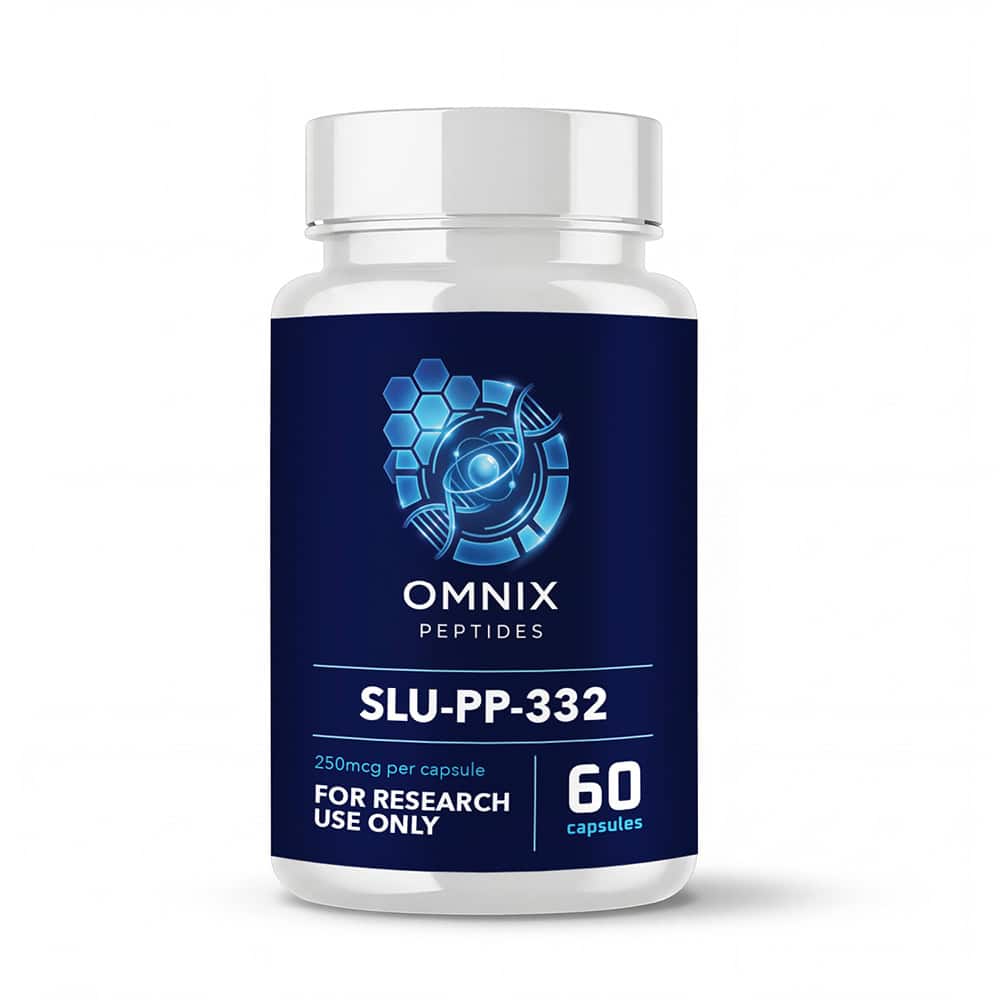
SLU-PP-332 Capsules 250mcg
SLU-PP-332 ((E)-4-Hydroxy-N'-(naphthalen-2-ylmethylene)benzohydrazide) is a synthetic small-molecule pan-agonist of the three estrogen-related receptors (ERR , ERR , ERR ), a family of orphan nuclear receptors that sit upstream of mitochondrial biogenesis, fatty acid oxidation, and the aerobic gene program activated by endurance exercise.
$129.99
Research goals: Metabolic & Weight
Description
SLU-PP-332 ((E)-4-Hydroxy-N’-(naphthalen-2-ylmethylene)benzohydrazide) is a synthetic small-molecule pan-agonist of the three estrogen-related receptors (ERRα, ERRβ, ERRγ), a family of orphan nuclear receptors that sit upstream of mitochondrial biogenesis, fatty acid oxidation, and the aerobic gene program activated by endurance exercise. The compound was developed by Thomas P. Burris and Bahaa Elgendy at Saint Louis University (the “SLU” prefix), with subsequent work continuing at Washington University in St. Louis and the University of Florida. SLU-PP-332 is widely characterized as an exercise mimetic because it activates many of the same intracellular pathways that endurance training activates — without the exercise itself.
The strongest preclinical finding comes from Billon et al.: in cell-based reporter assays, SLU-PP-332 activates ERRα with an EC50 of 98 nM. In mice, treatment increased the proportion of type IIa oxidative skeletal muscle fibers, induced an ERRα-specific acute aerobic exercise genetic program, and substantially enhanced exercise endurance — with running times in untrained mice approaching those of trained controls (Billon et al., ACS Chemical Biology 2023).1
Important Note on the Evidence Base
The published evidence base for SLU-PP-332 is preclinical. All controlled studies referenced below were conducted in cell culture (HEK293 reporter cells, C2C12 myocytes, neonatal rat ventricular cardiomyocytes) or mouse models (C57BL/6J for exercise studies, diet-induced obese and ob/ob for metabolic syndrome, transaortic constriction for heart failure). No human clinical trials of SLU-PP-332 have been registered or completed in peer-reviewed literature as of 2026, and the compound’s pharmacokinetics, safety, and efficacy in humans remain uncharacterized in the published literature. The body of evidence is concentrated in the Burris laboratory and direct collaborators; broader independent replication remains relatively limited. This product is for laboratory research only.
Published Research on SLU-PP-332
ERRα-Dependent Exercise Mimetic Activity — Billon et al., ACS Chemical Biology (2023)
This foundational paper established SLU-PP-332’s exercise-mimetic profile. In skeletal muscle cell lines, the compound increased mitochondrial function and cellular respiration. In C57BL/6J mice, SLU-PP-332 (50 mg/kg, IP, twice daily for 12–28 days) increased type IIa oxidative skeletal muscle fibers, enhanced quadricep cytochrome C, myosin IIA, and mitochondrial DNA content, and substantially improved running distance, time-to-exhaustion, and grip strength versus vehicle controls. The authors demonstrated that DDIT4 is a direct ERRα target gene and that the exercise-endurance phenotype was ERRα-dependent — activation of an ERRα-specific acute aerobic exercise genetic program is the mechanistic basis for the observed phenotype.1
Reversal of Diet-Induced Obesity and Metabolic Syndrome — Billon et al., Journal of Pharmacology and Experimental Therapeutics (2024)
This follow-up study tested SLU-PP-332 in mouse models of obesity and metabolic syndrome (diet-induced obese mice and ob/ob mice). SLU-PP-332 administration mimicked exercise-induced benefits on whole-body metabolism: increased energy expenditure, increased fatty acid oxidation, and decreased fat mass accumulation. The compound effectively reduced obesity and improved insulin sensitivity in models of metabolic syndrome. At 50 mg/kg twice daily, SLU-PP-332 decreased body weight, fat mass, total cholesterol, HDL, triglycerides, and adipocyte size, and reduced blood glucose levels in glucose tolerance testing. The authors framed pharmacological ERR activation as a tractable approach for treating metabolic disease.2
Cardiac Protection in Pressure-Overload Heart Failure — Xu et al., Circulation (2024)
This Circulation publication tested SLU-PP-332 and a structurally distinct pan-ERR agonist (SLU-PP-915) in a transaortic constriction (TAC)-induced heart failure model in mice. Both compounds significantly improved ejection fraction, ameliorated cardiac fibrosis, and increased survival, without affecting cardiac hypertrophy. Multi-omics analyses (RNA sequencing and metabolomics) showed broad activation of metabolic genes — particularly fatty acid metabolism and mitochondrial function pathways — mediated mainly through ERRγ. The cardiac effects were dependent on ERR engagement (confirmed by the structurally distinct SLU-PP-915 producing equivalent improvements), positioning ERR agonism as a candidate therapeutic strategy for heart failure with metabolic dysfunction.3
Reversal of Mitochondrial Dysfunction in the Aging Kidney — Wang et al., American Journal of Pathology (2023)
This study tested SLU-PP-332 (25 mg/kg/day for 8 weeks) in a mouse model of age-related kidney dysfunction. The compound inhibited age-related increases in albuminuria and kidney weights, restored age-related decreases in podocin levels, and reversed markers of mitochondrial dysfunction and inflammation in the aging kidney. The findings extend SLU-PP-332’s preclinical activity profile beyond skeletal muscle, cardiac, and metabolic-syndrome contexts into the aging-tissue domain, supporting the hypothesis that ERR-driven mitochondrial biogenesis is a tissue-general mechanism rather than skeletal-muscle-specific.4
About the Compound
SLU-PP-332 is a small-molecule (non-peptide) compound built on a benzohydrazide scaffold, structurally an aroylhydrazone of 4-hydroxybenzohydrazide and 2-naphthaldehyde. Its mechanism is pharmacological activation of the ERR family of orphan nuclear receptors. ERRs lack a known endogenous high-affinity ligand and function as constitutive transcriptional activators of mitochondrial biogenesis, fatty acid oxidation, and aerobic energy metabolism in tissues with high energy demand (skeletal muscle, heart, liver, kidney). SLU-PP-332 binding stabilizes the active conformation of all three ERR isoforms with the highest potency at ERRα, driving transcription of a gene program that closely overlaps with the molecular signature of endurance exercise — including PGC-1α, CPT1B, ACADM, HADHA, and mitochondrial electron transport chain subunits.
- Compound class: small-molecule pan-ERR agonist; benzohydrazide
- IUPAC name: (E)-4-Hydroxy-N’-(naphthalen-2-ylmethylene)benzohydrazide
- Synonyms: SR9861
- CAS Number: 303760-60-3
- Molecular Formula: C18H14N2O2
- Molecular Weight: 290.32 g/mol
- Receptor pharmacology: ERRα EC50 98 nM, ERRβ EC50 230 nM, ERRγ EC50 430 nM (cell-based reporter assay)
- Solubility: soluble in DMSO (up to 75 mg/mL); low aqueous solubility
- Mechanism: pan-agonism of ERRα/β/γ nuclear receptors; activation of mitochondrial biogenesis, fatty acid oxidation, and acute aerobic exercise genetic program (DDIT4-dependent)
- Regulatory status: not approved by the FDA or EMA. No human clinical trials registered or published as of 2026
Product Specifications
- Format: capsules
- Strength: 250 mcg per capsule
- Count: 60 capsules per bottle
- Purity: ≥98% (HPLC verified)
- Container: sealed amber bottle
- Certificate of Analysis: lot-specific COA available
See the FDA Disclosure, Storage Instructions, and RUO tabs for handling, storage, and regulatory information.
References
- Billon C, Sitaula S, Banerjee S, et al. Synthetic ERRα/β/γ agonist induces an ERRα-dependent acute aerobic exercise response and enhances exercise capacity. ACS Chem Biol. 2023;18(4):756-771. doi:10.1021/acschembio.2c00720
- Billon C, Schoepke E, Avdagic A, et al. A synthetic ERR agonist alleviates metabolic syndrome. J Pharmacol Exp Ther. 2024;388(2):232-240. doi:10.1124/jpet.123.001733
- Xu W, Billon C, Li H, et al. Novel pan-ERR agonists ameliorate heart failure through enhancing cardiac fatty acid metabolism and mitochondrial function. Circulation. 2024;149(3):227-250. doi:10.1161/CIRCULATIONAHA.123.066542
- Wang XX, Myakala K, Libby AE, et al. Estrogen-related receptor agonism reverses mitochondrial dysfunction and inflammation in the aging kidney. Am J Pathol. 2023;193(12):1969-1987. doi:10.1016/j.ajpath.2023.07.008
Preparation and storage
Research-only handling information. SLU-PP-332 is sold strictly for in vitro laboratory research. The handling and storage guidance below reflects standard practice in published peptide research literature. SLU-PP-332 is not a drug, supplement, or food product, and is not for human consumption, veterinary use, or medical applications.
Format
- Form: Capsules
- Available strengths: 60ct
- Verified purity: >99% (HPLC, LC–MS)
- Documentation: Batch-specific Certificate of Analysis (COA) included
Handling for Research Use
SLU-PP-332 capsules ship as a pre-encapsulated, dry oral-research format. No reconstitution is required. The capsules can be opened for analytical or assay work that requires the dry powder.
Storage & Handling
- Upon receipt: Store in a cool, dry place away from direct light.
- Short-term storage: Room temperature in a sealed container is acceptable for several months.
- Long-term storage: Refrigeration at 4 °C (39 °F) extends shelf stability. Capsules do not require freezing.
- Humidity: Keep the original desiccant-sealed container closed when not in use. Excess moisture can compromise capsule integrity.
- Light exposure: Minimize exposure to direct light during handling.
Important Notice
All Omnix Peptides products are sold for laboratory, research, or analytical purposes only. They are not for human consumption, veterinary use, or medical applications. Researchers and laboratory professionals must follow all applicable institutional, local, state, and federal regulations governing the handling of research compounds.
Citations
Citations and reference data. Omnix Peptides supplies research-grade compounds for use by qualified laboratory professionals. The references below cite published preclinical research conducted in animal models and in vitro systems. They are not intended to represent clinical evidence in humans, and SLU-PP-332 has not been approved by the FDA, EMA, or any other regulatory authority for any indication.
Compound Reference Data
- Compound: SLU-PP-332
- CAS Number: 303760-60-3
- Molecular Formula: C18H14N2O2
- Molecular Weight: 290.32 g/mol
- Sequence: —
- Synonyms: —
Selected Published Studies
The following peer-reviewed studies were conducted using animal models or in vitro cell-culture systems. They are listed here as a reference for researchers investigating SLU-PP-332. None of these studies should be interpreted as recommending SLU-PP-332 for human use, treatment, or any clinical purpose.
- Billon C, Sitaula S, Banerjee S, et al. Synthetic ERRα/β/γ agonist induces an ERRα-dependent acute aerobic exercise response and enhances exercise capacity. ACS Chem Biol. 2023;18(4):756-771. doi:10.1021/acschembio.2c00720
- Billon C, Schoepke E, Avdagic A, et al. A synthetic ERR agonist alleviates metabolic syndrome. J Pharmacol Exp Ther. 2024;388(2):232-240. doi:10.1124/jpet.123.001733
- Xu W, Billon C, Li H, et al. Novel pan-ERR agonists ameliorate heart failure through enhancing cardiac fatty acid metabolism and mitochondrial function. Circulation. 2024;149(3):227-250. doi:10.1161/CIRCULATIONAHA.123.066542
- Wang XX, Myakala K, Libby AE, et al. Estrogen-related receptor agonism reverses mitochondrial dysfunction and inflammation in the aging kidney. Am J Pathol. 2023;193(12):1969-1987. doi:10.1016/j.ajpath.2023.07.008
Evidence-Base Disclosure
The published evidence base for SLU-PP-332 consists predominantly of preclinical research — animal models (often rats or mice) and in vitro cell-culture experiments. Where Phase I or Phase II human trials exist, they are noted in the compound page summary. Researchers should interpret the cited literature within the experimental context of each individual study.
Frequently asked questions
Frequently asked questions about the SLU-PP-332 Capsules. Questions on this page cover handling, storage, documentation, and ordering. SLU-PP-332 is sold for laboratory, research, or analytical purposes only — not for human consumption, veterinary use, or medical applications.
Why does Omnix offer SLU-PP-332 in a capsule format?
Capsule format is used in oral-research and analytical contexts where dry, pre-measured administration is preferred over a reconstituted solution. The capsules contain the same research-grade compound supplied in the vial format and are tested to the same purity specification.
Do the SLU-PP-332 capsules require refrigeration?
Capsules are stable at room temperature for several months when kept in a cool, dry place away from direct light. Refrigeration at 4 °C (39 °F) extends shelf stability and is recommended for long-term storage. Capsules do not require freezing.
Can the capsules be opened to access the dry powder?
Yes. The capsule shell can be opened for analytical or assay work that requires direct handling of the dry powder. Once opened, the powder should be used immediately or transferred to a sealed, light-protected container.
Is SLU-PP-332 approved by the FDA?
No. SLU-PP-332 is not approved by the FDA, EMA, or any other regulatory authority for any indication. SLU-PP-332 is sold by Omnix Peptides strictly for laboratory, research, or analytical purposes. It is not for human consumption, veterinary use, or medical applications.
What is included with each SLU-PP-332 Capsules?
Each order includes the sealed product container and a batch-specific Certificate of Analysis (COA) verifying identity and purity by HPLC and LC–MS. The full COA library for Omnix Peptides is available at /coa-lab-reports/.
What is a Certificate of Analysis (COA), and how do I read it?
A COA is a batch-specific lab report that documents the identity, purity, and quality control results for the production lot you receive. The COA lists the compound name, CAS number, lot number, analytical methods used (HPLC, LC–MS), and the measured purity percentage. Every Omnix order includes the COA for the lot shipped.
What is the CAS number for SLU-PP-332?
The CAS number for SLU-PP-332 is 303760-60-3. Researchers can use this identifier to locate published literature in PubMed and other scientific databases.
How does Omnix Peptides ship orders?
Orders ship from a US-based facility with tracked domestic shipping. Free shipping is offered on orders over $99. Lyophilized vials and capsules ship at ambient temperature; sprays ship insulated when seasonal conditions require it. Tracking information is provided by email after the order ships.
What if my product arrives damaged or the seal is broken?
Contact Omnix Peptides within 48 hours of delivery. Product damaged in transit or arriving with a compromised seal will be replaced at no cost. See the Shipping & Return Policy at /shipping-return-policy/ for full terms.
Where can I find published research on SLU-PP-332?
Peer-reviewed studies relevant to SLU-PP-332 are listed in the Citations tab on this product page. The same studies can be located independently on PubMed using the CAS number (303760-60-3) or the compound name.
Customer reviews
Certificate of Analysis
Third-party HPLC purity analysis performed by an independent laboratory for this batch.
Reviews
There are no reviews yet.