
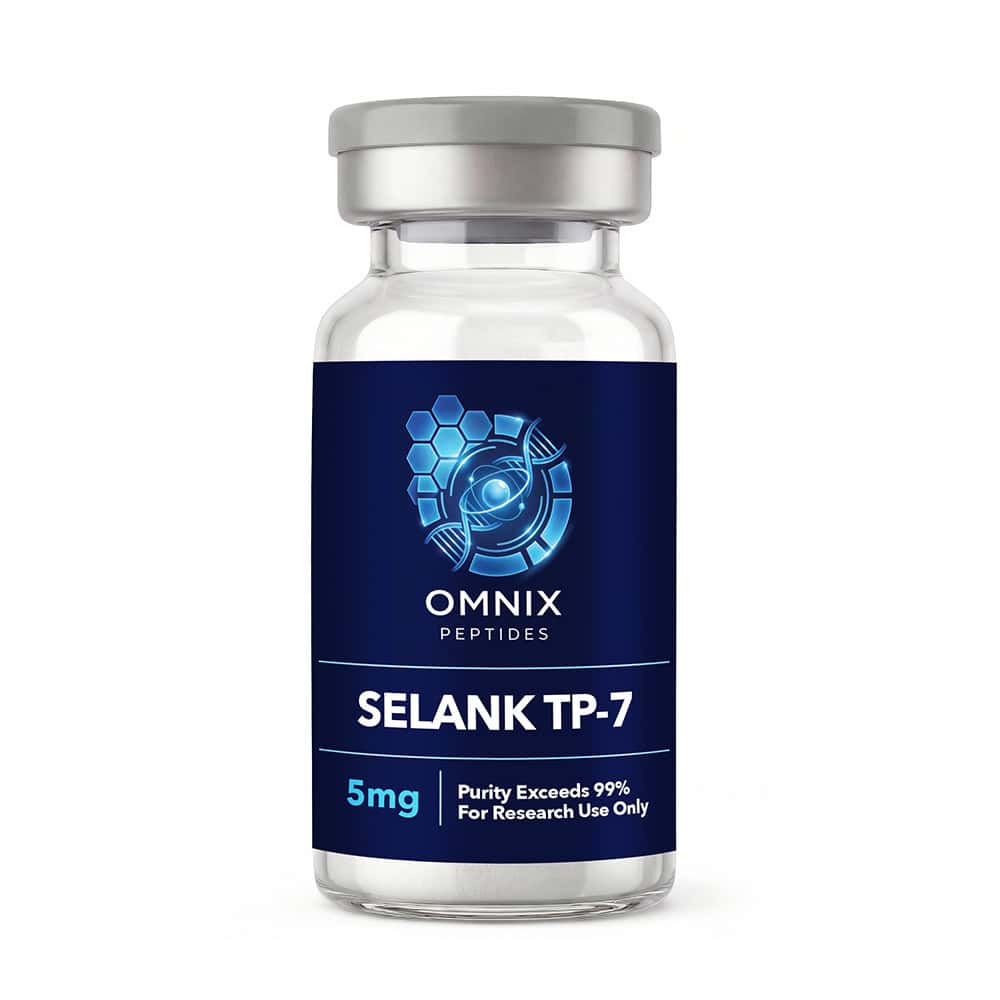
Selank TP-7 Vial
Lyophilized Selank heptapeptide for laboratory reconstitution. Supports research protocols investigating alternative delivery routes beyond the more common intranasal format used in Selank's anxiolytic and cognitive-enhancement studies. HPLC-tested, third-party COA per batch.
Research goals: Cognitive & Focus
Description
Selank TP-7 (Thr-Lys-Pro-Arg-Pro-Gly-Pro) is a synthetic heptapeptide developed by the Institute of Molecular Genetics of the Russian Academy of Sciences in cooperation with the V.V. Zakusov Research Institute of Pharmacology. It was designed by extending the C-terminus of the immunomodulatory tetrapeptide tuftsin (Thr-Lys-Pro-Arg) with a Pro-Gly-Pro tripeptide to increase metabolic stability and duration of action. Selank is approved as a prescription anxiolytic in Russia, where it is marketed as a 0.15% intranasal solution for generalized anxiety disorder and neurasthenia.
The strongest published human finding is from Zozulya et al.: in a 62-patient comparative trial against the benzodiazepine medazepam, the authors reported that the anxiolytic effects of both drugs were similar but selank had also antiasthenic and psychostimulant effects
.1
Important Note on the Evidence Base
Selank’s clinical and mechanistic literature is concentrated in Russian research institutions and Russian-language journals (e.g., Zh Nevrol Psikhiatr Im S S Korsakova), with a smaller body of mechanistic work published in English-language peer-reviewed journals (notably Frontiers in Pharmacology). The Zozulya 2008 randomized trial cited below is published in a Russian-language journal (PubMed PMID: 18454096); the abstract is available in English but the full text is in Russian. Selank is not approved by the FDA or EMA, no large multi-center Phase 3 trials by Western standards have been published, and most preclinical mechanistic studies were conducted by the same Moscow research consortium that developed the compound. These limitations are typical of the Soviet/Russian peptide pharmacology tradition and should be considered when interpreting the literature. This product is for laboratory research only.
Published Research on Selank TP-7
Generalized Anxiety Disorder vs. Medazepam — Zozulya et al., Zh Nevrol Psikhiatr Im S S Korsakova (2008)
This Russian-language randomized trial compared intranasal selank (n=30) against the benzodiazepine medazepam (n=32) in 62 patients meeting DSM-IV criteria for generalized anxiety disorder or neurasthenia. Both treatments produced comparable reductions on the Hamilton Anxiety Rating Scale and the Zung Self-Rating Anxiety Scale. Selank uniquely produced antiasthenic and mild psychostimulant effects (improved energy, reduced fatigue) and was associated with normalization of baseline-shortened plasma leu-enkephalin half-life — a biomarker the authors propose links anxiolysis to endogenous opioid peptide stabilization.1
GABAergic Gene Expression in Rat Frontal Cortex — Volkova et al., Frontiers in Pharmacology (2016)
This study tested whether selank’s benzodiazepine-like clinical profile reflects modulation of the GABAergic system. After single and chronic intranasal administration in rats, qPCR analysis of 84 genes involved in GABAergic neurotransmission in the frontal cortex revealed selank-induced changes in expression of several GABA-A receptor subunit and dopamine/serotonin pathway genes. The authors concluded that selank exerts complex effects on nerve cells
, with one likely molecular mechanism being allosteric modulation of GABA-A receptors rather than direct ligand binding.2
Cell-Line Confirmation in IMR-32 Neurons — Filatova et al., Frontiers in Pharmacology (2017)
This second paper from the same research group examined whether the gene-expression changes observed in vivo could be reproduced in IMR-32 human neuroblastoma cells. Direct exposure of IMR-32 cells to selank did not reproduce the in vivo gene-expression pattern, suggesting that selank’s effect on neurotransmission gene expression is indirect — likely mediated through release or modulation of upstream neurotransmitters in intact circuits — rather than through direct receptor binding on neurons. This refines the GABAergic hypothesis toward an allosteric or indirect modulatory mechanism.3
Enkephalinase Inhibition and Endogenous Opioid Stabilization — Kost et al., Bulletin of Experimental Biology and Medicine (2001)
This earlier mechanistic work demonstrated that selank inhibits enkephalin-degrading enzymes (enkephalinases) in plasma in a concentration-dependent manner, with reported potency exceeding the reference inhibitors bacitracin and puromycin. Because patients with generalized anxiety disorder show shortened endogenous leu-enkephalin half-life, this enkephalinase-inhibitory action provides a mechanistic explanation for selank’s anxiolytic profile that is distinct from benzodiazepine-style direct GABA-A modulation, and is consistent with the biomarker findings later reported in the Zozulya trial.4
About the Compound
Selank is a synthetic heptapeptide whose anxiolytic mechanism appears to be multi-pathway and indirect rather than receptor-direct: enkephalinase inhibition that stabilizes endogenous opioid peptides, allosteric modulation of GABAergic neurotransmission, BDNF regulation in the hippocampus, and modulation of cytokine balance (notably interleukin-6) under stress. The peptide is rapidly absorbed across nasal mucosa with onset of effect reported within minutes to hours, and clinical reports describe absence of sedation, tolerance, and dependence — distinguishing its profile from benzodiazepine-class anxiolytics.
- Compound class: synthetic heptapeptide; tuftsin analogue
- Sequence: H-Thr-Lys-Pro-Arg-Pro-Gly-Pro-OH (TKPRPGP)
- Synonyms: TP-7, Selanc
- CAS Number: 129954-34-3
- Molecular Formula: C33H57N11O9
- Molecular Weight: 751.89 g/mol
- Origin: Institute of Molecular Genetics, Russian Academy of Sciences
- Russian regulatory status: prescription anxiolytic, intranasal 0.15% solution
- Regulatory status: not approved by the FDA or EMA. Registered in Russia and CIS countries
- Mechanism (working hypothesis): enkephalinase inhibition + indirect GABAergic modulation + BDNF/cytokine effects
Product Specifications
- Format: lyophilized peptide in vial (reconstitute with bacteriostatic water)
- Strengths available: 5 mg per vial; 10 mg per vial
- Purity: ≥99% (HPLC verified)
- Container: sealed glass vial (lyophilized powder)
- Certificate of Analysis: lot-specific COA available
See the FDA Disclosure, Storage Instructions, and RUO tabs for handling, storage, and regulatory information.
References
- Zozulya AA, Neznamov GG, Siuniakov TS, et al. Efficacy and possible mechanisms of action of a new peptide anxiolytic selank in the therapy of generalized anxiety disorders and neurasthenia [Article in Russian]. Zh Nevrol Psikhiatr Im S S Korsakova. 2008;108(4):38-48. PMID: 18454096
- Volkova A, Shadrina M, Kolomin T, et al. Selank administration affects the expression of some genes involved in GABAergic neurotransmission. Front Pharmacol. 2016;7:31. doi:10.3389/fphar.2016.00031
- Filatova E, Kasian A, Kolomin T, et al. GABA, Selank, and Olanzapine affect the expression of genes involved in GABAergic neurotransmission in IMR-32 cells. Front Pharmacol. 2017;8:89. doi:10.3389/fphar.2017.00089
- Kost NV, Sokolov OY, Gabaeva MV, et al. Enkephalinase inhibition as a possible mechanism of the anxiolytic activity of the synthetic peptide selank. Bull Exp Biol Med. 2001;132(2):745-747. doi:10.1023/A:1013014109632
Preparation and storage
Research-only handling information. Selank TP-7 is sold strictly for in vitro laboratory research. The handling and storage guidance below reflects standard practice in published peptide research literature. Selank TP-7 is not a drug, supplement, or food product, and is not for human consumption, veterinary use, or medical applications.
Format
- Form: Vial
- Available strengths: 5mg · 10mg
- Verified purity: >99% (HPLC, LC–MS)
- Documentation: Batch-specific Certificate of Analysis (COA) included
Reconstitution for Research Use
Selank TP-7 is supplied as a sterile, lyophilized powder. Reconstitution with bacteriostatic water (BAC water) is the standard preparation step used in published research protocols. The volume of BAC water used determines the final concentration of the reconstituted solution.
Example (for a 5mg vial reconstituted in 2 mL of BAC water):
- Total peptide: 5mg
- BAC water added: 2 mL
- Resulting concentration: ~2.5 mg/mL
Recommended practice:
- Use sterile bacteriostatic water (0.9% benzyl alcohol) for reconstitution; this preserves the solution for multi-week handling in laboratory settings.
- Allow the lyophilized powder to reach room temperature before opening the vial.
- Inject the BAC water against the inside wall of the vial — do not aim the stream directly at the lyophilized cake.
- Gently swirl the vial until the powder is fully dissolved. Do not shake.
- Once reconstituted, store the vial under refrigeration at 4 °C (39 °F).
Storage & Handling
- Upon receipt: Keep peptides cold and away from light.
- Lyophilized (unreconstituted): Stable at room temperature for several weeks; refrigeration at 4 °C (39 °F) is acceptable for short-term storage (days to weeks).
- Long-term storage (months to years): Freeze the lyophilized vial at −80 °C (−112 °F). Freezing optimally preserves peptide stability for extended periods.
- Reconstituted solution: Refrigerate at 4 °C (39 °F). Avoid freeze/thaw cycles, which can degrade peptide structure.
- Light exposure: Minimize exposure to direct light during handling; light can accelerate peptide degradation.
- Heat exposure: Do not leave the vial at room temperature longer than necessary for handling.
Important Notice
All Omnix Peptides products are sold for laboratory, research, or analytical purposes only. They are not for human consumption, veterinary use, or medical applications. Researchers and laboratory professionals must follow all applicable institutional, local, state, and federal regulations governing the handling of research compounds.
Citations
Citations and reference data. Omnix Peptides supplies research-grade compounds for use by qualified laboratory professionals. The references below cite published preclinical research conducted in animal models and in vitro systems. They are not intended to represent clinical evidence in humans, and Selank TP-7 has not been approved by the FDA, EMA, or any other regulatory authority for any indication.
Compound Reference Data
- Compound: Selank TP-7
- CAS Number: 129954-34-3
- Molecular Formula: C33H57N11O9
- Molecular Weight: 751.89 g/mol
- Sequence: H-Thr-Lys-Pro-Arg-Pro-Gly-Pro-OH (TKPRPGP)
- Synonyms: —
Selected Published Studies
The following peer-reviewed studies were conducted using animal models or in vitro cell-culture systems. They are listed here as a reference for researchers investigating Selank TP-7. None of these studies should be interpreted as recommending Selank TP-7 for human use, treatment, or any clinical purpose.
- Zozulya AA, Neznamov GG, Siuniakov TS, et al. Efficacy and possible mechanisms of action of a new peptide anxiolytic selank in the therapy of generalized anxiety disorders and neurasthenia [Article in Russian]. Zh Nevrol Psikhiatr Im S S Korsakova. 2008;108(4):38-48. PMID: 18454096
- Volkova A, Shadrina M, Kolomin T, et al. Selank administration affects the expression of some genes involved in GABAergic neurotransmission. Front Pharmacol. 2016;7:31. doi:10.3389/fphar.2016.00031
- Filatova E, Kasian A, Kolomin T, et al. GABA, Selank, and Olanzapine affect the expression of genes involved in GABAergic neurotransmission in IMR-32 cells. Front Pharmacol. 2017;8:89. doi:10.3389/fphar.2017.00089
- Kost NV, Sokolov OY, Gabaeva MV, et al. Enkephalinase inhibition as a possible mechanism of the anxiolytic activity of the synthetic peptide selank. Bull Exp Biol Med. 2001;132(2):745-747. doi:10.1023/A:1013014109632
Evidence-Base Disclosure
The published evidence base for Selank TP-7 consists predominantly of preclinical research — animal models (often rats or mice) and in vitro cell-culture experiments. Where Phase I or Phase II human trials exist, they are noted in the compound page summary. Researchers should interpret the cited literature within the experimental context of each individual study.
Frequently asked questions
Frequently asked questions about the Selank TP-7 Vial. Questions on this page cover handling, storage, documentation, and ordering. Selank TP-7 is sold for laboratory, research, or analytical purposes only — not for human consumption, veterinary use, or medical applications.
How is the Selank TP-7 Vial prepared for laboratory research?
The Selank TP-7 Vial is supplied as a sterile, lyophilized (freeze-dried) powder. The standard preparation step described in published peptide research literature is reconstitution with bacteriostatic water (BAC water). The volume of BAC water used determines the final concentration of the solution. See the Amount & Handling tab for a worked reconstitution example.
Why is Selank TP-7 supplied as a lyophilized powder rather than a pre-mixed solution?
Lyophilization (freeze-drying) is the standard format for research-grade peptides because it maximizes long-term stability. A lyophilized vial stored cold and away from light remains stable for substantially longer than a pre-mixed solution. Reconstitution by the researcher also allows control over the final solution concentration.
Can the reconstituted Selank TP-7 solution be frozen?
Freeze/thaw cycles can degrade peptide structure and should generally be avoided. Reconstituted Selank TP-7 should be stored under refrigeration at 4 °C (39 °F) and used within the active research timeframe described in the Amount & Handling tab. For long-term storage, keep the vial lyophilized and freeze at −80 °C (−112 °F) until use.
Is Selank TP-7 approved by the FDA?
No. Selank TP-7 is not approved by the FDA, EMA, or any other regulatory authority for any indication. Selank TP-7 is sold by Omnix Peptides strictly for laboratory, research, or analytical purposes. It is not for human consumption, veterinary use, or medical applications.
What is included with each Selank TP-7 Vial?
Each order includes the sealed product container and a batch-specific Certificate of Analysis (COA) verifying identity and purity by HPLC and LC–MS. The full COA library for Omnix Peptides is available at /coa-lab-reports/.
What is a Certificate of Analysis (COA), and how do I read it?
A COA is a batch-specific lab report that documents the identity, purity, and quality control results for the production lot you receive. The COA lists the compound name, CAS number, lot number, analytical methods used (HPLC, LC–MS), and the measured purity percentage. Every Omnix order includes the COA for the lot shipped.
What is the CAS number for Selank TP-7?
The CAS number for Selank TP-7 is 129954-34-3. Researchers can use this identifier to locate published literature in PubMed and other scientific databases.
How does Omnix Peptides ship orders?
Orders ship from a US-based facility with tracked domestic shipping. Free shipping is offered on orders over $99. Lyophilized vials and capsules ship at ambient temperature; sprays ship insulated when seasonal conditions require it. Tracking information is provided by email after the order ships.
What if my product arrives damaged or the seal is broken?
Contact Omnix Peptides within 48 hours of delivery. Product damaged in transit or arriving with a compromised seal will be replaced at no cost. See the Shipping & Return Policy at /shipping-return-policy/ for full terms.
Where can I find published research on Selank TP-7?
Peer-reviewed studies relevant to Selank TP-7 are listed in the Citations tab on this product page. The same studies can be located independently on PubMed using the CAS number (129954-34-3) or the compound name.
Customer reviews
Certificate of Analysis
Certificate of Analysis (COA) for this batch is available on request. Email orders@omnixpeptides.com with your order number to receive a copy. COAs include HPLC purity analysis performed by an independent third-party laboratory.
Reviews
There are no reviews yet.