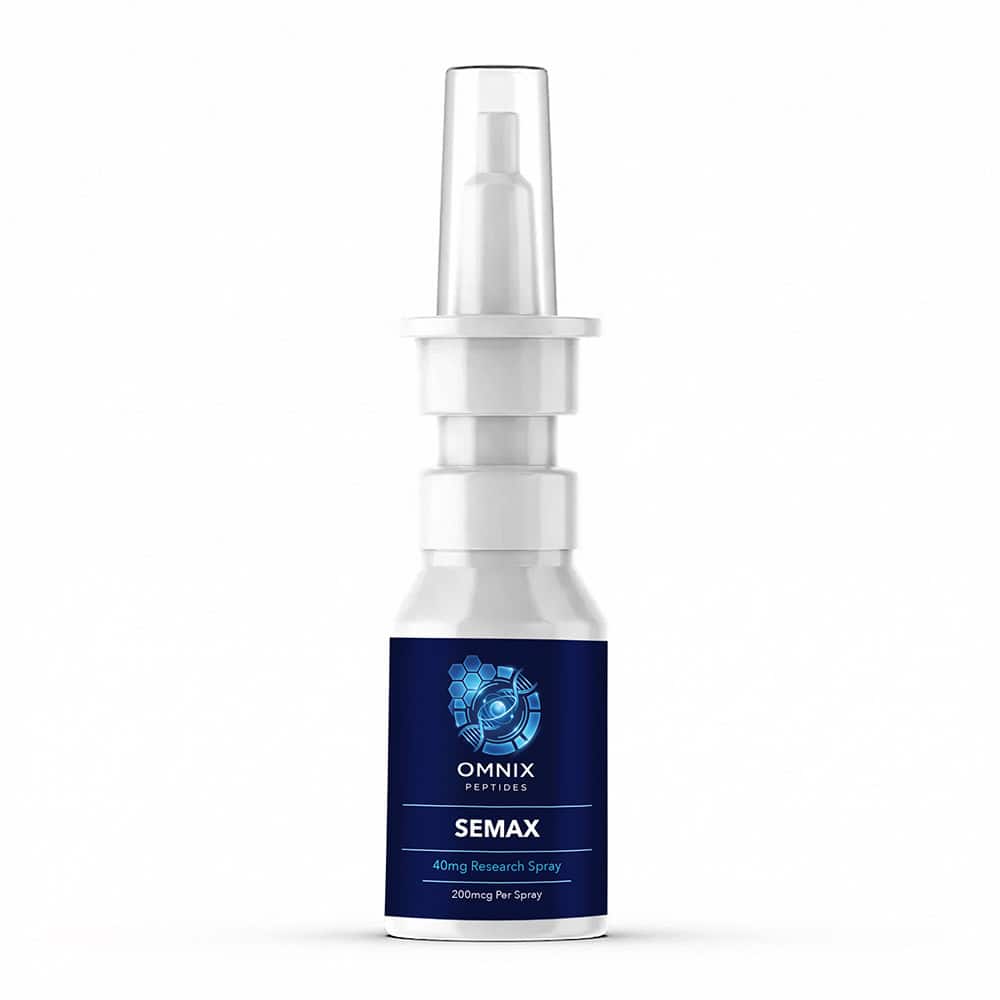
Semax Liquid Spray 50mg
Semax is a synthetic heptapeptide (Met-Glu-His-Phe-Pro-Gly-Pro, MEHFPGP) developed in the 1980s at the Institute of Molecular Genetics of the Russian Academy of Sciences.
$100.00
Research goals: Cognitive & Focus
Description
Semax is a synthetic heptapeptide (Met-Glu-His-Phe-Pro-Gly-Pro, MEHFPGP) developed in the 1980s at the Institute of Molecular Genetics of the Russian Academy of Sciences. It is structured as a hybrid molecule: the N-terminal four residues (Met-Glu-His-Phe) are the ACTH(4–7) fragment of adrenocorticotropic hormone, the melanocortin core responsible for ACTH’s neurotrophic effects, while the C-terminal Pro-Gly-Pro tripeptide tail blocks the carboxypeptidases that would otherwise degrade the peptide in seconds. The result is a peptide that retains ACTH’s neurotrophic activity without the parent hormone’s cortisol-stimulating effect. Semax has been registered as a pharmaceutical in Russia and CIS countries since 1994 and is clinically prescribed for ischemic stroke, optic nerve disorders, and cognitive disorders.
The strongest peer-reviewed mechanistic finding comes from Dolotov and colleagues at the Institute of Molecular Genetics: a single intranasal application of Semax (50 μg/kg) produced a 1.4-fold increase in BDNF protein, a 1.6-fold increase in TrkB tyrosine phosphorylation, and a 3-fold increase in BDNF mRNA in the rat hippocampus, suggesting that Semax acts on cognitive function through CREB-dependent regulation of the hippocampal BDNF/TrkB system (Dolotov et al., Brain Research 2006).1
Important Note on the Evidence Base
A substantial portion of the Semax literature is published in Russian-language journals (most prominently Zhurnal Nevrologii i Psikhiatrii im. S.S. Korsakova) and is not always available in full English translation. Available English-language abstracts are sometimes incomplete on numerical effect sizes, confidence intervals, and statistical significance values. Russian clinical trials of Semax have generally not been randomized or placebo-controlled by Western regulatory standards. Semax is not approved by the FDA or EMA. As of April 2026, Semax is listed as “Nominated but Withdrawn from FDA Category 2” and standard 503A/503B pharmacy regulations apply; this does not constitute FDA approval. This product is for laboratory research only.
Published Research on Semax
BDNF/TrkB Upregulation in the Rat Hippocampus — Dolotov et al., Brain Research (2006)
This study from the Institute of Molecular Genetics of the Russian Academy of Sciences is the most-cited mechanistic paper on Semax. A single intranasal application of Semax (50 μg/kg body weight) produced a maximal 1.4-fold increase in BDNF protein levels, a 1.6-fold increase in TrkB tyrosine phosphorylation, and 3-fold and 2-fold increases in exon III BDNF and TrkB mRNA, respectively, in the rat hippocampus. The authors propose that Semax affects cognitive brain function by modulating expression and activation of the hippocampal BDNF/TrkB system, with the BDNF exon III mRNA effect specifically pointing to CREB-dependent transcriptional regulation. The paper is widely cited as the mechanistic anchor for Semax’s nootropic activity.1
Clinical Trial in Ischemic Stroke Rehabilitation — Gusev, Martynov & Kostenko et al., Zhurnal Nevrologii i Psikhiatrii (2018)
This non-randomized clinical trial evaluated Semax efficacy in 110 post-stroke patients (43 men, 67 women; mean age 58.0 ± 9.7 years) divided into early-rehabilitation (89 ± 9 days post-stroke) and late-rehabilitation (214 ± 22 days post-stroke) groups. Semax was administered intranasally at 6,000 μg/day in two 10-day courses separated by a 20-day interval. The Semax-treated subgroups showed elevated plasma BDNF levels and improvements in Barthel index and MRC motor-scale scores over a ~5-month observation period versus comparator subgroups not receiving Semax. The authors conclude that early rehabilitation combined with Semax administration increases plasma BDNF, accelerates functional recovery, and improves motor performance. The trial was not randomized or placebo-controlled, and numerical effect sizes and p-values were not reported in the published abstract — meaningful limitations on the strength of the finding.2
Genome-Wide Transcriptional Response in Cerebral Ischemia — Medvedeva et al., BMC Genomics (2014)
This genome-wide transcriptomics study, published in an English-language open-access journal, investigated the effect of Semax on gene expression in the cortex of rats subjected to permanent middle cerebral artery occlusion (pMCAO). Semax (100 μg/kg, i.p.) was administered 15 minutes, 1 hour, 4 hours, and 8 hours after pMCAO. Three hours after occlusion, Semax modulated genes affecting immune cell activity; by 24 hours, the action of Semax on the immune response increased considerably. The peptide predominantly enhanced expression of genes related to immune system function and vascular system formation, providing molecular-level evidence that the protective effect of Semax in stroke models is mediated by coordinated modulation of inflammatory and angiogenic gene programs.3
Dopaminergic and Serotonergic System Activation — Eremin et al., Neurochemical Research (2005)
This study characterized Semax’s effects on monoaminergic neurotransmission in rats. Within 30 minutes of intranasal administration, Semax increased dopamine and serotonin turnover in brain regions associated with motivation, attention, and reward. The authors framed the findings as a second mechanism (beyond BDNF/TrkB) by which Semax exerts cognitive and behavioral effects, and the rapid onset of the monoaminergic effects is consistent with the 20–40 minute onset of cognitive effects reported in human use of intranasal Semax. The paper remains a primary reference for Semax’s neurotransmitter-system effects.4
About the Compound
Semax is a synthetic heptapeptide formed by attaching the C-terminal tripeptide Pro-Gly-Pro (PGP) to the ACTH(4–7) fragment Met-Glu-His-Phe. The PGP tail blocks the carboxypeptidases that rapidly cleave native ACTH fragments, extending Semax’s bioactivity to approximately 20–24 hours after intranasal administration in animal models. Semax retains ACTH’s neurotrophic and cognitive-enhancing effects without the hormonal effect on cortisol synthesis, making it pharmacologically distinct from full-length ACTH. Its primary research applications include cerebral ischemia and stroke recovery models, cognitive enhancement research, BDNF/NGF gene expression studies, and neurotrophic signaling in the hippocampus, basal forebrain, and cortex.
- Compound class: synthetic heptapeptide; ACTH(4–7) analogue with Pro-Gly-Pro stabilizing tail
- Sequence: Met-Glu-His-Phe-Pro-Gly-Pro (MEHFPGP)
- Synonyms: ACTH(4–7)PGP, Semax acetate (the salt form most commonly studied)
- CAS Number: 80714-61-0
- Molecular Formula: C37H51N9O10S
- Molecular Weight: 813.92 g/mol
- Solubility: water-soluble; suitable for saline-based intranasal formulations
- Mechanism: BDNF/TrkB upregulation in hippocampus; CREB-dependent transcription; dopaminergic and serotonergic system activation; immune and vascular gene expression modulation in cerebral ischemia
- Regulatory status: not approved by the FDA or EMA. Registered in Russia and CIS countries since 1994 for stroke recovery, optic nerve disorders, and cognitive indications. As of April 2026, listed by the FDA as Nominated but Withdrawn from Category 2; standard 503A/503B regulations apply
Product Specifications
- Format: pre-mixed liquid intranasal spray
- Strength: 50 mg per 30 mL bottle
- Purity: ≥99% (HPLC verified)
- Container: sealed metered nasal spray bottle
- Certificate of Analysis: lot-specific COA available
See the FDA Disclosure, Storage Instructions, and RUO tabs for handling, storage, and regulatory information.
References
- Dolotov OV, Karpenko EA, Inozemtseva LS, et al. Semax, an analog of ACTH(4–10) with cognitive effects, regulates BDNF and trkB expression in the rat hippocampus. Brain Res. 2006;1117(1):54-60. doi:10.1016/j.brainres.2006.07.108
- Gusev EI, Martynov MYu, Kostenko EV, et al. The efficacy of semax in the treatment of patients at different stages of ischemic stroke. Zh Nevrol Psikhiatr Im S S Korsakova. 2018;118(3 Vyp 2):61-68. doi:10.17116/jnevro20181183261-68
- Medvedeva EV, Dmitrieva VG, Povarova OV, et al. The peptide semax affects the expression of genes related to the immune and vascular systems in rat brain focal ischemia: genome-wide transcriptional analysis. BMC Genomics. 2014;15(1):228. doi:10.1186/1471-2164-15-228
- Eremin KO, Kudrin VS, Saransaari P, et al. Semax, an ACTH(4–10) analogue with nootropic properties, activates dopaminergic and serotoninergic brain systems in rodents. Neurochem Res. 2005;30(12):1493-1500. doi:10.1007/s11064-005-8826-8
Preparation and storage
Research-only handling information. Semax is sold strictly for in vitro laboratory research. The handling and storage guidance below reflects standard practice in published peptide research literature. Semax is not a drug, supplement, or food product, and is not for human consumption, veterinary use, or medical applications.
Format
- Form: Liquid Spray
- Available strengths: 30ml
- Verified purity: >99% (HPLC, LC–MS)
- Documentation: Batch-specific Certificate of Analysis (COA) included
Handling for Research Use
Semax Liquid Spray ships pre-formulated in solution. No reconstitution is required. The spray bottle delivers a metered volume per actuation; refer to the certificate of analysis (COA) for batch-specific peptide concentration.
Storage & Handling
- Upon receipt: Refrigerate immediately at 4 °C (39 °F).
- Short-term storage: Refrigeration at 4 °C (39 °F) is the standard for sprays in active research use.
- Long-term storage: Liquid sprays should not be frozen; freezing can damage the bottle and disrupt the solution.
- Light exposure: Store in original packaging away from direct light.
- Before each use: Gently invert the bottle to redistribute the solution. Do not shake.
Important Notice
All Omnix Peptides products are sold for laboratory, research, or analytical purposes only. They are not for human consumption, veterinary use, or medical applications. Researchers and laboratory professionals must follow all applicable institutional, local, state, and federal regulations governing the handling of research compounds.
Citations
Citations and reference data. Omnix Peptides supplies research-grade compounds for use by qualified laboratory professionals. The references below cite published preclinical research conducted in animal models and in vitro systems. They are not intended to represent clinical evidence in humans, and Semax has not been approved by the FDA, EMA, or any other regulatory authority for any indication.
Compound Reference Data
- Compound: Semax
- CAS Number: 80714-61-0
- Molecular Formula: C37H51N9O10S
- Molecular Weight: 813.92 g/mol
- Sequence: Met-Glu-His-Phe-Pro-Gly-Pro (MEHFPGP)
- Synonyms: —
Selected Published Studies
The following peer-reviewed studies were conducted using animal models or in vitro cell-culture systems. They are listed here as a reference for researchers investigating Semax. None of these studies should be interpreted as recommending Semax for human use, treatment, or any clinical purpose.
- Dolotov OV, Karpenko EA, Inozemtseva LS, et al. Semax, an analog of ACTH(4–10) with cognitive effects, regulates BDNF and trkB expression in the rat hippocampus. Brain Res. 2006;1117(1):54-60. doi:10.1016/j.brainres.2006.07.108
- Gusev EI, Martynov MYu, Kostenko EV, et al. The efficacy of semax in the treatment of patients at different stages of ischemic stroke. Zh Nevrol Psikhiatr Im S S Korsakova. 2018;118(3 Vyp 2):61-68. doi:10.17116/jnevro20181183261-68
- Medvedeva EV, Dmitrieva VG, Povarova OV, et al. The peptide semax affects the expression of genes related to the immune and vascular systems in rat brain focal ischemia: genome-wide transcriptional analysis. BMC Genomics. 2014;15(1):228. doi:10.1186/1471-2164-15-228
- Eremin KO, Kudrin VS, Saransaari P, et al. Semax, an ACTH(4–10) analogue with nootropic properties, activates dopaminergic and serotoninergic brain systems in rodents. Neurochem Res. 2005;30(12):1493-1500. doi:10.1007/s11064-005-8826-8
Evidence-Base Disclosure
The published evidence base for Semax consists predominantly of preclinical research — animal models (often rats or mice) and in vitro cell-culture experiments. Where Phase I or Phase II human trials exist, they are noted in the compound page summary. Researchers should interpret the cited literature within the experimental context of each individual study.
Frequently asked questions
Frequently asked questions about the Semax Liquid Spray. Questions on this page cover handling, storage, documentation, and ordering. Semax is sold for laboratory, research, or analytical purposes only — not for human consumption, veterinary use, or medical applications.
Why does Omnix offer Semax in a liquid spray format?
The spray format ships pre-formulated, removing the reconstitution step required for lyophilized vials. The metered-spray bottle delivers a fixed volume per actuation. Spray format is used in research applications where a pre-mixed solution is preferred.
How should the Semax spray be stored?
Refrigerate at 4 °C (39 °F) immediately upon receipt and during active use. Do not freeze — freezing can damage the bottle and disrupt the solution. Keep the bottle in its original packaging away from direct light.
What is the peptide concentration in the spray?
The total peptide content is listed on the product label. The per-actuation volume and concentration are listed on the batch-specific Certificate of Analysis (COA) that ships with each order.
Is Semax approved by the FDA?
No. Semax is not approved by the FDA, EMA, or any other regulatory authority for any indication. Semax is sold by Omnix Peptides strictly for laboratory, research, or analytical purposes. It is not for human consumption, veterinary use, or medical applications.
What is included with each Semax Liquid Spray?
Each order includes the sealed product container and a batch-specific Certificate of Analysis (COA) verifying identity and purity by HPLC and LC–MS. The full COA library for Omnix Peptides is available at /coa-lab-reports/.
What is a Certificate of Analysis (COA), and how do I read it?
A COA is a batch-specific lab report that documents the identity, purity, and quality control results for the production lot you receive. The COA lists the compound name, CAS number, lot number, analytical methods used (HPLC, LC–MS), and the measured purity percentage. Every Omnix order includes the COA for the lot shipped.
What is the CAS number for Semax?
The CAS number for Semax is 80714-61-0. Researchers can use this identifier to locate published literature in PubMed and other scientific databases.
How does Omnix Peptides ship orders?
Orders ship from a US-based facility with tracked domestic shipping. Free shipping is offered on orders over $99. Lyophilized vials and capsules ship at ambient temperature; sprays ship insulated when seasonal conditions require it. Tracking information is provided by email after the order ships.
What if my product arrives damaged or the seal is broken?
Contact Omnix Peptides within 48 hours of delivery. Product damaged in transit or arriving with a compromised seal will be replaced at no cost. See the Shipping & Return Policy at /shipping-return-policy/ for full terms.
Where can I find published research on Semax?
Peer-reviewed studies relevant to Semax are listed in the Citations tab on this product page. The same studies can be located independently on PubMed using the CAS number (80714-61-0) or the compound name.
Customer reviews
Certificate of Analysis
Third-party HPLC purity analysis performed by an independent laboratory for this batch.
Reviews
There are no reviews yet.