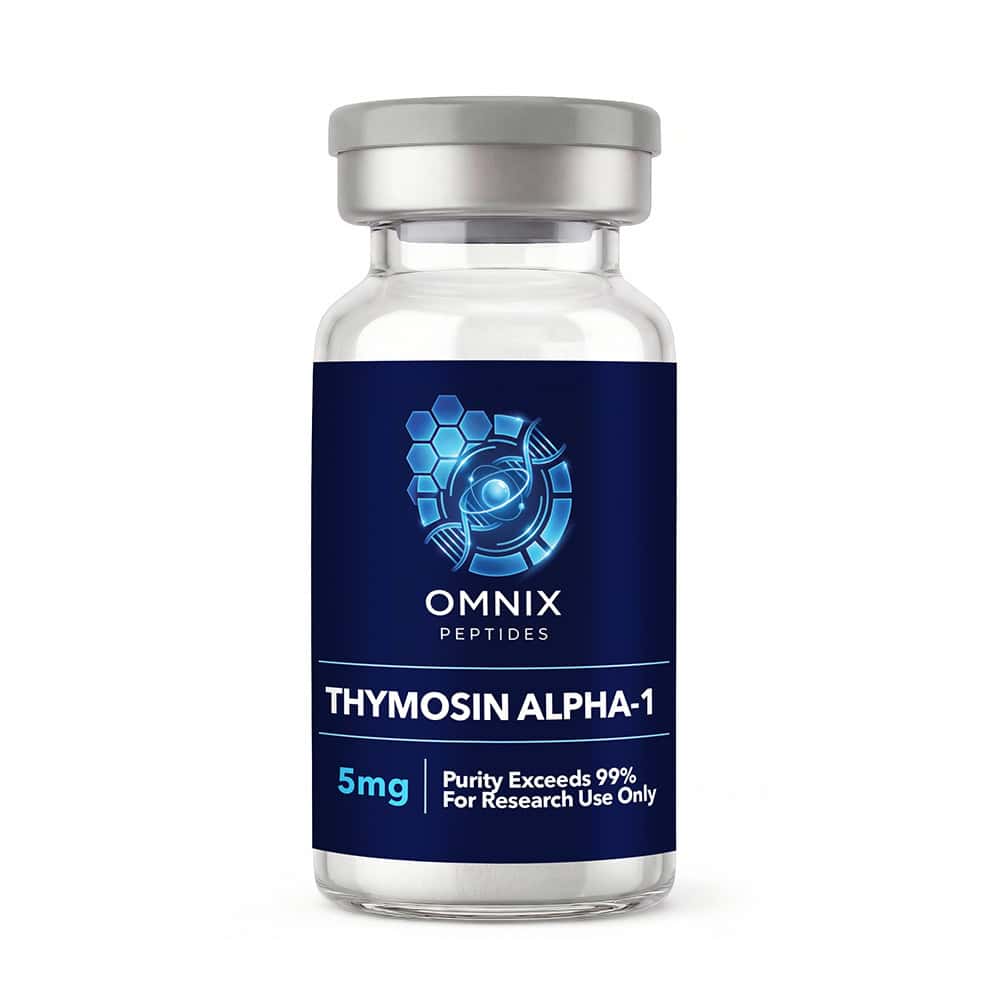
Thymosin Alpha-1 TA1 Vial
← All Thymosin Alpha-1 research
Thymosin Alpha-1 (also known as T 1, TA1, or thymalfasin; CAS 62304-98-7) is a synthetic 28-amino-acid peptide originally identified as the principal immunomodulatory component of thymosin fraction 5 isolated from bovine thymus.
Research goals: Recovery & Healing
Description
Thymosin Alpha-1 (also known as Tα1, TA1, or thymalfasin; CAS 62304-98-7) is a synthetic 28-amino-acid peptide originally identified as the principal immunomodulatory component of thymosin fraction 5 isolated from bovine thymus. Thymosin Alpha-1 is approved as a prescription pharmaceutical in approximately 35 countries (under the brand names Zadaxin® and Thymalfasin®) for the treatment of chronic hepatitis B, hepatitis C, and as an adjuvant for influenza and pneumonia vaccines in immunocompromised populations. It carries U.S. FDA orphan drug designation for hepatocellular carcinoma but has not received full FDA approval. The compound has been the subject of multiple peer-reviewed randomized controlled trials in adult human participants, with results published in Hepatology International, the BMJ, the International Journal of Infectious Diseases, and others.
In a randomized controlled trial of 120 patients with hepatitis-B-virus-related acute-on-chronic liver failure (HBV-ACLF) published in Hepatology International, the 90-day cumulative liver-transplantation-free survival rate was 75.0% in the Thymosin Alpha-1 arm versus 53.4% in the standard-medical-therapy control arm (P = 0.030) [1].
Important Note on the Evidence Base
Important note on the evidence base: The Thymosin Alpha-1 clinical literature includes both positive and null findings across different indications. Earlier meta-analyses of smaller RCTs in sepsis suggested mortality benefit; however, the large 2025 TESTS Phase 3 trial (1,106 patients) did not demonstrate a mortality reduction with Thymosin Alpha-1 in unselected sepsis, with positive signals limited to specific subgroups (elderly, diabetic). The studies summarized below include both supportive and challenging findings to provide an accurate picture of the current evidence base.
Published Research on Thymosin Alpha-1
The following peer-reviewed studies are summarized below. Full citations and direct links to each publication appear in the References section. All studies described in this section were conducted in adult human participants.
HBV-ACLF Trial — Shen et al., Hepatology International (2022)
Shen and colleagues conducted an open-label, randomized, controlled clinical trial (NCT03082885) at Sun Yat-sen University evaluating Thymosin Alpha-1 in patients with hepatitis-B-virus-related acute-on-chronic liver failure — a severe condition with high short-term mortality in which severe infection is the principal complication. From 2017 to 2019, 120 patients were enrolled and randomized to either standard medical therapy (SMT) alone (n = 58) or SMT plus subcutaneous Tα1 (n = 56) at 1.6 mg once daily for the first week, then twice weekly through week 12. The primary endpoint was 90-day liver-transplantation-free survival.
The investigators reported a 90-day cumulative liver-transplantation-free survival rate of 75.0% (95% CI 63.2–86.8%) versus 53.4% (95% CI 39.7–67.1%)
for the Tα1 group versus the SMT control group respectively (P = 0.030) [1]. The result was attributed to Tα1’s restoration of immune competence in the immunoparalyzed ACLF state.
Read the full study: Safety and Efficacy of Thymosin α1 in HBV-Related Acute-on-Chronic Liver Failure: A Randomized Controlled Trial (Hepatology International 2022).
TESTS Phase 3 Sepsis Trial — Wu et al., BMJ (2025)
Wu and colleagues conducted the TESTS trial (Thymosin alpha-1 for SEpsis Trial of Severe sepsis): a multicenter, double-blind, randomized, placebo-controlled phase 3 trial enrolling 1,106 adults with sepsis. Participants received subcutaneous Tα1 1.6 mg or placebo every 12 hours for 7 days. The primary endpoint was 28-day all-cause mortality. The trial is the largest and most rigorous Phase 3 evaluation of Tα1 in sepsis to date.
The investigators reported that Tα1 did not significantly reduce 28-day mortality in the overall sepsis population compared with placebo [2]. Pre-specified subgroup analyses identified potential benefit in elderly patients and in patients with diabetes. The TESTS result challenged earlier meta-analyses of smaller RCTs that had suggested broad mortality benefit, and the authors concluded that any future use of Tα1 in sepsis would need to be guided by patient-selection criteria rather than applied to unselected populations.
Read the full study: The Efficacy and Safety of Thymosin α1 for Sepsis (TESTS): Multicentre, Double-Blind, Randomised, Placebo-Controlled, Phase 3 Trial (BMJ 2025).
Sepsis Meta-Analysis — Li et al., International Journal of Infectious Diseases (2015)
Li and colleagues conducted a systematic review and meta-analysis of randomized controlled trials evaluating Thymosin Alpha-1 in sepsis. The analysis searched the Cochrane Central Register of Controlled Trials, MEDLINE, EMBASE, and Chinese-language medical databases through 2014, identifying 19 RCTs that met inclusion criteria. Mortality events from 10 of those trials (530 patients total) were analyzed in the primary meta-analysis.
The authors reported a significant decrease in mortality with Tα1 versus control
in the pooled analysis (RR 0.59; 95% CI 0.45–0.77; P = 0.0001) [3]. The investigators noted that individual trials were limited by small sample sizes and methodological variability, supporting the need for larger and better-designed RCTs — a need subsequently addressed by the 2025 TESTS trial cited above, which produced a different result in unselected sepsis populations.
Read the full study: Thymosin Alpha-1 Based Immunomodulatory Therapy for Sepsis: A Systematic Review and Meta-Analysis (Int J Infect Dis 2015).
Pharmacokinetics in Healthy Volunteers — Rost et al., International Journal of Clinical Pharmacology and Therapeutics (1999)
Rost and colleagues conducted a pharmacokinetic comparison of three subcutaneous formulations of Thymosin Alpha-1 in healthy adult volunteers. The study characterized absorption, peak plasma concentration (Cmax), time to peak (Tmax), elimination half-life, and bioavailability across the formulations to inform clinical-development administration decisions.
The investigators reported good absorption following subcutaneous injection, with peak plasma concentrations achieved within approximately 1–2 hours and a relatively short elimination half-life consistent with a small peptide cleared rapidly from the systemic circulation [4]. The pharmacokinetic data inform the administration regimens used in subsequent clinical trials and approved-product labeling in jurisdictions where Tα1 is registered.
The full publication is indexed in PubMed/MEDLINE: Pharmacokinetics of Thymosin α1 After Subcutaneous Injection of Three Different Formulations in Healthy Volunteers (Int J Clin Pharm Th 1999).
About the Compound
Thymosin Alpha-1 is a synthetic 28-amino-acid acidic polypeptide whose sequence is identical to the corresponding fragment of native human prothymosin alpha — the larger precursor protein from which Tα1 is generated by post-translational cleavage in vivo. The molecule was originally isolated from bovine thymosin fraction 5 in 1977 and subsequently characterized, sequenced, and produced by solid-phase peptide synthesis for pharmaceutical use.
The published research literature describes Tα1 as exerting immunomodulatory effects through multiple coordinated mechanisms: stimulation of T-cell maturation and differentiation; enhancement of natural killer (NK) cell cytotoxicity; modulation of dendritic cell function and cytokine production; restoration of cell-mediated immunity in immunoparalyzed states (such as the late phase of sepsis or end-stage liver disease); and toll-like receptor (TLR) modulation. The compound has been most extensively studied as an adjuvant immunotherapy in chronic viral hepatitis (B and C), in vaccination of immunocompromised hosts, in sepsis, and as a combination partner with conventional cytotoxic and immune-checkpoint cancer therapies.
- CAS Number: 62304-98-7
- Molecular Formula: C129H215N33O55
- Molecular Weight: 3108.32 g/mol
- Synonyms: Tα1, TA1, Zadaxin®, Thymalfasin®, prothymosin α (1–28)
- Mechanisms investigated in research literature: T-cell maturation/differentiation; NK cell cytotoxicity; dendritic cell modulation; TLR signaling; restoration of immune function in immunoparalysis
- Regulatory status (as of publication): Approved as a prescription pharmaceutical in approximately 35 countries (Zadaxin®, Thymalfasin®) for chronic hepatitis B, hepatitis C, and as a vaccine adjuvant. U.S. FDA orphan drug designation for hepatocellular carcinoma. Not approved by the FDA for general use.
Product Specifications
Omnix Peptides supplies Thymosin Alpha-1 as a sterile, lyophilized (freeze-dried) powder in a sealed glass vial intended exclusively for in vitro laboratory research. Each production lot is independently characterized using high-performance liquid chromatography (HPLC) and liquid chromatography–mass spectrometry (LC–MS) protocols.
- Format: Lyophilized powder
- Available strengths: 5 mg per vial · 10 mg per vial
- Verified Purity: >99% (HPLC, LC–MS)
- Container: Sterile, sealed glass vial
- Documentation: Batch-specific Certificate of Analysis (COA) available
Storage, handling, intended-use, and regulatory information are provided in the corresponding tabs on this product page.
References
- Shen C, Sun L, Liang Y, et al. Safety and efficacy of Thymosin α1 in the treatment of hepatitis B virus-related acute-on-chronic liver failure: a randomized controlled trial. Hepatol Int. 2022;16(4):775-788. doi:10.1007/s12072-022-10335-6
- Wu J, Pan T, Lin S, et al; TESTS trial group. The efficacy and safety of thymosin alpha-1 for sepsis (TESTS): multicentre, double blinded, randomised, placebo controlled, phase 3 trial. BMJ. 2025;388:e080561. doi:10.1136/bmj-2024-080561
- Li C, Bo L, Liu Q, Jin F. Thymosin alpha1 based immunomodulatory therapy for sepsis: a systematic review and meta-analysis. Int J Infect Dis. 2015;33:90-96. doi:10.1016/j.ijid.2014.12.032
- Rost KL, Wierich W, Masayuki F, Tuthill CW, Horwitz DL, Herrmann WM. Pharmacokinetics of thymosin α1 after subcutaneous injection of three different formulations in healthy volunteers. Int J Clin Pharm Th. 1999;37(1):51-57. PMID:9988163
Preparation and storage
Research-only handling information. Thymosin Alpha-1 is sold strictly for in vitro laboratory research. The handling and storage guidance below reflects standard practice in published peptide research literature. Thymosin Alpha-1 is not a drug, supplement, or food product, and is not for human consumption, veterinary use, or medical applications.
Format
- Form: Vial
- Available strengths: 5mg · 10mg
- Verified purity: >99% (HPLC, LC–MS)
- Documentation: Batch-specific Certificate of Analysis (COA) included
Reconstitution for Research Use
Thymosin Alpha-1 is supplied as a sterile, lyophilized powder. Reconstitution with bacteriostatic water (BAC water) is the standard preparation step used in published research protocols. The volume of BAC water used determines the final concentration of the reconstituted solution.
Example (for a 5mg vial reconstituted in 2 mL of BAC water):
- Total peptide: 5mg
- BAC water added: 2 mL
- Resulting concentration: ~2.5 mg/mL
Recommended practice:
- Use sterile bacteriostatic water (0.9% benzyl alcohol) for reconstitution; this preserves the solution for multi-week handling in laboratory settings.
- Allow the lyophilized powder to reach room temperature before opening the vial.
- Inject the BAC water against the inside wall of the vial — do not aim the stream directly at the lyophilized cake.
- Gently swirl the vial until the powder is fully dissolved. Do not shake.
- Once reconstituted, store the vial under refrigeration at 4 °C (39 °F).
Storage & Handling
- Upon receipt: Keep peptides cold and away from light.
- Lyophilized (unreconstituted): Stable at room temperature for several weeks; refrigeration at 4 °C (39 °F) is acceptable for short-term storage (days to weeks).
- Long-term storage (months to years): Freeze the lyophilized vial at −80 °C (−112 °F). Freezing optimally preserves peptide stability for extended periods.
- Reconstituted solution: Refrigerate at 4 °C (39 °F). Avoid freeze/thaw cycles, which can degrade peptide structure.
- Light exposure: Minimize exposure to direct light during handling; light can accelerate peptide degradation.
- Heat exposure: Do not leave the vial at room temperature longer than necessary for handling.
Important Notice
All Omnix Peptides products are sold for laboratory, research, or analytical purposes only. They are not for human consumption, veterinary use, or medical applications. Researchers and laboratory professionals must follow all applicable institutional, local, state, and federal regulations governing the handling of research compounds.
Citations
Citations and reference data. Omnix Peptides supplies research-grade compounds for use by qualified laboratory professionals. The references below cite published preclinical research conducted in animal models and in vitro systems. They are not intended to represent clinical evidence in humans, and Thymosin Alpha-1 has not been approved by the FDA, EMA, or any other regulatory authority for any indication.
Compound Reference Data
- Compound: Thymosin Alpha-1
- CAS Number: 62304-98-7
- Molecular Formula: C129H215N33O55
- Molecular Weight: 3108.32 g/mol
- Sequence: —
- Synonyms: Tα1, TA1, Zadaxin®, Thymalfasin®, prothymosin α (1–28)
Selected Published Studies
The following peer-reviewed studies were conducted using animal models or in vitro cell-culture systems. They are listed here as a reference for researchers investigating Thymosin Alpha-1. None of these studies should be interpreted as recommending Thymosin Alpha-1 for human use, treatment, or any clinical purpose.
- Shen C, Sun L, Liang Y, et al. Safety and efficacy of Thymosin α1 in the treatment of hepatitis B virus-related acute-on-chronic liver failure: a randomized controlled trial. Hepatol Int. 2022;16(4):775-788. doi:10.1007/s12072-022-10335-6
- Wu J, Pan T, Lin S, et al; TESTS trial group. The efficacy and safety of thymosin alpha-1 for sepsis (TESTS): multicentre, double blinded, randomised, placebo controlled, phase 3 trial. BMJ. 2025;388:e080561. doi:10.1136/bmj-2024-080561
- Li C, Bo L, Liu Q, Jin F. Thymosin alpha1 based immunomodulatory therapy for sepsis: a systematic review and meta-analysis. Int J Infect Dis. 2015;33:90-96. doi:10.1016/j.ijid.2014.12.032
- Rost KL, Wierich W, Masayuki F, Tuthill CW, Horwitz DL, Herrmann WM. Pharmacokinetics of thymosin α1 after subcutaneous injection of three different formulations in healthy volunteers. Int J Clin Pharm Th. 1999;37(1):51-57. PMID:9988163
Evidence-Base Disclosure
The published evidence base for Thymosin Alpha-1 consists predominantly of preclinical research — animal models (often rats or mice) and in vitro cell-culture experiments. Where Phase I or Phase II human trials exist, they are noted in the compound page summary. Researchers should interpret the cited literature within the experimental context of each individual study.
Frequently asked questions
Frequently asked questions about the Thymosin Alpha-1 Vial. Questions on this page cover handling, storage, documentation, and ordering. Thymosin Alpha-1 is sold for laboratory, research, or analytical purposes only — not for human consumption, veterinary use, or medical applications.
How is the Thymosin Alpha-1 Vial prepared for laboratory research?
The Thymosin Alpha-1 Vial is supplied as a sterile, lyophilized (freeze-dried) powder. The standard preparation step described in published peptide research literature is reconstitution with bacteriostatic water (BAC water). The volume of BAC water used determines the final concentration of the solution. See the Amount & Handling tab for a worked reconstitution example.
Why is Thymosin Alpha-1 supplied as a lyophilized powder rather than a pre-mixed solution?
Lyophilization (freeze-drying) is the standard format for research-grade peptides because it maximizes long-term stability. A lyophilized vial stored cold and away from light remains stable for substantially longer than a pre-mixed solution. Reconstitution by the researcher also allows control over the final solution concentration.
Can the reconstituted Thymosin Alpha-1 solution be frozen?
Freeze/thaw cycles can degrade peptide structure and should generally be avoided. Reconstituted Thymosin Alpha-1 should be stored under refrigeration at 4 °C (39 °F) and used within the active research timeframe described in the Amount & Handling tab. For long-term storage, keep the vial lyophilized and freeze at −80 °C (−112 °F) until use.
Is Thymosin Alpha-1 approved by the FDA?
No. Thymosin Alpha-1 is not approved by the FDA, EMA, or any other regulatory authority for any indication. Thymosin Alpha-1 is sold by Omnix Peptides strictly for laboratory, research, or analytical purposes. It is not for human consumption, veterinary use, or medical applications.
What is included with each Thymosin Alpha-1 Vial?
Each order includes the sealed product container and a batch-specific Certificate of Analysis (COA) verifying identity and purity by HPLC and LC–MS. The full COA library for Omnix Peptides is available at /coa-lab-reports/.
What is a Certificate of Analysis (COA), and how do I read it?
A COA is a batch-specific lab report that documents the identity, purity, and quality control results for the production lot you receive. The COA lists the compound name, CAS number, lot number, analytical methods used (HPLC, LC–MS), and the measured purity percentage. Every Omnix order includes the COA for the lot shipped.
What is the CAS number for Thymosin Alpha-1?
The CAS number for Thymosin Alpha-1 is 62304-98-7. Researchers can use this identifier to locate published literature in PubMed and other scientific databases.
How does Omnix Peptides ship orders?
Orders ship from a US-based facility with tracked domestic shipping. Free shipping is offered on orders over $99. Lyophilized vials and capsules ship at ambient temperature; sprays ship insulated when seasonal conditions require it. Tracking information is provided by email after the order ships.
What if my product arrives damaged or the seal is broken?
Contact Omnix Peptides within 48 hours of delivery. Product damaged in transit or arriving with a compromised seal will be replaced at no cost. See the Shipping & Return Policy at /shipping-return-policy/ for full terms.
Where can I find published research on Thymosin Alpha-1?
Peer-reviewed studies relevant to Thymosin Alpha-1 are listed in the Citations tab on this product page. The same studies can be located independently on PubMed using the CAS number (62304-98-7) or the compound name.
Customer reviews
Certificate of Analysis
Certificate of Analysis (COA) for this batch is available on request. Email orders@omnixpeptides.com with your order number to receive a copy. COAs include HPLC purity analysis performed by an independent third-party laboratory.
Reviews
There are no reviews yet.