
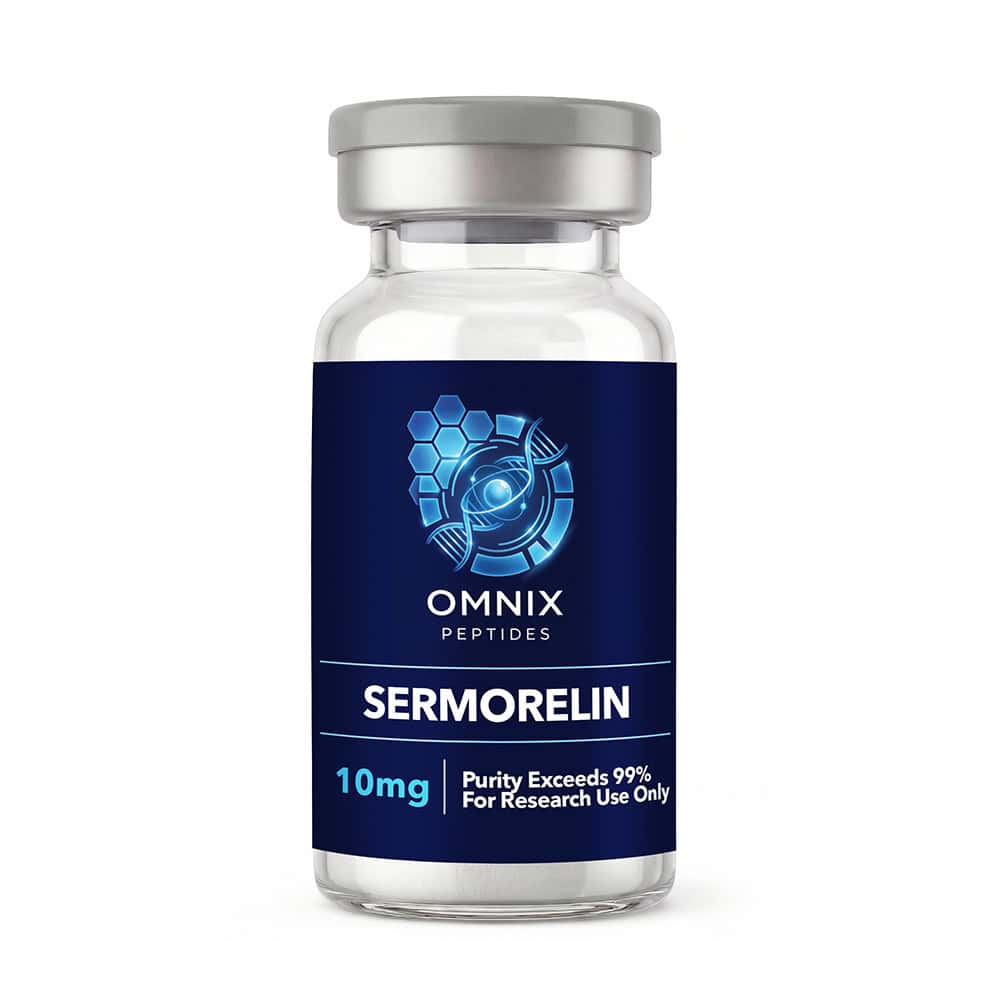
Sermorelin Vial
Sermorelin (CAS 86168-78-7; acetate salt CAS 100929-52-0) is a synthetic 29-amino-acid analog of human growth hormone-releasing hormone (GHRH) specifically, the biologically active N-terminal fragment GHRH(1 29)-NH2.
Research goals: Growth Hormone
Description
Sermorelin (CAS 86168-78-7; acetate salt CAS 100929-52-0) is a synthetic 29-amino-acid analog of human growth hormone-releasing hormone (GHRH) — specifically, the biologically active N-terminal fragment GHRH(1–29)-NH2. It has been the subject of multiple peer-reviewed randomized controlled trials in adult and pediatric human participants, with results published in the Journal of Clinical Endocrinology & Metabolism and Neurobiology of Aging. Sermorelin received U.S. Food and Drug Administration approval in 1997 (under the brand name Geref) for the treatment of children with idiopathic growth hormone deficiency.
In a randomized, placebo-controlled trial published in the Journal of Clinical Endocrinology & Metabolism, healthy adults aged 55–71 receiving once-nightly subcutaneous GHRH(1–29) at 10 µg/kg for 16 weeks demonstrated a 107% increase in 12-hour integrated growth hormone secretion in men and a 70% increase in women, accompanied by significant elevations in serum insulin-like growth factor 1 (IGF-1) [2].
Published Research on Sermorelin
The following peer-reviewed studies are summarized below. Full citations and direct links to each publication appear in the References section. All studies described in this section were conducted in adult or pediatric human participants.
Pediatric Growth Hormone Deficiency Trial — Thorner et al., Journal of Clinical Endocrinology & Metabolism (1996)
Thorner and colleagues, on behalf of the Geref International Study Group, conducted a multicenter, open-label trial of sermorelin in pediatric growth hormone deficiency. The trial enrolled 110 previously untreated prepubertal children with growth hormone deficiency, with 86 evaluable for the efficacy analysis. Participants received once-daily subcutaneous sermorelin at 30 µg/kg administered at bedtime for up to one year, with height velocity assessed as the primary efficacy endpoint.
The authors concluded that GHRH(1–29) was effective in increasing height velocity in GH-deficient children
over the one-year treatment period [1]. The data were among the foundational evidence supporting sermorelin’s 1997 FDA approval for the treatment of growth failure in children with idiopathic growth hormone deficiency.
Read the full study: Once Daily Subcutaneous Growth Hormone-Releasing Hormone Therapy Accelerates Growth in Growth Hormone-Deficient Children (JCEM 1996).
Body Composition in Older Adults — Khorram et al., Journal of Clinical Endocrinology & Metabolism (May 1997)
Khorram and colleagues conducted a single-blind, randomized, placebo-controlled trial in healthy elderly subjects (10 women and 9 men, aged 55–71 years). After a 4-week placebo lead-in, participants self-administered nightly subcutaneous GHRH(1–29) at 10 µg/kg for 16 weeks. The investigators evaluated 12-hour integrated growth hormone secretion (10-minute sampling intervals over 12 hours), serum IGF-1, body composition (skin thickness, lean body mass, body fat), and metabolic parameters at baseline, after placebo, and at 4 and 16 weeks of GHRH analog administration.
The investigators reported that GHRH analog administration produced a 107% increase in nocturnal integrated GH secretion in men and a 70% increase in women, with a 28% increase in serum IGF-1 in both sexes [2]. Statistically significant increases in skin thickness were observed in both men and women, while men showed a mean gain of approximately 1.26 kg in lean body mass and improved insulin sensitivity. No adverse effects were reported.
Read the full study: Endocrine and Metabolic Effects of Long-Term Administration of GHRH(1–29)-NH2 in Age-Advanced Men and Women (JCEM 1997).
Immune Function Substudy — Khorram et al., Journal of Clinical Endocrinology & Metabolism (November 1997)
In a companion analysis of the same elderly cohort, Khorram and colleagues evaluated immune-system endpoints. Freshly isolated peripheral lymphocytes were analyzed by flow cytometry for lymphocyte subsets and monocytes; mitogen stimulation responses, natural killer (NK) cell number and cytotoxicity, basal and stimulated interleukin-2 (IL-2) secretion, and IL-2/IL-2R messenger RNA expression were measured at baseline, after placebo, and during GHRH analog administration at 4 and 16 weeks.
The authors concluded that GHRH analog administration has profound immune-enhancing effects
and reported no sex differences in the immune response or adverse events [3]. Specific findings included increases in B-cell responsiveness and IL-2 receptor-expressing lymphocyte populations.
Read the full study: Effects of GHRH(1–29)-NH2 Administration on the Immune System of Aging Men and Women (JCEM 1997).
Cognition in Older Adults — Vitiello et al., Neurobiology of Aging (2006)
Vitiello and colleagues conducted a randomized, placebo-controlled trial evaluating cognitive function in healthy older adults receiving GHRH treatment. The study enrolled 89 healthy older adults randomized to either GHRH or placebo for six months, with cognitive performance assessed by a battery of standardized neuropsychological tests including measures of processing speed, performance IQ, and visual reasoning.
The authors reported that growth hormone releasing hormone improves the cognition of healthy older adults
, with statistically significant improvements observed in performance IQ, picture arrangement, and processing-speed measures in the GHRH arm compared with placebo [4].
Read the full study: Growth Hormone Releasing Hormone Improves the Cognition of Healthy Older Adults (Neurobiology of Aging 2006).
About the Compound
Sermorelin is a synthetic 29-amino-acid peptide corresponding to the N-terminal 1–29 fragment of native human growth hormone-releasing hormone (hGHRH1-44). It is the shortest synthetic GHRH fragment that retains full biological activity at the GHRH receptor. The molecule binds GHRH receptors expressed on anterior-pituitary somatotrophs, activating G-protein-coupled signaling through adenylyl cyclase, cyclic AMP, and protein kinase A pathways — resulting in stimulation of endogenous, pulsatile growth hormone secretion and downstream elevation of circulating IGF-1.
Like other GHRH analogs, sermorelin acts upstream of the pituitary, preserving the physiological negative-feedback regulation of the GH axis and the natural pulsatile secretion pattern. Sermorelin received FDA approval in 1990 as a diagnostic agent for growth hormone deficiency, and in 1997 as a therapeutic agent (under the brand name Geref) for the treatment of growth failure in children with idiopathic growth hormone deficiency. The product was commercially withdrawn by EMD Serono in 2008 due to active-ingredient supply issues, not due to any safety or efficacy concerns identified in clinical use.
- CAS Number: 86168-78-7 (free base); 100929-52-0 (acetate)
- Molecular Formula: C149H246N44O42S
- Molecular Weight: 3357.93 g/mol
- Synonyms: GHRH(1–29)-NH2, GRF(1–29), Geref, sermorelin acetate
- Receptor target (in research literature): Growth hormone-releasing hormone (GHRH) receptor
- Regulatory status (as of publication): FDA-approved 1990 (diagnostic) and 1997 (therapeutic) under the brand name Geref. Commercially withdrawn 2008.
Product Specifications
Omnix Peptides supplies sermorelin as a sterile, lyophilized (freeze-dried) powder in a sealed glass vial intended exclusively for in vitro laboratory research. Each production lot is independently characterized using high-performance liquid chromatography (HPLC) and liquid chromatography–mass spectrometry (LC–MS) protocols.
- Format: Lyophilized powder
- Available strengths: 10 mg per vial
- Verified Purity: >99% (HPLC, LC–MS)
- Container: Sterile, sealed glass vial
- Documentation: Batch-specific Certificate of Analysis (COA) available
Storage, handling, intended-use, and regulatory information are provided in the corresponding tabs on this product page.
References
- Thorner M, Rochiccioli P, Colle M, et al; Geref International Study Group. Once daily subcutaneous growth hormone-releasing hormone therapy accelerates growth in growth hormone-deficient children during the first year of therapy. J Clin Endocrinol Metab. 1996;81(3):1189-1196. doi:10.1210/jcem.81.3.8772599
- Khorram O, Laughlin GA, Yen SS. Endocrine and metabolic effects of long-term administration of [Nle27]growth hormone-releasing hormone-(1-29)-NH2 in age-advanced men and women. J Clin Endocrinol Metab. 1997;82(5):1472-1479. doi:10.1210/jcem.82.5.3943
- Khorram O, Yeung M, Vu L, Yen SS. Effects of [norleucine27]growth hormone-releasing hormone (GHRH) (1-29)-NH2 administration on the immune system of aging men and women. J Clin Endocrinol Metab. 1997;82(11):3590-3596. doi:10.1210/jcem.82.11.4363
- Vitiello MV, Moe KE, Merriam GR, Mazzoni G, Buchner DH, Schwartz RS. Growth hormone releasing hormone improves the cognition of healthy older adults. Neurobiol Aging. 2006;27(2):318-323. doi:10.1016/j.neurobiolaging.2005.01.010
Preparation and storage
Research-only handling information. Sermorelin is sold strictly for in vitro laboratory research. The handling and storage guidance below reflects standard practice in published peptide research literature. Sermorelin is not a drug, supplement, or food product, and is not for human consumption, veterinary use, or medical applications.
Format
- Form: Vial
- Available strengths: 10mg
- Verified purity: >99% (HPLC, LC–MS)
- Documentation: Batch-specific Certificate of Analysis (COA) included
Reconstitution for Research Use
Sermorelin is supplied as a sterile, lyophilized powder. Reconstitution with bacteriostatic water (BAC water) is the standard preparation step used in published research protocols. The volume of BAC water used determines the final concentration of the reconstituted solution.
Example (for a 10mg vial reconstituted in 2 mL of BAC water):
- Total peptide: 10mg
- BAC water added: 2 mL
- Resulting concentration: ~5 mg/mL
Recommended practice:
- Use sterile bacteriostatic water (0.9% benzyl alcohol) for reconstitution; this preserves the solution for multi-week handling in laboratory settings.
- Allow the lyophilized powder to reach room temperature before opening the vial.
- Inject the BAC water against the inside wall of the vial — do not aim the stream directly at the lyophilized cake.
- Gently swirl the vial until the powder is fully dissolved. Do not shake.
- Once reconstituted, store the vial under refrigeration at 4 °C (39 °F).
Storage & Handling
- Upon receipt: Keep peptides cold and away from light.
- Lyophilized (unreconstituted): Stable at room temperature for several weeks; refrigeration at 4 °C (39 °F) is acceptable for short-term storage (days to weeks).
- Long-term storage (months to years): Freeze the lyophilized vial at −80 °C (−112 °F). Freezing optimally preserves peptide stability for extended periods.
- Reconstituted solution: Refrigerate at 4 °C (39 °F). Avoid freeze/thaw cycles, which can degrade peptide structure.
- Light exposure: Minimize exposure to direct light during handling; light can accelerate peptide degradation.
- Heat exposure: Do not leave the vial at room temperature longer than necessary for handling.
Important Notice
All Omnix Peptides products are sold for laboratory, research, or analytical purposes only. They are not for human consumption, veterinary use, or medical applications. Researchers and laboratory professionals must follow all applicable institutional, local, state, and federal regulations governing the handling of research compounds.
Citations
Citations and reference data. Omnix Peptides supplies research-grade compounds for use by qualified laboratory professionals. The references below cite published preclinical research conducted in animal models and in vitro systems. They are not intended to represent clinical evidence in humans, and Sermorelin has not been approved by the FDA, EMA, or any other regulatory authority for any indication.
Compound Reference Data
- Compound: Sermorelin
- CAS Number: 86168-78-7 (free base); 100929-52-0 (acetate)
- Molecular Formula: C149H246N44O42S
- Molecular Weight: 3357.93 g/mol
- Sequence: —
- Synonyms: GHRH(1–29)-NH2, GRF(1–29), Geref, sermorelin acetate
Selected Published Studies
The following peer-reviewed studies were conducted using animal models or in vitro cell-culture systems. They are listed here as a reference for researchers investigating Sermorelin. None of these studies should be interpreted as recommending Sermorelin for human use, treatment, or any clinical purpose.
- Thorner M, Rochiccioli P, Colle M, et al; Geref International Study Group. Once daily subcutaneous growth hormone-releasing hormone therapy accelerates growth in growth hormone-deficient children during the first year of therapy. J Clin Endocrinol Metab. 1996;81(3):1189-1196. doi:10.1210/jcem.81.3.8772599
- Khorram O, Laughlin GA, Yen SS. Endocrine and metabolic effects of long-term administration of [Nle27]growth hormone-releasing hormone-(1-29)-NH2 in age-advanced men and women. J Clin Endocrinol Metab. 1997;82(5):1472-1479. doi:10.1210/jcem.82.5.3943
- Khorram O, Yeung M, Vu L, Yen SS. Effects of [norleucine27]growth hormone-releasing hormone (GHRH) (1-29)-NH2 administration on the immune system of aging men and women. J Clin Endocrinol Metab. 1997;82(11):3590-3596. doi:10.1210/jcem.82.11.4363
- Vitiello MV, Moe KE, Merriam GR, Mazzoni G, Buchner DH, Schwartz RS. Growth hormone releasing hormone improves the cognition of healthy older adults. Neurobiol Aging. 2006;27(2):318-323. doi:10.1016/j.neurobiolaging.2005.01.010
Evidence-Base Disclosure
The published evidence base for Sermorelin consists predominantly of preclinical research — animal models (often rats or mice) and in vitro cell-culture experiments. Where Phase I or Phase II human trials exist, they are noted in the compound page summary. Researchers should interpret the cited literature within the experimental context of each individual study.
Frequently asked questions
Frequently asked questions about the Sermorelin Vial. Questions on this page cover handling, storage, documentation, and ordering. Sermorelin is sold for laboratory, research, or analytical purposes only — not for human consumption, veterinary use, or medical applications.
How is the Sermorelin Vial prepared for laboratory research?
The Sermorelin Vial is supplied as a sterile, lyophilized (freeze-dried) powder. The standard preparation step described in published peptide research literature is reconstitution with bacteriostatic water (BAC water). The volume of BAC water used determines the final concentration of the solution. See the Amount & Handling tab for a worked reconstitution example.
Why is Sermorelin supplied as a lyophilized powder rather than a pre-mixed solution?
Lyophilization (freeze-drying) is the standard format for research-grade peptides because it maximizes long-term stability. A lyophilized vial stored cold and away from light remains stable for substantially longer than a pre-mixed solution. Reconstitution by the researcher also allows control over the final solution concentration.
Can the reconstituted Sermorelin solution be frozen?
Freeze/thaw cycles can degrade peptide structure and should generally be avoided. Reconstituted Sermorelin should be stored under refrigeration at 4 °C (39 °F) and used within the active research timeframe described in the Amount & Handling tab. For long-term storage, keep the vial lyophilized and freeze at −80 °C (−112 °F) until use.
Is Sermorelin approved by the FDA?
No. Sermorelin is not approved by the FDA, EMA, or any other regulatory authority for any indication. Sermorelin is sold by Omnix Peptides strictly for laboratory, research, or analytical purposes. It is not for human consumption, veterinary use, or medical applications.
What is included with each Sermorelin Vial?
Each order includes the sealed product container and a batch-specific Certificate of Analysis (COA) verifying identity and purity by HPLC and LC–MS. The full COA library for Omnix Peptides is available at /coa-lab-reports/.
What is a Certificate of Analysis (COA), and how do I read it?
A COA is a batch-specific lab report that documents the identity, purity, and quality control results for the production lot you receive. The COA lists the compound name, CAS number, lot number, analytical methods used (HPLC, LC–MS), and the measured purity percentage. Every Omnix order includes the COA for the lot shipped.
What is the CAS number for Sermorelin?
The CAS number for Sermorelin is 86168-78-7 (free base); 100929-52-0 (acetate). Researchers can use this identifier to locate published literature in PubMed and other scientific databases.
How does Omnix Peptides ship orders?
Orders ship from a US-based facility with tracked domestic shipping. Free shipping is offered on orders over $99. Lyophilized vials and capsules ship at ambient temperature; sprays ship insulated when seasonal conditions require it. Tracking information is provided by email after the order ships.
What if my product arrives damaged or the seal is broken?
Contact Omnix Peptides within 48 hours of delivery. Product damaged in transit or arriving with a compromised seal will be replaced at no cost. See the Shipping & Return Policy at /shipping-return-policy/ for full terms.
Where can I find published research on Sermorelin?
Peer-reviewed studies relevant to Sermorelin are listed in the Citations tab on this product page. The same studies can be located independently on PubMed using the CAS number (86168-78-7 (free base); 100929-52-0 (acetate)) or the compound name.
Customer reviews
Certificate of Analysis
Third-party HPLC purity analysis performed by an independent laboratory for this batch.
Reviews
There are no reviews yet.