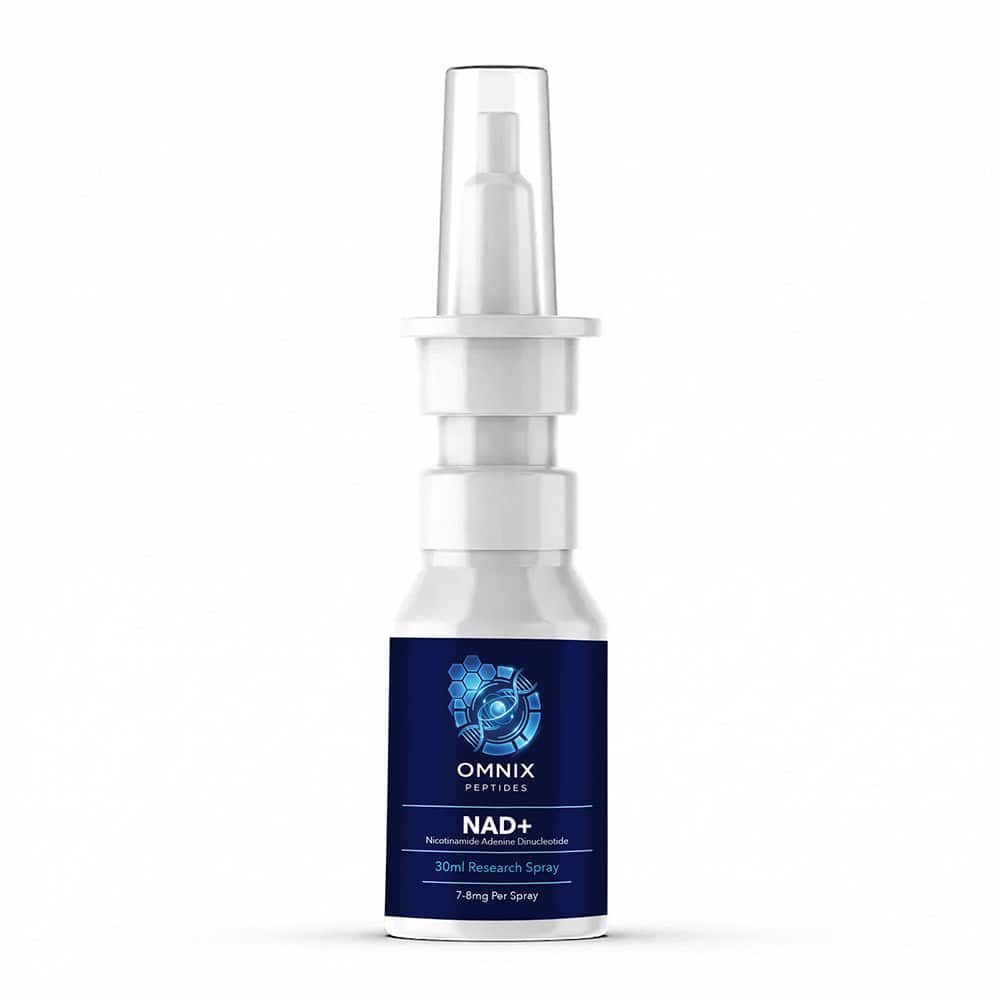
NAD+ Liquid Spray 1500mg
Sublingual/mucosal-delivery research format for laboratory studies investigating non-injectable NAD+ administration routes. Supports protocols where alternative bioavailability pathways are the research variable. HPLC-tested, third-party COA per batch.
$150.00
Research goals: Longevity & Anti-Aging
Description
NAD+ (β-nicotinamide adenine dinucleotide; CAS 53-84-9) is an essential dinucleotide cofactor present in every living cell, where it functions as a central redox coenzyme in cellular metabolism and as a substrate for the sirtuin family of deacylases, the poly(ADP-ribose) polymerase (PARP) family of DNA-repair enzymes, and the cyclic-ADP-ribose synthases that regulate calcium signaling. NAD+ pathway research has been the subject of multiple peer-reviewed clinical trials in adult human participants, with results published in Nature Communications, Frontiers in Aging Neuroscience, and Scientific Reports.
In a placebo-controlled, randomized, crossover trial of chronic NAD+-precursor supplementation published in Nature Communications, six weeks of oral nicotinamide riboside (NR) at 1,000 mg/day produced a statistically significant elevation of whole-blood NAD+ in healthy middle-aged and older adults compared with placebo, accompanied by signals of reduced systolic blood pressure and aortic pulse-wave velocity in subjects with above-normal baseline blood pressure [3].
Important Note on the Evidence Base
Important note on the evidence base: The most rigorous published human randomized-controlled-trial data on the NAD+ pathway involves the orally bioavailable NAD+ precursors nicotinamide riboside (NR) and nicotinamide mononucleotide (NMN), rather than direct administration of NAD+ itself. Direct NAD+ has limited published human pharmacokinetic data and is not appreciably absorbed via the oral route. Published research on direct intravenous NAD+ administration is sparse. Three of the four studies summarized below evaluate NAD+ precursors; one evaluates intravenous NAD+ directly. Each study identifies its compound and route of administration explicitly.
Published Research on the NAD+ Pathway
The following peer-reviewed studies are summarized below. Full citations and direct links to each publication appear in the References section. All studies described in this section were conducted in adult human participants.
Intravenous NAD+ Pharmacokinetic Pilot — Grant et al., Frontiers in Aging Neuroscience (2019)
Grant and colleagues conducted the first published human pharmacokinetic study of intravenous NAD+ administration. The pilot trial enrolled 11 healthy male participants aged 30–55 years, randomized to either an active arm (n = 8) receiving 750 mg of NAD+ in normal saline by intravenous infusion over 6 hours (~2 mg/min, ~3 µmol/min) or a saline-control arm (n = 3). Plasma and urine samples were collected throughout the infusion and follow-up period to characterize the appearance of NAD+ and its principal metabolites (nicotinamide, methylnicotinamide, adenosine diphosphate ribose, and nicotinamide mononucleotide).
The investigators reported that, surprisingly, no measurable changes in plasma NAD+ or its metabolites were detected during the first two hours of intravenous infusion [1]. Detectable plasma NAD+ metabolome changes appeared only after the 2-hour mark, with corresponding urinary excretion of methylated nicotinamide species observable through the post-infusion period. The pilot represents the only published human study to date directly characterizing the pharmacokinetic fate of intravenously administered NAD+.
Read the full study: A Pilot Study Investigating Changes in the Human Plasma and Urine NAD+ Metabolome During a 6-Hour Intravenous Infusion of NAD+ (Front Aging Neurosci 2019).
NR Pharmacokinetics — Trammell et al., Nature Communications (2016)
Trammell and colleagues conducted the first formal human pharmacokinetic study of the NAD+ precursor nicotinamide riboside (NR). The trial evaluated single oral amounts of 100, 300, and 1,000 mg of NR in healthy adult volunteers, with serial blood and urine sampling to quantify NAD+, nicotinamide, methylnicotinamide, nicotinic acid adenine dinucleotide (NAAD), and other NAD+ metabolome components over 24 hours.
The authors reported that nicotinamide riboside is uniquely and orally bioavailable in mice and humans
, with single oral amounts of 100, 300, and 1,000 mg producing concentration-dependent increases in the blood NAD+ metabolome [2]. The investigators also identified the appearance of NAAD as a sensitive biomarker of effective NAD+ repletion, a finding that has informed subsequent biomarker selection in NAD+-precursor trials.
Read the full study: Nicotinamide Riboside Is Uniquely and Orally Bioavailable in Mice and Humans (Nat Commun 2016).
Chronic NR in Aging — Martens et al., Nature Communications (2018)
Martens and colleagues at the University of Colorado, Boulder, conducted a 2 × 6-week, randomized, double-blind, placebo-controlled crossover trial in 30 healthy middle-aged and older adults. Participants received 500 mg of NR twice daily (1,000 mg/day total) or matching placebo for 6 weeks before crossing over to the alternate arm. Co-primary endpoints assessed safety/tolerability and change in NAD+ in peripheral blood mononuclear cells, with exploratory analyses of cardiovascular function (systolic and diastolic blood pressure, aortic pulse-wave velocity).
The authors reported that 6 weeks of NR supplementation was well-tolerated and effectively stimulates NAD+ metabolism
in healthy middle-aged and older adults [3]. Exploratory analyses suggested that NR supplementation may reduce systolic blood pressure and aortic pulse-wave velocity in subjects with above-normal baseline blood pressure (the authors noted these are hypothesis-generating findings requiring confirmation in larger trials).
Read the full study: Chronic Nicotinamide Riboside Supplementation Is Well-Tolerated and Elevates NAD+ in Healthy Middle-Aged and Older Adults (Nat Commun 2018).
Long-Term NR Safety & Metabolism — Conze et al., Scientific Reports (2019)
Conze and colleagues conducted an 8-week randomized, double-blind, placebo-controlled trial of crystalline NR chloride (NIAGEN®) in 140 healthy overweight men and women. Participants were randomized to placebo or one of three NR amounts (100 mg/day, 300 mg/day, or 1,000 mg/day), with whole-blood NAD+ and NAD+ metabolites measured at baseline and at weeks 2, 4, 6, and 8, alongside a comprehensive safety panel.
The authors reported that NR consumption amount-dependently and significantly increased whole blood NAD+
by 22%, 51%, and 142% at the 100, 300, and 1,000 mg amounts respectively, with elevations achieved within 2 weeks and maintained through the 8-week treatment period [4]. There were no significant differences in adverse events between NR-treated and placebo-treated groups, and no clinically meaningful effects on lipid profiles or one-carbon metabolism.
About the Compound
Nicotinamide adenine dinucleotide (NAD+) is a dinucleotide molecule composed of two nucleotides — nicotinamide and adenine — joined through their 5′-phosphate groups. It exists in cells in two forms: the oxidized form (NAD+) and the reduced form (NADH), which interconvert as the molecule accepts and donates electrons during cellular respiration. The phosphorylated forms (NADP+/NADPH) play complementary roles in biosynthetic reduction reactions.
Beyond its classical role in redox metabolism, NAD+ functions as a substrate — not merely a cofactor — for three families of consuming enzymes whose activity governs key cellular processes: the sirtuins (SIRT1–7), which regulate transcription, DNA repair, and metabolic homeostasis; the PARPs, which mediate DNA damage repair; and the cADP-ribose synthases (CD38, CD157), which regulate calcium signaling. Cellular NAD+ levels decline with advancing age in multiple tissues, and the rationale for “NAD+ boosting” interventions (whether by direct NAD+ administration or by precursor supplementation with nicotinamide, NR, or NMN) derives from preclinical evidence that restoring NAD+ availability can support sirtuin-, PARP-, and metabolic-pathway function.
- CAS Number: 53-84-9
- Molecular Formula: C21H27N7O14P2
- Molecular Weight: 663.43 g/mol
- Synonyms: β-Nicotinamide adenine dinucleotide, NAD, DPN, Coenzyme I, Codehydrogenase I
- Cellular roles (in research literature): Redox coenzyme; substrate for sirtuins (SIRT1–7), PARPs, cADP-ribose synthases (CD38, CD157)
- Mechanism: Redox coenzyme cycling between NAD+ (oxidized) and NADH (reduced); substrate consumption by sirtuins, PARPs, and CD38 drives cellular NAD+ turnover.
- Regulatory status (as of publication): Not approved as a drug for any indication. Available in some jurisdictions as a dietary ingredient and as a research-use chemical.
Product Specifications
Omnix Peptides supplies NAD+ as a pre-mixed liquid intranasal spray in a sealed metered nasal spray bottle intended exclusively for in vitro laboratory research. Each production lot is independently characterized using high-performance liquid chromatography (HPLC) and liquid chromatography–mass spectrometry (LC–MS) protocols.
- Format: Liquid intranasal spray
- Strength: 1,500 mg of peptide per 30 mL bottle
- Verified Purity: >99% (HPLC, LC–MS)
- Container: Sealed metered nasal spray bottle
- Documentation: Batch-specific Certificate of Analysis (COA) available
Storage, handling, intended-use, and regulatory information are provided in the corresponding tabs on this product page.
References
- Grant R, Berg J, Mestayer R, et al. A pilot study investigating changes in the human plasma and urine NAD+ metabolome during a 6 hour intravenous infusion of NAD+. Front Aging Neurosci. 2019;11:257. doi:10.3389/fnagi.2019.00257
- Trammell SAJ, Schmidt MS, Weidemann BJ, et al. Nicotinamide riboside is uniquely and orally bioavailable in mice and humans. Nat Commun. 2016;7:12948. doi:10.1038/ncomms12948
- Martens CR, Denman BA, Mazzo MR, et al. Chronic nicotinamide riboside supplementation is well-tolerated and elevates NAD+ in healthy middle-aged and older adults. Nat Commun. 2018;9(1):1286. doi:10.1038/s41467-018-03421-7
- Conze D, Brenner C, Kruger CL. Safety and metabolism of long-term administration of NIAGEN (nicotinamide riboside chloride) in a randomized, double-blind, placebo-controlled clinical trial of healthy overweight adults. Sci Rep. 2019;9(1):9772. doi:10.1038/s41598-019-46120-z
Preparation and storage
Research-only handling information. NAD+ is sold strictly for in vitro laboratory research. The handling and storage guidance below reflects standard practice in published peptide research literature. NAD+ is not a drug, supplement, or food product, and is not for human consumption, veterinary use, or medical applications.
Format
- Form: Liquid Spray
- Available strengths: 30ml
- Verified purity: >99% (HPLC, LC–MS)
- Documentation: Batch-specific Certificate of Analysis (COA) included
Handling for Research Use
NAD+ Liquid Spray ships pre-formulated in solution. No reconstitution is required. The spray bottle delivers a metered volume per actuation; refer to the certificate of analysis (COA) for batch-specific peptide concentration.
Storage & Handling
- Upon receipt: Refrigerate immediately at 4 °C (39 °F).
- Short-term storage: Refrigeration at 4 °C (39 °F) is the standard for sprays in active research use.
- Long-term storage: Liquid sprays should not be frozen; freezing can damage the bottle and disrupt the solution.
- Light exposure: Store in original packaging away from direct light.
- Before each use: Gently invert the bottle to redistribute the solution. Do not shake.
Important Notice
All Omnix Peptides products are sold for laboratory, research, or analytical purposes only. They are not for human consumption, veterinary use, or medical applications. Researchers and laboratory professionals must follow all applicable institutional, local, state, and federal regulations governing the handling of research compounds.
Citations
Citations and reference data. Omnix Peptides supplies research-grade compounds for use by qualified laboratory professionals. The references below cite published preclinical research conducted in animal models and in vitro systems. They are not intended to represent clinical evidence in humans, and NAD+ has not been approved by the FDA, EMA, or any other regulatory authority for any indication.
Compound Reference Data
- Compound: NAD+
- CAS Number: 53-84-9
- Molecular Formula: C21H27N7O14P2
- Molecular Weight: 663.43 g/mol
- Sequence: —
- Synonyms: β-Nicotinamide adenine dinucleotide, NAD, DPN, Coenzyme I, Codehydrogenase I
Selected Published Studies
The following peer-reviewed studies were conducted using animal models or in vitro cell-culture systems. They are listed here as a reference for researchers investigating NAD+. None of these studies should be interpreted as recommending NAD+ for human use, treatment, or any clinical purpose.
- Grant R, Berg J, Mestayer R, et al. A pilot study investigating changes in the human plasma and urine NAD+ metabolome during a 6 hour intravenous infusion of NAD+. Front Aging Neurosci. 2019;11:257. doi:10.3389/fnagi.2019.00257
- Trammell SAJ, Schmidt MS, Weidemann BJ, et al. Nicotinamide riboside is uniquely and orally bioavailable in mice and humans. Nat Commun. 2016;7:12948. doi:10.1038/ncomms12948
- Martens CR, Denman BA, Mazzo MR, et al. Chronic nicotinamide riboside supplementation is well-tolerated and elevates NAD+ in healthy middle-aged and older adults. Nat Commun. 2018;9(1):1286. doi:10.1038/s41467-018-03421-7
- Conze D, Brenner C, Kruger CL. Safety and metabolism of long-term administration of NIAGEN (nicotinamide riboside chloride) in a randomized, double-blind, placebo-controlled clinical trial of healthy overweight adults. Sci Rep. 2019;9(1):9772. doi:10.1038/s41598-019-46120-z
Evidence-Base Disclosure
The published evidence base for NAD+ consists predominantly of preclinical research — animal models (often rats or mice) and in vitro cell-culture experiments. Where Phase I or Phase II human trials exist, they are noted in the compound page summary. Researchers should interpret the cited literature within the experimental context of each individual study.
Frequently asked questions
Frequently asked questions about the NAD+ Liquid Spray. Questions on this page cover handling, storage, documentation, and ordering. NAD+ is sold for laboratory, research, or analytical purposes only — not for human consumption, veterinary use, or medical applications.
Why does Omnix offer NAD+ in a liquid spray format?
The spray format ships pre-formulated, removing the reconstitution step required for lyophilized vials. The metered-spray bottle delivers a fixed volume per actuation. Spray format is used in research applications where a pre-mixed solution is preferred.
How should the NAD+ spray be stored?
Refrigerate at 4 °C (39 °F) immediately upon receipt and during active use. Do not freeze — freezing can damage the bottle and disrupt the solution. Keep the bottle in its original packaging away from direct light.
What is the peptide concentration in the spray?
The total peptide content is listed on the product label. The per-actuation volume and concentration are listed on the batch-specific Certificate of Analysis (COA) that ships with each order.
Is NAD+ approved by the FDA?
No. NAD+ is not approved by the FDA, EMA, or any other regulatory authority for any indication. NAD+ is sold by Omnix Peptides strictly for laboratory, research, or analytical purposes. It is not for human consumption, veterinary use, or medical applications.
What is included with each NAD+ Liquid Spray?
Each order includes the sealed product container and a batch-specific Certificate of Analysis (COA) verifying identity and purity by HPLC and LC–MS. The full COA library for Omnix Peptides is available at /coa-lab-reports/.
What is a Certificate of Analysis (COA), and how do I read it?
A COA is a batch-specific lab report that documents the identity, purity, and quality control results for the production lot you receive. The COA lists the compound name, CAS number, lot number, analytical methods used (HPLC, LC–MS), and the measured purity percentage. Every Omnix order includes the COA for the lot shipped.
What is the CAS number for NAD+?
The CAS number for NAD+ is 53-84-9. Researchers can use this identifier to locate published literature in PubMed and other scientific databases.
How does Omnix Peptides ship orders?
Orders ship from a US-based facility with tracked domestic shipping. Free shipping is offered on orders over $99. Lyophilized vials and capsules ship at ambient temperature; sprays ship insulated when seasonal conditions require it. Tracking information is provided by email after the order ships.
What if my product arrives damaged or the seal is broken?
Contact Omnix Peptides within 48 hours of delivery. Product damaged in transit or arriving with a compromised seal will be replaced at no cost. See the Shipping & Return Policy at /shipping-return-policy/ for full terms.
Where can I find published research on NAD+?
Peer-reviewed studies relevant to NAD+ are listed in the Citations tab on this product page. The same studies can be located independently on PubMed using the CAS number (53-84-9) or the compound name.
Customer reviews
Certificate of Analysis
Third-party HPLC purity analysis performed by an independent laboratory for this batch.
Reviews
There are no reviews yet.