
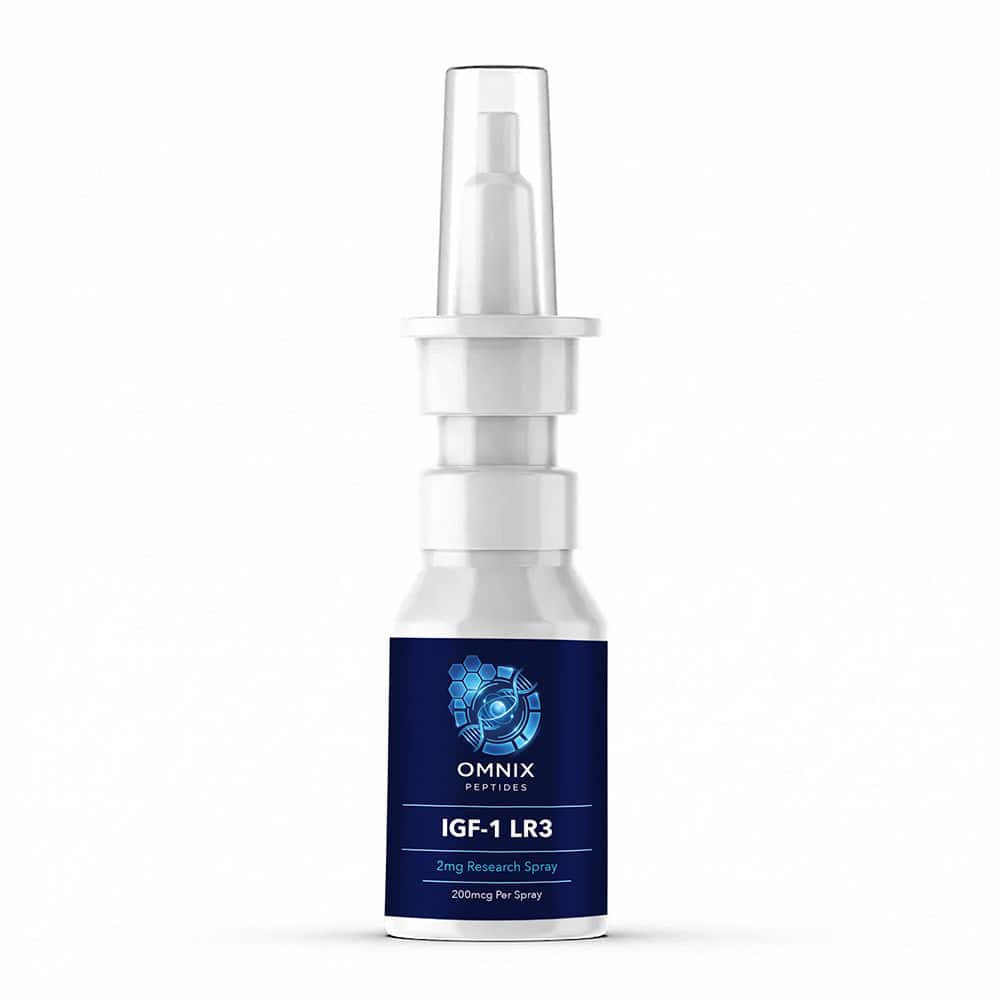
IGF-1 LR3 Liquid Spray 2mg
Mucosal-delivery research format of the long-acting IGF-1 analog. Supports laboratory protocols investigating non-injectable peptide delivery routes for growth-factor research. HPLC-tested, third-party COA per batch.
$100.00
Research goals: Growth Hormone
Description
IGF-1 LR3 (also known as Long-R3-IGF-1 or LR3-IGF-1; CAS 946870-92-4) is an 83-amino-acid synthetic analog of native human insulin-like growth factor 1 (IGF-1). The molecule retains the complete 70-amino-acid native IGF-1 sequence with two structural modifications — a 13-amino-acid N-terminal extension (the “Long” designation) and an arginine-for-glutamic-acid substitution at position 3 (the “R3” designation) — which together reduce binding affinity to circulating IGF binding proteins (IGFBPs) by approximately 600-fold while preserving full agonist activity at the IGF-1 receptor. The pharmacology of the native IGF-1 system has been characterized in peer-reviewed studies published in the New England Journal of Medicine, Endocrine Reviews, and other top journals, and the IGF-1 LR3 analog has been characterized in the American Journal of Physiology — Endocrinology and Metabolism and Drug Testing and Analysis.
The structural modifications extend plasma half-life from approximately 10–20 minutes for native IGF-1 to approximately 20–30 hours for IGF-1 LR3, producing a substantially different pharmacokinetic profile than the native molecule despite identical receptor pharmacology [1].
Important Note on the Evidence Base
Important note on the evidence base: The clinical evidence on the IGF-1 axis derives largely from trials of recombinant human IGF-1 (rhIGF-1, sold as mecasermin / Increlex®), which is FDA-approved for severe primary IGF-1 deficiency in pediatric patients. IGF-1 LR3 itself has not been clinically developed in humans; the published research on the LR3 analog specifically is primarily in (a) mechanistic and pharmacokinetic studies in animals and isolated tissues, (b) cell culture applications (it is widely used as a serum-free supplement for stem cell and cell-line maintenance), and (c) analytical/anti-doping methodology (LR3 is on the World Anti-Doping Agency prohibited list). The studies summarized below reflect this evidence-base structure.
Published Research on IGF-1 LR3 and the IGF-1 Axis
The following peer-reviewed studies are summarized below. Full citations and direct links to each publication appear in the References section.
Pharmacokinetics in Calves — Hammon & Blum, American Journal of Physiology — Endocrinology and Metabolism (1997)
Hammon and Blum at the University of Bern evaluated the somatotropic axis effects of subcutaneous and oral Long-R3-IGF-I administration in neonatal calves during the first week of life. The study compared subcutaneous and oral routes (50 µg·kg-1·day-1 for 7 days) against recombinant bovine GH and dietary intervention, measuring plasma IGF-I, IGF-II, IGF-binding proteins, and GH.
The investigators reported that plasma Long-R3-IGF-I increased significantly after subcutaneous administration but not after oral administration; native IGF-I was lowered by subcutaneous LR3 administration through negative feedback on the somatotropic axis; and parenteral LR3 decreased GH concentration without affecting the secretory pattern [1]. The study established the bioavailability and feedback profile of LR3-IGF-I after subcutaneous administration in a mammalian system.
Read the full study: The Somatotropic Axis in Neonatal Calves Can Be Modulated by Nutrition, Growth Hormone, and Long-R3-IGF-I (AJP-Endo 1997).
Native rhIGF-1 in IGF-1 Deficiency — Chernausek et al., Journal of Clinical Endocrinology & Metabolism (2007)
Chernausek and colleagues conducted the pivotal long-term clinical trial of recombinant human IGF-1 (mecasermin) in pediatric patients with severe primary IGF-1 deficiency — the trial that supported FDA approval of Increlex® for this rare growth-failure population. The trial enrolled 76 children with severe IGFD and followed them for up to 8 years on twice-daily subcutaneous mecasermin administration, with growth velocity, height standard-deviation score, and adverse events as primary endpoints.
The investigators reported sustained increases in growth velocity over 8 years of mecasermin treatment, with a favorable safety profile in this pediatric population [2]. The trial established the IGF-1 axis as a clinical therapeutic target and supports the broader pharmacological rationale for IGF-1 receptor agonism, of which IGF-1 LR3 is one analog with extended pharmacokinetic properties.
Read the full study: Long-Term Treatment with Recombinant Insulin-Like Growth Factor (IGF)-I in Children with Severe IGF-I Deficiency Due to Growth Hormone Insensitivity (JCEM 2007).
Detection in Doping Analysis — Mongongu et al., Drug Testing and Analysis (2021)
Mongongu and colleagues at the French Anti-Doping Laboratory developed and validated a sensitive analytical method for detecting Long-R3-IGF-I, Des(1–3)-IGF-I, and R3-IGF-I in human serum using immunopurification followed by nano-liquid chromatography coupled with high-resolution mass spectrometry. The investigators characterized analytical performance (linearity, detection limits, precision, specificity) and evaluated detection windows in rats following single intramuscular administration of each analog.
The authors reported that Long-R3-IGF-I disappeared rapidly from circulation after 4 hours following intramuscular administration in rats, while the related analogs Des(1–3)-IGF-I and R3-IGF-I remained detectable for up to 24 hours [3]. The investigators also identified oxidized forms in confiscated black-market products, indicating quality concerns in the gray-market supply. The study is the foundation for current anti-doping detection of IGF-1 analogs.
Read the full study: Detection of LongR3-IGF-I, Des(1-3)-IGF-I, and R3-IGF-I Using Immunopurification and High Resolution Mass Spectrometry for Antidoping Purposes (Drug Test Anal 2021).
Cell Culture Applications — Cell Sciences Technical Literature
The widespread use of Long-R3-IGF-I as a recombinant cell-culture supplement is documented in technical and methods literature published by manufacturers and end users in pharmaceutical bioprocessing, stem-cell maintenance, and other in vitro applications. The 200-fold-greater potency of LR3 versus insulin in cell-culture systems — coupled with the molecule’s resistance to enzymatic degradation in serum-free media — underlies its adoption as a substitute for native IGF-1 in animal-component-free cell-culture protocols.
The IGF-1 LR3 cell-culture application literature documents the molecule’s bioactivity at sub-nanomolar concentrations in human pluripotent stem-cell maintenance, hybridoma cell lines, CHO cell expression systems, and primary mammalian cell isolations [4]. These applications are the predominant published use case for LR3 specifically.
Industrial and methods literature, including Cell Sciences technical documentation on LONG R3 IGF-I.
About the Compound
Native human IGF-1 is a 70-amino-acid single-chain protein with three intramolecular disulfide bonds, structurally homologous to proinsulin and produced primarily in the liver in response to growth hormone stimulation. It mediates most of the systemic effects of growth hormone through agonism at the IGF-1 receptor (IGF-1R), a transmembrane tyrosine-kinase receptor expressed on most tissues. In circulation, the bioavailability of native IGF-1 is tightly regulated by a family of six IGF binding proteins (IGFBP-1 through IGFBP-6), which sequester ~99% of plasma IGF-1 and limit its receptor-accessible fraction.
IGF-1 LR3 was developed in the late 1980s and early 1990s as an analog with reduced IGFBP binding for cell-culture and research applications. The 13-amino-acid N-terminal extension (sequence MFPAMPLLSLFVN) shifts the three-dimensional conformation of the binding interface, while the Arg3→Glu3 substitution disrupts a key contact residue with IGFBPs. The result is a molecule with 600-fold reduced IGFBP affinity and approximately 3-fold greater potency at the IGF-1 receptor in cell-culture assays. The same modifications produce the extended plasma half-life (~20–30 h) that distinguishes LR3 from native IGF-1 (~10–20 min) in animal studies.
- CAS Number: 946870-92-4 (also reported as 143045-27-6 for the related sequence)
- Molecular Formula: C400H625N111O115S9
- Molecular Weight: ~9,111 Da (83 amino acids)
- Synonyms: Long-R3-IGF-1, Long Arg3-IGF-I, LR3-IGF-1, LONG®R3 IGF-I
- Receptor target (in research literature): IGF-1 receptor (IGF-1R)
- Plasma half-life (LR3): Approximately 20–30 hours (vs. 10–20 minutes for native IGF-1)
- Regulatory status (as of publication): Not approved by any regulatory authority. Native rhIGF-1 (mecasermin / Increlex®) is FDA-approved for severe primary IGF-1 deficiency. IGF-1 analogs including LR3 are on the WADA prohibited list for athletic competition.
Product Specifications
Omnix Peptides supplies IGF-1 LR3 as a pre-mixed liquid intranasal spray in a sealed metered nasal spray bottle intended exclusively for in vitro laboratory research. Each production lot is independently characterized using high-performance liquid chromatography (HPLC) and liquid chromatography–mass spectrometry (LC–MS) protocols.
- Format: Liquid intranasal spray
- Strength: 2 mg of peptide per 30 mL bottle
- Verified Purity: >99% (HPLC, LC–MS)
- Container: Sealed metered nasal spray bottle
- Documentation: Batch-specific Certificate of Analysis (COA) available
Storage, handling, intended-use, and regulatory information are provided in the corresponding tabs on this product page.
References
- Hammon HM, Blum JW. The somatotropic axis in neonatal calves can be modulated by nutrition, growth hormone, and Long-R3-IGF-I. Am J Physiol. 1997;273(1 Pt 1):E130-E138. doi:10.1152/ajpendo.1997.273.1.E130
- Chernausek SD, Backeljauw PF, Frane J, Kuntze J, Underwood LE; GH Insensitivity Syndrome Collaborative Group. Long-term treatment with recombinant insulin-like growth factor (IGF)-I in children with severe IGF-I deficiency due to growth hormone insensitivity. J Clin Endocrinol Metab. 2007;92(3):902-910. doi:10.1210/jc.2006-1610
- Mongongu C, Coudoré F, Domergue V, Ericsson M, Buisson C, Marchand A. Detection of LongR3-IGF-I, Des(1-3)-IGF-I, and R3-IGF-I using immunopurification and high resolution mass spectrometry for antidoping purposes. Drug Test Anal. 2021;13(7):1256-1269. doi:10.1002/dta.3016
- Cell Sciences. Quantitation of LONG®R3 IGF-I During Production and Cell Culture Application: Technical Whitepaper. View whitepaper.
Preparation and storage
Research-only handling information. IGF-1 LR3 is sold strictly for in vitro laboratory research. The handling and storage guidance below reflects standard practice in published peptide research literature. IGF-1 LR3 is not a drug, supplement, or food product, and is not for human consumption, veterinary use, or medical applications.
Format
- Form: Liquid Spray
- Available strengths: 30ml
- Verified purity: >99% (HPLC, LC–MS)
- Documentation: Batch-specific Certificate of Analysis (COA) included
Handling for Research Use
IGF-1 LR3 Liquid Spray ships pre-formulated in solution. No reconstitution is required. The spray bottle delivers a metered volume per actuation; refer to the certificate of analysis (COA) for batch-specific peptide concentration.
Storage & Handling
- Upon receipt: Refrigerate immediately at 4 °C (39 °F).
- Short-term storage: Refrigeration at 4 °C (39 °F) is the standard for sprays in active research use.
- Long-term storage: Liquid sprays should not be frozen; freezing can damage the bottle and disrupt the solution.
- Light exposure: Store in original packaging away from direct light.
- Before each use: Gently invert the bottle to redistribute the solution. Do not shake.
Important Notice
All Omnix Peptides products are sold for laboratory, research, or analytical purposes only. They are not for human consumption, veterinary use, or medical applications. Researchers and laboratory professionals must follow all applicable institutional, local, state, and federal regulations governing the handling of research compounds.
Citations
Citations and reference data. Omnix Peptides supplies research-grade compounds for use by qualified laboratory professionals. The references below cite published preclinical research conducted in animal models and in vitro systems. They are not intended to represent clinical evidence in humans, and IGF-1 LR3 has not been approved by the FDA, EMA, or any other regulatory authority for any indication.
Compound Reference Data
- Compound: IGF-1 LR3
- CAS Number: 946870-92-4 (also reported as 143045-27-6 for the related sequence)
- Molecular Formula: C400H625N111O115S9
- Molecular Weight: ~9,111 Da (83 amino acids)
- Sequence: —
- Synonyms: Long-R3-IGF-1, Long Arg3-IGF-I, LR3-IGF-1, LONG®R3 IGF-I
Selected Published Studies
The following peer-reviewed studies were conducted using animal models or in vitro cell-culture systems. They are listed here as a reference for researchers investigating IGF-1 LR3. None of these studies should be interpreted as recommending IGF-1 LR3 for human use, treatment, or any clinical purpose.
- Hammon HM, Blum JW. The somatotropic axis in neonatal calves can be modulated by nutrition, growth hormone, and Long-R3-IGF-I. Am J Physiol. 1997;273(1 Pt 1):E130-E138. doi:10.1152/ajpendo.1997.273.1.E130
- Chernausek SD, Backeljauw PF, Frane J, Kuntze J, Underwood LE; GH Insensitivity Syndrome Collaborative Group. Long-term treatment with recombinant insulin-like growth factor (IGF)-I in children with severe IGF-I deficiency due to growth hormone insensitivity. J Clin Endocrinol Metab. 2007;92(3):902-910. doi:10.1210/jc.2006-1610
- Mongongu C, Coudoré F, Domergue V, Ericsson M, Buisson C, Marchand A. Detection of LongR3-IGF-I, Des(1-3)-IGF-I, and R3-IGF-I using immunopurification and high resolution mass spectrometry for antidoping purposes. Drug Test Anal. 2021;13(7):1256-1269. doi:10.1002/dta.3016
- Cell Sciences. Quantitation of LONG®R3 IGF-I During Production and Cell Culture Application: Technical Whitepaper. View whitepaper.
Evidence-Base Disclosure
The published evidence base for IGF-1 LR3 consists predominantly of preclinical research — animal models (often rats or mice) and in vitro cell-culture experiments. Where Phase I or Phase II human trials exist, they are noted in the compound page summary. Researchers should interpret the cited literature within the experimental context of each individual study.
Frequently asked questions
Frequently asked questions about the IGF-1 LR3 Liquid Spray. Questions on this page cover handling, storage, documentation, and ordering. IGF-1 LR3 is sold for laboratory, research, or analytical purposes only — not for human consumption, veterinary use, or medical applications.
Why does Omnix offer IGF-1 LR3 in a liquid spray format?
The spray format ships pre-formulated, removing the reconstitution step required for lyophilized vials. The metered-spray bottle delivers a fixed volume per actuation. Spray format is used in research applications where a pre-mixed solution is preferred.
How should the IGF-1 LR3 spray be stored?
Refrigerate at 4 °C (39 °F) immediately upon receipt and during active use. Do not freeze — freezing can damage the bottle and disrupt the solution. Keep the bottle in its original packaging away from direct light.
What is the peptide concentration in the spray?
The total peptide content is listed on the product label. The per-actuation volume and concentration are listed on the batch-specific Certificate of Analysis (COA) that ships with each order.
Is IGF-1 LR3 approved by the FDA?
No. IGF-1 LR3 is not approved by the FDA, EMA, or any other regulatory authority for any indication. IGF-1 LR3 is sold by Omnix Peptides strictly for laboratory, research, or analytical purposes. It is not for human consumption, veterinary use, or medical applications.
What is included with each IGF-1 LR3 Liquid Spray?
Each order includes the sealed product container and a batch-specific Certificate of Analysis (COA) verifying identity and purity by HPLC and LC–MS. The full COA library for Omnix Peptides is available at /coa-lab-reports/.
What is a Certificate of Analysis (COA), and how do I read it?
A COA is a batch-specific lab report that documents the identity, purity, and quality control results for the production lot you receive. The COA lists the compound name, CAS number, lot number, analytical methods used (HPLC, LC–MS), and the measured purity percentage. Every Omnix order includes the COA for the lot shipped.
What is the CAS number for IGF-1 LR3?
The CAS number for IGF-1 LR3 is 946870-92-4 (also reported as 143045-27-6 for the related sequence). Researchers can use this identifier to locate published literature in PubMed and other scientific databases.
How does Omnix Peptides ship orders?
Orders ship from a US-based facility with tracked domestic shipping. Free shipping is offered on orders over $99. Lyophilized vials and capsules ship at ambient temperature; sprays ship insulated when seasonal conditions require it. Tracking information is provided by email after the order ships.
What if my product arrives damaged or the seal is broken?
Contact Omnix Peptides within 48 hours of delivery. Product damaged in transit or arriving with a compromised seal will be replaced at no cost. See the Shipping & Return Policy at /shipping-return-policy/ for full terms.
Where can I find published research on IGF-1 LR3?
Peer-reviewed studies relevant to IGF-1 LR3 are listed in the Citations tab on this product page. The same studies can be located independently on PubMed using the CAS number (946870-92-4 (also reported as 143045-27-6 for the related sequence)) or the compound name.
Customer reviews
Certificate of Analysis
Certificate of Analysis (COA) for this batch is available on request. Email orders@omnixpeptides.com with your order number to receive a copy. COAs include HPLC purity analysis performed by an independent third-party laboratory.
Reviews
There are no reviews yet.