
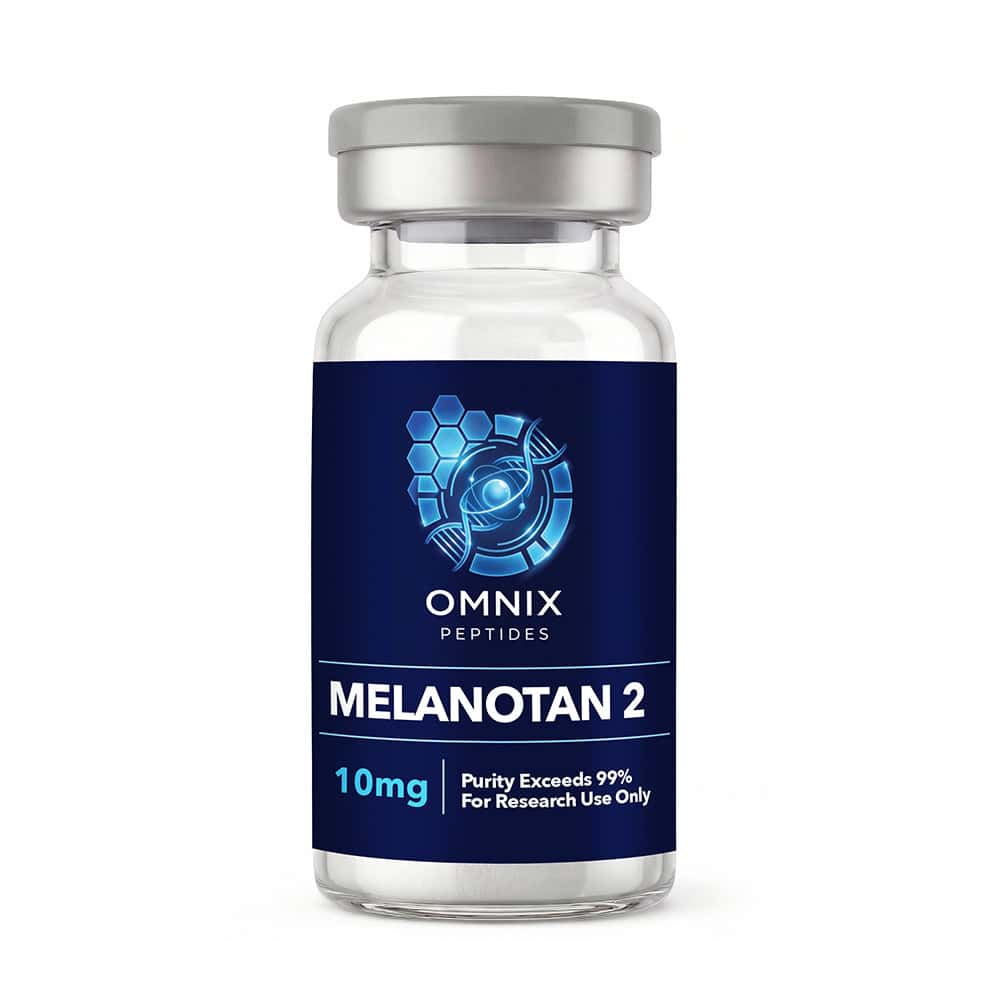
Melanotan II MT2 Vial
Melanotan II (also known as MT-II or MT2; CAS 121062-08-6) is a synthetic cyclic heptapeptide analog of the endogenous hormone -melanocyte-stimulating hormone ( -MSH).
Research goals: Sexual Health, Skin & Hair
Description
Melanotan II (also known as MT-II or MT2; CAS 121062-08-6) is a synthetic cyclic heptapeptide analog of the endogenous hormone α-melanocyte-stimulating hormone (α-MSH). The molecule was originally synthesized at the University of Arizona in the 1980s as a non-selective agonist at the melanocortin receptors (MC1R, MC3R, MC4R, MC5R), with the aim of producing a more potent and metabolically stable analog of native α-MSH for the study of melanogenesis and skin pigmentation. Melanotan II has been the subject of peer-reviewed early-phase clinical and pharmacology research, with results published in Life Sciences, the International Journal of Impotence Research, and the Archives of Dermatology.
In a Phase 1 pilot trial published in Life Sciences in 1996, Dorr and colleagues at the University of Arizona reported that subcutaneous administration of melanotan-II in healthy adult volunteers produced quantifiable increases in skin pigmentation in the face, upper body, and buttock as measured by reflectance photometry, demonstrating tanning activity in humans following only five low-amount subcutaneous injections [1].
Important Note on the Evidence Base
Important note on the evidence base and regulatory status: Melanotan II is not approved by the FDA, EMA, or any other regulatory authority for any indication. The peer-reviewed clinical literature consists primarily of small early-phase pharmacology trials conducted in the 1990s and early 2000s, alongside more recent qualitative research and case reports. Regulatory and public-health agencies in the United States, the United Kingdom, and several European countries have issued safety warnings about melanotan II, citing reported adverse events including nausea, facial flushing, fatigue, changes in pre-existing nevi (moles), and isolated case reports of more serious events such as rhabdomyolysis. The FDA-approved metabolite/derivative bremelanotide (PT-141) and the FDA-approved related compound afamelanotide (Scenesse®) were developed specifically because their pharmacological profiles differ from melanotan II’s. The studies summarized below are presented for completeness; the regulatory and safety context is integral to interpreting them.
Published Research on Melanotan II
The following peer-reviewed studies are summarized below. Full citations and direct links to each publication appear in the References section. All human studies described in this section were conducted in adult human participants.
Phase 1 Pilot Trial — Dorr et al., Life Sciences (1996)
Dorr and colleagues at the University of Arizona Cancer Center conducted a Phase 1 pilot study evaluating the safety, tolerability, and pharmacodynamic effects of subcutaneous melanotan-II in healthy male volunteers. Subjects received subcutaneous injections of MT-II or saline every other day (Monday/Wednesday/Friday) over a two-week period, with escalating-amount in increments of 0.005 mg/kg up to a maximum of 0.025–0.030 mg/kg. Skin pigmentation was assessed by quantitative reflectance photometry and visual inspection at multiple body sites.
The investigators reported that MT-II has tanning activity in humans
at the amounts studied [1]. Two subjects developed measurable increases in pigmentation in the face, upper body, and buttock that persisted for at least one week after administration ended. Adverse events at higher amounts included Grade II somnolence and fatigue and mild nausea; spontaneous penile erections preceded by a stretching/yawning complex were observed for one to five hours following higher MT-II amounts.
Read the full study: Evaluation of Melanotan-II, a Superpotent Cyclic Melanotropic Peptide, in a Pilot Phase-1 Clinical Study (Life Sciences 1996).
Sexual Function in Men — Wessells et al., International Journal of Impotence Research (2000)
Wessells and colleagues at the University of Arizona evaluated the effects of melanotan II on penile erection and sexual motivation in men with psychogenic and organic erectile dysfunction. The study used double-blind, placebo-controlled crossover design with subcutaneous administration of MT-II or saline placebo, with erectile response assessed by RigiScan tumescence monitoring and self-reported sexual interest measured by validated questionnaires.
The investigators reported that subcutaneous MT-II produced clinically significant improvements in erectile response and self-reported sexual desire compared with placebo in men with both psychogenic and organic erectile dysfunction [2]. The findings established the central nervous system melanocortin pathway as a target for sexual-function pharmacotherapy and provided the conceptual foundation for the subsequent development of bremelanotide (PT-141), now FDA-approved for hypoactive sexual desire disorder in premenopausal women.
Read the full study: Melanocortin Receptor Agonists, Penile Erection, and Sexual Motivation: Human Studies with Melanotan II (Int J Impot Res 2000).
MT-II + UV Radiation — Dorr et al., Archives of Dermatology (2004)
Dorr and colleagues conducted a follow-up controlled trial evaluating the combination of subcutaneous melanotan-II administration with controlled solar-spectrum ultraviolet radiation exposure in adult volunteers. The trial measured changes in skin reflectance (a surrogate for melanin density) across multiple body sites, comparing MT-II + UV against UV alone.
The authors reported that combined MT-II and UV radiation produced significantly greater and more durable skin pigmentation than UV exposure alone [3]. The trial extended the 1996 pilot data by characterizing the interaction between exogenous melanocortin receptor stimulation and natural UV-induced melanogenesis.
Read the full study: Effects of a Superpotent Melanotropic Peptide in Combination with Solar UV Radiation on Tanning of the Skin in Human Volunteers (Arch Dermatol 2004).
Historical Pharmacology Review — Hadley & Dorr, Peptides (2006)
Hadley and Dorr conducted a comprehensive review of melanocortin peptide therapeutics, integrating the chemistry, pharmacology, and clinical-trial development of melanotan I (afamelanotide), melanotan II, and subsequent receptor-selective melanocortin analogs. The review traced the historical milestones from native α-MSH characterization through the design and synthesis of cyclic, metabolically stable analogs at the University of Arizona.
The authors detailed the structure-activity relationships underlying melanocortin-receptor selectivity and reviewed the early-phase clinical trial data on multiple melanocortin analogs [4]. The review remains a primary reference for the historical development of the melanocortin therapeutic class and the rationale for the receptor-selective analogs (such as bremelanotide) that subsequently advanced through clinical development.
Read the full review: Melanocortin Peptide Therapeutics: Historical Milestones, Clinical Studies and Commercialization (Peptides 2006).
About the Compound
Melanotan II is a synthetic cyclic heptapeptide with the structure Ac-Nle-cyclo[Asp-His-D-Phe-Arg-Trp-Lys]-NH2. The cyclic backbone is closed by a lactam bridge between the side-chain carboxyl of aspartate at position 5 and the side-chain amine of lysine at position 10, conferring resistance to enzymatic degradation and constraining the peptide into a bioactive conformation. The molecule was developed by Hruby and colleagues at the University of Arizona in the 1980s as a non-selective melanocortin receptor agonist, more potent and metabolically stable than native α-MSH.
Unlike its receptor-selective successor bremelanotide (PT-141, which is also a cyclic heptapeptide based on the same scaffold but with a C-terminal carboxyl rather than amide and which has preferential activity at MC4R), melanotan II is a non-selective agonist at all four melanocortin receptors expressed in human tissues: MC1R (skin melanocytes; mediates pigmentation), MC3R and MC4R (central nervous system; mediate sexual response, energy homeostasis, and other CNS effects), and MC5R (peripheral tissues; mediates exocrine secretion and other effects). The non-selective profile is the basis for the broad pharmacological effects observed in early-phase trials — tanning, sexual function effects, and the side-effect profile of nausea, flushing, fatigue, and changes in pre-existing nevi. The receptor-selective analog bremelanotide was developed specifically to retain the MC4R-mediated sexual-function effects while reducing the off-target activity of melanotan II.
- CAS Number: 121062-08-6
- Molecular Formula: C50H69N15O9
- Molecular Weight: 1024.18 g/mol
- Sequence: Ac-Nle-cyclo[Asp-His-D-Phe-Arg-Trp-Lys]-NH2
- Synonyms: MT-II, MT2, α-MSH analog
- Receptor targets (in research literature): Non-selective melanocortin receptor agonist (MC1R, MC3R, MC4R, MC5R)
- Regulatory status (as of publication): Not approved by any regulatory authority. Public-health warnings have been issued in the US, UK, and other jurisdictions.
Product Specifications
Omnix Peptides supplies Melanotan II as a sterile, lyophilized (freeze-dried) powder in a sealed glass vial intended exclusively for in vitro laboratory research. Each production lot is independently characterized using high-performance liquid chromatography (HPLC) and liquid chromatography–mass spectrometry (LC–MS) protocols.
- Format: Lyophilized powder
- Available strengths: 10 mg per vial
- Verified Purity: >99% (HPLC, LC–MS)
- Container: Sterile, sealed glass vial
- Documentation: Batch-specific Certificate of Analysis (COA) available
Storage, handling, intended-use, and regulatory information are provided in the corresponding tabs on this product page.
References
- Dorr RT, Lines R, Levine N, et al. Evaluation of melanotan-II, a superpotent cyclic melanotropic peptide in a pilot phase-I clinical study. Life Sci. 1996;58(20):1777-1784. doi:10.1016/0024-3205(96)00160-9
- Wessells H, Levine N, Hadley ME, Dorr R, Hruby V. Melanocortin receptor agonists, penile erection, and sexual motivation: human studies with melanotan II. Int J Impot Res. 2000;12(Suppl 4):S74-S79. doi:10.1038/sj.ijir.3900582
- Dorr RT, Ertl GA, Levine N, et al. Effects of a superpotent melanotropic peptide in combination with solar UV radiation on tanning of the skin in human volunteers. Arch Dermatol. 2004;140(7):827-835. doi:10.1001/archderm.140.7.827
- Hadley ME, Dorr RT. Melanocortin peptide therapeutics: historical milestones, clinical studies and commercialization. Peptides. 2006;27(4):921-930. doi:10.1016/j.peptides.2005.08.029
Preparation and storage
Research-only handling information. Melanotan II is sold strictly for in vitro laboratory research. The handling and storage guidance below reflects standard practice in published peptide research literature. Melanotan II is not a drug, supplement, or food product, and is not for human consumption, veterinary use, or medical applications.
Format
- Form: Vial
- Available strengths: 10mg
- Verified purity: >99% (HPLC, LC–MS)
- Documentation: Batch-specific Certificate of Analysis (COA) included
Reconstitution for Research Use
Melanotan II is supplied as a sterile, lyophilized powder. Reconstitution with bacteriostatic water (BAC water) is the standard preparation step used in published research protocols. The volume of BAC water used determines the final concentration of the reconstituted solution.
Example (for a 10mg vial reconstituted in 2 mL of BAC water):
- Total peptide: 10mg
- BAC water added: 2 mL
- Resulting concentration: ~5 mg/mL
Recommended practice:
- Use sterile bacteriostatic water (0.9% benzyl alcohol) for reconstitution; this preserves the solution for multi-week handling in laboratory settings.
- Allow the lyophilized powder to reach room temperature before opening the vial.
- Inject the BAC water against the inside wall of the vial — do not aim the stream directly at the lyophilized cake.
- Gently swirl the vial until the powder is fully dissolved. Do not shake.
- Once reconstituted, store the vial under refrigeration at 4 °C (39 °F).
Storage & Handling
- Upon receipt: Keep peptides cold and away from light.
- Lyophilized (unreconstituted): Stable at room temperature for several weeks; refrigeration at 4 °C (39 °F) is acceptable for short-term storage (days to weeks).
- Long-term storage (months to years): Freeze the lyophilized vial at −80 °C (−112 °F). Freezing optimally preserves peptide stability for extended periods.
- Reconstituted solution: Refrigerate at 4 °C (39 °F). Avoid freeze/thaw cycles, which can degrade peptide structure.
- Light exposure: Minimize exposure to direct light during handling; light can accelerate peptide degradation.
- Heat exposure: Do not leave the vial at room temperature longer than necessary for handling.
Important Notice
All Omnix Peptides products are sold for laboratory, research, or analytical purposes only. They are not for human consumption, veterinary use, or medical applications. Researchers and laboratory professionals must follow all applicable institutional, local, state, and federal regulations governing the handling of research compounds.
Citations
Citations and reference data. Omnix Peptides supplies research-grade compounds for use by qualified laboratory professionals. The references below cite published preclinical research conducted in animal models and in vitro systems. They are not intended to represent clinical evidence in humans, and Melanotan II has not been approved by the FDA, EMA, or any other regulatory authority for any indication.
Compound Reference Data
- Compound: Melanotan II
- CAS Number: 121062-08-6
- Molecular Formula: C50H69N15O9
- Molecular Weight: 1024.18 g/mol
- Sequence: Ac-Nle-cyclo[Asp-His-D-Phe-Arg-Trp-Lys]-NH2
- Synonyms: MT-II, MT2, α-MSH analog
Selected Published Studies
The following peer-reviewed studies were conducted using animal models or in vitro cell-culture systems. They are listed here as a reference for researchers investigating Melanotan II. None of these studies should be interpreted as recommending Melanotan II for human use, treatment, or any clinical purpose.
- Dorr RT, Lines R, Levine N, et al. Evaluation of melanotan-II, a superpotent cyclic melanotropic peptide in a pilot phase-I clinical study. Life Sci. 1996;58(20):1777-1784. doi:10.1016/0024-3205(96)00160-9
- Wessells H, Levine N, Hadley ME, Dorr R, Hruby V. Melanocortin receptor agonists, penile erection, and sexual motivation: human studies with melanotan II. Int J Impot Res. 2000;12(Suppl 4):S74-S79. doi:10.1038/sj.ijir.3900582
- Dorr RT, Ertl GA, Levine N, et al. Effects of a superpotent melanotropic peptide in combination with solar UV radiation on tanning of the skin in human volunteers. Arch Dermatol. 2004;140(7):827-835. doi:10.1001/archderm.140.7.827
- Hadley ME, Dorr RT. Melanocortin peptide therapeutics: historical milestones, clinical studies and commercialization. Peptides. 2006;27(4):921-930. doi:10.1016/j.peptides.2005.08.029
Evidence-Base Disclosure
The published evidence base for Melanotan II consists predominantly of preclinical research — animal models (often rats or mice) and in vitro cell-culture experiments. Where Phase I or Phase II human trials exist, they are noted in the compound page summary. Researchers should interpret the cited literature within the experimental context of each individual study.
Frequently asked questions
Frequently asked questions about the Melanotan II Vial. Questions on this page cover handling, storage, documentation, and ordering. Melanotan II is sold for laboratory, research, or analytical purposes only — not for human consumption, veterinary use, or medical applications.
How is the Melanotan II Vial prepared for laboratory research?
The Melanotan II Vial is supplied as a sterile, lyophilized (freeze-dried) powder. The standard preparation step described in published peptide research literature is reconstitution with bacteriostatic water (BAC water). The volume of BAC water used determines the final concentration of the solution. See the Amount & Handling tab for a worked reconstitution example.
Why is Melanotan II supplied as a lyophilized powder rather than a pre-mixed solution?
Lyophilization (freeze-drying) is the standard format for research-grade peptides because it maximizes long-term stability. A lyophilized vial stored cold and away from light remains stable for substantially longer than a pre-mixed solution. Reconstitution by the researcher also allows control over the final solution concentration.
Can the reconstituted Melanotan II solution be frozen?
Freeze/thaw cycles can degrade peptide structure and should generally be avoided. Reconstituted Melanotan II should be stored under refrigeration at 4 °C (39 °F) and used within the active research timeframe described in the Amount & Handling tab. For long-term storage, keep the vial lyophilized and freeze at −80 °C (−112 °F) until use.
Is Melanotan II approved by the FDA?
No. Melanotan II is not approved by the FDA, EMA, or any other regulatory authority for any indication. Melanotan II is sold by Omnix Peptides strictly for laboratory, research, or analytical purposes. It is not for human consumption, veterinary use, or medical applications.
What is included with each Melanotan II Vial?
Each order includes the sealed product container and a batch-specific Certificate of Analysis (COA) verifying identity and purity by HPLC and LC–MS. The full COA library for Omnix Peptides is available at /coa-lab-reports/.
What is a Certificate of Analysis (COA), and how do I read it?
A COA is a batch-specific lab report that documents the identity, purity, and quality control results for the production lot you receive. The COA lists the compound name, CAS number, lot number, analytical methods used (HPLC, LC–MS), and the measured purity percentage. Every Omnix order includes the COA for the lot shipped.
What is the CAS number for Melanotan II?
The CAS number for Melanotan II is 121062-08-6. Researchers can use this identifier to locate published literature in PubMed and other scientific databases.
How does Omnix Peptides ship orders?
Orders ship from a US-based facility with tracked domestic shipping. Free shipping is offered on orders over $99. Lyophilized vials and capsules ship at ambient temperature; sprays ship insulated when seasonal conditions require it. Tracking information is provided by email after the order ships.
What if my product arrives damaged or the seal is broken?
Contact Omnix Peptides within 48 hours of delivery. Product damaged in transit or arriving with a compromised seal will be replaced at no cost. See the Shipping & Return Policy at /shipping-return-policy/ for full terms.
Where can I find published research on Melanotan II?
Peer-reviewed studies relevant to Melanotan II are listed in the Citations tab on this product page. The same studies can be located independently on PubMed using the CAS number (121062-08-6) or the compound name.
Customer reviews
Certificate of Analysis
Certificate of Analysis (COA) for this batch is available on request. Email orders@omnixpeptides.com with your order number to receive a copy. COAs include HPLC purity analysis performed by an independent third-party laboratory.
Reviews
There are no reviews yet.