
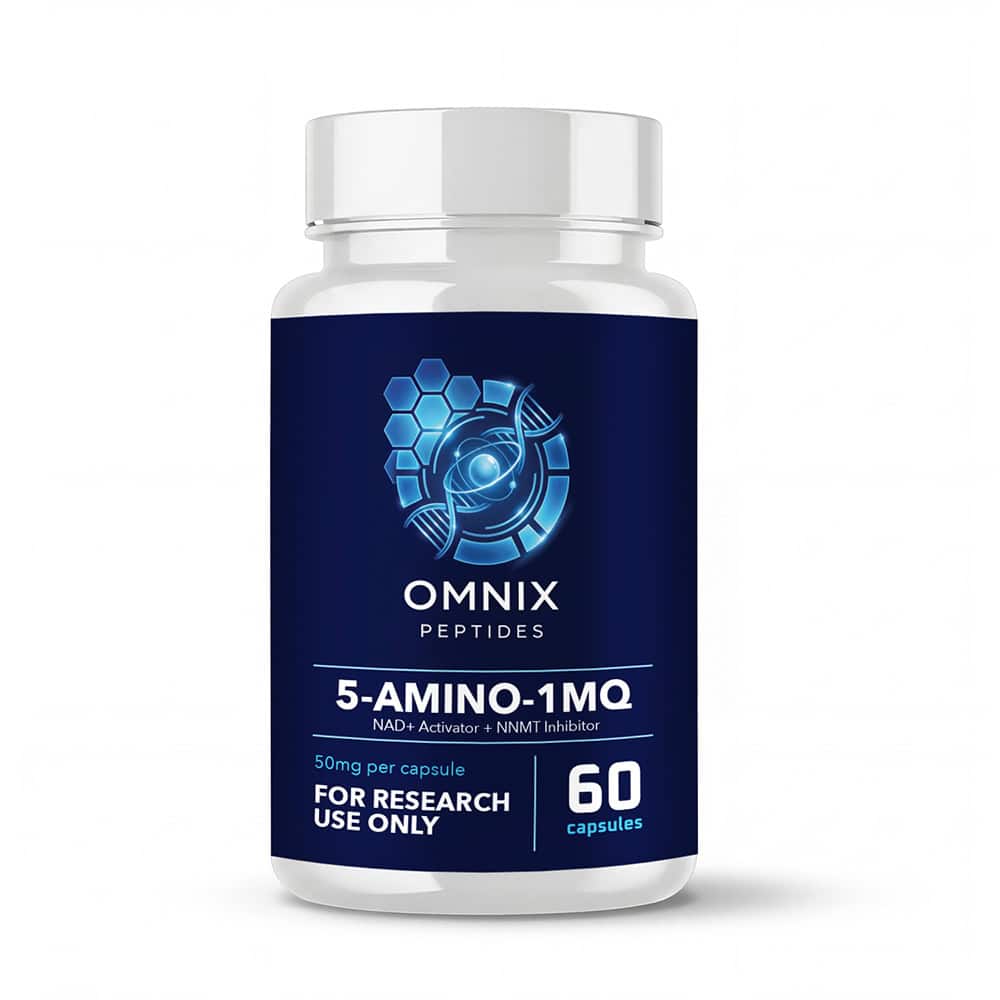
5-AMINO-1MQ Capsules 50mg
Oral research format of the small-molecule NNMT inhibitor. Capsules support chronic-dosing metabolic study designs where oral bioavailability and daily-dosing schedules are research variables. HPLC-tested, third-party COA per batch.
$190.00
Research goals: Longevity & Anti-Aging, Metabolic & Weight
Description
5-Amino-1MQ (5-amino-1-methylquinolinium iodide) is a small-molecule, membrane-permeable inhibitor of nicotinamide N-methyltransferase (NNMT), the enzyme that converts nicotinamide and S-adenosyl-l-methionine (SAM) into 1-methylnicotinamide and S-adenosyl-l-homocysteine. NNMT is upregulated in the white adipose tissue of obese animals and humans, and its activity is mechanistically linked to depleted cellular NAD+ and SAM pools. 5-Amino-1MQ was developed as a research tool to selectively block NNMT in vitro and in vivo, primarily by the Watowich group at the University of Texas at Austin.
The strongest published finding is from the foundational Biochemical Pharmacology study by Neelakantan et al.: in diet-induced obese mice, daily 5-Amino-1MQ administration produced reductions in body weight, white adipose tissue mass, and adipocyte size without any significant change in food intake.1
Important Note on the Evidence Base
The published evidence base for 5-Amino-1MQ is preclinical. All controlled studies referenced below were conducted in cell culture (3T3-L1 adipocytes, primary muscle stem cells) or rodent models (diet-induced obese mice, aged C57BL/6J mice). No human clinical trials of 5-Amino-1MQ in obesity, sarcopenia, or any other indication have been published in peer-reviewed journals. The peer-reviewed literature is also concentrated within a single research group (Watowich lab, University of Texas at Austin) and its industry partner Ridgeline Therapeutics, with limited independent replication to date. Animal-to-human amount translation is not straightforward and requires allometric scaling, and human pharmacokinetics, safety, and efficacy remain uncharacterized in published literature. This product is for laboratory research only.
Published Research on 5-Amino-1MQ
Foundational DIO Mouse Study — Neelakantan et al., Biochemical Pharmacology (2018)
This paper introduced 5-Amino-1MQ as a selective and membrane-permeable small molecule
inhibitor of NNMT and tested it in 3T3-L1 adipocytes and in male C57BL/6J mice maintained on a high-fat diet. Daily intraperitoneal administration for 11 days reduced body weight gain, decreased white adipose tissue mass by approximately 35%, and reduced adipocyte size, while food intake between treated and control groups did not differ significantly. The compound showed an in vitro NNMT IC50 of approximately 1.2 μM and did not inhibit related methyltransferases at concentrations tested.1
Aged Muscle Stem Cell Rejuvenation — Neelakantan et al., Biochemical Pharmacology (2019)
In a follow-up study, the authors tested whether NNMT inhibition could reverse the age-related decline in muscle stem cell (satellite cell) function. NNMT was confirmed to be upregulated in aged versus young mouse skeletal muscle. In 24-month-old mice subjected to muscle injury, 5-Amino-1MQ treatment increased satellite cell proliferation and myofiber cross-sectional area approximately 2-fold compared with vehicle controls. The authors framed the data as first clear evidence that NNMT inhibitors constitute a viable pharmacological approach
to enhance regenerative capacity in aged skeletal muscle.2
Grip Strength and Exercise Endurance in Aged Mice — Dimet-Wiley et al., Scientific Reports (2024)
This study compared 5-Amino-1MQ treatment, voluntary wheel-running exercise (PoWeR), and combined treatment in aged C57BL/6J mice. 5-Amino-1MQ alone improved grip strength to a greater degree than rigorous exercise training alone, and combined treatment produced sustained increases in daily running distance that did not taper off in the way exercise-alone groups did, suggesting reduced post-exercise muscle recovery requirement. The authors interpreted the data as supporting NNMT inhibition as a candidate exercise-mimetic.3
Extended Administration Pharmacokinetics in DIO Mice — Neelakantan et al., Biochemical Pharmacology (2024)
This study reported a 28-day once-daily administration protocol of 5-Amino-1MQ in diet-induced obese mice, characterizing plasma pharmacokinetics, tissue distribution, and effects on body composition, fatty liver pathology, and circulating biomarkers. Extended treatment continued to limit body weight gain and white adipose tissue mass, lowered total plasma cholesterol, and showed measurable accumulation in adipose tissue consistent with the compound’s lipophilic profile. The work supports the chronic-administration tolerability of 5-Amino-1MQ in mouse models of obesity-linked type 2 diabetes.4
About the Compound
5-Amino-1MQ is a quinolinium salt — a small, water-soluble, membrane-permeable molecule (not a peptide). Its mechanism is competitive inhibition within the NNMT catalytic pocket, blocking the methyl transfer from SAM to nicotinamide. Two downstream consequences are mechanistically central: nicotinamide is preserved for re-entry into the NAD+ salvage pathway (raising intracellular NAD+ availability), and SAM is preserved for other methylation reactions. The combination has been associated with elevated sirtuin activity, altered adipocyte differentiation markers, and changes in muscle stem cell quiescence and proliferation in the cited preclinical literature.
- Compound class: small-molecule NNMT inhibitor; quinolinium salt (non-peptide)
- Synonyms: 5A1MQ, 5-amino-1-methylquinolinium iodide
- CAS Number: 13441-78-4
- Molecular Formula: C10H11IN2
- Molecular Weight: 286.11 g/mol
- Solubility: water-soluble; dissolves readily in PBS and culture media
- Primary research origin: Watowich group, University of Texas at Austin
- Mechanism: competitive NNMT inhibition; preserves NAD+ salvage and SAM availability
- Regulatory status: not approved by the FDA or any other regulatory authority; research compound only
Product Specifications
- Format: capsules
- Strength: 50 mg per capsule
- Count: 60 capsules per bottle
- Purity: ≥99% (HPLC verified)
- Container: sealed amber bottle
- Certificate of Analysis: lot-specific COA available
See the FDA Disclosure, Storage Instructions, and RUO tabs for handling, storage, and regulatory information.
References
- Neelakantan H, Vance V, Wetzel MD, et al. Selective and membrane-permeable small molecule inhibitors of nicotinamide N-methyltransferase reverse high fat diet-induced obesity in mice. Biochem Pharmacol. 2018;154:161-171. doi:10.1016/j.bcp.2018.05.003
- Neelakantan H, Brightwell CR, Graber TG, et al. Small molecule nicotinamide N-methyltransferase inhibitor activates senescent muscle stem cells and improves regenerative capacity of aged skeletal muscle. Biochem Pharmacol. 2019;163:481-492. doi:10.1016/j.bcp.2019.02.008
- Dimet-Wiley A, Latham CM, Brightwell CR, et al. NNMT inhibition combined with exercise enhances skeletal muscle endurance and grip strength in aged mice. Sci Rep. 2024;14:14305. doi:10.1038/s41598-024-65310-y
- Neelakantan H, Hommel JD, Watowich SJ, et al. Nicotinamide N-methyltransferase inhibition mitigates obesity-related metabolic dysfunctions in diet-induced obese mice. Biochem Pharmacol. 2024;229:116476. doi:10.1016/j.bcp.2024.116476
Preparation and storage
Research-only handling information. 5-Amino-1MQ is sold strictly for in vitro laboratory research. The handling and storage guidance below reflects standard practice in published peptide research literature. 5-Amino-1MQ is not a drug, supplement, or food product, and is not for human consumption, veterinary use, or medical applications.
Format
- Form: Capsules
- Available strengths: 60ct
- Verified purity: >99% (HPLC, LC–MS)
- Documentation: Batch-specific Certificate of Analysis (COA) included
Handling for Research Use
5-Amino-1MQ capsules ship as a pre-encapsulated, dry oral-research format. No reconstitution is required. The capsules can be opened for analytical or assay work that requires the dry powder.
Storage & Handling
- Upon receipt: Store in a cool, dry place away from direct light.
- Short-term storage: Room temperature in a sealed container is acceptable for several months.
- Long-term storage: Refrigeration at 4 °C (39 °F) extends shelf stability. Capsules do not require freezing.
- Humidity: Keep the original desiccant-sealed container closed when not in use. Excess moisture can compromise capsule integrity.
- Light exposure: Minimize exposure to direct light during handling.
Important Notice
All Omnix Peptides products are sold for laboratory, research, or analytical purposes only. They are not for human consumption, veterinary use, or medical applications. Researchers and laboratory professionals must follow all applicable institutional, local, state, and federal regulations governing the handling of research compounds.
Citations
Citations and reference data. Omnix Peptides supplies research-grade compounds for use by qualified laboratory professionals. The references below cite published preclinical research conducted in animal models and in vitro systems. They are not intended to represent clinical evidence in humans, and 5-Amino-1MQ has not been approved by the FDA, EMA, or any other regulatory authority for any indication.
Compound Reference Data
- Compound: 5-Amino-1MQ
- CAS Number: 13441-78-4
- Molecular Formula: C10H11IN2
- Molecular Weight: 286.11 g/mol
- Sequence: —
- Synonyms: —
Selected Published Studies
The following peer-reviewed studies were conducted using animal models or in vitro cell-culture systems. They are listed here as a reference for researchers investigating 5-Amino-1MQ. None of these studies should be interpreted as recommending 5-Amino-1MQ for human use, treatment, or any clinical purpose.
- Neelakantan H, Vance V, Wetzel MD, et al. Selective and membrane-permeable small molecule inhibitors of nicotinamide N-methyltransferase reverse high fat diet-induced obesity in mice. Biochem Pharmacol. 2018;154:161-171. doi:10.1016/j.bcp.2018.05.003
- Neelakantan H, Brightwell CR, Graber TG, et al. Small molecule nicotinamide N-methyltransferase inhibitor activates senescent muscle stem cells and improves regenerative capacity of aged skeletal muscle. Biochem Pharmacol. 2019;163:481-492. doi:10.1016/j.bcp.2019.02.008
- Dimet-Wiley A, Latham CM, Brightwell CR, et al. NNMT inhibition combined with exercise enhances skeletal muscle endurance and grip strength in aged mice. Sci Rep. 2024;14:14305. doi:10.1038/s41598-024-65310-y
- Neelakantan H, Hommel JD, Watowich SJ, et al. Nicotinamide N-methyltransferase inhibition mitigates obesity-related metabolic dysfunctions in diet-induced obese mice. Biochem Pharmacol. 2024;229:116476. doi:10.1016/j.bcp.2024.116476
Evidence-Base Disclosure
The published evidence base for 5-Amino-1MQ consists predominantly of preclinical research — animal models (often rats or mice) and in vitro cell-culture experiments. Where Phase I or Phase II human trials exist, they are noted in the compound page summary. Researchers should interpret the cited literature within the experimental context of each individual study.
Frequently asked questions
Frequently asked questions about the 5-Amino-1MQ Capsules. Questions on this page cover handling, storage, documentation, and ordering. 5-Amino-1MQ is sold for laboratory, research, or analytical purposes only — not for human consumption, veterinary use, or medical applications.
Why does Omnix offer 5-Amino-1MQ in a capsule format?
Capsule format is used in oral-research and analytical contexts where dry, pre-measured administration is preferred over a reconstituted solution. The capsules contain the same research-grade compound supplied in the vial format and are tested to the same purity specification.
Do the 5-Amino-1MQ capsules require refrigeration?
Capsules are stable at room temperature for several months when kept in a cool, dry place away from direct light. Refrigeration at 4 °C (39 °F) extends shelf stability and is recommended for long-term storage. Capsules do not require freezing.
Can the capsules be opened to access the dry powder?
Yes. The capsule shell can be opened for analytical or assay work that requires direct handling of the dry powder. Once opened, the powder should be used immediately or transferred to a sealed, light-protected container.
Is 5-Amino-1MQ approved by the FDA?
No. 5-Amino-1MQ is not approved by the FDA, EMA, or any other regulatory authority for any indication. 5-Amino-1MQ is sold by Omnix Peptides strictly for laboratory, research, or analytical purposes. It is not for human consumption, veterinary use, or medical applications.
What is included with each 5-Amino-1MQ Capsules?
Each order includes the sealed product container and a batch-specific Certificate of Analysis (COA) verifying identity and purity by HPLC and LC–MS. The full COA library for Omnix Peptides is available at /coa-lab-reports/.
What is a Certificate of Analysis (COA), and how do I read it?
A COA is a batch-specific lab report that documents the identity, purity, and quality control results for the production lot you receive. The COA lists the compound name, CAS number, lot number, analytical methods used (HPLC, LC–MS), and the measured purity percentage. Every Omnix order includes the COA for the lot shipped.
What is the CAS number for 5-Amino-1MQ?
The CAS number for 5-Amino-1MQ is 13441-78-4. Researchers can use this identifier to locate published literature in PubMed and other scientific databases.
How does Omnix Peptides ship orders?
Orders ship from a US-based facility with tracked domestic shipping. Free shipping is offered on orders over $99. Lyophilized vials and capsules ship at ambient temperature; sprays ship insulated when seasonal conditions require it. Tracking information is provided by email after the order ships.
What if my product arrives damaged or the seal is broken?
Contact Omnix Peptides within 48 hours of delivery. Product damaged in transit or arriving with a compromised seal will be replaced at no cost. See the Shipping & Return Policy at /shipping-return-policy/ for full terms.
Where can I find published research on 5-Amino-1MQ?
Peer-reviewed studies relevant to 5-Amino-1MQ are listed in the Citations tab on this product page. The same studies can be located independently on PubMed using the CAS number (13441-78-4) or the compound name.
Customer reviews
Certificate of Analysis
Third-party HPLC purity analysis performed by an independent laboratory for this batch.
Reviews
There are no reviews yet.