
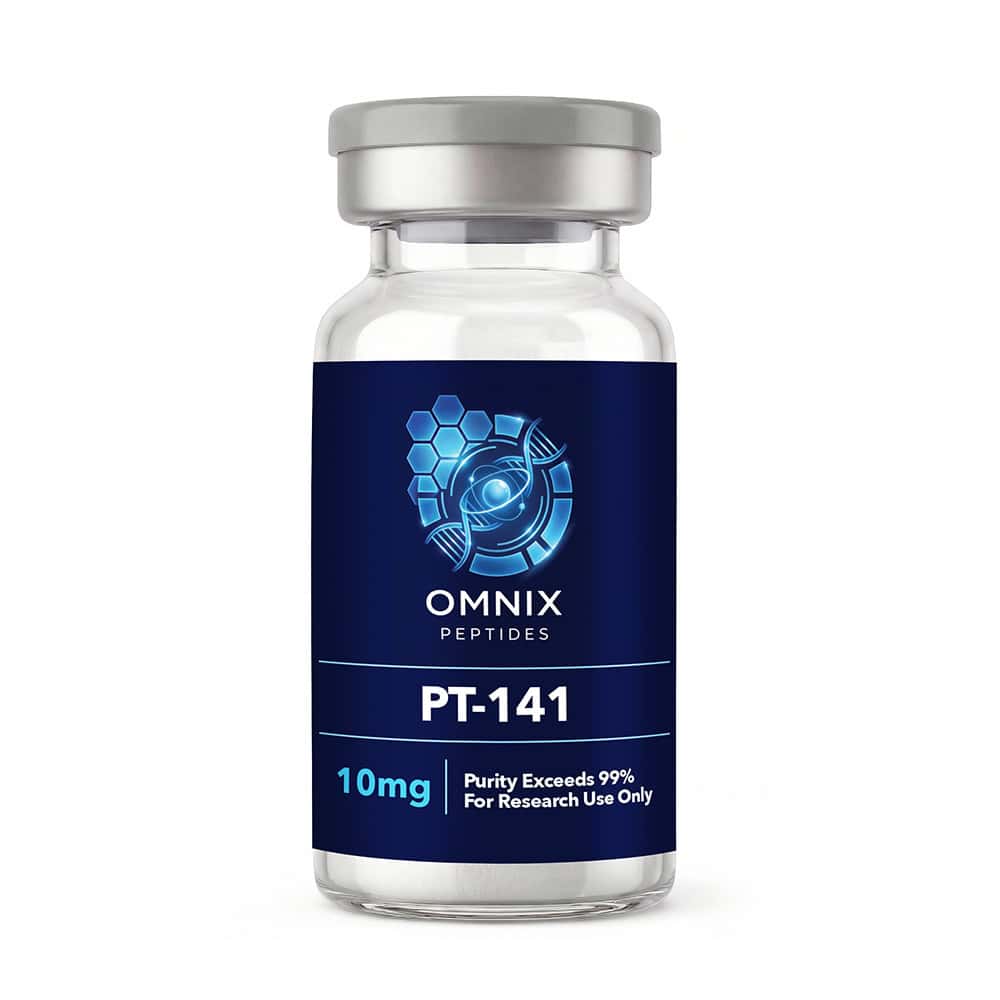
PT-141 Vial
Lyophilized Bremelanotide for laboratory reconstitution. The subcutaneous-injection research format mirrors the route used in the published clinical studies that led to its FDA-approved formulation (Vyleesi). HPLC-tested, third-party COA per batch.
Research goals: Sexual Health
Description
PT-141 (also known as bremelanotide; CAS 189691-06-3) is a synthetic cyclic heptapeptide analog of the endogenous hormone α-melanocyte-stimulating hormone (α-MSH) that functions as an agonist of the melanocortin receptor system, with preferential activity at the melanocortin-4 receptor (MC4R) believed to mediate its central nervous system effects on sexual response. Bremelanotide has been the subject of multiple peer-reviewed randomized controlled trials in adult human participants, with results published in Obstetrics & Gynecology, Women’s Health, and the Journal of Sexual Medicine. It received U.S. FDA approval in 2019 (under the brand name Vyleesi) for the treatment of acquired, generalized hypoactive sexual desire disorder (HSDD) in premenopausal women.
In the pooled Phase 3 RECONNECT program (two identically designed double-blind, placebo-controlled trials enrolling 1,247 premenopausal women with HSDD), bremelanotide 1.75 mg administered subcutaneously on demand produced statistically significant improvements over placebo on both co-primary endpoints — the Female Sexual Function Index Desire Domain and the Female Sexual Distress Scale (Desire/Arousal/Orgasm) Question 13 — with P < 0.001 for both endpoints in the integrated analysis [1].
Published Research on PT-141 (Bremelanotide)
The following peer-reviewed studies are summarized below. Full citations and direct links to each publication appear in the References section. All studies described in this section were conducted in adult human participants.
Phase 3 RECONNECT Trials — Kingsberg et al., Obstetrics & Gynecology (2019)
Kingsberg and colleagues conducted the RECONNECT program: two identically designed Phase 3, randomized, double-blind, placebo-controlled, multicenter trials (Studies 301 and 302; ClinicalTrials.gov NCT02333071 and NCT02338960). The trials enrolled approximately 1,247 premenopausal women with acquired, generalized HSDD across approximately 80 sites in the United States and Canada. Participants self-administered subcutaneous bremelanotide 1.75 mg or placebo on an as-needed basis (no more than one amount per 24 hours, no more than eight amounts per month) for a 24-week core treatment phase, prior to anticipated sexual activity.
The authors reported that bremelanotide demonstrated statistically significant and clinically meaningful treatment benefit compared with placebo
on both co-primary endpoints [1]. In the integrated analysis, women receiving bremelanotide showed statistically significant increases in sexual desire (FSFI-D, P < 0.001) and statistically significant reductions in distress related to low sexual desire (FSDS-DAO Q13, P < 0.001) over the 24-week treatment period. Nausea was the most common treatment-emergent adverse event.
Read the full study: Bremelanotide for the Treatment of Hypoactive Sexual Desire Disorder: Two Randomized Phase 3 Trials (Obstet Gynecol 2019).
52-Week Long-Term Extension — Simon et al., Obstetrics & Gynecology (2019)
Simon and colleagues reported the prespecified 52-week open-label extension of the RECONNECT program. Women who completed the 24-week double-blind core phase and had not experienced serious adverse events were eligible to enroll. All participants in the extension received open-label bremelanotide, with co-primary efficacy endpoints from the core phase reassessed and adverse-event monitoring conducted across the additional 52 weeks of follow-up (mean total exposure ~407–409 days).
The authors reported that efficacy gains observed during the core phase were maintained over the 52-week open-label extension, with no new safety signals identified [2]. Patients in the bremelanotide-to-bremelanotide arms received a median of 25–27 total injections over the combined core and extension phases. The data formed part of the regulatory dossier supporting the FDA approval of Vyleesi™ in 2019.
Read the full study: Long-Term Safety and Efficacy of Bremelanotide for Hypoactive Sexual Desire Disorder (Obstet Gynecol 2019).
Phase 2 Amount-finding Trial — Clayton et al., Women’s Health (2016)
Clayton and colleagues conducted a Phase 2, randomized, placebo-controlled amount-finding trial in premenopausal women with female sexual arousal disorder (FSAD) and/or hypoactive sexual desire disorder (HSDD). The trial evaluated three subcutaneous amounts (0.75 mg, 1.25 mg, and 1.75 mg) administered as needed via pre-filled syringe prior to anticipated sexual activity, with co-primary endpoints assessing change in number of satisfying sexual events and change in FSFI desire domain.
The investigators reported amount-related efficacy across the bremelanotide arms, with the 1.75 mg amount providing the most favorable benefit-risk profile and forming the basis for the amount subsequently advanced into Phase 3 testing [3]. The trial established the on-demand administration paradigm and pre-filled auto-injector delivery system used in subsequent registrational studies.
Read the full study: Bremelanotide for Female Sexual Dysfunctions in Premenopausal Women: A Randomized, Placebo-Controlled Amount-finding Trial (Womens Health 2016).
Mechanistic CNS Effects — Pfaus et al., Journal of Sexual Medicine (2007)
Pfaus and colleagues conducted a comprehensive review of the preclinical central-nervous-system pharmacology of bremelanotide, focusing on its actions in the medial preoptic area, paraventricular nucleus, and other hypothalamic regions implicated in the regulation of sexual response. The paper integrated electrophysiology, neurochemistry, and behavioral pharmacology data from animal models to characterize bremelanotide’s downstream effects on dopaminergic and oxytocinergic signaling.
The authors concluded that bremelanotide’s effects on female sexual function are mediated through central activation of melanocortin-4 receptors, with downstream modulation of dopamine release in regions associated with sexual motivation [4]. This pharmacological framework informed the subsequent Phase 2 and Phase 3 clinical development program in HSDD.
Read the full review: Bremelanotide: An Overview of Preclinical CNS Effects on Female Sexual Function (J Sex Med 2007).
About the Compound
PT-141 (bremelanotide) is a synthetic cyclic heptapeptide with the structure Ac-Nle-cyclo[Asp-His-D-Phe-Arg-Trp-Lys]-OH. It is a metabolite and structural analog of melanotan II, originally identified through analog programs at the University of Arizona in the 1990s and subsequently developed by Palatin Technologies. Unlike its parent compound, PT-141 retains agonist activity at central melanocortin receptors but does not produce significant tanning activity at the melanocortin-1 receptor on melanocytes at therapeutic amounts.
The molecule activates the melanocortin-4 receptor (MC4R) in central nervous system regions involved in the regulation of sexual response — including the medial preoptic area, paraventricular nucleus, and other hypothalamic structures — producing modulation of dopaminergic and oxytocinergic signaling pathways. This central mechanism of action is fundamentally different from that of phosphodiesterase-5 (PDE5) inhibitors such as sildenafil, which act peripherally on vascular smooth muscle. PT-141 received FDA approval in June 2019 under the brand name Vyleesi™ (Palatin Technologies / AMAG Pharmaceuticals) for the treatment of premenopausal women with acquired, generalized HSDD.
- CAS Number: 189691-06-3
- Molecular Formula: C50H68N14O10
- Molecular Weight: 1025.18 g/mol
- Sequence: Ac-Nle-cyclo[Asp-His-D-Phe-Arg-Trp-Lys]-OH
- Synonyms: Bremelanotide, Vyleesi™, PT 141
- Receptor target (in research literature): Melanocortin receptor agonist, with primary activity at melanocortin-4 receptor (MC4R)
- Regulatory status (as of publication): FDA-approved 2019 under the brand name Vyleesi™ for premenopausal women with acquired, generalized HSDD.
Product Specifications
Omnix Peptides supplies PT-141 as a sterile, lyophilized (freeze-dried) powder in a sealed glass vial intended exclusively for in vitro laboratory research. Each production lot is independently characterized using high-performance liquid chromatography (HPLC) and liquid chromatography–mass spectrometry (LC–MS) protocols.
- Format: Lyophilized powder
- Available strengths: 10 mg per vial
- Verified Purity: >99% (HPLC, LC–MS)
- Container: Sterile, sealed glass vial
- Documentation: Batch-specific Certificate of Analysis (COA) available
Storage, handling, intended-use, and regulatory information are provided in the corresponding tabs on this product page.
References
- Kingsberg SA, Clayton AH, Portman D, et al. Bremelanotide for the treatment of hypoactive sexual desire disorder: two randomized phase 3 trials. Obstet Gynecol. 2019;134(5):899-908. doi:10.1097/AOG.0000000000003500
- Simon JA, Kingsberg SA, Portman D, et al. Long-term safety and efficacy of bremelanotide for hypoactive sexual desire disorder. Obstet Gynecol. 2019;134(5):909-917. doi:10.1097/AOG.0000000000003514
- Clayton AH, Althof SE, Kingsberg S, et al. Bremelanotide for female sexual dysfunctions in premenopausal women: a randomized, placebo-controlled amount-finding trial. Womens Health (Lond). 2016;12(3):325-337. doi:10.2217/whe-2016-0018
- Pfaus J, Giuliano F, Gelez H. Bremelanotide: an overview of preclinical CNS effects on female sexual function. J Sex Med. 2007;4(Suppl 4):269-279. doi:10.1111/j.1743-6109.2007.00610.x
Preparation and storage
Research-only handling information. PT-141 is sold strictly for in vitro laboratory research. The handling and storage guidance below reflects standard practice in published peptide research literature. PT-141 is not a drug, supplement, or food product, and is not for human consumption, veterinary use, or medical applications.
Format
- Form: Vial
- Available strengths: 10mg
- Verified purity: >99% (HPLC, LC–MS)
- Documentation: Batch-specific Certificate of Analysis (COA) included
Reconstitution for Research Use
PT-141 is supplied as a sterile, lyophilized powder. Reconstitution with bacteriostatic water (BAC water) is the standard preparation step used in published research protocols. The volume of BAC water used determines the final concentration of the reconstituted solution.
Example (for a 10mg vial reconstituted in 2 mL of BAC water):
- Total peptide: 10mg
- BAC water added: 2 mL
- Resulting concentration: ~5 mg/mL
Recommended practice:
- Use sterile bacteriostatic water (0.9% benzyl alcohol) for reconstitution; this preserves the solution for multi-week handling in laboratory settings.
- Allow the lyophilized powder to reach room temperature before opening the vial.
- Inject the BAC water against the inside wall of the vial — do not aim the stream directly at the lyophilized cake.
- Gently swirl the vial until the powder is fully dissolved. Do not shake.
- Once reconstituted, store the vial under refrigeration at 4 °C (39 °F).
Storage & Handling
- Upon receipt: Keep peptides cold and away from light.
- Lyophilized (unreconstituted): Stable at room temperature for several weeks; refrigeration at 4 °C (39 °F) is acceptable for short-term storage (days to weeks).
- Long-term storage (months to years): Freeze the lyophilized vial at −80 °C (−112 °F). Freezing optimally preserves peptide stability for extended periods.
- Reconstituted solution: Refrigerate at 4 °C (39 °F). Avoid freeze/thaw cycles, which can degrade peptide structure.
- Light exposure: Minimize exposure to direct light during handling; light can accelerate peptide degradation.
- Heat exposure: Do not leave the vial at room temperature longer than necessary for handling.
Important Notice
All Omnix Peptides products are sold for laboratory, research, or analytical purposes only. They are not for human consumption, veterinary use, or medical applications. Researchers and laboratory professionals must follow all applicable institutional, local, state, and federal regulations governing the handling of research compounds.
Citations
Citations and reference data. Omnix Peptides supplies research-grade compounds for use by qualified laboratory professionals. The references below cite published preclinical research conducted in animal models and in vitro systems. They are not intended to represent clinical evidence in humans, and PT-141 has not been approved by the FDA, EMA, or any other regulatory authority for any indication.
Compound Reference Data
- Compound: PT-141
- CAS Number: 189691-06-3
- Molecular Formula: C50H68N14O10
- Molecular Weight: 1025.18 g/mol
- Sequence: Ac-Nle-cyclo[Asp-His-D-Phe-Arg-Trp-Lys]-OH
- Synonyms: Bremelanotide, Vyleesi™, PT 141
Selected Published Studies
The following peer-reviewed studies were conducted using animal models or in vitro cell-culture systems. They are listed here as a reference for researchers investigating PT-141. None of these studies should be interpreted as recommending PT-141 for human use, treatment, or any clinical purpose.
- Kingsberg SA, Clayton AH, Portman D, et al. Bremelanotide for the treatment of hypoactive sexual desire disorder: two randomized phase 3 trials. Obstet Gynecol. 2019;134(5):899-908. doi:10.1097/AOG.0000000000003500
- Simon JA, Kingsberg SA, Portman D, et al. Long-term safety and efficacy of bremelanotide for hypoactive sexual desire disorder. Obstet Gynecol. 2019;134(5):909-917. doi:10.1097/AOG.0000000000003514
- Clayton AH, Althof SE, Kingsberg S, et al. Bremelanotide for female sexual dysfunctions in premenopausal women: a randomized, placebo-controlled dose-finding trial. Womens Health (Lond). 2016;12(3):325-337. doi:10.2217/whe-2016-0018
- Pfaus J, Giuliano F, Gelez H. Bremelanotide: an overview of preclinical CNS effects on female sexual function. J Sex Med. 2007;4(Suppl 4):269-279. doi:10.1111/j.1743-6109.2007.00610.x
Evidence-Base Disclosure
The published evidence base for PT-141 consists predominantly of preclinical research — animal models (often rats or mice) and in vitro cell-culture experiments. Where Phase I or Phase II human trials exist, they are noted in the compound page summary. Researchers should interpret the cited literature within the experimental context of each individual study.
Frequently asked questions
Frequently asked questions about the PT-141 Vial. Questions on this page cover handling, storage, documentation, and ordering. PT-141 is sold for laboratory, research, or analytical purposes only — not for human consumption, veterinary use, or medical applications.
How is the PT-141 Vial prepared for laboratory research?
The PT-141 Vial is supplied as a sterile, lyophilized (freeze-dried) powder. The standard preparation step described in published peptide research literature is reconstitution with bacteriostatic water (BAC water). The volume of BAC water used determines the final concentration of the solution. See the Amount & Handling tab for a worked reconstitution example.
Why is PT-141 supplied as a lyophilized powder rather than a pre-mixed solution?
Lyophilization (freeze-drying) is the standard format for research-grade peptides because it maximizes long-term stability. A lyophilized vial stored cold and away from light remains stable for substantially longer than a pre-mixed solution. Reconstitution by the researcher also allows control over the final solution concentration.
Can the reconstituted PT-141 solution be frozen?
Freeze/thaw cycles can degrade peptide structure and should generally be avoided. Reconstituted PT-141 should be stored under refrigeration at 4 °C (39 °F) and used within the active research timeframe described in the Amount & Handling tab. For long-term storage, keep the vial lyophilized and freeze at −80 °C (−112 °F) until use.
Is PT-141 approved by the FDA?
No. PT-141 is not approved by the FDA, EMA, or any other regulatory authority for any indication. PT-141 is sold by Omnix Peptides strictly for laboratory, research, or analytical purposes. It is not for human consumption, veterinary use, or medical applications.
What is included with each PT-141 Vial?
Each order includes the sealed product container and a batch-specific Certificate of Analysis (COA) verifying identity and purity by HPLC and LC–MS. The full COA library for Omnix Peptides is available at /coa-lab-reports/.
What is a Certificate of Analysis (COA), and how do I read it?
A COA is a batch-specific lab report that documents the identity, purity, and quality control results for the production lot you receive. The COA lists the compound name, CAS number, lot number, analytical methods used (HPLC, LC–MS), and the measured purity percentage. Every Omnix order includes the COA for the lot shipped.
What is the CAS number for PT-141?
The CAS number for PT-141 is 189691-06-3. Researchers can use this identifier to locate published literature in PubMed and other scientific databases.
How does Omnix Peptides ship orders?
Orders ship from a US-based facility with tracked domestic shipping. Free shipping is offered on orders over $99. Lyophilized vials and capsules ship at ambient temperature; sprays ship insulated when seasonal conditions require it. Tracking information is provided by email after the order ships.
What if my product arrives damaged or the seal is broken?
Contact Omnix Peptides within 48 hours of delivery. Product damaged in transit or arriving with a compromised seal will be replaced at no cost. See the Shipping & Return Policy at /shipping-return-policy/ for full terms.
Where can I find published research on PT-141?
Peer-reviewed studies relevant to PT-141 are listed in the Citations tab on this product page. The same studies can be located independently on PubMed using the CAS number (189691-06-3) or the compound name.
Customer reviews
Certificate of Analysis
Third-party HPLC purity analysis performed by an independent laboratory for this batch.
Reviews
There are no reviews yet.